Denver Newsroom, Sep 22, 2020 / 03:01 am (CNA).- When Thomas Earnest Bradley wrote and edited The Lamp, a 19th century British Catholic periodical, he did so largely from his cell in debtors’ prison, “that horrible institution that existed in those days.”
Bradley sold his magazine for a penny, a fifth of the price of his competitors, and his definition of Catholic was broad.
“It ran articles on themes that were not always, in a narrow or straightforward sense, Catholic topics,” Matthew Walther told CNA.
“They would run a story about some new scientific innovation or about a book or a play, that was not by a Catholic or didn’t have in any ostensible way a Catholic theme.”
That version of The Lamp has been defunct for years. But it was, in part, the inspiration for a new Catholic magazine by the same name, with the same logo.
Walther, a journalist, and his friend William Borman (friends call him Billy), founded The Lamp magazine in the United States this past year with similar goals in mind: “a magazine that was sort of witty and urbane, in a way that was not shrill or grating to read, that tried to speak to the full range of what the Church teaches,” Walther said.
“We’re operating under the assumption that anything that is good, true and beautiful falls within the purview of what should be in a good Catholic magazine,” he said.
Borman added that it is not a carbon-copy of the original Lamp magazine, which was “basically a working class daily magazine,” with a penchant for “scientific articles, almost like a Popular Science.”
But the use of similar aesthetics, along with an equally-broad idea of what kinds of topics qualify as Catholic, gives the magazine “a throwback flavor. A little picture of the oil lamp burning on the cover is the same picture (as the original), with a slight modern twist,” Borman said.
Some Catholics may protest that such a truly Catholic magazine already exists. There are, after all, several periodicals in the United States that label themselves as Catholic magazines.
But Walther and Borman would argue that it does not already exist. Not in the way they envision.
“(T)here really is no such thing, in an otherwise pretty wide and diverse landscape of Catholic media in the English-speaking world, something that is actually a magazine as opposed to a website or a newswire or what have you that is orthodox, without naming any names,” Walther said.
That’s what The Lamp hopes to be. A magazine faithful to the magisterial teaching of the Catholic Church that covers all manner of things from a Catholic point of view. It will cover politics – though only broader political ideas, and not so much the “shrill horse-race” of particular elections. It will cover goings-on in the Church, but not in the way of “Can you believe this bishop did this? Oh my goodness,” Walther said. No pope-bashing, and no ultramontanism either.
So what kinds of stories is the new Lamp magazine interested in?
“We wanted something that would also tell people interesting (we hope), and at times encouraging or moving stories about parts of Catholic life that are ordinary, but also, not talked about very much. Things like the history of rural parish churches, or the lives of someone like the man in the first issue who served several decades of an unjust prison sentence.”
The latter is told in the first issue of The Lamp, in which author Brandon McGinley tells the story of Jeff Cristina, who served a 40 year sentence for a wrongful conviction of murder as a juvenile. Cristina, nominally Catholic when his sentence began, returned to the sacraments and brought many others with him during his years behind bars.
“The story had been on my desk for a while and I didn’t have a home for it,” McGinley told CNA. But when Walther and Borman, friends of McGinley’s, started The Lamp, “they were really kind to offer it a home.”
McGinley is a Catholic speaker, and author of The Prodigal Church as well as a contributing editor to Plough Quarterly. Like the founders of The Lamp, McGinley believes that the magazine is filling a previously empty niche in Catholic media – a niche for longform journalism that is “broad both in the kind of content, the topics that they cover, and in terms of the specific points of view that they’re bringing in (while) still being faithfully and integrally and genuinely Catholic.”
“And it’s fun,” McGinley added. “In the opening section, the ‘feuilleton’ (a French word for the opening section of a magazine with short, light literature), Matthew is just hilarious. They have fun with this, it’s not joyless.” As an example, one of the sample articles on The Lamp’s website is “The Bull Against Open Letters” (or, The Open Letter Against Open Letters), which the author declares are the “most revolting, foul, noxious, poisonous, blasphemous, vicious, wicked, deceitful, covinous, Brummagem, catch-penny Pamphlets…offensive to to men, women, holy priests, deacons, sub-deacons, porters, lectors, exorcists, acolytes, virgins, wives, sons, daughters, suckling babes, lawyers, practitioners after physick, and others, we hereby declare anathema these selfsame base cullions, rascals, apes, dogs, shoes, &c. who have addressed themselves to the baptized under the supposed appellation of ‘Open Letters.’”
The aforementioned letter, as well as a handful of other sample articles, appear on The Lamp’s website – but not much else does, as the publication is primarily a print magazine, a decision Borman and Walther are well aware was a risky one in a digital age.
“We’d heard (that print was dead), but we are both unfortunately terrible book collectors,” Borman said. “And so we’re maybe just in the habit of thinking that print is superior to online or to digital.”
“That costs money, but we found people have been plenty willing to pay it,” Borman said. They’ve thus far had successful fundraisers – some online, due to the pandemic – and have attracted readers, primarily between the ages of 25-45, from all over the world, from “New York and Washington to London, Australia, and India.”
The first issue of the bi-monthly magazine came out in Easter, at the height of the global coronavirus lockdowns, an unforeseen challenge when the idea for The Lamp was conceived, Borman said. It delayed their first issue and caused some shipping snafus, but otherwise did not have too big of an impact.
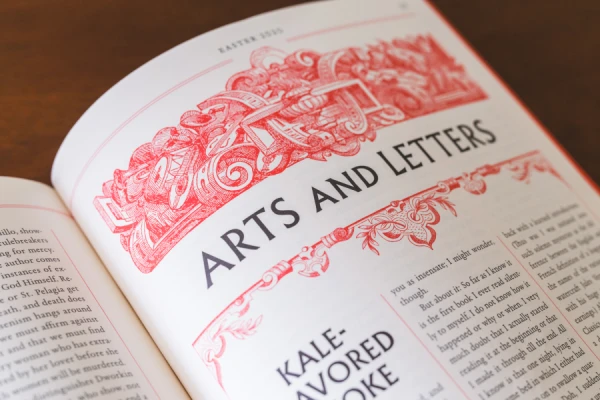
Besides having an affinity for physical copies, a print magazine also helps further the goals of The Lamp, Walther said – it’s a beautiful object people can hold in their hands that prompts them to slow down and enjoy what they’re reading, something that they’d want to save and display on their coffee table or bookshelf. Borrowing a phrase from Cardinal Robert Sarah, Walther said a print magazine helps elevate The Lamp above the “culture of noise.”
“The great upside in online journalism is that now people, no matter where they are, if they have access to an internet connection, they can read as much as they want from as many different voices or perspectives as possible, 24 hours a day, seven days a week, 365 days a year,” Walther said.
“And the downside of online journalism is all of those things, because it becomes this cycle in which you get caught up in and you can lose sight of more important things when you’re immersed in not even day-to-day, but hour-to-hour, minute-to-minute-cycle in journalism,” he said.
“We wanted to create something that will allow people to step away from the computer for an hour or two, put their feet up, and have a drink and immerse themselves in something very different, something slower, and, we hope, maybe a little bit more thoughtful, and less animated by the kinds of concerns that prevail in the online media infrastructure,” he said.
<blockquote class=”twitter-tweet”><p lang=”en” dir=”ltr”>Evening plans now that issue #2 arrived <a href=”https://twitter.com/thelampmagazine?ref_src=twsrc%5Etfw”>@thelampmagazine</a> <a href=”https://t.co/jMVvSYhPHU”>pic.twitter.com/jMVvSYhPHU</a></p>— Cullen (@CullenETB) <a href=”https://twitter.com/CullenETB/status/1298055746907774976?ref_src=twsrc%5Etfw”>August 25, 2020</a></blockquote> <script async src=”https://platform.twitter.com/widgets.js” charset=”utf-8″></script>
The desire to rise above divisiveness is key to The Lamp’s identity, Borman added.
“I think that people today more than ever are growing tired with the constant outrage and the relentless attention to partisan (politics) sometimes at the expense of the faith,” he said.
“We are attempting to be a kind of an anomaly in an age of a barrage of constant information – where we publish six times a year and we print very few illustrations in here,” he said.
“I think that people are really hungry for it, and the response we’ve gotten has confirmed this for us. They’re hungry for an approach to life in the light of the faith that takes its reader seriously and gives them serious ideas to think about.”
McGinley agreed that The Lamp is “breaking the mold” of the deeply-entrenched partisan rhetoric that can be found on social media today.
“It’s not on a team, that’s the first thing I think about it,” McGinley said.
“The content you’re going to find in this magazine, in this journal, is not going to be easily identifiable with any currently existing alliance in Catholic politics and politics generally,” he said, noting that thus far the magazine has included pieces from a Jewish Marxist alongside those of Catholic scholars.
So far, Borman and Walther have found contributors to the magazine from among their friends and connections, but they also accept cold submissions. They’re looking for pieces that are entertaining, edifying, moving, and thought-provoking.
“Apart from the obvious goals that any magazine would have, which is producing something that readers will enjoy, I think what we really want is to encourage people to lay aside secular prejudices and really think through what it means to approach our political and cultural issues with the mind of the Church,” Walther said.
Ultimately, he said, “we just want people to try to think like Catholics.”

[…]






Kudos to the USCCB!
What took them so long?
Please Edward, for once be thankful for what they did!
Why? Their willful moral weakness over the decades has effectively been criminal.
With many victims.
Good point as the Bishops just trimmed their sails to the prevailing winds…
The fact that they need to do this tells you they have have no authentic Catholic character. Much like “Catholic” colleges and university with pride clubs.
Transgenderism is no biological, medical or psychological anomaly. It is a concoction resulting from a breakdown in the moral and cultural fiber of society. As such, it requires a restoration of moral and cultural values and practices.
Now that the teens have already moved on to the next fad, revenues are down, and there is the possibility of lawsuits…
Please, God.
I’m thankful for the Bishops conference and what they are doing and think that we should support them in any way that we can. It’s time for the whole Church to come together and stand for truth and recognize the different ministries working on different issues. Abortion is just one of many moral and social concerns that we face. Scriptures teach us that the body ( Church) has many members and that each contributes to the good of the whole. While some members may be more important, the lesser should not be neglected or despised- all are equally needed for the health of the whole. The work and mission of the Catholic Worker movement, for instance, is just as necessary as the pro- life movement. Note I DID NOT say “as important “. While the Church allows for one to be pacifist and non-resistant, it does not require these beliefs of all, and they are not to be scorned or belittled. We must not put down those who have been called to minister to the immigrants among us. If God called them to this ministry, who are we to question or judge? It is between them and God and we should keep our nose out of it and do what we are called to do. The same stands for all of the other ministries in the Church. We should thank God for them all. God loves us all and we are all on different levels and stages on our various paths to sanctification. Hopefully, we are ever changing and growing closer to God. We can’t judge anyone, because we don’t know the burdens that they are carrying or effect of their physical and emotional makeup. In short- we can’t walk in their shoes.let’s lay down the hatchet and unite against our common enemy- moral and secular decadence. God bless you all.
I have no trouble with people who minster to migrants and/or immigrants and I doubt very deeply any so-called MAGA person does either; however, I am deeply disgusted with the graft and human trafficking that has occurred, the waste of tax payer dollars, the enrichment of NGOs, circumvention of law, etc.
.
The bishops are receiving criticism, rightly or wrongly, because too many of us no longer have anything left with which to “give them the benefit of the doubt.”
What Church are you talking about? What moral precept allows for not defending innocent life under assault? Absolute pacifism is immoral, evil, a sin. Defensive action is not a prudential option. And the Catholic Worker movement, for which I did volunteer work decades ago, today reflects the disintegration that inevitably occurs from minds convinced that social concerns necessarily calls for revolutionary thought and action. It does not. We are not God’s superior, and God does not abandon us to a capricious inadaquate understanding of how we ought to order our lives. He gave us a moral order innate to our being, for all times and all places.
When we lose sight of unchanging truth, we are more subject to the temptations of assumed enlightenment acquiescent to culture. Many good people have passed through CW, but more recent divisions have occurred among differing voices including support of all manner of the LGBTQ agenda and support for abortion by some. And Catholic witness ought never include a “religious calendar” by any group identifying itself as Catholic that features celebratory days primarily for pioneers of communism and anarchy alternating with selected feast days of a handful of saints whose lives have been coopted in a manner that depicts them as revolutionaries “before their time.”
I challenge anyone to tell me what constitutes calling any “Catholic” hospital CATHOLIC. The staffs are comprised of a minority of practicing Catholics and the healthcare provided is never carried out in the name of Christ nor as an expressuon of the mission of the Church. These “Catholic” hospitals are no different from any secular hospital. And just because you have a chapel and a saint’s name attached to the building doesn’t make it “Catholic”. I know; I worked at a Catholic hospital for 30 years.
For my money and guided by the ecclesial principle of subsidiarity, I would like to see all “Catholic” hospitals sold to the highest bidder and use the proceeds to set up neighborhood CATHOLIC clinics that strictly follow CATHOLIC teachings. Another preference of mine for these neighborhood CATHOLIC clinics would be services for women with crisis pregnancies as an alternative to abortion.
Supposedly, the Catholic Healthcare Initiative is trying to do something like that
https://chi-usa.com/about-catholic-healthcare-international/padre-pio-hospital-is-coming-to-the-usa/
Well said and I totally agree with you .
more are closing, along with others, that cannot keep up after the covid money dried up but the costs haven’t decreased
a friend works in one of the larger chains and the coworkers would talk about taking out Trump after his second election, pro abortion stuff etc… he said it was/is depressing
Wonderful !!
But they don’t “forbid and condemn” vital organ harvesting of comatose patients !
Consensus and ignorance, indeed ! Meet moral relevance and stupidity !
This is why you must push back when Cafeteria Catholics flaunt the dogma of our faith: “nearly 150 Catholic hospitals across the United States provided children with transgender drugs or performed gender-transition surgeries on them between 2019 and 2023.”