


Washington, D.C. Newsroom, Oct 31, 2025 / 14:17 pm
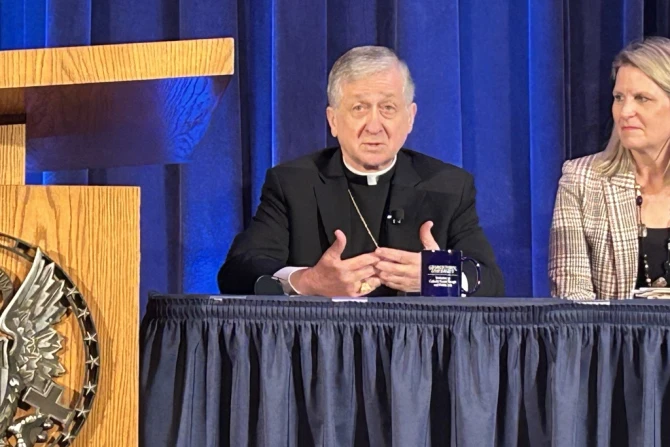
Cardinal Blase Cupich of Chicago described artificial intelligence (AI) as Pope Leo XIV’s “industrial revolution” at a Georgetown University forum Oct. 30.
The event, “Pope Leo XIV’s New Challenge and Moral Leadership on Poverty, Work, and Artificial Intelligence,” examined the impact of AI and the guidance provided by Catholic Social Teaching, as a part of the university’s Initiative on Catholic Social Thought and Public Life.
“Pope Leo XIV’s pontificate began during what Pope Francis often called a change of effort, with major changes transforming our world, among them the rise of AI and the effects it would have on work and the economy, something Pope Leo has called another ‘industrial revolution,’” said Kim Daniels, the director of the initiative, at the event.
Discussing the impact of AI on society, Cupich said the “entry point” to discernment on the topic is whether or not it “creates the possibility of everyone having human flourishing.”
“You accept that the economy belongs to everybody, then you have to be very careful of allowing the technologies to be used in a certain way that gives people more power and control over the economy than they should have,” Cupich said. “The economy should allow for the human flourishing of everyone. It’s like health care. Everyone has a right to health care.”
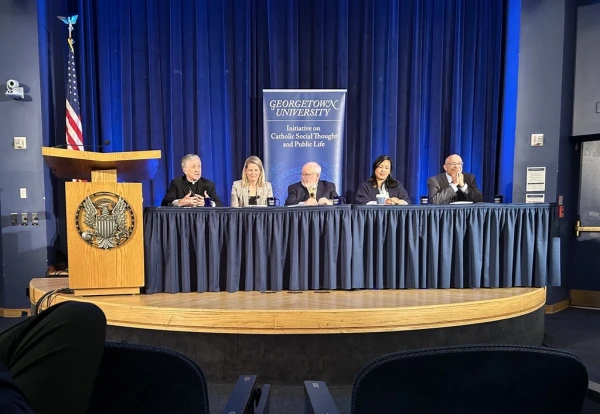
Panelists included Cecilia Flores, executive director of the Catholic Volunteer Network; Liz Shuler, president of the AFL-CIO; Paul Almeida, dean and William R. Berkeley chair at Georgetown University’s McDonough School of Business; and the initiative’s founder, John Carr.
Against the backdrop of the government shutdown and the resulting expected lapse in food assistance, with increasingly heightened political division, Carr said, “many poor and working people are falling further behind or just struggling to keep up.”
“At the same time, a new elite is moving forward with new technology, new wealth, and new power,” he said, “some of it related to artificial intelligence with its possibilities and dangers for work, the economy, and our society.”
Cupich, who was described by Daniels as a “close advisor to Pope Francis and now Pope Leo,” said: “I think the Holy Father has already indicated how the Church should respond and what he’s already done, namely to make sure that the inspiration of Rerum Novarum, which is about the defense of human dignity of the worker, but also human dignity at large, should all begin with preferential option for the poor. “
Cupich emphasized the need to view the poor not as “subjects,” but as “agents,” who “have something to offer us,” and underscored Catholic Social Teaching as being at the heart of “who we are.”
Flores, who was part of a delegation that went to the Vatican last week to meet with Pope Leo for the World Meeting of Popular Movements, echoed this sentiment, saying: I’m sure many of you have heard a lot of people say it’s the best kept secret of the Catholic Church. I think that’s categorically untrue…This is who we are.”
Flores told CNA that the Gospel and Catholic Social Teaching requires Catholics to approach compassion for migrants without discernment. “There should be an element that does not need to be discerned because it’s a gospel response,” she said. “I see a person that’s suffering, what does the gospel require me to do? That shouldn’t have to be discerned.”
If you value the news and views Catholic World Report provides, please consider donating to support our efforts. Your contribution will help us continue to make CWR available to all readers worldwide for free, without a subscription. Thank you for your generosity!
Click here for more information on donating to CWR. Click here to sign up for our newsletter.

Cardinal Cupich discerns the “preferential option for the poor” and Cecilia Flores discerns that national immigration policy is exempt from discernment.
On the FIRST point, St. John Paul II teaches that [the preferential option for the poor] is not limited to material poverty, since it is well known that there are many other forms of poverty, especially in modern society–not only economic but cultural and spiritual poverty as well” (Centesimus Annus, n. 57). He even went so far as to remind us all–even including cardinals–that “…the Church’s Pastors have the duty to act in conformity with their apostolic mission, insisting that THE RIGHT OF THE FAITHFUL [italics] to receive Catholic doctrine in its purity and integrity must always be respected” (Veritatis Splendor, VS, n. 113).
As for the SECOND point, from Flores, less ideological minds recognize both the concreteness of each and every person (her very valid point), and the irreducible problem–in a fallen, finite, and complicated world–of tailoring public policy. Beyond the moral absolutes, Catholic Social Teaching is compassionate, yes, but no less, it is the application of the moral virtues of prudential judgment, justice, courage and temperance…
About which: “The Church has no models to present: models that are real and truly effective can only arise within the framework of different historical situations, through the efforts of all those who responsibly confront concrete problems in all their social, economic, political and cultural aspects, as these interact with one another” (Centesimus Annus n. 43; Gaudium et Spes, n. 36; Octogesimo Adveniens, nn. 2-5).
Some discern that discernment cannot be exiled, expatriated, or deported.
Cupich knows nothing about the industrial revolution or AI.
Perhaps he might opine pride flags or mistreating priests.