

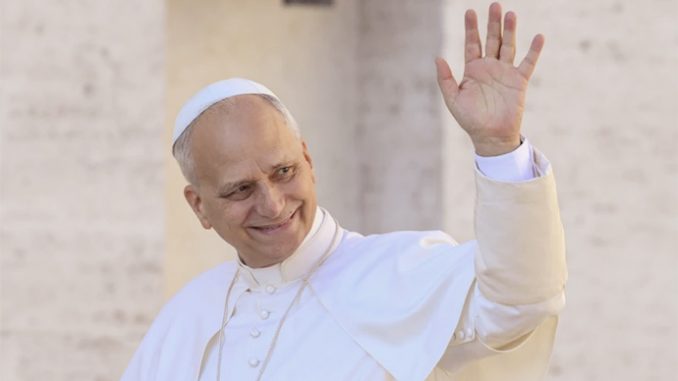
One of the more noteworthy episodes during the late nineteenth-century tenure of Pope Leo XIII was the pope’s response to the so-called “Americanist” controversy in the United States.
Leo XIII wrote two encyclicals addressing issues that implicated the Catholic Church in America. The first, Libertas Praestantissimum (1888), was written to refute a theory of freedom that was contrary to the Christian understanding of liberty. While this encyclical was not written expressly about Americanism, the political theory of freedom criticized in Libertas was minted in the U.S.
The second, Testem Benevolentiae (1899), was written directly to Cardinal James Gibbons, then Archbishop of Baltimore, addressing a controversy that bloomed in France but that had been planted in the U.S.
In his very brief tenure as Supreme Pontiff, Pope Leo XIV has demonstrated that he—the first American pope—is not an Americanist pope. Yes, he is America’s pope, but not any more or less than he is the Supreme Pontiff of the Universal Church. As such, he is no less suspicious of American tendencies to compromise the Faith than his illustrious predecessor. The manifestation of Americanist impulses in 2025 is somewhat different from that of the late 19th century. The importance of affirming a robust Catholic understanding of the human person, social life, and economic considerations, however, is no less urgent for Leo XIV than it was for his immediate patronymic predecessor.
In Libertas, Leo XIII complained about the modern assertion that freedom is merely the ability to make a contrary choice, without regard to the object chosen or the proper end of the human person. He criticized a theory of freedom, especially prominent in the U.S., that celebrates “natural” liberty but rejects “moral” liberty.
Natural liberty, Leo XIII explained, is the capacity to reflect and choose among contradictory objects. Moral liberty is the freedom from using natural liberty to choose wrong objects. Natural liberty is the necessary basis of moral liberty, not its completion. Moral liberty is achieved through the exercise of natural liberty as schooled by virtue in the Church. Natural liberty is the necessary condition for any moral action (good or evil), but not the sufficient condition for a good moral action.
The modern liberal notion of freedom, as epitomized in the U.S., effectively denies this distinction, holding that the highest moral good is the mere ability of choosing among contraries, without making a judgment about the choices made. This is a manifestation of the theory of individualist personal autonomy at the heart of the modern liberal project, as perfected in U.S. politics and law.
Testem Benevolentiae was written to Cardinal Gibbons after a translation of the autobiography of Fr. Isaac Hecker, the founder of the American religious order, the Paulist Fathers, appeared in France. Hecker represented an attempt in the U.S. to assimilate the Catholic Faith with the liberal moral theory at the heart of American politics. In a similar criticism voiced in Libertas, Leo XIII expressed concern that the freedom embraced by Hecker and his kind was really license rather than liberty.
Rooted not in the Catholic doctrine of solidarity, but rather in the individualist theory of freedom from the 16th century, the notion of freedom advocated by Hecker seemed to downplay, if not eliminate, the necessity of the institutional church and teaching magisterium from the development of Christian virtue. Hecker’s flirtation with this liberal moral theory even drew a cautionary note from his somewhat sympathetic colleague, Orestes Brownson. Brownson warned Hecker that his advocacy of individualism is more akin to liberal Protestantism than historical Catholicism.
While the problems addressed in these two encyclicals were not limited to the U.S., the American Catholic experience was especially prone to these errors, founded as it is on a theory of the human person at odds with Catholic moral anthropology. In the apostolic exhortation Dilexi te, the first major publication of his tenure as pope, Leo XIV demonstrated that he is just as wary of these tendencies as Leo XIII was some 130 years ago.
This is especially clear in Leo XIV’s harsh criticism of laissez-faire economics, a staple of right liberalism in the U.S., and embraced in some of the influential American Catholic institutions that perpetuate the Americanist problem more generally.
Among American Catholics, influential voices advocate what might be called “Catholic economic libertarianism.” This is characterized by a strong presumption in favor of laissez-faire economics and nearly absolute criticism of any government involvement either in economic regulation or wealth redistribution. Certain think tanks, prominent professors, and other Catholic intellectuals advocate a presumption both that markets should be left alone to decide how wealth is created and that the solutions the market finds should be undisturbed.
This results in an equally strong impulse to oppose economic regulation or redistribution of any kind as inconsistent with free markets and, so the theory goes, free persons. While the specific economic expression of this tendency is a new variation, the theory that informs it is a consistent descendent from the 19th-century Americanist impulses condemned by Leo XIII.
Pope Leo XIV has just such an approach to economics in mind in Dilexi te. “We must … denounce the ‘dictatorship of an economy that kills,’ and to recognize that ‘while the earnings of a minority are growing exponentially, so too is the gap separating the majority from the prosperity enjoyed by those happy few,’” admonishes the pope, quoting Pope Francis’s 2013 apostolic exhortation Evangelii Gaudium.
This necessarily entails embracing the whole of Catholic Social Doctrine, and rejecting false notions of individualist, libertarian morality and economics. Pope Leo XIV has no patience for “economic thinking [that] requires us to wait for invisible market forces to resolve everything.” This does not respect the “dignity of every human person,” especially those who are not capable of participating in economic life, whether through personal incapacity or structural impediments.
Work, the pope explains, is “a participation in God’s work of creation,” and thus should be considered the first step out of poverty. “On the other hand,” however, “where [work] is not possible, we cannot risk abandoning others to the fate of lacking the necessities for a dignified life.” This invokes the duties of both private almsgiving and “governmental institutions to care for the poor,” he explains. Thus, Leo XIV rejects “pseudo-scientific data [that] are invoked to support the claim that a free-market economy will automatically solve the problem of poverty.”
In his landmark 1991 encyclical Centesimus Annus, Pope St. John Paul II offered a highly qualified and tentative endorsement of what he preferred to call the “market economy,” “business economy,” or “free economy,” which are terms he preferred to “capitalism.” While recognizing that the human person must be free to take economic risks and to reap the rewards when those risks pay off, he also understood that the economy must not be unfettered from moral principles expressed through reasonable regulation. Regulatory structures are needed both to assure as many people as possible may participate in economic life and to assist those who cannot participate through no fault of their own. Unregulated markets cannot address either of these concerns.
In Dilexi te, Leo XIV takes up John Paul II’s admonition, cautioning us to be wary of a theory of markets that shuns regulation and redistribution, in favor of one that recognizes the need for oversight and correction. The Church’s robust history of social doctrine, Leo contends, is a much more hopeful path toward care for the poor and dispossessed than liberal theories of morality, politics, and markets. Catholic social doctrine, especially its doctrines of dignity and solidarity, cannot be compromised by the moral and political philosophy of any regime that rejects the inherent social nature of the human person and the proactive duty to preserve the dignity of all.
Leo XIV—the American pope—understands that Americanism is no more legitimate in 2025 than it was in 1899.
If you value the news and views Catholic World Report provides, please consider donating to support our efforts. Your contribution will help us continue to make CWR available to all readers worldwide for free, without a subscription. Thank you for your generosity!
Click here for more information on donating to CWR. Click here to sign up for our newsletter.

It’s terribly sad for the Church — and for humanity — that the new pope appears to be a leftist.
Leftists like Leo seems to be have never understood the genius of capitalism.
They view work in a capitalistic system as nothing more than a burden, an occasion for the exploitation and predation of workers.
It somehow escapes them that the reason the standard of living goes up in a country is that workers are producing products and services — the good things that make people’s lives better and make societies thrive.
The fact is, leftists always focus on money. But, quite obviously, money produces nothing. It’s people spending their days working their jobs who bring the good life.
At its core, leftism is unfair. In a system of distributive justice, everyone receives “the resources they need” — which always sounds wonderful. After all, who wants to see people in poverty?
But when everyone receives “enough,” it means that the lazy, unproductive, unreliable workers get the same pay as the dedicated, diligent, hard-working workers.
And psychologists will tell you that in a system that does not recognize and reward outstanding performance, the best participants come to understand that their extra efforts are wasted. And they will inevitably begin reverting to the mean — lackadaisical, subpar performance.
Which is why socialist countries always end up as varying degrees of gray, depressing and impoverished.
It’s inevitable.
Think about it. In Venezuela, all the workers — and the layabouts, for that matter — have “enough” money for “the resources they need.”
Just one problem. There aren’t enough of those “resources.”
The fact that everyone gets “enough” money, whether they work or not, ensures that many don’t work. And so there are severe shortages of products — including food — throughout the country.
And so what is your money worth when there’s nothing to buy, Mr. Leftist?
Leftists have no concept that capitalism’s genius is to align the interests of the individual with the interests of society.
People are rewarded for their hard work and productivity. And society benefits accordingly.
And people are also rewarded for their good ideas for new products or services — personal computers, online shopping, iPhones, whatever — according to the value that others place on them.
Finally, while leftists are obsessed with money, they have no idea of what money really is.
Money is a societally recognized abstraction for value produced. When a worker completes a job, he has delivered something that is of value to someone. That value created is reflected in the pay he receives.
When many workers create much value — producing food, fixing cars, replacing roofs, whatever — wealth is created. There’s lots of money to spread around, leading to more economic growth and cultivating a robust and prosperous economy.
When you hold a $100 bill in your hand, you’re in a very real sense touching the time and imagination and lives of countless individuals who contributed to all of the value which that bill has delivered since it was first created.
Leftists understand none of this.
Which is why socialist societies always, always, *always* end up oppressing their citizens.
For socialism to succeed, people must be forced to act in ways that are against their best interests. Whereas, under capitalism, people are free to pursue their best interests, wherever they perceive those interests leading them.
So what about the unfortunate individuals who for whatever reason are left behind in poverty within capitalist economies?
That’s where charity comes in. Virtue. Compassion.
Or, if you prefer, Christianity.
It’s worth noting that charity is also ennobling to those on both ends of the transaction, both the giver and the receiver. The giver feels good about helping someone, and the receiver feels worthwhile because he’s being blessed by a personal gesture of fellowship by another.
Charity is a virtue and is, therefore, of God.
Whereas government entitlements tend to rob an individual of his sense of accomplishment, of self-respect, of satisfaction. In fact, government handouts can prompt people to feel like victims and sullenly resent those who have more. In this way, they’re able to justify to themselves their dependency.
The sad fact is, distributive justice’s real effect is to make sure that everyone has “enough” of the scarcity, the poverty, and the starvation it inevitably produces.
Remember that Jesus never compelled anyone to act virtuously. He respected the dignity of each individual, realizing that coercion is the absolute end of virtue.
Perhaps it’s time to expect governments, which are definitively *not* divine, to act with at least the same level of restraint shown by the Savior of the universe.
“Which is why socialist societies always, always, *always* end up oppressing their citizens.”
*******
And they always end up with an upper, more affluent class. Just fallen human nature again.
Norway, Denmark, Sweden?
Do your homework. They’re not purely socialist countries 🙄
Did I say they were? We are also socialist, but to a lesser degree.
Its true that there are different flavors of socialism Br. Jacques. I think it’s the hard-core type that was in question.
Socialists who treat life as utilitarian commodities of convenience. Great example Br. Jaques, an inevitable ethos of socialism.
Would be this the Norway and Sweden that rate substantially higher than the United States on multiple economic freedom indices?
Hmmm, with a combined population of 21M for N/S/D, not a great comparison @ 340M for USA.
Feel free to submit to the EU technocrat godless bureaucracy if you wish. Not me. TYVM.
Norway, Denmark and Sweden have erected robust welfare states under the American nuclear umbrella. Norway and Denmark have been NATO countries since 1949. They’ve also adopted high tax rates and have long been known for libertinism.
However, this is not the sum total of “socialism” as there are extraordinarily wealthy people in those countries. One important measure of socialism, is the inability to transfer wealth intergenerationally. there is no inheritance tax in Sweden or Norway. Denmark imposes an inheritance tax of 15 percent.
If this is the extent of your knowledge, you might want to sit this one out.
Brineyman, tell us how you really feel! 👊
Truly, the Pope is hard on us oligarchs. He writes as if all of us are billionaires needing a scolding. All this reminds me of a homeless gentleman at the shelter who quipped after I said something stupid to him during my volunteer shift: “I don’t know what you are talking about…You have to be rich to think like that!”
I like a good lecture. So I didn’t mind Dilexi te. It was better than the tongue lashing of his immediate predecessor. And yet, it is difficult to take our Popes seriously. What we need is a real St. Francis approach. Why doesn’t the Pope consider cleaning house. For instance:
1. Auction off all no -religious property. ALL OF IT! Start with that eco-Castle Summer Palace. Next Art that is not expressly for a Catholic piety. And all those low rent apartments, offices, etc. Nix half the Curia, or more! Etc.
2. Put everything liquid into a couch potato ETF portfolio and quit pretending to be investors.
3. Pay off all debts. Fund the pension obligations.
4. Sit is ashes on Fridays and get that white habit a bit dirty.
5. Preach that Jesus Christ is Lord and that free markets work.
I’ll go on all day…
Popes, the last two in particular, have a consistent critique of global capitalism, which for me raises questions about moral consistency. It is difficult to reconcile the Vatican’s condemnation of private material accumulation and its demands for extreme charitable devotion while the vatian’s own maintenance of vast, protected capital wealth just sits.
This hypocrisy is further highlighted by the contrast between calling upon nations to open borders for immigration while simultaneously maintaining strict, sovereign controls over the Vatican’s own borders.
For any moral authority to maintain powerful ethical demands of the world, it must first demonstrate the principle of consistency in the same self-sacrifice it asks of others. The application of two different ethical standards — one for the Vatican and one for everyone else — undermines the pope’s moral standing and harms the Church.
People rewarded for hard work, genius of Capitalism? Women and children mill workers, coal miners? Unbridled Capitalism was evil. Unions and regulations had a place and they STILL have a place. There is a middle ground between Capitalism and Socialism which represents the Solidarity of Catholic social teaching. I believe St. John Paul ll feared the American way almost as much as the Communist way, and he experienced the loneliness of the middle way. Today both parties are violating basic human rights, but in very different ways. It’s high time that all Christians, and especially Catholics, unite and create a “third way”!
There is no middle way between capitalism and socialism. Only a progressive thinks like that. And there is no such thing as unbridled capitalism in this day and age. More NPR talking points.
Athanasius:There certainly is a middle way. Look up and read the platform of the American Solidarity Party. It was based on the social teachings of the Catholic Church. A hybrid mix of the best of Capitalism and Socialism within the framework of traditional Jewish/Christian morality. This is an example of a possible “middle way”. I’ll say it again. Not everything on the right is right and everything on the left wrong. Not everyone who does not approve of the present Republican Party is a leftist.
There is no middle way, and most of what is happening on the left is morally, intellectually,and spiritually bankrupt. You just don’t have the sense to see that clearly, which is the case with most ideologues. You have no moral or legal right to confiscate people’s private property and redistribute that to anyone, not for any reason.
Only a complete fool would think that one can design some system that appeals to its designers and then impose it on society without dissent. Not everybody will agree with their benevolent overlords, so then we have to resort to force-that’s what always happens.
A quick survey of their website shows the usual array of left-wing nocturnal e*******s, using the same tired nebulous claptrap. Poorly concealed Marxism.
Common sense is never ever giving power to some hyperactive individual with an “environmental studies” degree and JD. Pro tip: any degree that appends “studies” i.e. Woman’s Studies, Queer Studies, is invariably four years of indoctrination disguised as academics, designed to appeal to some patron fake saint of perpetual obsession and producing a banner of inadequate utility in employment.
To me “common sense” and serving the “common good” would be to actually be required to pass a rudimentary economics test before polluting the public discourse.
Yes. Spot on correct. The fruits of my labor belong to my family and to others as I see fit.
Generosity to the poor is required, of course, always.
But taxes are always taken at the barrel of a gun. Our leftest clergy would like us pew sitting peasants to ignore that. Bet on it.
I believe unions had a legit place earlier in the last century or so but my own limited experience with unions today hasn’t been great.
Seeking a “third way” represents a utopian defiance of the realities of the permanent imperfectability of the human condition. Evil can never be engineered out of existence, and it is inherently evil for governments to try.
Capitalism is a silly word that does not accurately describe the imperatives of an economic freedom necessary for the flourishing of individual virtue. The word is used to project images of unlimited private greed, a vice, but not inevitable. Concentrations of wealth can become evil or they can sustain stability and prosperity. Prosecuting fraud and exploitation, when and where it exists, while recognizing innate rights of human transactions, is the only means for managing our weaknesses and corruptions. Governments are not good at acknowledging their crimes.
We can be certain that Jesus and Joseph acted with fairness and honesty in Their transactions.
Brineyman – excellent commentary.
Appears to be?
You really ought to stop utilizing ChatGPT to write your comments. They’re really poorly written and are completely lacking in substance or logic. Obviously written by an AI.
I normally wouldn’t approve such a stupid, infantile comment. But:
(1) Disagree or agree, brineyman’s comment is not poorly written, etc.
(2) I’ve known brineyman personally for nearly 30 years, and I know that he writes all of his comments. He’s a published author (articles and books).
(3) I ran a check online to see if anything in brineyman’s comment was AI generated. I got this response: “0% of this text appears to be AI-generated.”
Confirming that you know at least two thing: nothing and less than nothing. Congrats.
Capitalism as practiced in the 1950’s was good, productive and fair. Our current late stage capitalism with leveraged buyouts, overpaid CEO’s who get enormous buyouts despite doing a lousy job and billionaires who treat employees unfairly is not good.
We have billionaires buying elections (see Elon Musk), and basically owning the government.
The top 1% have more wealth than the bottom 90%. Do you think this is good? The minimum wage has not moved in 15 years. Do you think that is good?
And yet Ven. Sheen criticized capitalism almost as harshly as he did communism/socialism. In the 1950s. For example: “Both capitalism and socialism are opposite sins against property. Capitalism emphasizes private rights to property without any social responsibility to the common good; socialism emphasizes the social use of property, to the forgetfulness of personal rights. The true solution is one in which the rights to property are personal, but the responsibility is social. A man is free on the inside because he can call his soul his own; he is free on the outside because he can call his property his own.” — Venerable Archbishop Fulton Sheen, “Crisis in History”, 1952.
Yes, and don’t forget Matthew 25. One of my degrees is from a Jesuit business school.
They don’t condemn capitalism but do preach social responsibility. Treating your workers justly is not Marxist.
Sheen’s analysis reaches deeper than economics: it touches the very anthropology of the person. Today, capitalism still penalizes the biographically poor—those without means or power—while cultural Marxism extends that logic to the ontologically poor, denying dignity to human life from conception to natural death.
For Hans Urs von Balthasar, the true medium of human communion is neither impersonal reason, nor the free will of individuals bound by contract, nor the species as pure nature, but the original being created in the Son. In Him, what is most universal and most personal are reconciled. Outside this Christic foundation, every social bond becomes either anonymous or coercive.
Only Christian social doctrine breaks the dialectic of master and slave—the economic and ideological struggle inherited from Hegel and Marx—and replaces it with the analectic of friendship, where freedom and communion are harmonized in charity.
Agree, excellent commentary. I would add also that unrestricted capitalism leads to excess for the rich, that’s what regulations are for. So the answer to the problems of capitalism is not socialism or especially not communism, just fix the capitalism, with common sense regulations. For example Amazon is getting into the Real-estate market, buying properties and selling shares removing more already scarce and overpriced homes from the market. Doesn’t Amazon have enough? They are already violating antitrust laws and as close to a monopoly as you can get. HOMES SHOULD NEVER BE A COMMODY. Just like a rich person I know who owns 130 single family homes. As more and more rich people and corporation keep removing homes making most people renters eliminating home ownership harms the whole country and places most under the thumbs of the rich. This can be fixed with regulations and a proper tax strategy to discourage this.
Thank you. Well written.
There is no place in the United States where laissez faire capitalism exists. There are hundreds of pages of Federal and State regulations covering most every economic transaction large and small.
Laissez faire is a straw man for the socialists who are always completely unqualified to redistribute anything.
“Jesus never compelled anyone to act virtuously.” Please read Jesus response to the rich young ruler in Mathew 19:16-22. Jesus instructs him to “sell your possessions and give the money to the poor.”
But he let him walk away. He encouraged, but did not compel.
Interesting article.
Para. 7 – natural liberty vs. moral liberty – explains in a nutshell what is wrong with “pro-choice” on abortion. Why don’t we hear more about this?
“cautioning us to be wary of a theory of markets that shuns regulation and redistribution, in favor of one that recognizes the need for oversight and correction.”
It always amazes me how theologians, clergy and the Episcopacy opine on the dismal science without the slightest education, practice or experience and their apparent belief that the use of nebulous pseudo-economic jargon such as “laissez-faire” constitutes critique comprehension; when all it does confess ignorance and conjure boogeymen.
The problem with the above statement is that it is a classic strawman. No such theory exists. That’s why the author didn’t name it. Markets require oversight if for no other reason other than enforcement of contract. Contractual enforcement is the primary requirement to ensure exchange, rather than predation.
But that’s not exactly what CA said. In paragraph 34 of CA, there is a sensible admonition that not everything can be reduced to market transactions. “But there are many human needs which find no place on the market.”
On the other hand, we have persistent calls from the Catholic left for regulation and redistribution, there is this grand assumption that regulatory and redistributive authorities will be beneficent, incorrupt and omniscient. They have no concern for negative effects of regulation. They see no suppression of the charitable impulse in welfare states. They are blind to the potential for even well-intended interventions to produce inefficiencies or paradoxical effects or worse, to be co-opted or corrupted, such as when market rigging is disguised as regulation or when regulatory capture occurs. Their screeds make idols of administrative bureaucrats, never stopping to think that the extraordinary powers they would grant should be limited in scope or scale, despite copious examples of inept, corrupt, inefficient or tyrannical regimes.
The Church needs better stewards than we have. The circumstances are dire, and the hour is late. Instead, we have the appointment of Cupich and his award to an inveterate general in the war of mechanized slaughter and an Islamic prayer room in the Vatican.
The key point, as economist Stefano Zamagni reminds us, is that development cannot be reduced to economic growth alone—still today measured by GDP. Growth is indeed one dimension of development, but certainly not the only one. The other two dimensions are socio-relational and spiritual, and the three exist in a multiplicative, not additive, relationship. This means that the sacrifice of any one dimension nullifies the whole: if the social or spiritual fabric decays, no amount of economic accumulation can truly count as development.
This distinction between growth and integral human development perfectly illuminates Pope Leo XIV’s argument in Dilexi te. Growth belongs to the order of means, while development pertains to the order of ends—it transforms lives rather than merely increasing output. As history teaches, societies can grow and yet decline. True Catholic Social Doctrine, therefore, seeks not simply inclusive growth but inclusive development: a multiplicative flourishing of economic, social, and spiritual life.
Glad to see the connection to St. John Paul II. Upon the collapse of the Soviet Union and communism, he was asked if “capitalism should be the goal of countries now making efforts to rebuild their economy and society. Is this the model which ought to be proposed to the countries of the of the Third World which are searching for the path to true economic and civil progress?”
Here’s his complex response, which refers to a “judicial” framework which, possibly to be distinguished from a “regulatory” framework, is less capable of being misunderstood and reduced by some by to a mandate for the Administrative State.
“The answer is obviously complex. If by ‘capitalism’ is meant an economic system which recognizes the fundamental and positive role of business, the market, private property and the resulting responsibility for the means of production, as well as free human creativity in the economic sector, then the answer is certainly in the affirmative, even though it would perhaps be more appropriate to speak of a ‘business economy,’ ‘market economy’ or simply ‘free economy.’ But if by ‘capitalism’ is meant a system in which freedom in the economic sector is not circumscribed within a strong juridical framework which places it at the service of human freedom in its totality, and which sees it as a particular aspect of that freedom, the core of which is ethical and religious, then the reply is certainly negative” (Centesimus Annus, 1991, n.42).
About Hecker, my recollection is that Pope Leo XIII never mentioned him by name and possibly–as his defenders claim–that Americanist tendencies were exaggerated in the French introduction to his works as published in France. So, here, and in our support for CST and Dilexi te–(but also in an imperfect and post-Cold War world)–the complete context for principled CST should include China, Venezuela, Ukraine and maybe Russian oil/missile (not missal!) politics.
If always find it ironic that Popes and bishops so facile about weighing in on matters of economics when a. the financial situation of the Vatican is so horribly run and bereft of sufficient funds and b. these are men who have never had to work to support a family.
When the Church pronounces on economics (a field in which she holds no special remit), I always wonder if the pronouncements are meant to favor the best of outcomes or the best of intentions. That free markets, suitably regulated to preserve the integrity of the price system, produce better outcomes for almost everyone, can hardly be doubted today. And that they produce surpluses which can be, and generally are, used for the relief of the remaining poor is also clear. However, they reach this happy state by giving mostly free rein to individual self-interest.
Would the popes instead prefer a system based on benevolent regulation, even if the effect is to disrupt the price system, stripping information out of the system and leaving it subject to a central planning agency, which, however benevolent in theory, will be corrupt in practice, and will be operating with inadequate information and therefore making poor decisions which will result in less wealth for everyone?
Do we serve the poor better through benevolent intent or through economic realism? Should we subject our benevolent instincts to the hard test of what actually works? Is it better for our souls to be benevolent and wrong or hard-nosed and right?
“When the Church pronounces on economics (a field in which she holds no special remit)”
And yet there are things that should be opined upon, such as the distortions that occur when the rights of ownership ship rights are exercised by intermediaries when capital is accumulated and deployed by the Blackrocks, Fidelities and Vanguards who then use their control to install directors, executive and managers that advance private agendas (Abortion, etc) by installing people who will alienate return-usually under the guise of “social responsibility”.
Larry Fink is a fink.
Fidelity has made me a lot of money. I find it odd that they favor abortion?
I don’t know as much about Fidelity but I did some research into Ave Maria funds several years ago. I know they do their best but some of the investments in those funds weren’t so great as far as who & what what the companies donated to. Perhaps that’s changed more recently.
It’s not a perfect world & you can only avoid so much. I guess you have to pick your battles as your conscience dictates. Choosing individual stock shares is clearer task than mutual funds.
I think stocks are overvalued and it might be good to park your funds elsewhere. I moved a couple hundred thousand into an annuity (5%), which is less than the S&P 500 over the past 5 years. Do not go anywhere near cryptocurrency. It’s a scam.
I think that no matter what policies “the government” should enact, it should still be primarily up to us individuals and families to “help the poor”.
This means, of course, designating as much of the family budget for “charity” as you possibly can without compromising the bills that must be paid (e.g., utilities, mortgage or rent, etc.).
One way to do this is to stop buying so much “stuff” that ends up cluttering our homes sometimes to the point of prompting us to make a very expensive decision to “sell our tiny house and buy a BIGGER house that can accommodate all our “stuff!” (Sound like a familiar Bible story that Jesus told?!).
Perhaps have a giant yard sale and sell all the “stuff” that you ended up never using–and use the money for a family activity that EVERYONE in the family wants! That activity can be as simple (and cheap!) as going to a local softball game or hiking in a local forest preserve, or just going out for the best pizza in your town or city!
Another way to do this is to take cheaper vacations instead of buying a family vacation at hyper-expensive places like Disney World. Go hiking or camping in a nearby State Park. Stay in your town or city and make a list of all the “local” attractions that you’ve never bothered to visit–and go visit them during the time off work! Do a “stay-cation” at your house–watch all those old home movies that your parents filmed of you when you were little and eat everyone’s favorite food during the movies–your kids will love that! Or allow each family member to choose a local activity and bring the whole family. Have picnics in the back yard or in the living room if the weather is bad. Camp out in your backyard (or on your porch!). Organize a family reunion and ask everyone to bring a dish to pass, and plan fun activities (cheap!) for the family during the reunion; e.g., a jigsaw puzzle, a long walk to a local park, watching old home movies, various games that involve everyone, etc.
As for everyday life–just live cheaper! Watch more television–it’s actually pretty cheap! Take a family walk every evening! Go to the library and check out books–and have a family reading time! Get rid of most of the electronic games (which will definitely cause rebellion among your family gamers–perhaps just limit the time that they are allowed to play on these games–or sell them and give the gamer the money from the sale to spend as they like–but not on more games!). Stop buying all the latest “tools” and “home care stuff” like lawn care implements, new kitchen aid products that usually only get used once a year, new furniture, new clothing–Ai yi yi! Just because it’s on HGTV doesn’t mean you have to have it!
If your kids attend a parochial or private school, don’t feel obligated to spend as much money as the rich people do in the school. My daughters attended an expensive private school–a great investment as it turned out!–and my older daughter used to buy all her school wardrobe at the Goodwill store that was in our neighborhood–and her wealthy school friends would ooh and ah and ask her where she bought those cool jeans, or that really rad dress! My younger daughter took a different approach–she found a Subway that would hire 14-year old’s–and earned the money to buy nice clothing, plus was able to try EVERY sandwich on the menu back then (her Subway lunch or dinner was part of the company benefits)!
And whatever you do, if you really want to save money–avoid the most expensive childhood sports and activities like figure skating (can be around $1500/week for two kids!)–but also keep in mind that SOME sports CAN be done for a LIFETIME–like figure skating! Both of my daughters are now in their 40s, and still skate, still work on figure skating tests, and still are involved with the team sport of synchronized skating (with adult teams) and also with local ice shows. Both daughters coached while they were in college, and one of my daughters STILL coaches (and makes a fairly good salary good along with her “real” job.). It’s a great sport, and once they got older and started paying for all their own skating, my late husband and I experienced a pretty big uptick in our personal spending money!
One more thing–tithe to your local parish, and make decisions about which “charitable” organizations you wish to give to–and then give! Charitable giving is one of the BEST investments you can make in this life on earth! IF you can’t give due to low income and expenses, then perhaps consider volunteering at a charitable outreach in your area to fulfill a need for volunteers that is probably even more pressing than cash for a lot of local charities.
Just a few thoughts from someone who has been around for a while!
Excellent Recommendations!
Right on, Sharon, thanks!
“Anti-Americanist” is the lazy Catholic’s euphemism for “economically illiterate.”
Here’s my suggestion for Pope Prevost: Take a “pastoral visit” to both Cuba and North Korea which have Socialist systems. See for yourself what 65 or so years of Socialism has wrought and then report back to us what your assessment is.
Cuba is a disaster. I don’t know how much longer they’ll hang on the way it’s been going there. It’s really tragic.
I believe our pope is Benedict XIV! Then he should go to the Scandinavian countries to see what socialism can do for the people. Not perfect by any means, but a lot better than we have.
You mean like Sweden and Norway, that are higher on multiple “freedom indexes” that the United States?
So it’s “better” to have government financed extermination of inconvenient life?
Given the theological tower of Babel we have shouldered since the mid-century council and the fractured Church we inhabit you would hope, you would think, our new Holy Father would get to work on what is suppose to be his expertise. Given the lack of economic acumen exhibited by the Vatican with its own finances, and indeed its political alliances, it would be best to heal the real wounds of the faithful before addressing the marketplace.
Suggest the Pope and in fact all Bishops, Priest etc read FA Hayek’s book titled “Road to Serfdom”.
Pope John Paul met with Hayek. There are pictures of the two men together. I wonder who Leo met with other than his own thoughts.
The best understanding of economics comes not from academics-too prone to what the late Ronald Coase called “blackboard economics”, but from participation in economic life.
The reason that some poor can be attracted to the Pied Piper of socialism is that they have never participated or failed to participate through inability or inclination. The reason some heir to great wealth or some career clergy are attracted to the same Pied Pipers is that they have been INSULATED from from participation. Experience is the best teacher.
Before the introduction of the “Janney” knuckle train coupler, it was common for men seeking employment on railroads to have to show their hands. If they were missing a finger or two, the hiring manager assumed they had learned the hard way that death and injury rode the rails and they would be vigilant in the performance of their duties.
Thank you for the info on Hayek meeting Pope John Paul, didn’t know that. Regarding economics, especially the understanding of free markets, it is a subject few understand. A good place to understand it at Hillsdale College Website where they offers a few free courses. Would suggest all Bishops and Priests go there, or other sources on You Tube. The ultimate irony is that free markets, property rights, etc. creates uplifting prosperity, which also unfortunately involves greedy billionaires. However the thing most people don’t get is that the alternative results in poverty, no rights and real dictators, think Stalin, Moa etc.
Pope Leo is a totally globalist.
JP: Wow! What a generalist statement!
BJ: What an uncharitable statement.
But entirely accurate.
Clearly, he is.
Simply look at where he spends his time and with whom he surrounds himself.
I’m with JP, et al.. Globalist lackey Prevost was groomed by Bergoglio to suceed him. I doubt either’s legitamcy. Sedevacant 12/31/2022.
Wow, reading some of the above replies to the article makes me wonder how I became so illiterate in theology or theological terminology as it relates to “dilexi te”. I am a simple Catholic and have now for years (since Pope Francis pontificate and now again) wondered who the Pope is writing to and if it is me and the rest of us non-theologians, the common man, why not simply state “this is the solution, the answer,the process, what you need to do” to achieve what apparently they are asking of me, of us, of the faithful.
If free-market capitalism, Americanism, is apparently not in his view (and maybe not in God’s view via the Holy Spirit) then why not say that what is needed is a “socialist economic system” that redistributes wealth- instead, there seems to be this continuous attack on the current economic system without stating, here is what I, they, you need to do to be “saved” – that is the feeling that I get and I suspect many others feel when reading these pronouncements.
Did the Pope mean to target the rich? The upper-middle and middle classes in terms of the disparity between those in or near poverty vs. those who are not considered impovershed? Are we being asked to give more, do more, change our economic system by electing those who promote socialism or marxism?
Frankly both Francis (Rest his soul) and now Leo XIV, should look at what reality is in our parishes, our Diocese, our Catholic instutitions. We are continually being asked to give more, how many collections are taken each year for every aspect of Diocesan, parish, schools and Vatican “needs”? There is never enough it seems, and yet the average Catholic can look at “Catholic” institutions that receive multi-million dollar donations for new buildings, churches, etc. – One example the college I graduated from received a donation of $50M for a new building that includes the gym abd athletic facilities. How much could $50M help those in need? Yet, every one of these papal disertations seems to focus on we who have been helped by a free-market economy and many who are retired relatively comfortably after many years of hard work AND continued donations to the Church, to those in need, etc..
If the intention is to make us feel as though we don’t do enough, or feel badly or even become upset about our being part of the free-market system to work hard, earn money for our families and future then Pope Leo XIV clearly met his objective. If you want more money say so, but don’t have us give it to the USCCB or to the Vatican, neither of which has proven to be financially smart. There are times when I wonder if this Pope and the last re-watched the movie Shoes of the Fisherman, the Pope in dire times sold virtually all Vatican holdings in order to feed the poor- is that what is required here but instead of the Vatican, we are being asked to do as the disciples after Jesus Ascention, sell everything, bring it to the Vatican to distribute to those in need according to need?
Sorry if this sounds my being upset, as a Knight of Columbus I live Charity, yet it seems too often our Pope’s either do not know or they don’t care that their pronouncements impact the flock in negative ways.
In the spring of 1969, our Catholic school class in Newton, Mass. rode the trolley downtown to see Shoes of a Fisherman. I have since come to see it as well crafted marxist agitprop, part and parcel of Vatican 2’s planned destruction of the Faith. I wonder who, at what level, recommended that film, along with the many other Faith dissolving actions of those years.
Socialism 101: The Pilgrims initially shared and allocated in a communal system of farming and food distribution, which resulted in a lack of incentive to work and less overall productivity. With the colony on the verge of starvation, Governor William Bradford let the Pilgrims farm their own land, for their own families, in an individualized, family-oriented system. This system led to increased farming.
https://americanheritage.org/pilgrims-private-property-pilgrims-might-thought-communism-socialism/
Since Pope Prevost so thoroughly loathes the economic system in place here in the USA, it only follows that he would refuse even a dime of donations to the Vatican from the USA. To do otherwise would make him a hypocrite and I’m certain that no Pope would want to be accused of being a morally-compromised hypocrite.
Well said, Ron.
To illustrate Oregon’s recent economic debacles, the largest employer in Oregon is….the Oregon state government!
Today’s conservatives are rightly concerned about regulation practiced by a leftist government that seeks to marginalize if not eliminate religious people and their beliefs altogether. If the choice is between leftist regulation and no regulation at all, the latter seems far more attractive, especially if we are dealing with extreme leftists. At least in a completely unregulated market, an individual on the face of it has the freedom to do what is moral– the ultimate end of freedom. But in the saner moments of a conservative, he knows deep down that a completely or even largely unregulated market is as much a disaster as one governed by regulations promulgated by leftists. If nothing else, regulation is necessary to prevent the concentration of power in large corporations to the point that an individual’s freedom to do good is limited to the point of uselessness.
“Regulation is necessary to prevent the concentration of power in large corporations”
What sort of regulation do you imagine prevents the “concentration of power in large corporations? Be specific.
Also explain the mechanism by which this happens.
Show your work.
I’m thinking in particular of anti-trust laws. Unfortunately, they are enforced only occasionally and tend to get undone, so it’s hard to see what happens when they are used effectively. Examples of undoing are the ExxonMobil merger (they used to be Standard Oil of New York and Standard Oil of New Jersey after the 1911 breakup) and the recombining of the former AT&T companies. Why break them up only to let them get back together again? I have said before that Google and Amazon (among others) should be broken up into probably a dozen different companies each. The government should promote competition by regulation so that companies such as these can’t abuse their power in the way we have all too often seen in recent years.
Francis and Leo “popes” of the New World Order.
neither social Darwinism
nor a Nanny State
in terms of human dignity
both ways will denigrate…
Capitalism is a good system, but there must be honesty. No scams, bribes or other dishonesty. Rather than Harvard or Wharton, I would rather have a CEO who went to West Point and believes in the Honor System. A CEO will not lie, cheat or steal, or tolerate those who do.
It doesn’t advance the discussion to refer to Pope Leo as a “leftist”. Both socialism’s opposition to private property and Edmund Burke’s idea of market sovereignty are at odds with Catholic social teaching. Pope Leo is only repeating this teaching, which doesn’t answer to political or ideological fashion. Leo XIII, quite some time ago, defended the direct intervention of government to alleviate the economic distress of the poor, and “distributive” policies in government economic management. He asserted that contracts between employer and employee, even if “freely” entered in to, had to answer to a justice that was above the market, otherwise such contracts would represent “violence”. With Trump’s empowerment of the technocrats and their mercenary vision of all human society as a kind of market, Pope Leo XIV is very relevant indeed.
You haven’t been paying attention if you believe Trump is favorably disposed to “technocrats.” And a market driven economy, which Burke never viewed as absolute, is not in any way at odds with Catholic teaching. Abuse of workers is not reflexively predetermined.
This author’s defense of Leo is an arrogant rendering of a moral and economic determinism that does not exist. We can start with Leo’s baseless falsehood that economics is a zero-sum game. The rich getting richer has no connection to the plight of the innocent poor, and free economies are not economies that kill. It is willful evil that kills, whether from willful exploitation or from willful government greed and thuggery.
No one opposes sane regulation, distinguished from idiotic regulation by prideful bureaucrats and grand-standing politicians, drunk with power, performing “oversight,” a reality rarely even noticed by popes.
The economic ignorance of Leo ignores the reality of how most businesses struggle to operate while teetering on the edge of bankruptcy, yet whom the non-innocent poor, in their sloth and envy, and many of the religious, in their sanctimony, characterize as the “rich.” The pursuit of a false moral self-satisfaction while not really being moral does, in the real world, produce persecution of the industrious, real human events that kill. Unless Leo believes we should ignore the 130 million slaughtered in the glorious pursuit of state socialism, not even including the forced abortions. Socialism not freedom reduces life to utilitarian commodities. And no good ever comes from replicating the dumb assumptions of Marx, an actual murderer.
I’m afraid it’s impossible to disassociate Thiel, Musk, Yarvin, Vance and the ‘Dark Enlightenment’ etc. from Trump. Burke unfortunately did make the market absolute, divinising its “laws” as the laws of “God”. He asserted that a contract between an employer and employee freely entered into could not be immoral, whereas Pope Leo XIII wrote that if such a contract did not meet the requirements of a justice that was above the market, it would be an act of violence and immoral. Pope Leo XIII also made the point that those who had more than enough money to live according to their station were morally-obliged to give to the poor; their wealth was not absolutely theirs. And he spoke of a state governing the nation distributively, not in order to make the rich unrich, or poor, but in order to ensure that at many people as possible had some ownership of property as a means of sustenance. When there are millions of working poor in the United States living in caravans, it’s obscene for Musk to accumulate 500 billion by playing the market. No, for the Catholic, the ‘laws’ of economics are about morality first and foremost.
Burke did not endorse Laissez-faire economics as an absolute in the sense of being isolated from the moral responsibilities that you cite correctly, only personal transactions free from the state. He was not a social Darwinist. The government cannot perform compassion, which means suffering with someone, nor should they try. It never takes much for their “compassion” to be redefined in terms agreeable to leftist ideology no matter how many lives they need to slaughter to prove a new age of enlightenment.
In my young adulthood, as a volunteer, I taught bowling to blind children and swimming to retarded children. The programs were funded jointly from a government allowance and private sector money. It worked very well, as it should.
And the wealth of the super rich does not come at the expense of the poor. Wealth is not finite. It exists in the form of ideas as well as means of exchange. Your example is misplaced towards a very generous man.
Incidentally, I respect your comments and agree with you most of the time.
“The Church’s robust history of social doctrine, Leo contends, is a much more hopeful path toward care for the poor and dispossessed than liberal theories of morality, politics, and markets.”
What about the “the poor and dispossessed” in our Catholic school system? The student fees are now so high that the system is serving primarily the upper classes while the “the poor and dispossessed” are left in the public schools. Let’s practice what we preach!
While discussions on the nature of governments, capitalism versus socialism, are important, the cause of poverty needs more discussion. Break-up of the traditional family is a major cause of poverty today, especially among the black population. This issue becomes even greater in a society that is becoming more secular by the day. In addition, we also have a society that denies the definition of classical marriage., along with woman being more interested in a career than marriage and reproduction, which is resulting in a significant reduction in population along with an aging population.
“Dilexi Te: Preferential Option or Perilous Departure?
Leo XIV’s Dilexi Te rebrands the Faith as social theory, turning the supernatural virtue of charity into a blueprint for class struggle.”- Hiraeth In Exile
“The Holy Spirit was not promised to the successors of Peter that by His revelation they might make known new doctrine, but that by His assistance they might inviolably keep and faithfully expound the Revelation, the Deposit of Faith, delivered through the Apostles. ”
The fact that Unity is of The Holy Ghost, Illuminates the fact that Delexi Te is not a development of Catholic Doctrine but a rupture.
I grew up lower middle class at best. Hand me down clothing, inexpensive pasta meals. Parents owned a wreck of a used car. Had an intact family unit thankfully, that was very present for me and my siblings, pushed us to work, stay out of trouble, and get an education. End of story. Yes we had tough times but not enough to prompt my parents to look to the govt for something they had not earned. Mom worked in an age when few women did. Dad took on extra side work as well. I took on a part time job at age 16.
I am generally sick of hearing about the so-called poor in this country. Sick of being lectured about it. Sick of it being implied I have “too much” and need to give it away to those who have not earned it. There is more than enough availability of free food stamps, Obama-phones, health care, education, welfare and the rest. In California I understand the govt will subsidize your rent to the tune of $5,000 a MONTH if you are poor enough to qualify!!!Wow. Tough life. The money comes from the overtaxed working stiffs. The skin crawling communist about to be elected mayor of NYC will destroy it rapidly by giving out “free” stuff and driving out the wealthy who are also sick of being taxed to support the usually undeserving. I am very much for helping our PTSD veterans who are on the streets. After that, this topic is a hard sell to me. Got to the upscale neighborhood where I now live because my husband and I worked like crazy to get here. No apologies. The new Pope has been a gross disappointment. Does he think these people owe ANY effort to society or to supporting themselves? I would like to hear him say something about not dropping out of school, not using drugs and alcohol, individual responsibility, and HARD WORK. I wont hold my breath waiting.
LJ: Brilliant post…honest. I’d suggest to Pope Prevost to get a salary-earning position to support himself, move out of the Vatican and get an apartment, buy his own food, pay for his heakth care and then tithe.
LJ: Your comments were absolutely the best of all and accurately describe the way most workin class people feel. Six children in my Catholic family and my father was self-employed contractor. We all went to Catholic school, tuition paid. But somehow my father managed to send some of my cousins who couldn’t afford tuition to Catholic school too. Needless to say, he did not die a rich man when money is considered “rich”. Neither did he have a fortune to leave to his children so they did not need to work. No sir. We all worked as he expected and intended for us. But a funny thing. We NEVER considered ourselves to be poor. We seemed to be as rich as rich could be. And that is how most of our friends grew up too. Today is a very sad state of affairs which I don’t think will be remedied in my lifetime. If you have a roof over your head, and food enough not to starve, then you are rich. Just my opinion. God Bless your family. You are a success story.
Lockwood, thank you! I agree with you too! Yes, I grew up without many material things but so did all my friends. Catholic neighborhood where everyone looked out for each other. Knew we had little, yet didnt envy those who had more. Sometimes 6 kids in the family, first generation Irish and Italian for the most part. But , when the going gets tough…… You know the rest! My friends and I used to roam the undeveloped lots near our homes looking for glass soda bottles left by older teens to return to the local grocery stores for a few pennies each so we could indulge in buying a candy bar that our parents could not afford. I also attended Catholic school. These experiences formed the base of what I think and believe today. They shape you in a way that handouts cannot. “Poor” is a relative thing. Since Leo worked in the mission areas of Latin America I would have thought he had a sounder idea of what REAL poverty is like. Its NOT having free rent, food stamps, cell phones, and the latest sneakers. ALL of those things would be considered great luxuries in much of the rest of the world. He should be aiming his lectures at the dictators in Latin America who are looting their nations, instead of at honest Americans. I wonder when working hard and becoming well-off became criminal in America?? I understand that the US donates more foreign aid than the next several nations combined. Exactly what is his gripe??