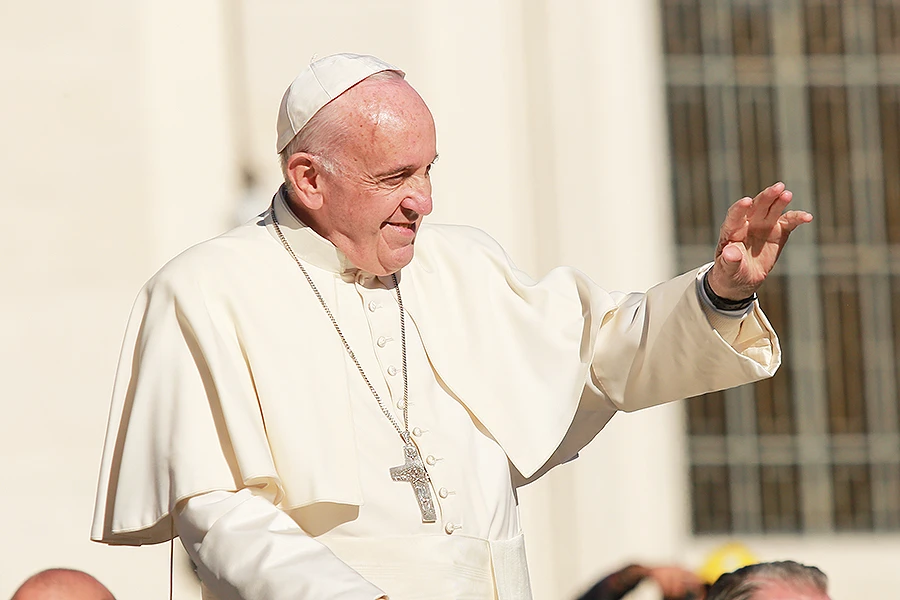
Vatican City, Oct 2, 2017 / 05:00 pm (CNA/EWTN News).- The September 19 re-establishment of the Pontifical John Paul II Theological Institute for Science on the Family and Marriage is a good object lesson in the modus operandi of Pope Francis. It offers observers some helpful lessons about the Roman Pontiff’s leadership style.
The John Paul II Pontifical Institute, founded by the late Polish Pope, whom Pope Francis calls the “Pope of the Family”, has developed as well-respected institution in theological circles. It is known to foster and promote theological discussions on family and marriage issues at twelve campuses around the world.
The institute’s work was mentioned in the 2014 Synod on the Family’s instrumentum laboris – its working document. It is worth noting, however, that no professors of the institute were invited to serve as theological experts to the 2014 Synod.
Fr. José Granados, however, who is one of the institute’s most prominent faculty members, was included among the participants of the 2015 Synod.
Nevertheless, some have suggested the institute seems to have been sidelined under Pope Francis.
The appointment of Archbishop Paglia as Grand Chancellor of the institute, together with the appointment of Professor Pierangelo Sequeri as its president, were interpreted as a shift away from the institute’s ordinary approach, which some speculated the Pope considered too traditional.
With the motu proprio refounding the institute, Pope Francis apparently wanted dispel any perception that he had sidelined the institute.
Speaking with journalists Sep. 20, Sequeri remarked twice that “the Pope renews an institute that was considered sidelined, and involves the same professors of the institute in this renewal.”
The institute’s new direction will not take shape until its statutes are drafted. It is possible that some faculty members will be involved in the drafting process. The Pope, however, gave clear indication of his intentions in the motu proprio.
According to Archbishop Paglia, the new institute will broaden its focus to include history, economics, and other social sciences.The social science focus will include a new endowed chair, to be named for Gaudium et Spes, the Second Vatican Council’s pastoral constitution on the Church in the modern world.
However, much remains uncertain about the institute’s future. Nothing is known about how the new statutes will be developed, nor if the institute’s present professors will be invited to stay on.
So how can the establishment of this new theological institute can give clues about Pope Francis’ modus operandi?
First of all, it is clear that Pope Francis wants to make every reform very personal. He issued a motu proprio to renew a Pontifical Institute, an unusually involved step that might ordinarily be delegated, which seems intended to connect his desired reforms to his name and to his authority.
Likewise, this reform follows his pattern: all the others reforms he has enacted in the Curia have begun with a motu proprio or a chirograph.
In general, the Pope has left the details to be determined after announcing his intentions – discussion of the statutes of the new dicasteries has typically come after his announcements.
He has done the same with the new John Paul II Theological Institute. He issued a motu proprio, setting the direction, and he left the discussion of statutes, which govern the practical details of reform, to others.
A second characteristic of Pope Francis’ leadership style is that he likes to do reform “in the making.”
What does this mean? A response to the question can be provided by Pope Francis’ apostolic exhortation Evangelii gaudium.
In the exhortation, the Pope stressed that “giving priority to time means being concerned about initiating processes rather than possessing spaces”, and so “what we need, then, is to give priority to actions which generate new processes in society and engage other persons and groups who can develop them to the point where they bear fruit in significant historical events. Without anxiety, but with clear convictions and tenacity.”
The Pope begins reforms, and then he waits for things to organically move in the direction for which he is calling.
Finally, it is an old saying in leadership that “people are policy.” Pope Francis seems to approach personnel decisions uniquely. Rather than firing people, the Roman Pontiff prefers to add new people or new groups to decision-making processes, in order to rebalance the general discussion.
At the renewed John Paul II Institute, it seems unlikely that the Pope will dismiss the full professors, who are hired into tenured positions. Instead, he will add to the faculty new chairs on different topics in order to broaden the conversation.
And then, if history is a good predictor, he will wait to see what happens next.
 […]
[…]






I suppose there’s no point in asking why, if the judges were selected in July, they weren’t formally nominated until three months later. If the documentary on the Rupnik case hadn’t been released last month, we’d probably still be waiting.
Two weeks until October 27th, the exact day when Pope Francis lifted the statute of limitations. Will the trial start by the time the two-year mark is reached? I have been searching and haven’t found any news about that.
Exactly. And Catholic News Agency failed to do basic diligence and mention the July 3 press conference. This should be a wake up call for those who still think Leo is not Francis 2.0, including in the cover up and protection of abusers. It’s beyond doubt this is being deliberately slow-walked. The loophole mentioned on July 3 of saying they weren’t officially appointed on paper must have been deliberate tactic. As a canonist, the handling of the case defies belief, including this latter trick- make a point of announcing that judges were selected, but instead of just appointing them then, or waiting until the official appointment to make any announcement, we’re told they’re “selected,” but tell us three months later they were not actually “appointed” until now. Of course, Leo is suspect of having protected abusers as a bishop and superior. Rupnik perhaps knows where some bodies are buried with respect to Leo as well as much of the corrupt figures at the holy see that are still there from Francis’ time.
Mary E,
“If the documentary on the Rupnik case hadn’t been released last month, we’d probably still be waiting.”
Than you for mentioning it; now I am aware of the documentary and watched already the interview with its author; she is a Catholic and she made a point that she is not lashing the Church (for which she has a huge respect); she is concerned with the inhumane system.
I know how important it is for the victims of that kind of abuse to be heard. Now they are heard in the most effective way and the knowledge that the lid is off will provide them with some relief (the worse aspect of such an abuse is a suffocating silence/silencing). This documentary will be of help to other victims, religious and lay women, not just of Rupnik.
My only grief is that if you are right and the Vatican moved only because of the documentary = publicity it means they do not care about anyone but themselves and own image. Of course, the lack of actions/cover up of Rupnik already stated “we do not care” but somehow now it is even worse.
“One year later, the Vatican declared Rupnik to be in a state of “latae sententiae” excommunication for absolving an accomplice in a sin against the Sixth Commandment. His excommunication was lifted by Pope Francis after two weeks.”
And this in microcosm is the Francine pontificate. What possible reason would there be for such extraordinary Pontifical clemency? Asking for former Archbishop Vigano and Bishop Strickland.
A day late and a dollar short.
More farce from the pontifical theater of “the-church-for-the-decapitated-Body.”
Just to make sure I’m understanding correctly. Bishop Strickland was immediately, unceremoniously, and spitefully removed from his position because he dared to call Francis out on his moral and spiritual compromises. But the Rupnik case is still being litigated. Challenge the pope and you’re out. Commit repeated spiritual and sexual abuses, and we’ll hope that it goes away if we drag it out long enough. Got it.
Athanasius: The truth is we have a morally bankrupt Catholic hierarchy. We know justice will be carried out by the Perfectly Just Judge. In the meantime, the Body of Christ is being tortured daily.
Justice delayed is justice denied. Rupnik’s victims have been denied justice.
Ya think this will have a just verdict anytime before the Second Coming? Yadayadayada…
Given the number of sexual abuses cases, it seems almost risible that Rome has to go searching like Diogenes to constitute a panel of judges at the trial level to hear a case. That’s like America saying, “darn, there was a crime! Maybe we should hire some judges?!?!’ This whole procedure, if abnormal to accommodate Rupnik, is laughable. If normal for the way Rome handles such cases, it is ludicrous. Somebody might start teaching the canon lawyers what most of the integral judicial systems of the world already know, because these “canonical” procedures don’t pass the common sense smell test.