

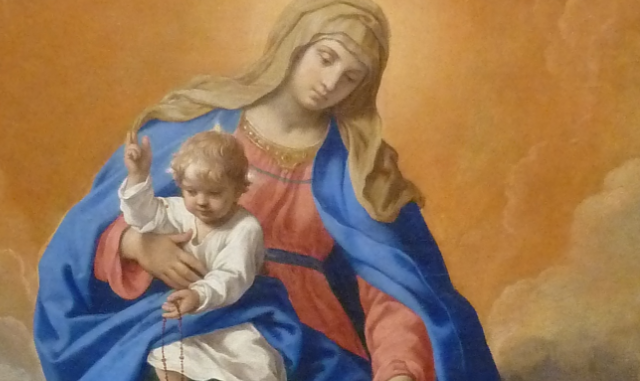
As Tom Holland’s 2021 book Dominion: How the Christian Revolution Remade the World reveals, in every past civilization (even our Greco-Roman forbearers), women were either commodities, guarded by their families as dynastic assets, or simply booty, “sex objects”—as were their children.
The birth of God into history as a real baby of a real mother changed all that. Only Christian civilization achieved a prodigious overturning of men’s natural drives by insisting on the dignity of women as such, founded in motherhood.
Most astounding, in chivalry, devotion to the Madonna taught the manly virtues of chastity, monogamy, and reverence for women to testosterone-charged, rape-loving young Germanic warriors. We might contemplate the conscientious Sir Gawain. This was a naturally impossible achievement, overthrowing the natural norms of Huns, Vikings, Mongols, Arabs, Achaeans, Samurai, and Apaches. Achilles would have gaped. Nietzsche did rage.
Correcting idiotic anthropologies
Any post-Enlightenment anthropology that denies real freedom of the will cannot account for this prodigious “moral inversion.” A Freudian might attribute it to the arrested development of prepubescent boys, but that would imply that a developmental pathology could generate all the familial, political, and cultural blessings that resulted, not the least being monogamous fatherhood.
What’s more, it’s now becoming obvious that modern atheistic philosophy fumbles badly the reality of human consciousness. Aristotle points to this real mystery (Ethics IX— in the context significantly of friendship): “He who sees, discerns that he sees, and he who hears, that he hears… so there is something, when we are feeling or thinking, that is conscious of our feeling or thinking.” Yet atheistic philosophy, trapped in its mechanistic rhetoric, simply “hand waves” myself, being a self, a subject in the world among other subjects.
Hobbes and Locke were content to propose “words as the spies of the appetites,” but had no one “back at headquarters,” collating the intelligence. Hegel’s master-servant dialectic presupposes the very “being in and for itself” that it purports to explain: any weaker dog in the jaws of its alpha simply goes limp in submission. Nietzsche at least embraces honestly the modern effort to “assassinate the old idea of the soul,” embracing “the merely apparent existence of the subject” (BGE III.54).
In short, they all presuppose what they’re obliged to explain: consciousness as essentially, spiritually relational. As we will see, only embracing the origin of consciousness in love—a mother’s love—corrects these idiotic anthropologies.
Newborn development and the mother’s face
The study of newborn development is a latecomer to our self-understanding, given historically high infant mortality rates and consequential parental detachment. Yet, as Simone Weil saw, given the revelation of the Imago Dei in every person, Christianity is both theology and anthropology.
One early explorer of the terra incognita of babyhood was Thomist-pediatrician Herbert W. Ratner (The Family, an Office of Nature, 1982): “Because love holds together the delicate membranes of human society, and is the basis of our relationship with God, the chief need of the child is to experience love,” says Ratner. “For this task, nature selected the mother. As a female, her capacity to care for the newborn is unique.”
Humans with reasoned speech are essentially relational persons. Therefore, we enter the world naturally incomplete, neurologically underdeveloped, so we can learn the local lingo in all its subliminal analogies and distinctive poetry. Like Kanga’s Roo, we mature outside the womb in the maternal embrace, what Ratner calls “a womb with a view.” In Mommy’s cradling arms, soothed by her scent and already familiar voice, newborns are neurologically hard-wired to fix their gaze on her smiling face, with a focal range of a single foot, the distance from her breast to her face. “When the Psalmist pleads to God to ‘turn His Shining Face upon me,'” Ratner concludes, “he echoes the acceptance the nursling seeks from its mother, its source of security.”
Mommy constantly flatters us, so over those first formative weeks, we learn to distinguish speech-sounds from noise-sounds: sounds from the Shining Face are speech, and ambient sounds, mere noise. Babies thus nurtured can later, as adults, understand conversations in heavy traffic. Television cannot substitute. Babies deprived of face-to-face stimulus (like hundreds of Romanian orphans in the 1990s) suffer from permanently crippled frontal lobes.
Baby and Mommy wonder at each other—what we’ll shortly call Mimetic Communion—like two parallel mirrors. Aristotle identifies wonder as likewise the beginning of philosophy: “Why is there something?” But this sort of question assumes the mature distinctions of reasoned speech, which themselves presuppose that something, discerning that we’re reasoning. Our aboriginal experience is not the “why?” of anything, but the overwhelming fact, “That is there someone”—not something, but someone, the original wonder of Adam. That maternal friendship draws each of us into the Cosmos, entices us into the universe, conscious in our relationships to others as others.
“The infant’s inability to communicate verbally and conceptually bespeaks the woman’s ability to communicate in a modality of ‘feeling’,” Ratner elaborates, “knowing and loving through the intuitive, poetic, experiential, and affective. These non-conceptual modes of communicating result in a preternatural form of knowledge… a predominantly spiritual, sensorial gestalt.” So we mature as conscious beings in a family, preparing for lives of confident agency. However, we may be stunted in our maturation by our family’s (and eventually our own) failures to love. Friendship, delight in the being of others as others, with our shared good, is our life fabric, where we find happiness, “life fully alive,” freedom, and meaning.
The nursing couplet’s mutual delight explains our eventual ability to experience Beauty, given our aboriginal experience of the Shining Face’s bilateral symmetry, coherent complexity, and affirming participation: the ur-analogy of the goodness of Creation. This wonder of Beauty, delight in the simple being of that Shining Face, nurtures our delight in simple existence. This is the lived experience of the first axioms of Christian metaphysics and natural law: “To be and to be good mean the same.” And this, in its turn, refutes with aboriginal experience the supposedly undeniable, modern “fact-value distinction.”
Imitation, desire, and consciousness
How can this aboriginal experience of consciousness find traction in our current debates?
Rene Girard argues convincingly in I See Satan Fall Like Lightning that civilizations first arose with the ritual sacrifice of a scapegoat. Human beings are not instinctual animals, not merely reflexive, but rather mimetic, imitating the behaviour and motives of others. Thus, we are naturally capable of community and cultural innovation. The cost, however, is mimetic desire: a toddler sees another playing with an unnoticed toy, imitates the desire for that toy, then fights for it.
In adulthood, this metastasizes into mimetic competition within society at large, people competing for possessions, sexual prey, and public prominence, for the sole reason that others want them. Over time, these tensions build to unbearable levels, threatening the common peace. Finally, spasmodic, cathartic violence erupts, focusing the community’s accumulated resentment upon a single innocent victim. This mimetic snowballing develops over the ages into the ritual sacrifice of divinized victims. This Girard sees as the driver of all coercive (pre-Judeo-Christian) cultures.
There’s little space here to discuss Girard’s anthropology, except to affirm his persuasive realism. He asserts (like Tom Holland) the utter uniqueness of the Judeo-Christian revelation in “siding with the victim.” Yet he carefully brackets his analytical science from any synthetic metaphysics, restraining, for example, the temptation to identify mimetic competition with Original Sin. So, to his analytical hammer, all the world looks like a competitive nail, with archaic cultures arising only in cathartic violence. Yet, mimetic competition describes a failure of love, a corruption of a more fundamental, maternal Memetic Communion. Toddlers first compete for toys, but they can then learn to play together.
The origin of consciousness in Mimetic Communion, implicitly presupposed by Gerard’s Mimetic Competition, explains the primeval myth of a lost Golden Age. It explains the capacity for conqueror-guilt or “tragic sense of life,” awakened in virile barbarians (Agamemnon) by their sacking the awesome, archaic temple cities (Priam) in the so-called Axial Age. It explains the aboriginal awareness of “an ocean of supernatural energy,” revered by prehistoric shamans.
The mother’s smile and nurturing communion
This “intuition of pure being” constitutes the real substratum of all cultures (pace Hobbes).
“It may seem paradoxical to suggest that the [origin] of human [culture] is found in the highest type of knowledge—the intuition of pure being,” says Christopher Dawson in Progress and Religion, “but mankind’s development is not so much from the lower to the higher, as from the confused to the distinct… A ‘low’ culture can produce [visual and poetic] art perfect and incapable of improvement.” Likewise, Chesterton in The Everlasting Man views the prehistoric cave-painters and their ochre horses as perfect as Picasso’s Dove. A reverent awareness of the All, the other as a nurturing Totality, inspires the most primitive hunter-gatherer cultures. Among feudal warriors, iconic motherhood inspires Gothic cathedrals. In bureaucratic cultures, infant daycare inspires a plague of Happy Face stickers, longing for their truant Shining Face.
Theologian Hans Urs von Balthasar, in Mary: The Church at the Source, focuses on this aboriginal infant consciousness, “this founding event of human existence… recognized only in our own day.” We now realize that the helpless newborn is “intrinsically ordered to ‘being with’ (Mitsein) other humans…and awakens to consciousness only through other humans, normally his mother.” The mother’s smile “draws him into a welcoming world…the primordial experience [where] he becomes aware of himself for the first time.”
So, while insisting the Divine Son always remains in conscious communion with his Father, von Balthasar suggests that “Jesus himself has His Mother to thank for his human self-consciousness”—his understanding of Aramaic and Hebrew, the idioms and rhythms of Israel’s faith, and humanity’s myriad idiocies. He “increased in wisdom and stature” (Lk 2:52) by learning, like any good teacher, what his students do not know. If Jesus of Nazareth was to be “fully human,” von Balthasar concludes, his nurturing communion with his mother must have been more than simple biological, but spiritual (Luke 8:21).
What ultimately became the Greek term for Christian charity—agape—originally pointed only to the irrational self-sacrifice of postpartum mothers for their newborns. And in a manner paralleling the recent and God-friendly discoveries in astronomy and genetics, developmental psychology is reconfirming the Christian anthropology of motherhood. The conclusion here is the necessity of Marian symbolism, the Madonna, in any renewal of a Christian culture.
Culture of Power v. Culture of Love
In the end, humanity’s fundamental alternatives are a Culture of Power, coercion, and rape, or a Culture of Love, chivalry, and motherhood. If we seek the rebirth of a sacrificial Christian culture, as Marian Chivalry once transformed homicidal Germanic warriors, that effort cannot be hamstrung (as it has been) by skeptical or sectarian male contempt for the Providential dignity of Jesus’ mother and motherhood itself.
Cultural prescriptions in music, literature, or visual art are chancy at best, but recall the explosion of “Notre Dames” in every major market town of 12th-century Europe. As Kenneth Clarke described in Civilization, Abbott Suger’s unpredictable genius—weightless Gothic pillars, bathed in divine light—seized the imagination of Western Christendom. Today, Christians of all stripes are responding in defense of the embattled family, but our eventual success will be enabled by the image of the Madonna, the Mother of God. By way of introduction, see Gerard Manley Hopkins’ prophetic poem, “The Blessed Virgin Compared to the Air We Breathe”.
The simply human face of the Economy of Salvation is seen in the Stabat Mater—“the Mother standing” beneath the cross of her bruised and broken Son, suffering more than any other human creature has ever suffered. The notion that the Perfect Man might inflict that pain upon his own mother indifferently, pointlessly, is simply grotesque, unless her pain—“her cross”—shares joyously in his salvific purpose.

If you value the news and views Catholic World Report provides, please consider donating to support our efforts. Your contribution will help us continue to make CWR available to all readers worldwide for free, without a subscription. Thank you for your generosity!
Click here for more information on donating to CWR. Click here to sign up for our newsletter.

It seems providential that I should be reading this article on October 13th — the day of the sixth apparition at Fatima, which coincides with the day of Nisan in the Book of Esther, when the people of God were delivered from the designs of Haman. It is also the annual day requested by the Rosa Mystica for the Communion of Reparation, and just yesterday the first international congress of the Rosa Mystica concluded in Montichiari.
One of the contributions that most struck me there concerned the biblical roots of the title “Mystical Rose.” This title, far from being a mere poetic epithet of the Litany of Loreto, has profound scriptural and patristic depth. The rose appears already in the Song of Songs — the locus classicus of love and fruitfulness — and again in Wisdom 27 and Sirach 50 (or 58), where it becomes a sign of divine beauty and renewal. The Fathers, above all Ambrose and later Bernard, read in the hortus conclusus, the enclosed garden of the Bride, a symbol of Mary’s virginity, her intimacy with God, and her role as the fruitful dwelling of the Word.
Thus the rose in Christian symbolism unites the three attributes of love, purity, and fecundity — a triad that perfectly expresses the Marian mystery. Saint John Damascene greets Mary as “the enclosed garden whose fragrance is the sweet odour of the fertile field… the immortal rose, ever fragrant, whose aroma gladdened the Lord.” The odor suavitatis that issues from her womb is none other than the “fragrance of Christ” (2 Cor 2:15), through whom the world is perfumed with divine grace.
Saint Bernard, the great Marian doctor, calls Mary the garden into which only the Bridegroom may enter, where the rose of love grows among lilies and violets. And even Saint John Henry Newman, in continuity with Saint Irenaeus, sees in Mary the Mystical Rose and Advocate, whose image — the woman clothed with the sun of Revelation 12:1 — is already present in the catacombs. He notes that if no one doubts that the male child of that vision is Christ, then neither should we doubt that the woman who bears him is his Mother. Mary’s mediating role, he observes, is inscribed in the very beginnings of Christian iconography and faith.
All this suggests that what the CWR article calls the “culture of love” has, in Mary, its supreme embodiment. She is not merely a symbol of tenderness, but the living form of divine Wisdom in creation — the Mystical Rose from whose fragrance the whole Christian civilization once drew its sweetness.
If, as the author argues, only a Marian civilization can counter the culture of power and nihilism, then perhaps we may add: it is time to recover a Scotist, Marian personalism — one that confronts the voluntarist and existential philosophies of modernity with the primacy of love. For in Duns Scotus’s vision, Mary stands at the apex of creation as the first object of divine predilection, the personal form of the universe’s orientation toward the Incarnation.
In that light, the culmination of Marian doctrine would be not an innovation but a recognition — the dogmatic affirmation of Mary as Mystical Rose, Mediatrix of all graces, and Mother of the Church. Such a proclamation would not only crown Marian theology but express, at the highest level, the truth this article evokes: that love, embodied in the Mother, is the very source of consciousness, culture, and redemption.
I would like to correct a mistake I made in an earlier comment regarding the biblical references to the “rose.” I had misquoted the verses. The correct passages are: Song of Songs 2:1; Wisdom 2:8; and Sirach 50:8. My apologies to the readers for the oversight, and thank you for your patience.
Ah, finally, an explanation for why I cant find my car keys but know where the last slice of pizza is! This delightful piece confirms what we all knew deep down: the universe’s most powerful force is maternal communion, not dark matter. Who knew understanding traffic jams stemmed from staring at the Shining Face? While Im not sure mimetic desire explains my obsession with that limited-edition sock, the article has certainly illuminated my spiritual journey from crying baby to competitive adult. Let us all bask in the wisdom of the maternal embrace and prepare for a future where Gothic cathedrals and Happy Face stickers coexist in perfect, if baffling, harmony. Truly, the mother of God holds all the answers – and maybe my missing socks too.act 2 ai
Nietzsche did rage. Woodard, Marian devotee and philosopher, targets the emancipation of woman as responsible for the humanization of men.
Woman is man’s other self. If he demeans and simply uses her he remains the barbarian, passive and cowardly or fierce and murderous. Karl Stern, The Flight From Woman details her irreplaceable place in the fabric of culture. When Adolf and his philosopher Alfred Rosenberg determined to suppress the feminine to the complete sovereignty of the masculine Germans returned to barbarism.
Then there’s today’s tragic depravity of weak men who in their admiration and jealousy want to be women. A satanic worm inching into the psyche to reverse the order of nature. Perhaps it’s the mission of women to restore mankind to sanity. Woodard articulates Mary as the irreplaceable model for its realization.
Your words Father are possibly more reassuring than you know.
We read that Rene Girard restrains from “the temptation to identify mimetic competition with Original Sin.”
But what happens if we sideline altogether the mystery of Original Sin? Today we have in the West a post-Enlightenment/post-Christian devolution which rationalizes its cancelation of both the Marian/maternal and the complementary paternal with the oxymoronic “gay marriage.” While the anti-Enlightenment/pre-Christian (not chronologically) Islam still values Mary, but not as the Mother of God. And, at the same time devalues Christ–such that the Holy Spirit, too, is cancelled, and replaced by (he fatherless at the age of two) Muhammad with his “uncreated and dictated” Qur’an. Is the Islamic distancing from free will and from an inscrutable and deterministic Allah, itself, the consequence of a sin “original” to ourselves?
So, yes, a brilliant summary from Simone Weil that incarnational “Christianity is both theology and anthropology.” The disjointedness of our time is twofold: that in the secularistic West, today, too many young males are unable to identify with their (abusive, absentee, etc.) fathers and become absorbed into stunted homosexuality; and that in the Islamic world (where the term “Father” does not even appear in the Qur’an) theology is absorbed into the bubble of 7th-century cultural anthropology.
In full knowledge of the Truth of this beautiful article, St Maximilian Kolbe sought to build “The City of the Immaculata” and had this to say of the purpose of Niepokalanow: “not only to defend the faith, to contribute to the salvation of souls, but with daring entreprise, not caring at all about ourselves, to conquer for the Immaculata one soul after another, one outpost after another, to raise her banner in the publishing houses of newspapers the periodical and non-priodical press of news agencies, via radio antennas, in artistic and literary institutions in théâtres, cinemas, parliaments, senates- in a word everywhere all over the earth.
“In addition, watch that no one ever manages to remove these banners. Then socialism, communism, heresies, atheisms, Freemasonry, and any other similar nonsence that comes from sin will fall apart.”
The writings of St Maximilian Kolbe,vol 1. Page 608. Nerbini International:2016
Building the City of the Immaculata is the mission of those who seek to realigne the World to Catholicism.
Louis de Montfort’s The Secret of the Rosary quotes the Blessed Virgin Mary talking to St. Dominic:
“I want you to know that, in this kind of warfare, the battering ram has always been the Angelic Psalter which is the foundation stone of the New Testament. Therefore if you want to reach these hardened souls and win them over to God, preach my Psalter.”
The traditional 150 ave Angelic Psalter – the full Rosary – is the foundation stone of the New Testament.
The Ave is composed of the virtical angelic salutation from heaven, the horizontal salutation of St Elisabeth, associated with an ancient supplication. It is a prayer imploring the Yes of the Blessed Virgin Mary!
The triptych of meditations focus on the Mysteries of the Incarnation and Redemption which flow from that Yes.
The rosary is the foundation stone which will win back souls to the Immaculata and rebuild her Catholic City.