

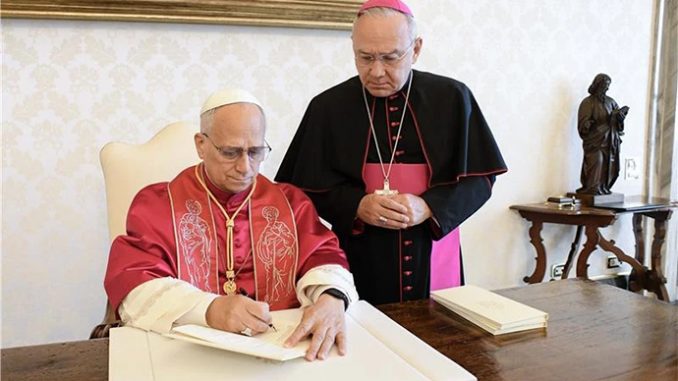
Pope Leo XIV’s first magisterial document of his papacy, Dilexi Te (“I have loved you”), has understandably generated a lot of interest. An apostolic exhortation is a fairly low-level document in terms of the classical criteria for adjudicating the authority of magisterial texts. Pope Leo has played his cards close to the vest during these first months of his papacy, doing and saying little that would generate much controversy, and so the level of interest in this—the first of his documents—is running almost at a fever pitch. And so it is not surprising that many Catholics from all sides of the ecclesial spectrum have submitted the new text to a detailed analysis to glean any hints of where Pope Leo intends to take the Church.
I think that has led many to overthink the text and to see in it more than it intends or portends. All in all, for reasons I will elucidate below, I think Dilexi Te, though a fine document that is at points both profound and beautiful, says very little that is new in the sense of a theological novelty, says hardly anything even mildly controversial, and is at pains to position itself as in total continuity with the Tradition. I liked the text, but I think those seeking a deeper insight into the mind of Pope Leo will come away empty-handed.
No new insights into the thought of Pope Leo
For starters, this is a text that was largely already written by Pope Francis. And it is difficult, if not impossible, to know which bits of it are from him and which are from Leo. One can say that such things do not matter since Pope Leo put his signature to its final iteration, but such things do matter. It may be that, as with the first encyclical from Pope Francis (Lumen Fidei), which was mostly written by Benedict, publishing the mostly finished final writings of a recently deceased (or retired) pope is more an act of papal homage to their predecessor than a completely programmatic expression of the new pope’s deepest convictions. It might just be a magisterial gesture in the direction of continuity with one’s predecessor than a robust statement of where the new pope plans to go with his thought and pontificate.
By contrast, St. Pope John Paul II’s first encyclical, Redemptor Hominis, was a Christocentric theological anthropology very near and dear to his heart. And as his full papacy made clear, it was indeed a definite programmatic statement from the new Pope about the main themes of his papacy. However, Lumen Fidei was not that, nor, I suspect, is Dilexi Te.
I am not saying that this habit of publishing unfinished papal texts from one’s immediate predecessor is little more than an empty encomium in the form of a eulogy, signifying little. It obviously means something, and that could be nothing more than the obvious. To wit, Pope Leo really does have a love for the poor and desires that the Church take the matter seriously. Nevertheless, there is a definite sense in which Dilexi Te is not yet a full-orbed expression of what the main themes of Leo’s papacy will be.
In other words, the Pope, who has so far played his cards close to the vest, continues to do so.
The second reason this new document may not provide the tea leaves some desire for reading the future direction of this papacy is that it deals with relatively uncontroversial topics. And, once again, that may be by design. Poverty of body and soul, economic injustice, greed, the spirit of acquisition, the libido dominandi as it gets expressed in the typical dominance of the wealthy over the poor and weak, the commands of our Lord regarding to wealth and poverty, are hardly the stuff of deep disagreement and sharpened controversy. There are precious few in the Church who would disagree with what the pope says on those topics.
Immigration and free markets
The closest Dilexi Te comes to controversy is its treatment of the issue of immigration. Nevertheless, even here it touches upon the topic in ways so generic that no particular political policy recommendation can be discerned from it with clarity. As one might expect from a pope who spent many years as a missionary in Peru, Leo is certainly not a populist nationalist who seeks to promote a neo-isolationist nativism that turns its back on immigrants who are seeking asylum. Nevertheless, neither does he come across as an advocate for globalist removal of all national borders and a total “open door” policy of unrestricted access to any nation an immigrant may choose to enter.
Instead, the document swims in the safe waters of rather anodyne comments about the full dignity of all human beings, native or migrant, and the need to treat everyone with respect and with a deep charitable impulse to help everyone achieve a fully human integral development as persons. Who can disagree with that?
Therefore, critics of this document who view it as expressive of some kind of George Soros-style globalist agenda in league with the “Davos elites” are engaging in unvarnished alarmist nonsense. It is nothing of the sort, as can be easily seen in the fact that a good 60% of the text is dominated by a thick retelling of the lives of the many saints in the Church’s history who have championed the cause of the poor, the sick, the immigrant, the socially marginalized, and the imprisoned. Pope Leo could not be clearer that the bonds of Christian charity are not reducible to mere philanthropy and that the Church is not just another humanitarian aid agency.
Similarly, there is too much overthinking about the text regarding the topic of free markets. Nowhere in the text does the Pope advocate for a socialist answer to economic inequality. It is true that he criticizes “free markets”, but it is also abundantly clear that when read charitably and in full context, those remarks are aimed at a particular kind of free market capitalism. It is targeted at those forms of free market economics that view the invisible hand of the market as existing in a zone of amoral indifference to human need, the universal destination of goods, or the higher moral purposes that must accompany wealth accumulation lest it devolve into a bestial social Darwinism.
One may say that this is a fiction of the pope’s imagination and that no such robber baron capitalism exists anymore, but they would be wrong. Gone are the economic oligarchs of oil, coal, railroads, and shipping, and in their place we have the oligarchs of our new digital paradigm of computer tech, military weaponry, and financial and commodity speculation.
Seen in this light, everything that Pope Leo says in the text about the shortcomings of specific kinds of free market economies is completely in line with all previous papal social teachings, stretching from Leo XIII and on down through Francis. Absolutely nothing in Delexi Te is out of step with previous papal teaching on the potential pitfalls of unbridled free market economies.
The Christological concentration and defining “the poor”
My point, once again, is that Dilexi Te says very little that is new, controversial, or unsettling. It is in places beautifully written, even moving, and when it deals with the “poverty” of Christ (section 18 and following) it reaches levels of lyrical theological beauty that are truly the key to the whole document. The section begins with this:
The Old Testament history of God’s preferential love for the poor and his readiness to hear their cry — to which I have briefly alluded — comes to fulfillment in Jesus of Nazareth. By his Incarnation, he “emptied himself, taking the form of a slave, being born in human likeness” (Phil 2:7), and in that form he brought us salvation. His was a radical poverty, grounded in his mission to reveal fully God’s love for us (cf. Jn 1:18; 1 Jn 4:9). As Saint Paul puts it in his customarily brief but striking manner: “You know well the grace of our Lord Jesus Christ, that though he was rich, yet for your sakes he became poor, so that by his poverty you might become rich” (2 Cor 8:9).
So there is a Christological concentration that breathes fire into the equations of what would otherwise be merely human stratagems. On this point, Pope Leo could not be clearer, and insofar as this Christocentrism is the hermeneutical key to the whole, it places him in firm continuity with every pope of the 20th century and before.
Some critics say the text is characterized (some would even say “marred”) by a breezy set of generalizations about “the poor” and “migrants” and the different “kinds of poverty” to the point of a kind of romanticized idealization. The poor in this text, so the criticism goes, are never the conniving liars and manipulators that many of them are in reality. And migrants are never portrayed as sex trafficking coyotes or drug runners for murderous cartels. They are instead portrayed by Pope Leo as purely innocent victims of economic and political oppression in our unjust system.
However, in my opinion, the pope is instead rightly deriding the classical distinction between the “worthy and the unworthy poor” as a mere tool of the rich and powerful to dismiss the moral claim laid upon them. As he states in section 14:
The poor are not there by chance or by blind and cruel fate. Nor, for most of them, Is poverty a choice. Yet, there are those who still presume to make this claim, thus revealing their own blindness and cruelty. Of course, among the poor there are also those who do not want to work … However, there are so many others – men and women – who nevertheless work from dawn to dusk, perhaps collecting scraps or the like, even though they know that their hard work will only help them to scrape by, but never really improve their lives. Nor can it be said that the poor are such because they do not ‘deserve’ otherwise, as maintained by the specious view of meritocracy that sees only the successful as ‘deserving’.
In this quote, we see no romanticization. What we see is the clear-eyed expression of the full reality of poverty from a man who has seen it up close and personal in Peru and elsewhere. In our country, much of the poverty we see is caused by drug addiction and/or untreated mental illness. And if I had one wish, it is that the pope had addressed those realities as real causes of much of the poverty in economically affluent societies. However, he is entirely correct to note that around the world, in nations that have huge swaths of impoverished persons, this poverty is not caused by laziness or rank stupidity but is instead the product of unjust economic and political structures.
This statement from the Pope also exposes the critics of the Church’s preferential option for the poor as the actual perpetrators of vague abstractions in the service of an ideology. For example, there are American critics of this text who can cite every single crime and act of violence by immigrants to Europe and America as evidence of why mass deportations are justified without making distinctions between the criminal element and those who are here without harm. An illegal is an illegal, some insist, and no such distinctions are necessary; they are an abstraction insofar as they are all, by statutory definition, “criminals”.
Yet those same critics ignore our own history as a nation that allowed tens of millions of Irish and Italian immigrants to enter this country, and who promptly formed some of the most violent and evil criminal organizations in the world. And today, such immigrants are now lionized and praised as the great addition to our society that they were, despite the nativist backlash they experienced at the time and despite the very real criminal element within their ranks.
This historical amnesia, combined with constant references to the unique evils of modern immigration, is itself a subtle lie that Pope Leo is rightly calling out. He is not advocating open borders. But he is obviously also opposed to strictly closed borders, as we all should be in the run of Christian charity.
The Pope is well aware that poverty and immigration often go hand in hand and that it can create awful social conditions. And nobody is claiming, including Pope Leo, that nations do not have the right to control and regulate borders. But he is reminding us that borders are not absolute and that the rise of the modern concept of the “sovereign nation state” is itself open to an idolatrous apotheosis of one’s own country. In this regard, one aspect of Dilexi Te that needs emphasizing is the Pope’s focus upon the traditional Catholic doctrine of the universal destination of all goods. Private property is not absolute and is instead a function of the universal destination of goods when properly understood in its full social context (see section 86).
But beyond social context, the entire tone and tenor of Dilexi Te is Christological. The universal destination of all goods, irrespective of its grounding in natural law, is first and foremost grounded in the common origin and destiny of all things in Christ. Drawing copiously from the writings of Paul VI, John Paul II, Benedict XVI, and Francis, Pope Leo underscores the deep Christological continuity of the Church’s teaching on our obligation to see the face of Christ in the poor.
Monasticism and true inclusion
Finally, I would like to note the pope’s analysis of the Church’s monastic tradition and the relationship between the monasteries and the poor as yet another example of his Christological focus. Pope Leo states:
In the West, Saint Benedict of Norcia formulated a Rule that would become the backbone of European monastic spirituality. Welcoming the poor and pilgrims occupies a prominent place in the document: “The poor and pilgrims are to be received with all care and hospitality, for it is in them that Christ is received.” These were not just words: for centuries Benedictine monasteries were places of refuge for widows, abandoned children, pilgrims and beggars.
Over time, Benedictine monasteries became places for overcoming the culture of exclusion. Monks and nuns cultivated the land, produced food, prepared medicines and offered them, with simplicity, to those most in need. Their silent work was the leaven of a new civilization, where the poor were not a problem to be solved, but brothers and sisters to be welcomed. The rule of sharing, working together and helping the vulnerable established an economy of solidarity, in contrast to the logic of accumulation. (55-56)
I think it is significant that Pope Leo begins this section by recalling the Christological grounding of Benedictine hospitality, but then links it at the beginning of the next section to “overcoming the culture of exclusion.” I think this might be one of the most important and (so far) most neglected statements in the text. I think it is no accident that the pope is grounding a properly Catholic notion of “inclusion”—a term much used and abused today in the breaking down of barriers initiated by Christ, who alone grounds the solidarity of the human race in himself.
Therefore, it is more than a mere statement of sociological significance. The Pope is affirming that all notions of “inclusion” must ultimately be Christological and rooted in the Gospel and not in any secular ideology.
All in all, as I said at the beginning, Dilexi Te is actually a strikingly unremarkable text in terms of any novelty we might be seeking. It is instead a rather typical amalgam, so characteristic of modern popes, of tradition and a concern for modern social conditions. In that regard, Pope Leo XIV might just be not so different from Leo XIII and should be read through that lens.
Finally, and I say this with some relief, the text is in many ways a simple recapitulation of long-standing Catholic teaching, stated without saying anything really controversial or unusual. And perhaps that is the best thing about it.
If you value the news and views Catholic World Report provides, please consider donating to support our efforts. Your contribution will help us continue to make CWR available to all readers worldwide for free, without a subscription. Thank you for your generosity!
Click here for more information on donating to CWR. Click here to sign up for our newsletter.



This is a comment I wished I didn’t have to write, but I’m so angry.
I am deeply offended by El Paso Bishop Mark Seitz’ ambush of the pope by bringing to him bundles of letters and a video from aliens who break US immigration law but now claim to be victims of that law.
More specifically, the letters complain that Trump is the villain, without understanding that the president did not make the law – he is simply enforcing it.
Unfortunately, the pope seemed to really like being ambushed. He was so touched by the sob stories, he almost cried. Boo-hoo!
I like the pope’s exhortation on the poor, “Dilexi Te,” but he does not distinguish between legal immigrants and the illegal aliens. He says the Church “knows that in every rejected migrant, it is Christ himself who knocks at the door of the community.”
Fine. Except that illegal aliens don’t knock – they break in.
Through his veiled criticism of the US immigration system, you can see that it’s the illegal aliens to whom the pope gives preferential option. It is the illegal alien whom the pope loves. (Dilexi Te means “I have loved you.”) He is almost encouraging people to break the law.
If illegal immigrants are the “face of Christ” what about the legal ones?
The legal ones follow US immigration law, show respect to the host country and its sovereignty, but are made to wait in line for decades to be let in (up to 20 years for Filipinos.)
Whereas the illegals, until recently, broke in like an invading army – by the caravans, by the thousands – waving their flags and giving the one-finger salute to citizens and legals.
The illegals overwhelmed the system and elbow aside those who have been waiting in the legal immigration line. They complain about the broken immigration system, but it’s them that broke the system. Good for them that Trump is deporting them, as he promised.
We’ve seen pictures and videos of the insulting, invading caravans, yet those pictures were not what Bishop Seitz showed the pope. No, of course, not.
What the illegals did and even now doing – with their temerity to bring their complaints to the pope – is the real slap on the face of Christ. They lie – they broke through the back door and expect the householders to make them co-owners of the house. Isn’t that a sin against the Seventh Commandment?
God help me. I am so angry.
May the peace of Christ be with you. Seeing the Pope having a cry with Bishop Seitz is not surprising but very disappointing. Pope Leo has shown that he is following Franciscus on this (all?) issues. In sum, the border buddies of Texas Bishops like Seitz consider our immigration laws to be “restrictionist.”
For more on the open border radical friends of the Texas Bishops like Seitz and Pope Leo, see the Franciscus inspired Hope Border Institute, see:
https://www.influencewatch.org/non-profit/hope-border-institute-hope/
https://www.hopeborder.org/our-mission
Search “NGOs that oppose restrictionist border laws in the U.S.”. You will find the Hope Border Institute and their NGO friends like the ACLU, Amnesty International, Human Rights First, Human Rights Watch, International Rescue Committee (IRC), National Immigration Law Center (NILC), United We Dream, Church World Service (CWS, Catholic Charities USA and U.S. Conference of Catholic Bishops (USCCB), Lutheran Immigration and Refugee Service (LIRS), Detention Watch Network, Witness at the Border, etc.
Most all of these also lobby for legal abortion.
Thank you, God’s fool. I appreciate your concern. God bless you.
It should be emphasized that no county is as generous as the USA, especially regarding immigration. By any measure, we welcome millions every year. China has had less than 1 million immigrants since the US anccepted over 50 million!:
https://worldpopulationreview.com/country-rankings/immigration-by-country
Margarita: dividing the legal from the Illegal is not a sheep/ goat situation. Just because a person came into the country legally does not mean he is good, or just because they came illegally doesn’t mean not mean they are bad. We must consider each situation as being unique. Yes, the illegal entry was wrong and must be accounted for but should not be an automatic reason for incarceration or deportation. The same should apply for those who have lived here for long period time. These people are part of the flock even if they slipped in the back door unnoticed. Should children of illegal’s be deported just because they were smuggled across . What about those who were born here? Arn’t they just as “American “ as you or me? We must be very careful in labeling or stereotyping people. Nathaniel Hawthorne’s Scarlet Letter comes to mind. It has been many years since I read the book, but as I remember it the woman of repute was a sinner, but also a victim. Sinners are not necessarily bad people, There are many reasons people cross boarders illegally, and not all of them are bad and there shouldn’t be one blanket treatment. The upmost consideration should be given to families, women and children and the most vulnerable. What about teens without roots? There must be a middle ground on the Justice- mercy continuum.
James Connor: If you read Dilexi Te, the pope there enumerates the different kinds of poverty, including spiritual poverty. I suppose that includes the inability to distinguish between right and wrong.
Illegal aliens who violate a country’s sovereignty are obviously impoverished in that sense. They should be taught that it’s wrong to break another country’s laws.
In the NT, we read Jesus’ inaugural address of His ministry: “The Spirit of the Lord is upon me, because he has anointed me to proclaim good news to the poor…”
Why did the Lord say He would free the prisoners and make the blind to see, but will only “proclaim good news to the poor?” Will the good news exempt the poor from the obligation to pay the rent, or pay for food? Of course, not. The Lord sees the spiritual poverty of the poor as more important to address than encouraging them to break other country’s immigration law because there, they are entitled to free hotel lodging, food, health care, education for their children, etc.
Our bishops – and yes, the pope – should proclaim the good news of telling the poor, it is wrong to violate the Seventh Commandment. Breaking in through the back border of another country is like breaking through the back door of your neighbor’s house and expecting to be co-owner of that house.
I should know, because, I, too, am very poor. I came from a poor country, but I’ve followed the law. I’ve worked all my life, but never able to lift myself up from poverty. I lost whatever I have saved during Covid. That’s why I say, I really like the pope’s “Dilexi Te,” except that in it, he seemed to canonize the illegal aliens instead of proclaiming to them the “good news.”
James Connor:
The Catechism of the Catholic Church 2241 states:
“The more prosperous nations are obliged, TO THE EXTENT THEY ARE ABLE, to welcome the foreigner in search of the security and the means of livelihood which he cannot find in his country of origin. Public authorities should see to it that the natural right is respected that places a guest under the protection of those who receive him. Political authorities, for the sake of the common good for which they are responsible, may make the exercise of the right to immigrate subject to various juridical conditions, especially with regard to the immigrants’ duties toward their country of adoption. Immigrants are obliged to respect with gratitude the material and spiritual heritage of the country that receives them, TO OBEY ITS LAWS and to assist in carrying civic burdens.”
I understand all of the above, but would like to emphasize to you what I’ve set in CAPS there. “TO THE EXTENT THAT THE NATIONS ARE ABLE.” And the immigrants’ duty to OBEY THE NATION’S LAWS. If they break into the country without permission – that is not obeying the law. It is then a violation of the Catechism.
My dear sister,Margarita, From what you have written I think you are an extraordinary woman who exemplifies one who has been through a lot and who strives to live out the faith. You have done it the right way and you have paid the price for it. Your reward will be great and I have a feeling that you will be called up to a higher place at the banquet. You may be poor materially, but you are rich in spirit.
All I was trying to communicate was that our treatment of illegals in this country should be open to mercy and each case shoul be considered as unique. Each illegal has a different story and should be treated as such. Many deserve to be given a second chance and should be given a chance to normalize their status in this country. Many are in family situations and should not be separated. Others were lured her by people out to exploit them. Some smuggled in by parents who worked hard in order to pay a high price to get them in. Many have been here for years working “under the table “ in order to keep a family fed and housed. Some of these people have proved that they have the makings of good citizens. They are not ALL murders, rapist, thieves, and drug dealers. They are not altogether bad people. All I’m saying is there is some room for mercy, and that on the continuum between justice and mercy, it may be well to error on the side of Mercy. Our boarders were very porous in the past and it is not wrong to make them secure, and It is not wrong to limit immigration; but we must address the problems that resulted from our laxness with discretion, mercy and compassion. It is wrong to round up people indiscriminately by a bunch of hooded strong men posing as immigration agents and throwing them in makeshift camps before deporting them to forteign camps against their wills without the chance of council. This HAS and IS being done. This IS NOT the USA that I was taught about in civics class ( we were not taught about the treatment of many Japanese during WWII). We are better than this and , as Christians, should demand our government to do better. It is not wrong to hold our elected officials accountable no matter what party they belong to. They are supposed to represent us and they should not try to silence us when we question their actions.
James Connor:
Thank you for buttering me up. I disclosed myself as an immigrant to show you that I do understand how it is to be one. Other than that, I am not the topic of this discussion.
Have you seen pictures and videos of the last years’ caravans? They came in by the thousands – caravan after caravan. They were not individual immigrants, but an army of invaders. They did not give the US the chance to sort them out one by one BEFORE THEY ENTERED. They simply pushed through, with the end result of overwhelming the system to the point that the host country could just drop its hands and give up.
You don’t deal with flood waters drop-by-drop. It’s impossible to give “due process” to every drop that did not even give you the chance to say no. They did not give the host country “due process” before entering. And it’s impossible to give every single one of them the “due process” that they denied the country.
Those are the people the pope exhorted the country to give preferential option to. True, the Lord makes the sun shine and the rain drop equally on everyone. So why give the illegals preferential option?
I believe that the love we owe them is in the form of moral teaching to show them there is a difference between good and bad. It is bad to break another country’s law.
A few years ago, when our parish still had a 24/7 Eucharistic adoration, I was slated on the midnight to 2:00am shift with a prayer partner named Toribio Romo. He was a handsome gentleman originally from a town called Santa Ana de Guadalupe in the Mexican state of Jalisco.
Toribio told me that he was named after his hometown’s patron saint, St. Toribio Romo.
True enough, I found St. Toribio Romo on the internet. What was surprising is that he had been declared by the people (not the Church) as the “Patron Saint of Illegal Immigrants,” when in fact, as a young priest, he had been against Mexican migration to the United States.
I never got around to asking my friend Toribio to explain how his namesake saint became the patron of something he was against. The round-the-clock Eucharistic adoration has been discontinued, and I haven’t seen Toribio since.
So, I was left with just the web to learn more about St. Toribio Romo.
First and foremost, St. Toribio Romo was a martyr for the faith. He is one of the 25 Mexican Martyrs of the Cristero War honored by the Catholic Church. He was later beatified and then canonized in 2000. People remember him for his martyrdom and for a satirical play he had written before the war that mocked those who illegally migrated to the US.
In 1920, while still a seminarian, Toribio Romo published “Vamos al Norte” (Let’s Go North!) a comedy about the perils and immorality of illegally crossing the border to find work in the United States and what would happen to a man after spending too much time on the other side of the border.
Like many Catholic priests of the time, Romo discouraged people from leaving their small towns to seek work in the US illegally.
Despite Fr. Romo’s preachings and the play, the roads continued to be packed with Mexicans heading toward the United States in search of bitter bread. Everywhere you heard the rallying cry: “Let’s go north!”
In a perverted way, the illegal migrants added to the pain of St. Toribio’s martyrdom by insulting him with invented stories of his alleged apparitions helping them to violate another country’s sovereignty.
They carried pictures of the saint and enshrined him side-by-side with other invented folk “saints”, the demonic “Santa Muerte,” the skeletal patron of death dressed in a nun’s habit; and the despicable drug trafficker and hoodlum, “San Jesus Malverde.”
Suddenly, the Church’s catechetical teaching on the immorality of illegal immigration was turned on its head: Catholic bishops on both sides of the border now condone a sin that is clearly against the Seventh Commandment: Thou shalt not steal. “He who does not enter through the gate, but by climbing over the wall is a thief and a robber,” said the Lord. (John 10:1)
But St. Toribio, like the Lord, will not be mocked. The US is now deporting alien lawbreakers by the thousands back to Mexico and beyond. Catholic do-gooder NGOs that assisted in human trafficking are suddenly without US taxpayer funding. And Bishops are reduced to whispering, “Human dignity…human dignity…human dignity,” as if to save face.
God help you is right. “Do not let the sun go down on your anger. And do not leave room for the devil”. Anger is rooted in a perceived injustice, but don’t be too certain that you are right and that those who disagree with you are wrong, that is, that their viewpoint constitutes an injustice. Our opponents are usually smarter than we give them credit for, and matters of immigration are very complex. I’d recommend this for reading:
https://reviewcanada.ca/magazine/2014/04/arguing-for-open-borders/
Thomas James, “… Anger is rooted in a perceived injustice, but don’t be too certain that you are right…” In your charity, do tell me where I am wrong. Thank you and God bless you.
Margarita, ignore the ignorant. There is such a thing as righteous anger that know-it-alls like Thomas James fail to see. Leftists are given to telling others about all their faults but never seem to possess the humility to own their own sins. Do not fear your righteous anger as you’re in good company with the Savior who threw the money-changers out of the temple and who referred to Peter as Satan. And, know this, your humility comes through loud and clear in what you write. Can’t say that about some others here whose hubris is sickening. And, as for “migrants”, we welcome them to the USA when they do so legally but not when they break our laws. I note that Leo says nothing about the Mexican cartels who extort money from the poor to transport them illegally into the USA nor does he say anything about the “migrant” women and children who have been sold into sexual slavery by the cartels as part of the Biden “migration” (aka invasion) scam. ..
Thank you for your comment, DiogenesRedux. It makes me feel better. God bless you.
Your analogy may be false. It’s your premises that are very questionable. If the analogy was entirely sound, you’d have a case, but I’m not sure about it.
I don’t actually know where you are wrong, but what I am certain of is that the inferences we make daily are not money in the bank, and that as our life goes on, we gradually discover that “Hey, I was wrong 30 years ago” , or “It took me 20 years to finally realize that so and so, whom I thought was a fool back then, was right after all”. We begin to realize that we tend to make overconfident inferences on the basis of deficient information, which only experience can correct— which is why young people tend to be very doctrinaire. But when we allow ourselves to be angry at another’s viewpoint, especially a pope, we’ve already decided we are right and that listening to others with much more experience is not necessary. The world is just way too complex for dogmatism. Socrates had the right idea: “I’m wiser than everyone in that although they know nothing, I at least know that I know nothing”.
Thomas James,
Prudential judgement may change over time, depending on circumstances, but the Truth does not change. If a total stranger breaks into your home WITHOUT YOUR PERMISSION and claims co-ownership of your house, raids your refrigerator, sleeps on your bed, drives your car, demands access to your bank account, expects you to pay for his health care and education – those are sins against the Seventh Commandment because they are done WITHOUT YOUR PERMISSION. They are crimes according to moral law, state law, natural law, and common sense because they are done WITHOUT YOUR PERMISSION. In other words, those things done WITHOUT YOUR PERMISSION are illegal. The Seventh Commandment does not change. Even the Lord, in John 10:1 says that anyone who does not enter the sheepfold by the gate but climbs in another way is a thief and a robber. It is not a matter opinion. It is not a matter of prudential judgement. It is an objective truth. Neither you nor I nor the pope can change the truth.
We read from Thomas James that “the world is much too complex for dogmatism.” Surely this exclusive statement is much too dogmatic.
Thomas James,
The Catechism of the Catholic Church 2241states:
“The more prosperous nations are obliged, TO THE EXTENT THEY ARE ABLE, to welcome the foreigner in search of the security and the means of livelihood which he cannot find in his country of origin. Public authorities should see to it that the natural right is respected that places a guest under the protection of those who receive him. Political authorities, for the sake of the common good for which they are responsible, may make the exercise of the right to immigrate subject to various juridical conditions, especially with regard to the immigrants’ duties toward their country of adoption. Immigrants are obliged to respect with gratitude the material and spiritual heritage of the country that receives them, TO OBEY ITS LAWS and to assist in carrying civic burdens.”
I understand all that, but would like to emphasize to you what I’ve set in CAPS there. “TO THE EXTENT THAT THE NATIONS ARE ABLE,” And the immigrants’ duty to OBEY THE NATIONS’ LAWS.
What exactly does “to the extent that the nation is able” mean? Who determine that “extent” – the taxpayers, or the illegal aliens?
If they break into the country without permission – that is not obeying the nation’s laws. It is then a violation of the Catechism.
Margarita: The problem with this forum is that it does not allow us to reply to your reply, at least not in every case. My remark above about your analogy was in the wrong place. It should have appeared below your reply. In any case, your analogy with immigration and a household may be a false analogy, resting on a questionable premise. It’s interesting too that the indigenous would say this is precisely what the Europeans did to them. In any case, it is not clear that you can compare a nation with a household when it comes to an illegal immigrant and someone who just walks in and sleeps in your living room. It’s a tempting analogy, but if this forum permitted it, I think I could show that this is the fallacy of false analogy.
As for you Peter D. Beaulieu, you are not as clever as you tend to think. I’m referring to your: “We read from Thomas James that “the world is much too complex for dogmatism.” Surely this exclusive statement is much too dogmatic.”
No it isn’t. You should probably study statistics. We can be 100% certain about an uncertainty, and that is not logically inconsistent. For example, it is incorrect to say “I am 100% certain that I am going to win the lottery this time around. I feel it in my bones”. You cannot be 100% certain that you are going to win. To think you can is delusional.
But we can be 100% certain that you have a 0.0049% chance of winning the lottery. We are deductively certain about an uncertainty. There is no internal inconsistency in this. In other words, we do not violate the principle of non-contradiction, which seems to be what you are implying.
If you think you’ve demonstrated a mastery of statistics, you are wrong.
Frank H. Knight, known for his bitter anti-Catholicism did provide a useful distinction between risk (measurable uncertainty) and uncertainty (unmeasurable, unpredictable events).
So to say “We can be 100% certain about an uncertainty” is wrong on two counts. A 100% change is a certainty and is deterministic, not stochastic. Secondly, “uncertainty” is defined as an immeasurable risk, so we can’t express any quantification about any dimension about the contingency, magnitude or variation of the contingency.
You should study statistics.
To help pay my way through grad school I taught statistics. Thank you for your tutorial. Very clever.
And, about Margarita’s false (?) analogy of a “household”, some really smart guy named Abraham Lincoln once forced home the same analogy—that “a house [!] divided against itself cannot stand.”
Thomas James,
You wrote, “It’s interesting too that the indigenous would say this is precisely what the Europeans did to them.”
You may be right. If the Europeans did steal the land from the Indigenous, then that might have been a sin against the Seventh Commandment. This may be something where “whataboutism” wins the debate; if the present situation of illegal immigration parallels to that.
Since I am not a 16th century European, I might have to ask you, a White man who knows his history: What was the original purpose of crossing the Atlantic? Was it to find out what was across the waters? Was it to see if the earth is round or flat? Was it to evangelize whoever lived there? Or was the main purpose, to steal the land (as you asserted) and the indigenous’ livelihood?
Did the natives have immigration laws that the Europeans violated? Can you tell me what those laws were? Did the Europeans come in order? What constitutes order? I am asking these because St. Junipero Serra had been criticized by the left of conducting wholesale genocide of the natives; whereas other historians say the “genocide” happened during or after the gold rush in California, long after Fr. Serra has died.
But going back to the first Europeans to cross the ocean: How many migrants were sustainable by the natives’ taxes? Where the entire continent already occupied by the natives when they came, or were there unoccupied space left? I believe these are factors to consider in discussing Kipling’s questionable “White man’s burden.”
I also believe that the European migration and the present illegal alien invasion are not necessarily the same in intent and scope.
To be fair Margarita, our previous administration enabled those folks to come in through our back door.
Mrs C, The previous administrations enabled them to break the law, but that did not change the law. Trump did not make the law, either – he is merely enforcing it.
The previous administration changed the laws re. claiming asylum .
Mrs. C, It seems the changes only affect the fees; otherwise, the asylum law stays as it was before. Poverty is still not a ground for seeking asylum.
Here’s what I found out through research:
Asylum is a legal protection for individuals fleeing persecution or harm in their home countries. Under U.S. law, anyone physically present in the U.S. or arriving at a U.S. port of entry can apply for asylum.
To qualify for asylum, applicants must demonstrate:
A well-founded fear of persecution based on:
Race
Religion
Nationality
Political opinion
Membership in a particular social group
Application Process
Filing Deadline: Applicants must file for asylum within one year of their arrival in the U.S., unless they can show changed circumstances that affect their eligibility.
Application Submission: Asylum seekers can apply through the U.S. Citizenship and Immigration Services (USCIS) or in immigration court.
Burden of Proof: The applicant must provide evidence supporting their claim of persecution. This may include personal testimony and corroborating documents.
Rights and Benefits
Asylum seekers can remain in the U.S. while their application is processed.
If granted asylum, individuals can apply for permanent residency after one year.
Asylees can work and may petition for family members to join them.
Recent Changes
New fees have been introduced for asylum applications, including a $100 initial filing fee and an annual fee of $100. Processing times for applications and work permits have also been affected by recent policy changes.
Understanding these aspects of U.S. asylum law is crucial for anyone considering applying for asylum.
Source: Council on Foreign Relations asaptogether.org
CCC ¶ 2241
The more prosperous nations are obliged, TO THE EXTENT THEY ARE ABLE, to welcome the foreigner in search of the security and the means of livelihood which he cannot find in his country of origin. Public authorities should see to it that the natural right is respected that places A GUEST under the protection of those who receive him.
Political authorities, for the sake of the common good for which they are responsible, MAY MAKE THE EXERCISE OF THE RIGHT TO IMMIGRATE SUBJECT TO VARIOUS JURIDICAL CONDITIONS, especially WITH REGARD TO THE IMMIGRANTS’ DUTIES TOWARD THEIR COUNTRY OF ADOPTION. Immigrants are obliged TO RESPECT WITH GRATITUDE THE MATERIAL AND SPIRITUAL HERITAGE OF THE COUNTRY THAT RECEIVES THEM, TO OBEY ITS LAWS and TO ASSIST IN CARRYING CIVIC BURDENS.
1.) We are $40T in acknowledged debt. We are no longer able to have a massive influx of people, who become wards of the state, are engaged in criminal activity or are merely a way for commercial interests to
2.) The first duty is to enter with permission.
3.) Gratitude among illegals is noticeably absent. Multiple immigrants who have been elected to office here and openly declared that they consider it their duty to use the office to advance the interests of their former country and/or its present residents.
4.) In places like Dearborn, the material heritage of the country is being eviscerated and the spiritual heritage erased.
5.) Obedience to the law starts with legal entry.
6.) Among some groups, there is absolutely no knowledge of civic burden outside the ones they place on us.
7.) Nowhere does this say the Episcopacy has any special right or competency to question the judgments of public authorities.
Mark Seitz demonstrated that he is a 60’s radical when he genuflected to the George Floyd nonsense.
TPR: Thank you for enumerating what should be obvious to all but which the dolts fail to grasp.
Count me in as one of your “dolts” your rigid legalism just does not make sense.
JAMES CONNOR: Nothing makes sense to dolts.
Reply to Pitchfork and Peter B (Sorry that this is in the wrong spot):
You write: “If you think you’ve demonstrated a mastery of statistics, you are wrong”.
Why in the world would you think that I had set out to demonstrate a mastery of statistics? And, I’m still trying to figure out how your comeback refutes my claim against Beaulieu’s point regarding my contention that the “world is much too complex for dogmatism”. Good scientists avoid being doctrinaire, because they know that new data can and often does upset the apple cart–that truth claims in science are tentative. This is true for history as well, and theology (insofar as theology depends upon the study of scripture), and certainly for politics and economics. The analogy with statistics was very straightforward: I am certain that I have a 1 in 6 chance of rolling a 3. However, I am uncertain whether the next roll will be a 3. In this light, I am certain about an uncertainty. No need to appeal to Frank Knight–I don’t even think his distinction between economic risk and uncertainty have a bearing on what I was saying, which has me wondering why you brought it up. And I don’t remember saying that a 100% change (deterministic) is stochastic. Nor do I recall saying anything that would suggest that an uncertainty is not an immeasurable risk (or that we can quantify the magnitude or variation of a contingency). Moreover, unless I have completely misunderstood this second point, it seems to help my case that there is more uncertainty in our truth claims than people like Beaulieu would be willing to admit.
And as for you, Peter B, if you taught statistics, then you should know better, at least something of the epistemological implications of statistics. As for Lincoln, the analogy is fine, but most analogies are imperfect and have a very limited scope, and to use that analogy to settle complex questions about open borders and the rights of foreigners and the ethics of immigration law is probably a bit simplistic.
“Why in the world would you think that I had set out to demonstrate a mastery of statistics?”
Because if you tell somebody else to bone up and then proceed to lecture the other person with examples, it is clear that you think you have superior mastery of the subject than they person you are chiding.
“And I don’t remember saying that a 100% change (deterministic) is stochastic.”
You didn’t. Spellcheck decided my use of the word chance was intended as “change”. You’ll have to live with these technical intrusions. I noticed after posting and there’s no edit option here.
However that’s wordplay, not statistics. It’s no different than saying “I’m certain everything is uncertain” or “the only constant is change”. It provides no useful information about the event or condition in question. Saying I am certain the next trial is uncertain is useless, since nothing is certain, other than “death and taxes”.
While Knight used the distinction between risk and uncertainty in the economic realm, the distinction is useful in evaluating all contingent events. That you don’t understand that is in fact quite revealing. A
Any event or condition is contingent-and it’s a risk (quantitatively predictable) or uncertain (quantitatively unpredictable). Nassim Taleb has made a name for himself reminding us that we have falsely imposed the nature of risk on things that are uncertain doing so in search of a falsely mathematized acceptance and mitigation strategy.
What I’m certain of is that you shouldn’t be lecturing other posters on a supposed deficiency, when you exhibit a misunderstanding of the subject in question.
2nd Reply to Pitchfork.
You write: “Because if you tell somebody else to bone up and then proceed to lecture the other person with examples, it is clear that you think you have superior mastery of the subject than they person you are chiding.”
No, that simply does not follow. A simple example from statistics (such as: we have deduced, given a probability distribution, that there is a 1 in a million chance of winning the lottery) is much easier than pointing out that the intellect is capable of complete self-reflection, such that one can be certain of an uncertainty–i.e., not only do I know that I know, I also know that what I know that p is uncertain, and I am certain of that. This is not a self-refuting claim. It’s easier to employ a very basic example from gambling than epistemology. That this means that I somehow claim to be a master of statistics is a non-sequitur. You should be able to see that from the context of the entire paragraph.
Now, when I return to your original post and re-read this as “chance”, I see that you meant to say “a 100% chance is a certainty and is deterministic, not stochastic”.
Great! Who would deny that? The fact is I did not say “100% chance”, but a 100% certainty.
You say: “It’s no different than saying “I’m certain everything is uncertain”.
No, it’s not. To say “everything is uncertain” is clearly self-refuting. Only some things are uncertain, but to be certain of that presupposes an apprehension of self-evident principles, which are certain. To say that the world is too complex for dogmatism (something Taleb would agree with, given his love for Popper) is not to put forth a self-refuting proposition, as Peter B implied.
You write: “While Knight used the distinction between risk and uncertainty in the economic realm, the distinction is useful in evaluating all contingent events. That you don’t understand that is in fact quite revealing.”
Huh? What makes you think I would disagree with Knight? What he says is perfectly reasonable. And I love Taleb. It’s beginning to look to me as if upon reading my probability example for Peter B (which was very basic), your imagination got the better of you and you read into it a host of things that were just not there. I don’t think you did that because you are stupid; rather, I think it has more to do with psychology than ignorance. As a CPA, you likely have a good background in mathematics. It’s pretty obvious that you are engaging in male posturing. You didn’t successfully defend Peter B, but you did reveal something about your maturity level. And yet I do appreciate this back and forth. It’s not often I get this opportunity on this forum.
About complex questions and dogma (not dogmatism), there’s this bit of epistemology, or conviction, or decision, or standard deviation or un-standard deviancy, or whatever:
“Many a man will live and die upon a dogma: no man will be a martyr for a conclusion […] No one, I say, will die for his own calculations [!]; he dies for realities” (Cardinal Newman, saint and doctor of the Church, “An Essay in Aid of a Grammar of Assent,” 1903).
“Who is legal or not legal immigrant?” is today’s “Who is my neighbor?”
Amusing. In the back of my Church, there used to be a guide to examination of conscience. It used the Decalogue as a guide-and under the Fourth Commandment, it extended the duty of obedience to one’s parents to employment and civil authority.
One specific question was about whether or not the penitent had paid all their taxes. The first time I saw it, I almost laughed out loud. As a CPA, I know that tax codes are labyrinthine and laborious, and nobody knows how long it is-let alone whether they have complied. The best they could say is they haven’t intentionally chested.
If obedience to the Title 26 (Tax Code)-despite the extraordinary effort and uncertainty involved-is a requirement of the Fourth Commandment, then why isn’t it equally a sin to violate Title 8, where compliance is fat easier and certain.
Cheated not chested.
Stupid phone.
It’s really annoying when that happens. I can get some very strange auto corrections and occasionally some that are off colour.
Every person is our neighbor. It is our duty to love them. Many times, the way to show that love is to tell them where they are wrong. Telling them it is wrong to steal is also love.
We read that Dilexi Te is “a simple recapitulation of long-standing Catholic teaching, stated without saying anything really controversial or unusual.”
And, are even more encouraged that the earlier seeds for such novelty, sprinkled into the Gospel (Evangelii Gaudium, 2013) as four overlaid “principles” (later echoed by Cardinal Grech as “stretching the grey area”) are here silent—and possibly unstated, that is, forgotten?
The former “principles:” “realities are more important than ideas” (nominal-ISM?), “time is greater than space” (gradual-ISM/historicISM?), “unity prevails over conflict” (global-ISM?), and “the whole is greater than the part” (synodal-ISM?)
Instead, and as a footnote to this “simple recapitulation,” surely clearer inclusion (!) of the “long-standing Catholic teaching” of natural law and moral absolutes—as now explicitly part of the Magisterium (Veritatis Splendor, 1993).
Consider the” isms “ of global, and national ; isn’t there a possibility of danger in both?
Mea culpa! I did not mean to be exclusive. Adding nationalism and others, there are 234 different isms. https://www.phrontistery.info/isms.html
Dilexi Te is DOA!
Either this Pope is being unwittingly played by his wokeist hierarchy and the globalists or he is as nefarious an accomplice in wokeism as was his predecessor. Either way, he needs to pull back, reflect on his ministry to the Church as Pope and exercise much more circumspection than he has. As for Seitz and his ilk among the hierarchy, we wait in suffering until every one of them is 75.
My daughter-in-law is an immigrant to this country. She does not fear ICE. She does not fear separation from her husband and son. She goes to work openly in a respectable job. When she recently visited her home country, she had no problems leaving the U.S. and returning.
Why does she live like this ? Simple. She came to the U.S. legally. She applied, waited in line, kept appointments, told the truth to government officials, submitted the proper documentation, waited, and paid the required fees.
Our clergy says we should not notice the immigration status of people in the U.S. as if it doesn’t matter. Wrong. People should be encouraged to obey the law – life is much easier and safer if they do. Immigration status does matter.
Francy: I could only wish our bishops and Pope were as respectful of US laws as your daughter-in-law. God bless your family.
yes, also we can’t afford to bring all these people in willy nilly; we’ve got too much debt now.
In the gospel the question about “who is my neighbor?” is today in the U.S. raised contextually, “who is legal or illegal immigrant?”
Francy,
Your daughter-in-law’s story is my story, too. I was a legal immigrant that became a naturalized citizen and have been a citizen for 50 years. Like her, I have nothing to fear. Thank you and God bless you and your family.
“In every rejected migrant, it is Christ Himself who knocks.” One could reasonably interpret this line to be advocacy for open borders, which is, in effect, the position of the vast majority of the Church hierarchy. In fact, it is the only plausible way to read it. That Pope Leo wrote this and Larry Chapp defends it, is unsurprising. I still think that Leo is an improvement over Francis even though I took his political leftism for granted. My hope was that he wouldn’t put the emphasis on ideological crusading that his predecessor did. It appears that wish will go unfulfilled.
What always infuriates me the most about the political meddling of bishops, popes and laymen like Mr. Chapp is how trite their arguments are and how impervious they are to evidence that contradicts their platitudes . They never make an honest attempt to give serious consideration to contrary points of view on these complex prudential judgement matters. They simply impute bad motives (greed, racism, callousness, etc.) on anyone who disagrees.
As I recently posed on this topic at National Catholic Register – I wonder, was Christ poor, relative to the standards of his day? In his marvelous archeological analyses Michael Hesemann describes how the Greek used in the Gospels show that Joseph was no mere subsistence level tradesman but likely a prosperous contractor. Jesus’s adult life as an itinerant preacher was certainly grueling and challenging, but like the clergy of today, his disciples, students and audiences provided him with food, shelter, etc. If their holinesses want to tell us that Jesus wants us to bring unfortunate people out of poverty, everyone can agree and respect that. If they want to tell us that Jesus tells us that we will be better people if we live more like poor people than like rich people, well we should pray for the strength to do as he asks. But if they tell us to be poor because Jesus was poor, maybe they are leading us the wrong way.
What you say is true, but Jesus seemed to give preferential opinion to the materially poor, and we must ALL be poor in spirit.
Thank you Br.Jacques.
Thomas Ryder: On purely human terms, Jesus worked as an itinerant preacher for only 3 years. Most of the rest of us labor for 40 years or so. But, then again, we’re sinners and He was not. In addition, he lived for his first thirty years in his parents’ home. I was on my own from age 20 onwards.
Nah. The life of Christ was wood not marble. Barn, workshop, cross. He made everything and took the form of a slave (Philippians 2:7). For more, see the life of the Saints, especially St. Francis.
Also, nothing against Michael Hesemann, but his best books were about UFOs. 👽🛸
It’s been a very long time since I’ve enjoyed reading an article by Larry Chapp. Finally, an article without the anti-Francis toxicity.
He writes: “I liked the text, but I think those seeking a deeper insight into the mind of Pope Leo will come away empty-handed”.
But the document, in what it chooses to say and what it chooses to leave out at this time, does indeed say quite a bit. We know that many conservatives have been desperately trying to uncover subtle hints that Leo XIV is departing from the mind of Francis, or better yet, repudiating the Francis papacy. Yes, there is nothing new, but Francis brought us a new emphasis, and Leo is simply continuing along this avenue, and that itself is a pretty strong signal.
He writes: “Finally, and I say this with some relief, the text is in many ways a simple recapitulation of long-standing Catholic teaching, stated without saying anything really controversial or unusual. And perhaps that is the best thing about it.”
Not sure why that is the best thing about it. Perhaps this is not the time to say anything controversial, but if these apostolic exhortations and encyclicals, etc., continue to say nothing new, controversial or unusual, people will simply stop reading them. The more general the level of discussion, the safer and less useful it becomes. At some point he has to take a risk and say something more useful, thus more subject to correction. That’s the only way we (individuals and institutions, including the Church) grow and move forward.
“The more general the level of discussion, the safer and less useful it becomes. At some point he has to take a risk and say something more useful…”
In a polarized world, trying to take a middle-of-the-road approach can itself be risky and controversial. In a Hatfield vs. McCoy world, refusing to take either side invites bullets from both sides.
Family feuds aside, I always figure that if you catch flack from either extreme you must be doing something right.
🙂
Maintaining balance always seems a challenge for Christians.
Right on sister.
“In a polarized world, trying to take a middle-of-the-road approach can itself be risky and controversial.”
The world isn’t “polarized”. We aren’t arguing about benign preferences. What’s the “middle of road approach” to abortion? homosexual pseudonogamy? legalized assisted suicide?
Perhaps there’s a reason that argumentum ad temperantiam is a fallacy. It might be injurious to your soul.
But because thou art lukewarm, and neither cold, not hot, I will begin to vomit thee out of my mouth.
Rev 3:16
More change for change sake. Most of us outgrew that mindset of the 60’s and 70’s Church a long long time ago.
St. Gregory the Great speaks to many clerics, and laity(!), but might the self-appointed jury pause a bit longer on Pope Leo XIV as he inherits and begins to navigate a “mess” not of his making?
“A spiritual guide should be silent when discretion requires and speak when words are of service. Otherwise he may say what he should not or be silent when he should speak. Indiscrete speech may lead men into error and an imprudent silence may leave in error those who could have been taught. Pastors who lack foresight hesitate to say openly what is right because they fear losing the favor of men. As the voice of truth tells us, such leaders are not zealous pastors who protect their flocks, rather they are like mercenaries who flee by taking refuge in silence when the wolf appears” (Liturgy of the Hour, Twenty-seventh Sunday in Ordinary Time).
Thomas, thank you for the pro-Francis toxicity!
As I commented shortly after Pope Leo’s election – He has the opportunity to do much, do little or do nothing.
As PLXIV openly declared that he completely supports what PFI did, PLXIV can play laissez-faire to the extreme and still come out as being successful in his own mind.
In the mean time, the reality remains that our One, Holy, Catholic and Apostolic Church is divided, essentially leaderless and dominated by perverts. Truly courageous bishops are few and far between.
By continuing to guide the rudder of the Barque of Saint Peter in the same direction as PFI, it becomes easy to see how Revelation will be fulfilled when the antichrist is seated on the papal throne. And the cardinals will welcome him as a brother.
Thank you Larry: very balanced and well stated.
Thank you, Larry. Always look forward to your insightful, challenging and wise writings.
Trying to be humble and charitable, here are my thoughts. This Exhortation seems to be aligned in a general way with our Lord’s words in Matthew: 25, 31-46 and can be charitably received as such. The question then becomes how do we put into practice these words, as directed by Christ in today’s Lectionary reading?
I just can’t imagine anyone saying, “OK, I’m going to observe this Exhortation by giving money directly to the Vatican or to the USCCB.” I rather think most discerning members of the Church would direct their cheerful giving to organizations that do effectively help those in great need (just one example, The Sudan Relief Fund).
Which is the greater poverty in the world: The spiritual poverty or the material poverty? I would say decidedly the former. The spiritual impoverishment is of primary concern, superseding material poverty. If God is not first, then disorder and chaos follows. Look at the consequences when Adam and Eve did not put God first. Or the Israelites in the Promise Land. Or King Saul. Think of how different and profound the exhortation could have been with this as the primary emphasis.
Thank you, Windswept House. You put it better than I did. I really appreciate your explanation. God bless you.
Basically in agreement with Larry Chapp except where he makes a comparison of Irish and Italian immigrants, their history of violence and evil with illegal immigrants, suggesting all is equal. Although the Irish and Italians were not illegals. The only consistent likeness was their abject poverty, their exclusion by predominantly Anglo Saxon Protestants. Italians and Irish had to take the most difficult work, laying railroad track, digging and paving roadways, dockside loading and unloading ships.
Their shared poverty did not afford them any favored status. Whereas illegals entering the US are perceived by the Church as the suffering Christ. There is a form of deification of the poor that privileges them to illegally cross borders here and in Europe, and find entitlement to medical care, even free hotel room and board.
What this speaks to is a favored status, a quasi deification of the illegal migrant, the acclamation that Catholicism is the Church of the poor. Although Christ revealed himself to all the world for the salvation of all whether rich or poor, pauper or prince. The narrowing of messaging to the poor has given our current Magisterium the rationale to focus on the environment, ecological, natural phenomena issues and global warming topping the list. Indeed, Pope Leo considers it sinful if we reject scientific evidence. This is entirely new, except when the Magisterium required Galileo Galilei renounce his cosmology. We’re steadily becoming a Church of social services.
Thank you, Fr Peter Morello PhD. I appreciate your comment very much. God bless you.
Yes Margarita. There’s a fearful disparity. While rejecting the science of global warming is a sin, we have men who sexually penetrate men, and women who perform shameful acts with each other celebrated in the sanctuary of Saint Peter’s Basilica.
The morally disordered flaunting their depravity receiving the Eucharist while those who are correcting the injustice of illegal border crossings, the rectification of some 300 thousand children who have disappeared in the US likely due to trafficking and the sexual abuse of children – are condemned for being overly punitive.
Thank you again, Father. Your words mean so much to me. God bless you.
Thanks for the comment. The issue here with regard to the crime element among immigrants is my only point. There are those out there who are arguing against immigration based solely on stories of crimes committed. My one and only point is that this is not the first time in our history that we have had to do with a huge crime problem as a result of immigration. The problem then is not about legal versus illegal immigration. I am not in favor of illegal immigration either. But even back in the 19th and early 20th centuries we allowed to enter in (legally) tens of millions of immigrants from Italy and Ireland. This is a problem then with all mass migrations from poor countries, legal or illegal. When you let that many poor folks into your country you are going to get a criminal element. It is inevitable. I am not an advocate for open borders since it leads to all kinds of problems. But to argue against it based solely on the crime element is not a good argument. The deeper and better argument is that an open border allows in too many too fast and overwhelms all of our social systems.
A good clarification of your thought on migration.
Mr. Chapp, I think you make sound intelligent distinctions here; however, I interject that the system becomes overwhelmed when it is too slow to act and if you look back over the course of the last three administrations and where this one is now, that is what you discover. There is a way to set about dealing with millions in influx when you bring it along in an official course; and that way still applies when you have to deal with millions in influx as a result of another course.
Three of those administrations deliberately left things askew because they wanted (and their people continue to seek) a field of action where they can have it and the results all to themselves. So there you go with another point of distinction, it is not purely a migrant problem, it is immigration being instrumentalized in political cut and thrust that at the same time feeds and manipulates like “don’t care who or what has to suffer from here or abroad so long as we achieve our goals”.
To me open borders smacks of spiritual gluttony. People whose eyes are too big for their stomachs. Their solution all too often is to make other people pay via compulsory taxes to assuage their guilty consciences. Creating top down globalist systems of authoritarian oligarchies ruling over the people with no accountability or responsibility for the consequences of their actions. Systems with corrupting concentrations of power. One way of looking at communism, and to some extent socialism, is as a system that makes the proletariat pay a 100% tax whose redistribution is then controlled by a usually all powerful state. No checks and balances. People like to blast America’s Founding Fathers, but they well understood the need for the decentralization of power, a system of checks and balances, and the rule of law.
Being from Northeastern Pennsylvania, I am fully aware of the indignities visited on the Irish, Italians and others by WASPS. Eckley, PA the site of the events that were portrayed (with dramatic license) in the movie The Molly McGuires is about a 40 minute drive from where I grew up. We must however, tell the complete story. After the Irish established themselves in mining, they “gave as good as they got.”
My long dead great grandfather had his lunch stolen by Irish miners (fellow Catholics) in order to imperil his performance. On the railroads, once established, they engaged in ruthless ethnic nepotism to dominate the higher paying jobs such as engineer and conductor.
It’s always worth noting that alleged mistreatment of Poles, including disallowing the teaching of Polish in schools by the Irish hierarchy resulted in a fracture that not even a Polish Pope resolved.
It’s ironic that some such as Cardinal Dolan have actually used the “Irish experience” to justify the deification of the poor and to demand open borders.
Poorly written by our last and new Pope, with a complete and utter failure to explain to the people what we should do, what is expected. Who are the poor, what is the requirement to forget the poor citizens in lieu of immigrants who are illegal, who commit crimes. Tired of our religious leaders putting the blame on capitalism, on we who live in capitalism, on we who support the poor with our hard earned money and send more to teh Church. Then we find that the Church leaders ask us to support LGBQT, support priests, bishops and cardinals whose actions and pronouncements are non-Catholic and heretical and they themselves are apostates. We have no leadership in Rome, just continual attacks on doctrine, tradition and faith.
If Leo wants so badly to be a government official because he’s an expert on running a country , he ought to resign the papacy and pick a country where he can run for office. It’s time for churchmen to concern themselves with matters related to God’s work and leave the things concerning to Caesar to Caesar.
“Who are the poor?”
This is an interesting question. In Scripture, we hear of the poor as widows or orphans. Conditions that obviously impaired a person’s ability to provide for themself and was outside their control.
Today there are similar circumstances-people still die unexpectedly and leave families-but we could do so much more to prevent poverty by encouraging people to adequately ensure their lives before they die. There was a time when the Church helped meet that need, establishing “fraternal” insurance companies-and while they weren’t generally writing policies that would provide enough to replace a breadwinner’s earnings for a surviving widow and children, they at least had enough to provide a decent funeral and some liquidity.
I’m so tired of episcopal “telescopic philanthropy”. They love to write letters and have conferences-and always in nice venues-that accomplish zip, nada, nothing to to prevent or alleviate poverty.
Amplifying Beaulieu’s St. Gregory. As I may.
In order to process irregular migrants as well as regular ones, individually or en masse, the machinery of the State has to mobilize properly not be left immobilized or impotent and not be used like a blunt or cruel instrument.
As I mentioned in another section in CWR before now, immigration is in law a matter in discretion; and is not a punitive legal dimension sui generis.
It is law organized around effecting accommodation through sound policy. It is meant to bring people into an ordered management and it inheres for the benefit of those who are not yet officially within it.
The reality is that the US is in need of a new wave of immigration and is neglecting to deal with it comprehensively and intelligently, eg., too few embassies to process applications, most of them out of reach. Like everything else a turf mentality has in some places set in as you see happening more plainly in UK where you have to pay thousands of (local) dollars to get a visitor’s visa.
“The reality is that the US is in need of a new wave of immigration”.
Only if you run a business that is dependent on a ready supply of people who would work at sub-market wages due to reduced opportunity (language or skills deficiency) and you then can offload your benefits costs on subsidized health insurance.
We certainly don’t need anymore cities blaring the Islamic call to prayer.
You bring up a good point. We see a lot of illegal immigrants rounded up and perp walked, but when do we see the CEO’s who hired them arrested and perp walked?
You won’t see it, you should.
The Arkansas mega-retailer pioneered the method of hiring people and giving them just enough hours to remain off the company healthcare-parking them on Medicaid. It’s no accident that the heirs, especially one are wokey-woke.
Make no mistake, there are powerful commercial interests aligned with the left.
People are generally unable to answer “cui bono?”. There was a time Otis Elevator lobbied Congress to raise the minimum wage. Their motive? They wanted to sell their then new automatic elevator and understood that “elevator men” (generally, older men without special skills and past the age where they could work in physically taxing positions) were often paid minimum wage. Increasing minimum wage made the older elevators more expensive and the newer ones easier to sell.
Unless you are at least 65, you have no memory of the old man on the stool asking “what floor”?
ELIAS GALY:”The reality is that the US is in need of a new wave of immigration.”
It sounds to me like an attitude whereby human persons are thought of as a commodity. Are we talking about the re-introduction of slavery – importing low earning poor people to do our landscaping?
The USA has the largest legal immigration policy in the world. so said Grok.
Two-faced NGO-Vatican cultists crack down on illegal entry into Vatican territory, setting jail time up to 4 years:
https://www.catholicnewsagency.com/news/261557/vatican-cracks-down-on-illegal-entry-into-its-territory
Their NGO-ATM-Cult Creed: “Illegal Immigration for Thee, but not in Vatican City.”
Message to the World: “Please ignore everything we say and do, WE ARE NOT TO BE TREATED AS SERIOUS PEOPLE.”
Speaking of Lincoln, over there in Springfield, Illinois, Fr. Trummer is sharing truly valuable insights about migrants.
https://www.ncregister.com/commentaries/trummer-catholic-response-immigration
Today, Holy Eucharist and Sacrament of Penance refused entry at ICE centre in Broadview, Illinois.
https://www.lifesitenews.com/news/catholic-priests-blocked-from-distributing-holy-communion-at-ice-facility-in-illinois/
ELIAS GALY: Are you advocating the weaponizatuon of the Eucharist to advance a political cause? Because that’s exactly what this was. I hope you’re not virtue signaling.
Redux, I make comments in various aspects whether law, or faith, or religion, or politics, etc. According to context. Here I thought it useful to just bring the news I found in another location, to the front.
I have a couple of comments on the situation in Broadview, here in Grondelski’s Ten Observations CWR article in the link. Also take a look at Beaulieu’s comment in there. It is not as if everything is always in total stand-off; and this is so in the Church as in all environments. Whatever the aberration is in Broadview, let them correct it and channel their good zeal.
Virtue signaling? During the Obama-Biden years I was pressing for American reaction against the border failures jamboree. What you see happening today in the US is not a response to virtue signaling from me, it is Trump’s genuine attempt to minister what I and others were saying, properly. As I measure it. On that, good for him. I continue to comment in this area because I would like find that it goes right and I imagine my few suggestions could help that, for those who would be listening.
About that jamboree, the overflow from Central and South America was -as I had been emphasizing- bringing with it, inter alia, the export of the Bolivarian Revolution which aims to spread itself, Pink Tide, narcotics gangs, human trafficking and various criminal elements and the spread of fentanyl.
The giveaway at the border represented a surrender in the war on drugs coinciding with an apparent malaise and possible breakdown in the DEA and its ops and effectiveness. Coinciding as well with the explosion of rioting in US cities and other exaggerated backlash to movements like Tea Party.
These WEAPONIZATION things are affecting the whole hemisphere including where I live AND SO MUCH OF THEM ARE NOT ACCIDENTS; and something obviously and urgently had to change. Nonetheless, to deal with it well ICE and others must distinguish the different parts and go at them intelligently.
Many diverse points need to be enumerated.
You lose intel and intel cogency when you deport people en masse.
You make political enemies when you act arbitrarily worse when it is proven to have been stupid.
One centre or locus of Bolivarian/Pink Tide activity has been the Univ. Of San Francisco.
There are many Bolivarian cells in the US and in the hemispheric region. Anti-Maduro people fled Venezuela into the Caribbean but Maduro people came with them too and the Caribbean has so far been pro-Maduro.
Maduro keeps the peace in Venezuela but it is raw communism and very corrupt and the hardships cry to heaven.
A sect of liberals from Toronto had been trying to mediate things in Caracas but everything they did seemed only to consolidate Maduro after Chavez finally died.
To begin with Chavez was cultivated by the extreme-left elements in the US bureaucracies and in Canada.
And so on. Again, I don’t mean to be utterly conclusive. Pressing for intervention means we also want answers to crux questions all in the pending tray.
https://www.catholicworldreport.com/2025/10/13/ten-observations-about-the-eucharist-at-ice-incident-in-illinois/
Edit, that’s Stanford U. not USF.
‘ I’ve been in the San Francisco Bay Area over forty years and it was the first time I’ve driven the thirty-five miles to Stanford in Palo Alto. What I knew about Stanford was that it’s one of “the top 3 [universities] in multiple global and national rankings” and its specialization in technology gave birth to Silicon Valley.
…..
As I took my seat in the auditorium, I caught sight of someone I vaguely recognized and yet couldn’t place at first. He wasn’t to appear on the panel but instead took a seat toward the back. Only later did I find out that it was Leopoldo López Sr. And there were other older Venezuelans like him sprinkled throughout the otherwise very diverse audience.
…..
Santos said many people had found his conclusions pessimistic and depressing. Let me here interject some thoughts from the peanut gallery. By the end of his talk I couldn’t help feeling he was way too optimistic. His conclusions seemed to presume the near-total transformation of Venezuelan culture and society from rent-chasing to highly productive: in itself, hard for me to conceive. The conclusions also assumed the likelihood of luring back international investors, entrepreneurs and the small business persons who had fled the country, not to mention all the professionals (like the oil workers Chávez had blithely dismissed on television some fifteen years ago). All those people are now settled in new lives all over the world. Why would they want to return to a country driven back to the stone age in development by wrong-headed policies where the daily challenge of finding enough food to eat will likely still be a problem for a long time to come after a post-chavista transition? ‘
https://www.caracaschronicles.com/2017/03/15/venezuela-crossroads-side-tracks/
Soros may or may not not be Bolivarian but the International Crisis Group has been a fomenter, oops, “shape-er”, throughout the whole hemisphere.
You may wish to say that I am making links that do not necessarily exist. I may wish to say that they do exist and will tend to deepen/worsen.
The “no kings” idea is meant to be inflammatory and incite via “an American historical theme” even though it really applies to the Clinton-Obama-Biden leaderships/demagogues that have been fostering the developments, this way.
‘ All of the sponsors of these protests are adamant left-wing groups that promote abortion, the LGBT agenda, and other liberal causes. ‘
https://www.lifesitenews.com/blogs/soros-funded-no-kings-protests-attack-america-christianity-not-just-trump/
https://www.lifesitenews.com/news/anarchist-group-urges-protesters-from-george-floyd-revolt-to-rally-against-trump-this-weekend/
Christians are the face of Christ in this world. If the world wants to see what Christ is about, it will have to look at us. The notion that the poor-in-general represent Christ is just bad theology, rooted in a gross misunderstanding of Matthew 25. In that passage, Jesus the Judge is identifying with his poor, suffering disciples (not with the poor as an economic class), and demanding that his followers be treated well. The basic thought here is “Whoever receives you (my disciples) receives me” and “Whoever gives a drink of water to one of these little ones (my disciples) will not fail to receive his reward”. It’s not a judgment of Christians on the basis of how they have treated the world–quite the opposite, in fact. Catholics, including some recent popes, are pretty bad at the Bible, and need to get better at it before all the third-rate exegesis sends the Church to the bottom.