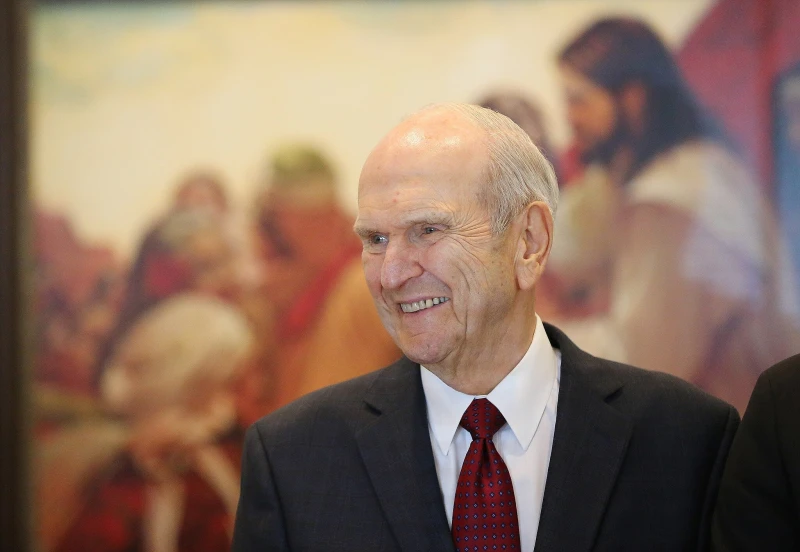
Portrait of Russell M. Nelson, 17th president of the the Church of Jesus Christ of Latter-day Saints. / Credit: Deseret News, CC BY-SA 4.0 via Wikimedia Commons
Washington, D.C. Newsroom, Oct 1, 2025 / 18:37 pm (CNA).
A small Catholic church in Heber City, Utah, will offer a Mass for the repose of the soul of Russell M. Nelson, the president of the Church of Jesus Christ of Latter-day Saints (LDS), who died on Sept. 27 at the age of 101.
St. Lawrence Catholic Church, a mission church of St. Mary’s in Park City, will celebrate the Mass at 9:30 a.m. on Thursday, Oct. 2. The community will pray a rosary for the repose of his soul at 8:45 a.m. before the weekday Mass begins.
Catholics offer prayers for the dead to ask God to grant graces to the recently deceased for the purification of their souls, which may not be complete at the moment of the person’s death.
The church extended an “open invitation” to everyone in the Heber Valley community to attend the Mass in a message posted to Facebook. It is open to any person who wants to join in prayer for Nelson, “especially our LDS neighbors,” according to the post.
“We are grateful for President Nelson’s kindness to the Catholic community especially in Utah,” the post read. “Over the years, he has led efforts to support our Catholic charity work as well as renovation projects at the Cathedral of the Madeleine — our mother church for the Diocese of Salt Lake City.”
Justin Hibbard, the mission administrator and director of evangelization at St. Mary’s, told CNA the Catholic community in Heber Valley has a “great relationship with our LDS neighbors here.”
He noted the area is predominantly LDS, and nearby congregations have volunteered to help with Catholic service projects. He said he suggested a Mass for the repose of the soul of Nelson to St. Mary’s pastor, Father Arokia Dass David, who felt it would be “a great way to show solidarity to our community and be good neighbors to our Mormon friends.”
“These are the types of things our community needs to bring us together and to do things together as a broader faith community,” Hibbard added.
Hibbard said he expects one of Nelson’s daughters to attend the Mass. He said the church will have rosaries and handouts explaining how to pray the rosary for non-Catholics who attend the Mass and are unfamiliar with the prayers. He said a member of a local LDS ward reached out to him to request materials to “help people with praying the rosary.”
The church has enough pews for about 130 people. Hibbard said the weekday morning Masses usually get about 25 to 30 people, but he expects a much larger number on Thursday because of the LDS members who are likely to be in attendance.
Father Christopher Gray, the rector of the Cathedral of the Madeleine in Salt Lake City, said in a statement that he thanks Nelson and the LDS community for the support for the cathedral in recent years and expressed sorrow for his death.
“As the mother church for Catholics in Utah, the Cathedral of the Madeleine joins the world in mourning the passing of President Russell M. Nelson,” he said in a post on Facebook. “We offer our condolences to our brothers and sisters of the Church of Jesus Christ of Latter-day Saints.”
Gray noted that Nelson offered his condolences when Pope Francis died earlier this year. Gray added: “With a heavy heart, I express my gratitude for [Nelson’s] lifetime of dedication, faith, and service, and I thank our LDS neighbors for generously sharing his teaching with us.”
Nelson met Francis at the Vatican in 2019, which was the first-ever meeting between a pope and an LDS president.
Gray told CNA he is “tremendously grateful for the charitable work of the [LDS] throughout the world, and the many ways it interfaces with the work of Catholic organizations like Catholic Relief Services.”
“In Utah, we work together closely and are grateful to the LDS members who, under the leadership of President Nelson, have so powerfully witnessed to the dignity of all people by working with the Diocese of Salt Lake City’s Catholic Community Services,” he said. “We are united in meaningfully assisting the poor, the afflicted, the refugees, and others in need here in Utah, and this same spirit can be seen at work around the world.”
If you value the news and views Catholic World Report provides, please consider donating to support our efforts. Your contribution will help us continue to make CWR available to all readers worldwide for free, without a subscription. Thank you for your generosity!
Click here for more information on donating to CWR. Click here to sign up for our newsletter.
Washington D.C., Apr 12, 2019 / 01:00 pm (CNA).- Former NFL player turned megachurch pastor Derwin Gray has spoken about how his church’s support of a pregnancy resource center was inspired by his own mother’s decision to choose life. Derwi… […]
Pope Francis meets with the United States bishops at St. Matthew’s Cathedral in Washington, D.C., on Sept. 23, 2015. / Credit: L’Osservatore Romano
CNA Staff, Apr 22, 2025 / 07:00 am (CNA).
Pope Francis, who died on April 21 at the age of 88, visited the United States just once, nearly 10 years ago, in September 2015.
Despite the brevity of the visit, he accomplished a lot: Attracting hundreds of thousands of participants, he canonized a new saint (St. Junípero Serra), became the first pope to ever address a joint session of Congress, and galvanized the U.S. Catholic community with his presence and his speeches on the East Coast.
Washington, D.C.
Pope Francis began his tour of North America with several days in Cuba. Landing in Washington, D.C., on Sept. 22, 2015, Pope Francis met with President Barack Obama first thing the next morning. The meeting came amid a time of concerns for many American Catholics regarding politics, including the Obama administration’s contraceptive mandate and the recent legalization of same-sex marriage nationwide, via the June 2015 Supreme Court decision in Obergefell v. Hodges.
Pope Francis is greeted by President Barack Obama on Sept. 22, 2015. Credit: Somodevilla/Getty Images
During the presidential meeting, Francis praised Obama’s commitment to inclusivity and noted that American Catholics have contributed greatly to building a tolerant and inclusive society while also stressing that religious liberty “remains one of America’s most precious possessions.” He also encouraged commitment to addressing the “urgent” issue of climate change, building on his expansive 2015 encyclical on the environment, Laudato Si’.
Pope Francis says Mass for clergy and religious in Philadelphia’s Cathedral Basilica of Sts. Peter and Paul, Sept. 26, 2015. Credit: L’Osservatore Romano.
While in D.C., that same day, the pope addressed bishops and priests at the Cathedral of St. Matthew the Apostle and later celebrated Mass at the Basilica of the National Shrine of the Immaculate Conception. At the latter Mass, he celebrated the first canonization on American soil by declaring Junípero Serra, who founded missions along present-day California, a saint.
“He was the embodiment of ‘a Church which goes forth,’ a Church which sets out to bring everywhere the reconciling tenderness of God,” the pope said.
Crowds gather for the Mass canonizing St. Junipero Serra at the Basilica of the National Shrine of the Immaculate Conception in Washington, D.C., on Sept. 23, 2015. Credit: Alan Holdren/CNA
On the same day, Francis made an unscheduled stop to visit with the Little Sisters of the Poor in Washington, D.C., to support the sisters as they awaited word on whether or not the Supreme Court will hear their case against the federal contraception mandate. (The sisters are still fighting aspects of the mandate, even after more than 14 years in court.)
Pope Francis greets Sister Marie Mathilde, 102 years old, at the Jeanne Jugan Residence in Washington, D.C., Sept. 23, 2015. Credit: Photo courtesy of the Little Sisters of the Poor
Francis addressed a joint session of Congress the next day, Sept. 24, making him the first pope to ever to do so. During his lengthy speech, he condemned the arms trade and the death penalty — statements that reportedly made some lawmakers in the room squirm.
Francis went on to assert that the family was being threatened like never before and praised American figures, including Abraham Lincoln and Martin Luther King Jr., for their tireless efforts to defend freedom and moral values. He also touched on respect for human life and the environment in the well-received speech.
Pope Francis speaks to the U.S. Congress in Washington, D.C., on Sept. 24, 2015. Credit: L’Osservatore Romano
The pope also visited St. Patrick Parish and met with people experiencing homelessness at Catholic Charities, addressing people who minister to the poor. He offered St. Joseph as their patron and model, because, he said, St. Joseph grappled with injustice and suffering in his care for Mary and Jesus.
“The Son of God came into this world as a homeless person,” the pope said. “The Son of God knew what it was to start life without a roof over his head.”
“We can find no social or moral justification, no justification whatsoever, for lack of housing. There are many unjust situations, but we know that God is suffering with us, experiencing them at our side. He does not abandon us.”
Controversially, while in D.C. Pope Francis met with Kim Davis, a Kentucky county clerk who had become a cultural lightning rod for refusing to issue same-sex marriage licenses. The pope reportedly told her to “stay strong,” offering rosaries to Davis and her husband. The Vatican later clarified that Francis met with Davis and her husband as part of a large group invited by the nunciature, with the Vatican spokesperson adding that the pope “did not enter into the details” of her situation.
New York City
After flying to New York City the evening of Sept. 24 and praying vespers at St. Patrick’s Cathedral in Manhattan, Francis addressed the United Nations General Assembly the next day, Sept. 25, the fifth time a pope had addressed the body.
The pontiff issued a call to the countries of the world to reject what he called “ideological colonization” — the “imposition of anomalous models and lifestyles which are alien to people’s identity and, in the end, irresponsible.”
Pope Francis’ historic address to the U.N. in New York City on Sept. 25, 2015. Credit: Alan Holdren/CNA
Like his predecessor, Benedict XVI, Pope Francis made a solemn visit with other religious leaders to Ground Zero, the site of the 9/11 attacks, later on Sept. 25. He met with families of first responders, saying at the site museum that acts of destruction always have “a face, a concrete story, names.” He offered a “prayer of remembrance” for all those killed that day, along with a prayer for the survivors and those who are mourning the loss of their loved ones.
Pope Francis speaks during an interreligious prayer service at Ground Zero, Sept. 25, 2015. Credit: Addie Mena/CNA
Later that day, after visiting Our Lady, Queen of the Angels School in the Harlem neighborhood of New York City, Francis celebrated Mass at Madison Square Garden. He encouraged people to remember those in the city who are often forgotten, including “foreigners, the children who go without schooling, those deprived of medical insurance, the homeless, the forgotten elderly.”
Madison Square Garden prepares for the papal Mass, Sept. 25, 2015. Credit: Alan Holdren/CNA
“Knowing that Jesus still walks our streets, that he is part of the lives of his people, that he is involved with us in one vast history of salvation, fills us with hope. A hope which liberates us from the forces pushing us to isolation and lack of concern for the lives of others, for the life of our city,” the pope said.
“A hope which frees us from empty ‘connections,’ from abstract analyses, or sensationalist routines. A hope which is unafraid of involvement, which acts as a leaven wherever we happen to live and work. A hope which makes us see, even in the midst of smog, the presence of God as he continues to walk the streets of our city.”
Philadelphia
Pope Francis’ visit included an appearance at the 2015 World Meeting of Families (WMF) in Philadelphia, an event that focuses on celebrating the gift of the family.
Pope Francis at the World Meeting of Families in Philadelphia on Sept. 26, 2015. Credit: L’Osservatore Romano
After flying to the “City of Brotherly Love” the morning of Sept. 26, Pope Francis took part in a Mass for clergy and religious at Philadelphia’s Cathedral Basilica of Sts. Peter and Paul. In his homily address, the pope challenged the clergy and religious to inspire new vocations.
He called for women to take on a greater role in the Church, highlighting the example of St. Katharine Drexel — a Philadelphia native — and he reminded the priests and religious present of their role in ministering to families, couples preparing for marriage, and young people.
He later addressed a crowd of some 50,000 people at Independence Mall, the site of Independence Hall and the Liberty Bell, for a religious freedom rally with Hispanic and other immigrants.
Speaking to thousands of families gathered on the Benjamin Franklin Parkway in Philadelphia that night, a visibly moved Pope Francis ditched his prepared remarks and instead gave an impromptu reflection on the beauty and dire importance of family life. He voiced his thanks at “the presence of all of you — who are a real witness that it’s worth being a family!” A society “is strong, solid, and edified on beauty, goodness, and truth,” he added.
Pope Francis addresses the Festival of Families in Philadelphia on Sept. 26, 2015. Credit: EWTN
On Sept. 27, the next day, Francis had an unscripted meeting with five abuse survivors — three women and two men — all of whom had been abused in childhood either by members of the clergy, family members, or educators. He promised accountability for perpetrators and expressed sorrow for the victims’ suffering.
In the face of such heinous acts as sexual abuse, “God cries,” he said, adding that “the criminal sins of the abuse of minors can’t be kept in silence any longer … I promise, with the vigilance of the Church, to protect minors and I promise [that] all of those responsible will be held accountable.”
He told a gathering of international bishops afterward that the survivors’ stories of suffering “have aggravated my heart” and said that crimes of abuse must never be kept in silence.
Later that morning, Francis visited a Philadelphia correctional facility, saying at the meeting with a group of 100 inmates and their families that every person is marked and bruised by life, but Jesus washes away our sins and invites us to live a full life.
Pope Francis embraces a man at Curran-Fromhold Correction Facility in Philadelphia on Sept. 27, 2015. Credit: EWTN
Reflecting on the trip, the Holy Father said it was “particularly moving for me to canonize St. Junípero Serra, who reminds us all of our call to be missionary disciples.”
He added that he was touched “to stand with my brothers and sisters of other religions at Ground Zero, that place which speaks so powerfully of the mystery of evil. Yet we know with certainty that evil never has the last word, and that, in God’s merciful plan, love and peace triumph over all.”
Furthermore, he promised his prayers for the U.S. people, saying: “This land has been blessed with tremendous gifts and opportunities. I pray that you may all be good and generous stewards of the human and material resources entrusted to you.”
“I thank the Lord that I was able to witness the faith of God’s people in this country, as manifested in our moments of prayer together and evidenced in so many works of charity.”
Concluding, he asked those present: “Do not let your enthusiasm for Jesus, his Church, our families, and the broader family of society run dry.”
“May our days together bear fruit that will last, generosity and care for others that will endure!” he said. “Just as we have received so much from God — gifts freely given us, and not of our own making — so let us freely give to others in return.”
CNA Staff, Nov 17, 2020 / 03:01 pm (CNA).- While the Bishop of Tyler asserted Monday that the coronavirus vaccine being developed by Moderna “is not morally produced”, the National Catholic Bioethics Center and the Charlotte Lozier Institute have indicated it is ethical.
Bishop Joseph Strickland tweeted Nov. 16 that “Unborn children died in abortions and then their bodies were used as ‘laboratory specimens’. I urge all who believe in the sanctity of life to reject a vaccine which has been produced immorally.”
Moderna vaccine is not morally produced. Unborn children died in abortions and then their bodies were used as “laboratory specimens”. I urge all who believe in the sanctity of life to reject a vaccine which has been produced immorally.
But the Charlotte Lozier Institute, research arm of the pro-life Susan B. Anthony List, has listed the Moderna vaccine among the “ethically uncontroversial CoV-19 vaccine programs.”
Moderna recently announced that a trial of its vaccine demonstrated it to be 94.5% effective. The trial involved 30,000 people, half of whom were given two doses of the vaccine, and half a placebo.
In the trial, 95 people developed symptoms of Covid-19; five of them had received the vaccine, while 90 had received the placebo. None of those vaccinated developed severe cases of the disease.
The company plans to apply soon for approval to use the vaccine in the US.
Moderna’s vaccine is based on the virus’ RNA, and uses a spike protein, or peplomer, from SARS-CoV-2 rather than cell lines derived from aborted fetuses.
The RNA is injected into the recipient, which induces their cells to produce the spike protein. This triggers the production of antibodies and T cells by the recipient.
Scientists not from Moderna had initially made DNA vectors with the gene sequence of the spike protein, and injected them in HEK-293 cells to produce the spike protein. The HEK 293 cell line is derived from a baby who was aborted in the Netherlands in the 1970s.
The production of the DNA vectors was studied and evaluated by experts at the National Institute of Allergy and Infectious Diseases and the University of Texas, who determined that the spike protein was a good candidate for testing. Moderna was not involved in the DNA construction, nor was it involved in the evaluation of the construction.
Dr. John Brehany, director of institutional relations at the NCBC, told CNA in July that while Moderna thus has some association with the use of cell lines from elective abortions, it is not responsible for that use, and its vaccine was not produced using HEK 293 cells.
He added that the inoculation of the Moderna vaccine “is not based on using cells at all in production.”
The Vatican has said that researchers have a duty to avoid using cell lines derived from aborted children in vaccine production, but that parents can, for serious reasons, use these vaccines for their children if already produced, in the interest of public health, while publicly advocating for an ethical alternative.
Numerous companies are developing coronavirus vaccines.
The vaccines being developed by AstraZeneca and Janssen are produced using abortion-derived cell lines.
Merck, Novavax, and Sanofi are producing vaccines from animal cells, while Inovio Pharmaceuticals is developing a DNA vaccine without the use of cells in its production. The Charlotte Lozier Institute holds these to be ethical permissible.
Like Moderna’s vaccine, Pfizer’s is produced using the coronavirus’ RNA. It recently announced a 90% effectiveness rate from its trial.
Leave a Reply
