
Washington D.C., Dec 31, 2020 / 12:10 pm (CNA).- This article is the second part of Mary Farrow’s two-part series on the Church, gender-critical feminists, and transgender ideology. Part one can be found here.
In their efforts to teach the truth in the face of the transgender ideology, Catholics are finding an unlikely ally: trans-exclusionary, or “gender critical,” feminists, who say the transgender movement hurts women.
But while there are some points of common ground between Catholics and gender critical feminists, there are also important points of disagreement, even on the issue of what gender is.
One point of unity between the Church and trans-exclusionary radical feminists is agreement that the growing transgender movement is especially dangerous to children, who will often outgrow feelings of gender dysphoria naturally, or are led to believe their gender differs from their biological sex simply because they have atypical toy preferences for their biological sex.
“We agree that children should not be subjected to medical experimentation by doctors who profit from ‘affirming’ children, especially girls, in transgender or non-binary identities” in ever-increasing numbers, Mary Rice Hasson, the Kate O’Beirne Fellow in Catholic Studies at the Ethics and Public Policy Center in Washington, D.C. and director of the Catholic Women’s Forum, told CNA.
Kara Dansky, a board member of the Women’s Liberation Front, agreed, telling CNA that children going through the typically-turbulent time of puberty deserve care and guidance, but not medical treatments that could cause them permanent harm.
“A child who is confused about her or his sex definitely deserves compassion and care and guidance to understanding that they’re not born in the wrong body. Their body is fine just the way that it is (barring physical, medical ailments that should be treated appropriately), but we’re all born in the bodies that we’re born in,” she said.
“And we need to learn how to love ourselves physically and emotionally,” Dansky added. “So any child who is struggling to figure out what sex they are really needs caring, compassion and concern and guidance, but not sterilization and mutilation.”
Hasson said she hopes parents are aware of how the growing transgender movement is “radically reshaping how our children understand themselves and others, in ways that are incompatible with Christian beliefs. We need to be compassionate and kind to those who embrace transgender ideology, but we must be wise, and educate and guard ourselves – and our children- against the lies it proposes.”
On Causes, churches, and homophobia
On the causes of transgenderism, feminists and Catholics have both points of agreement and of disagreement.
Feminist Mary Kate Fain, who grew up in a conservative Evangelical church and community, said she thinks that in some cases, an overly rigid take on gender roles has contributed to the rise in the transgender phenomenon. For example, she said that feminists have long fought the gender norm that the only way to be a woman is to desire to stay home, cook in the kitchen, and raise children.
Feminists have argued that women can partake in any role in society that she wishes, Fain said.
But today, she said, a pervasive social message has become: “If you want to stay at home, work in the kitchen, and be feminine, have children, then you must be a woman. And therefore, if you don’t want to do any combination of these things, you must not be a woman.”
Fain also said that from her perspective, some communities with rigid gender roles also speak about homosexuality in particularly negative or disparaging ways. That can lead children in these communities who experience same-sex attractions to believe they were born in the wrong body, Fain believes.
She added that she has friends from such communities who, upon experiencing same-sex attractions, choose to identify as transgender or non-binary (neither male nor female), rather than face the stigma of identifying as gay or lesbian.
“We’re seeing this new ‘trans-the-gay-away’ movement happening, and people think that it’s progressive, when in reality this is happening in some of the most conservative areas across the globe,” Fain said.
“It’s happening in Iran where the government outlaws homosexuality on pain of death, but they’re paying for homosexual people to transition in order to no longer be gay. Then we see it in the United States, where the most red states are where you have the highest rates of transgenderism, and it’s no wonder that this is deeply linked to homophobia,” Fain said.
But Hasson cautioned against the assertion that homophobia in Christian and conservative churches is a significant contributor to the rise in transgenderism in youth. She said the assumption that most Christian churches with a biblical view of homosexuality are homophobic is unfair.
“I can’t speak to the views of ‘conservative’ or ‘evangelical’ churches as such. But I can say that those who adhere to biblical morality, like Catholics who adhere to Catholic teaching, are frequently charged with being ‘homophobic’ because they believe that homosexual sexual activity is wrong, or that the homosexual inclination is not what God intended, because sexual desire should be ‘ordered’ rightly towards the opposite sex,” Hasson said.
“So there’s an unfortunate tendency for those who identify as gay or lesbian to cry ‘homophobia’ when a Church teaches against same-sex sexual relationships or behavior,” she noted.
Hasson said most churches today that teach a biblical view of sexuality do so with the distinction of the action and the person. – the Church’s rejection of homosexual acts is not a rejection of the person, but of the act of sexual relations outside of marriage, which the Church holds is only possible between a man and a woman.
“But there are a significant number, including Catholic churches, that rightly reject the expression of sexuality towards a same-sex partner (which is always outside of marriage, as understood by the Church). We need to push back on the left’s talking point that Catholic teaching is by definition ‘homophobic.’”
Furthermore, Hasson said, she doubts the assertion because Christian parents by and large would not prefer that their children be transgender instead of homosexual, as both transgenderism and homosexuality go against God’s plan for human sexuality.
“…conservative churches and evangelicals who are against homosexual behavior are generally not going to accept assertions of a trans-identity,” Hasson said.
“They both involve deviations from God’s explicit design, plus no parent would prefer a trans-identity over a same-sex attraction issue with a child, given the chemical castration and surgical interventions that are becoming commonplace ‘treatments’ for identity confusion.”
Hasson acknowledged that there are some fringe Christian communities that could be perpetuating truly homophobic attitudes. She also added that she is aware of a small subculture of Catholics who hold overly-rigid gender roles, such as that women shouldn’t wear pants and are not capable or fit to hold jobs outside the home.
“I think it’s not healthy when someone does that and that strain of Catholicism is nothing new,” Hasson said, though she added that the sliver of truth there is that there is a different between men and women, and there are certain social cues used to distinguish between men and women that vary from culture to culture.
“Within that narrow slice, my sense is that someone who’s growing up and feels constrained, if they feel some sort of weight of conscience like – ‘Oh, my gosh. I’m being a terrible woman,’ – they’re also going to be getting a message that there are men or women,” Hasson said.
She said she didn’t necessarily see how someone who failed to fit into rigid gender stereotypes would then assume that they were actually a different biological sex.
“The most fundamental thing is whether you are a female, and that just doesn’t change,” she said.
“And the fact that someone has put you in a box as to how to express that, it would take quite a leap of logic or something to talk that around and say, ‘Oh, that means I must be the opposite sex,’ when everything else that you would be taught in that same environment would say, ‘No, you are one sex or another.’ And your body tells you that. And science tells you that.”
First-person voices
A growing number of people who were given medical treatments to transition their gender, and then regretted it, are now speaking out against the push to medically treat minors with gender dysphoria.
Keira Bell, a 23 year-old woman in the UK, has recently joined a lawsuit against the gender clinic that began her gender transition when she was 16 and wanted to be a male.
At 16, Bell was given hormone blockers to stunt her development as a female, and then was given male hormones. Bell said the treatments gave her symptoms of menopause, depleted her sex drive and weakened her bones, and may have rendered her infertile. At the age of 20, the National Health Service paid for a surgery that removed her breasts, the Daily Mail reported.
It was not long after the surgery that Bell started to question her gender transition. She told the Daily Mail that she felt “stuck” between male and female, and that she didn’t feel she fit with either gender. At the age of 22, she decided to detransition back to female, and to fight giving such treatments to other young people. She said she felt like a “guinea pig” that was experimented on by the gender clinic, without much thought given as to how the treatments would affect her life in the long-term.
Bell is now considered a key witness in a high-profile case against Tavistock and Portman NHS Foundation Trust, which runs the gender clinic where she had gone for treatments. The lawsuit was brought against the clinic by a psychiatric nurse formerly employed at the clinic, who is arguing in the suit that children are not capable of consenting to the powerful and experimental puberty blockers and hormones being prescribed to them.
Bell is just one of many people – many of them women – who are speaking out after having gone through experimental gender transitioning treatments as minors and who are now in the process of detransitioning.
Charlie Evans, a 28 year-old woman living in the UK, is in the process of detransitioning after identifying as trans since her teenage years. After sharing her story, Evans was contacted by so many men and women who regretted their gender transitions that she was inspired to found The Detransition Advocacy Network, a non-profit that seeks to support men and women who regret their gender transitions.
Evans told The Telegraph that she attributes her own desire to transition as a young person to abuse that she suffered outside of her family, that made her hate her own body so much that she wanted to cut parts of it off. That experience seems to be common among the people who contact her Detransition network, she added.
“…you can’t be born in the wrong body – it’s our minds that need treatment, not our sex,” Evans said.
This article was originally published on CNA Feb. 13, 2020.

[…]




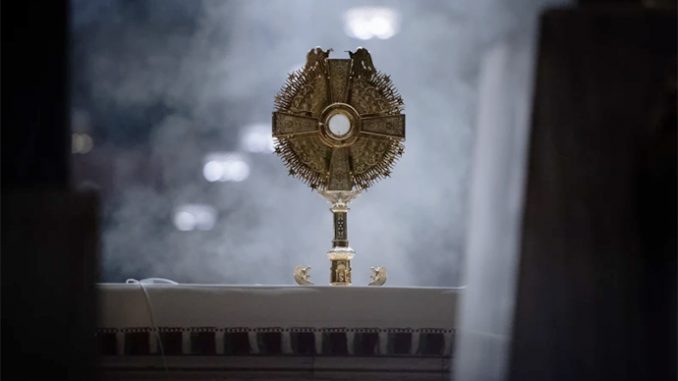


From personal ‘lived’ experience when first considering a spiritual life it was the Trappist Abbey Our Lady of the Genesee [now sadly Genesee Abbey speaks for itself] the monks offered Mass in the simplest of settings in their temporary dwelling while the Abbey was being constructed – in accord with the ancient rite. It was the most spiritual, beautiful liturgical experience.
It was then that my sense of Christ’s presence deepened. Although by the time many years later ordained when the Novus Ordo was the rule, I previously had the great privilege of attending Mass at Precious Blood Monastery in Brooklyn offered by Msgr Joseph B Frey, Director of the Confraternity of the Precious Blood that included, with the printing of religious inspired books the Adorers of the Precious Blood.
In 1910, the Precious Blood Monastery in Brooklyn NY became the home of the Sisters Adorers of the Precious Blood which was founded by Mother Catherine Aurelia of the Precious Blood [Aurelia Caouette] in 1861 in Quebec, Canada. Back to Msgr Frey, who loved the TLM and wrote a book called My Mass.
When the changes came Msgr Frey conveyed the same joyous love of the Mass. His movements and tone conveyed holiness, awareness of Christ’s presence. Although that all began with the TLM.
Every Catholic worthy of the name should envy you the beautiful spiritual heritage you have known. I will search for Msgr. Frey’s book. Thank you for commenting, Father Morello.l
Asante Sana Sarah.
We had a Precious Blood order priest serving our Southern parish years ago. He got recalled back to wherever the order’s home base was. Ohio maybe?
Father related back then that the only way he got a new pair of shoes was when another priest had died-assuming the shoes fit. Perhaps they had a supply of deceased priest’s shoes on hand. Who knows?
I presume, then, that those Catholics who do not believe in the Real Presence think that what they’re receiving is merely a piece of bread. They really are fools then, since the bread is very lousy bread indeed. I could point them to any number of bakeries that make far superior bread. And, if that’s the case, just stay home and don’t bother to go to church at all. Better yet, get yourself to Dunkin Donuts on Sunday morning for some superb pastries.
I agree totally with this! Absolutely more enjoyable to go purchase a dozen donuts for the family from Dunkin’, then go home with the treats and relax with the Sunday paper in an easy chair. Why go to church to eat a wafer that has no taste and no meaning!
Krispy Kreme, please Deacon Edward…
🙂
My apologies to the KK faction for showing partiality to DD
Disbelief in the Real Presence is symptomtic of the doubts spread by Modernists concerning 2 other questions:
1) Was Jesus just a man good man like any other religious leader, or is He the Christ?
2) Was the resurrection a collective symbolic cŕeation or did Jesus historically rise from the dead?
The correlation between disbelief in the divinity of Christ and His historical resurrection and disbelief in the Real Presence would probably be a perfect match.
Otherwise put, this is not just about Latin Mass and receiving on the tongue.
This is about a crisis in dogmatic preaching and basic catechism about the second person of the Blessed Trinity.
We might conclude, those in contact with priests formed traditionally have more likelihood of developing Real-Deal Catholic Faith.
Those in contact with Vatican II liberals / who listened to Pope Francis’ relativist ramblings have less likelihood of developing the Real-Deal Catholic Faith. They remain nominally Catholic with the potential to develop the Catholic Faith if brought into contact with it.
Conclusion: without the Traditional wing of the Catholic Church, all that remains of Catholicism is a heritage show at different stages of being emptied of the faith.
Mr. Cracked Nut, I generally agree with your sentiment: it seems obvious to me that if you don’t accept Jesus as God, it’s going to be very difficult to accept that same Man can become present in the Eucharist some 2000 years after his death. To that end, I think you’re spot on about Catechesis. I’m not so sure, however, that a view of Church that divides participants into either the “modernists” or the “traditionalists” is a helpful distinction. Tradition itself only carries weight in so far as the Magisterium asserts its Goodness. By necessity, an Ecumenical Counsel is always traditional. So to attempt to divide the Church into “Vatican II Liberals” in opposition to, I suppose (and forgive the license I’m about to take if it’s not what you mean), “Pre-conciliar Traditionalists” seems to be an unhelpful dichotomy. Perhaps a more useful distinction are orthodox Catholics as opposed to unorthodox Catholics.
Dear James,
Thank you for the correction, brother in Christ. Your suggestion of Orthodox/heterodox is a gôod one, but perhaps the term “Post-Conciliarists” and not “Vatican II liberals” would have been better? Since the implementation of the Spirit of the Council bears little ressemblence to the council texts.
The problem being the preconceived ambiguities that were planted therein by the political-scheming enemies of Holy Mother Church.
PpBXVI claimed that the real council had yet to be discovered. Where there is hope, there is a way?
But the devastated vineyard is in a State of Decay, as attested to herein.
What characterises those persecuting the SUMMORUM PONTIFICUM TLM is a spirit that stands in opposition that great light in the darkness that was ppBXVI, and therefore the True Council of Vatican II of which he spoke and upon which he acted by signing SUMMORUM PONTIFICUM on 07.07.2007.
Anyone who has seen 07.07.07 on a tabernacle knows it stands for God’s holy name. The path to discovering the True Council is the restoration of SUMMORUM PONTIFICUM rather than Post-Conciliarism?
Howdy Mr. Cracked Nut,
I think the biggest problem with people understanding the landscape of Catholicism in the United States post-Vatican II is an over-simplistic characterization of the movements of various groups before and after the Council. No question that the implementation of the Council was mostly spearheaded in the US by those who claimed the “Spirit of the Council” (who were mostly of a group later called Concilium). This group believed the changes of Vatican II to be a “rupture” with the past – and it’s this group that, mostly, millennials and zoomers are pushing against by seeking a return to a more Scholastic (pre-conciliar) model of Catholicism.
The problem is that neither the Concilium or Scholastic vision of Vatican II really capture what the Council teaches. There is a authentic path to adopt the Council – and it’s the path of Communio theology which stands in continuity with the pre-Conciliar church while still embracing the teaching of the Council. The teachings of Communio are Traditional for this very reason, including embracing the Ordinary Form of the mass (Pope Benedict was of this ilk, btw, despite also bristling at the liturgical abuses implemented mostly by Concilium folks).
All that to say, there is a more nuanced way of looking at the Church’s growth and development that I find very hopeful for where we’re headed in the next pontificate. I could say much more on this topic; but suffice it to say, there is a way to approach the Sacramental Life of the Church with reverence that is consistent with the Council, and I think we’re just coming to the moment where the Church is ready to try it.
Peace,
James
Dear James,
If I may:
“I think we’re just coming to the moment where the Church is ready to try it [reverence].”
Why for 60 years was it possible to try out anything except Sacred Tradition?
What ppBXVI did with SUMMORUM PONTIFICUM 2007-2021 was to try the tried and tested! And normal Catholicism was working so well the meanies shut it down.
Traditionis Custodes was implemented with “an over simplistic characterisation” that too many Catholic faithful were being attracted to tradition and consequently questioning the validity of the last 60 years of Post-Conciliarism. Perish the thought.
We can only pray that the wisdom of ppBXVI will provide an impetus for the Church to exit the Post-Conciliar impasse of tearing-down Catholicism.
A restoration of SUMMORUM PONTIFICUM would be the logical first step towards rediscovering the Catholic Church of the Council: the Catholic Religion as taught and lived ad33-1962. Without it, what use is there in the council texts which issued from and adressed the Catholic Religion and not a Post-Conciliar heritage show busy building the freemasonic brotherhood of man?
But what is cause here, and what is effect? Does belief in the real presence lead one to prefer these liturgical practices, or does participation in these liturgical practices lead one to believe in the real presence? This is a distinction of some importance.
Faith, good works…good works, faith.
Perhaps a little bit of both, one fuels the other.
Going back to the tradition of capitalizing Body and Blood and Real Prescence and His and Him will go a long way to realizing the True Prescence of Jesus in the Holy Eucharist too.
Our intellect can allow us to ponder variable descriptions of the Eucharist, and how it should be presented and maintained. But in simplicity, it is the body of Christ, and the absolute essence of the Catholic Mass, and of our faith. At my last duty station in the Navy, I finally became Catholic. My first communion was sort of a miracle in a sense. My Navy duty watches were draining: two eve watches (4PM-12AM), 8 hours later, two day watches (8AM-4PM), 8 hours later, two midnight watches (12AM-8AM). My last midnight watch ended on a Sunday (I was baptized between my two eve watches), and now I was eligible to receive the Eucharist at Mass. However, the last midnight watch was the most frantic, and hectic watch I ever served. We detected 13 Soviet submarines, 18 miles offshore; up and down the East coast (each submarine had 19 nuclear armed missiles). In the Mediterranean, three Soviet ships deliberately bumped into our ships. And China suddenly had 3 army divisions situated at their closest land point to Taiwan. And my duty station was handling and forwarding a ton of messages concerning these specific issues. When the shift was over, I just wanted to get a ton of sleep. But I also wanted to attend Mass. At Mass, I was quite dreary and drained. When it came time for Communion, I dragged myself up to receive the Eucharist. After I received the Eucharist, I took 3 steps, and then suddenly every cell in my body exploded with energy. So after Mass, I drove the 3 hour drive to my parent’s house. I entered the foyer, closed the door, and then suddenly, every ounce of energy left me. I was confused, and wondered what happened. Then I remembered that this all started when I received the Eucharist. At that point, Jesus spoke directly to me: “IT IS my body, always treat it with reverence and respect”. It wasn’t something in my mind, but what I physically heard with my ears. The Eucharist is simply a miracle every time we receive it. That is really the only concern we should have about it.
This certainly is interesting research; but I wonder if it goes far enough to really identify what’s going on. Most people whom I know who attend the Extraordinary Form of the Latin Rite attend because they’re seeking it out – not necessarily because they’ve been going to it their whole lives. Even in the case of this paper, they’ve indicated that the average age of those attending the EF is around 49 years old, which is older than the typical sample. Given Vatican II having occurred some 60 years ago, I’d assume its far more likely for anyone born after the Counsel to have sought out the EF rather than being raised attending it.
For the record, I certainly think that utilizing all the sacramentals, gestures, praying in Latin during the sacred liturgy, and fostering easy access to Adoration asserts our collective belief in what we’re saying we’re doing (receiving Jesus in the Word and Eucharist) at our parishes and, broadly speaking, reminds congregants/parishioners of the Truth of what we practice at Mass. At the same time, I’m not convinced that correlation necessarily equals causation in all of the tested-for practices. If you really want to know what’s happening in mainstream America, I’d want to see what the data say after you remove those who attend a parish that exclusively offers the EF of the Latin Rite.
The beauty of the whole thing is the validity of the sacrament is that it is not dependent on either the moral status or the beliefs of the celebrant. If he was validly ordained and uses the correct lectionary, the sacrament is valid. At the same time it is not necessary to believe in order to receive grace from reception of the sacrament. Myself being unable to get my head around the whole idea of transubstantiation, I take great comfort in a saying sometimes attributed to Queen Elizabeth I of England – “ His were the words that spake it ( the consecration) His were the hands that brake it ( the bread ) what His word does make it, I accept take it”. In this way I don’t need to know exactly what happened, but I can will to accept it in the fullest measure that Christ means it to be. Even a doubting Thomas can receive in good faith! Praise God!
This survey should not come as a surprise. The new mass teaches a Protestant understanding of the Eucharist, so after 50 years the we have the majority of Catholics with a confused understanding of our faith.
If I may: in your article you have made the following statement: “Five indicated that person is “certain that Jesus is really present in the bread and wine of the Eucharist.”
I have a problem with the phrase “in the bread and wine of the Eucharist”. Using the word “in” implies that the substance of bread still exists! My understanding of ‘transubstantiation’ is that the bread, despite appearances, ceases to exist and the substance of bread is completely changed into the Body, Blood, Soul, and Divinity of Jesus the Christ.
From my very limited understanding, it is the Anglican/Episcopalian belief of “Consubstantiation” that the Body of Christ co-exists in the ‘consecrated bread”. I could be totally wrong.
As an aside: the phrase “Jesus is present in the Blessed Sacrament” is also somewhat misleading… Jesus is the Blessed Sacrament and the Blessed Sacrament is Jesus, totally and completely!
Our English language is very deficient to explain and present the mysteries of our Faith.