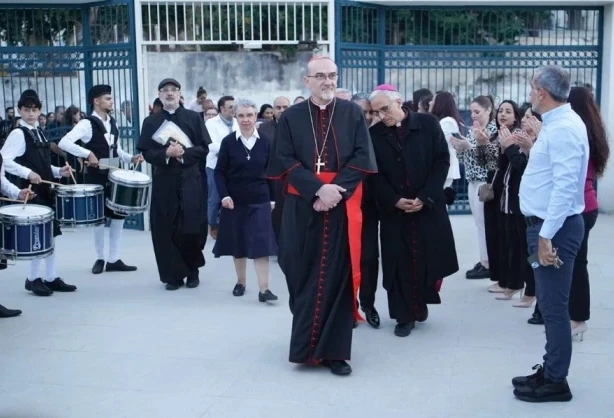
Cardinal Pierbattista Pizzaballa visits a kindergarten in Haifa. / Credit: Latin Patriarchate of Jerusalem
ACI Prensa Staff, Sep 17, 2025 / 15:44 pm (CNA).
The Latin Patriarchate of Jerusalem has decided to forgive the school debts of all families in the diocese for the school years prior to the Jubilee of Hope as a gesture “to promote and demand justice, equity, and, above all, solidarity.”
The patriarchate is the Latin-rite Catholic diocese based in Jerusalem, reestablished in 1847 by Pope Pius IX. Its ecclesiastical jurisdiction encompasses Israel, Palestine, Jordan, and Cyprus, serving the Latin Catholic communities present in the Holy Land and these regions of the Middle East.
In a statement, Cardinal Pierbattista Pizzaballa, Latin patriarch of Jerusalem, said the jubilee year “has taken place in a context of violence and war,” which “seems to be increasing evermore.”
The cardinal explained that under the motto “Hope Does Not Disappoint,” Catholics are called “to a special conversion of heart. We are called to return to God, to rediscover our Christian roots and the beauty of our faith.” They are also called to “heal the relationships we have wounded” and to “rediscover the joy of encountering Christ.”
Despite the perilous situation in the region, one that has had “serious consequences for the lives of all our families and institutions,” Pizzaballa said he sees it as an opportunity not to get lost “in petty and short-sighted considerations but to focus on the essentials of life in our relationship with God and in the life of the world.”
Thus in order to give expression to “this desire for change, for renewal, for a return to God and to our brothers and sisters,” the patriarchate has decided to forgive “all debts of all the families to the schools of the Latin Patriarchate for the years prior to the jubilee, that is, up to and excluding the 2024-2025 school year.”
“This was not an easy decision to make because of the costs involved. As you can imagine, the various administrative offices did not fail to raise their legitimate concerns. Nevertheless, we feel it is necessary to make this gesture and to once again trust and rely on God and his providence,” the patriarch wrote.
“We hope that this gesture will make life easier for many of our families in need and help them to regain confidence and hope,” the statement added.
Pizzaballa pointed out that the jubilee is also “a time of responsibility” and that debt forgiveness “means that everyone commits to changing their lives and taking responsibility for their obligations.”
“The forgiveness of these debts therefore does not release anyone from their responsibilities, not even families, in their obligations to schools. It is a special time that, precisely because it is so, remains a unique moment that involves us as a Church and requires everyone to take their responsibilities seriously,” the patriarch explained.
He therefore asked all school principals to “to implement and communicate this decision immediately to those concerned” and the patriarchate’s administrators to “update our books in accordance with the decision made.”
This story was first published by ACI Prensa, CNA’s Spanish-language news partner. It has been translated and adapted by CNA.
If you value the news and views Catholic World Report provides, please consider donating to support our efforts. Your contribution will help us continue to make CWR available to all readers worldwide for free, without a subscription. Thank you for your generosity!
Click here for more information on donating to CWR. Click here to sign up for our newsletter.
The Catholic bishops in Nigeria’s Onitsha ecclesiastical province have condemned recent attacks in Benue state that reportedly resulted in the death of some 200 people and called for fasting and prayer in honor of the victims. / Credit: Nigeria … […]
Alfred Magero, Matthew Njogu, and Edward Chaleh Nkamanyi are three Catholic fathers from Africa who recently shared insights about being a present dad, protecting their families amid threats to the African family, and being a model of family values for their children with ACI Africa, CNA’s news partner in Africa. / Credit: Photos courtesy of ACI Africa
ACI Africa, Jun 17, 2024 / 12:37 pm (CNA).
On the occasion of Father’s Day 2024, a day focused on the celebration of fatherhood, four Catholic men from different African countries recently shared their experiences of impacting the lives of their children.
The Catholic fathers — who hail from Cameroon, Kenya, and Nigeria — talk about the importance of “being present,” of protecting their families amid threats to the African family, and of being a model of family values for their children, who they believe someday will become parents as well.
Tony Nnachetta, 68: Fatherhood is a full-time enterprise
Tony Nnachetta shares a moment with Pope Francis. The married father of four is a parishioner in the Catholic Archdiocese of Onitsha. Credit: Photo courtesy of ACI Africa
Tony Nnachetta is a married father of four who attends the Church of the Assumption Parish in Nigeria’s Archdiocese of Lagos. Nnachettahas been a parishioner there for 40 years, and he was wed there 38 years ago. A member of the Grand Knights of St. Mulumba, he originally hails from the Archdiocese of Onitsha.
I got married to my friend after we dated for four years. I was looking forward to fatherhood and I was mentally prepared for it. Here are the lessons I have learned along my fatherhood journey.
First, being a father means you watch your children grow and become independent. You watch them get to a point in their lives where they can engage in a debate with you and even disagree with you.
Fatherhood is a long process. You would be fortunate to go through the entire process and maybe see your children’s children. I have seen mine achieve excellence in school and even leave home and go across the world as they sought to become independent.
Wherever your children go, what is important for them is what they take away from home — what they take from mommy and daddy. I have always told mine to “remember the child of who you are.” This means that they are not allowed to break the Christian values in our family.
I taught them to always stand for the truth and never to flow with the tide. We have encouraged them to always say what they mean. These days, they have jokingly turned around the statement and they tell me, “Remember the dad of who you are,” and we laugh about it.
You can’t always be there to take the bullet for them, but you can support them through prayers. Our family relies a lot on the intercession of the saints. We call ourselves a family of Jesuits because the school my children went to is under the patronage of St. Ignatius of Loyola.
Fatherhood is a full-time engagement. It is not like you can be a father in the morning and take a break in the evening. You worry about your children even when they are grown and have left your home. They preoccupy you everywhere. You wonder whether they are warm and if they have had their meal. But all this brings a father immense joy.
Young fathers in Africa are overburdened by poverty. Because of poverty they don’t have a way to help their families. Others are scared to enter the marriage institution. Poverty has made young men weak and helpless. Some are leaving their young families and going to faraway places outside the continent to make a living.
Poverty is eroding family values because some fathers do what they do, including stealing, for their children to survive. In doing so, they are setting a bad example for their children …
It is important for our leaders to confront this situation. They must accept that they have let us down.
Matthew Njogu, 75: Tips on being a present dad
Matthew Njogu is the moderator of the Catholic Men Association at St. Austin’s Msongari Parish of Kenya’s Archdiocese of Nairobi. His children are now adults. Credit: Photo courtesy of ACI Africa
Fathers need to be present in the lives of their children. For a long time, it was assumed that it was the mother’s responsibility to take care of the young children; fathers kept off. But being absent in the lives of your children hurts your relationship with them. They end up growing up without you having any impact on their lives.
Unfortunately, some fathers assume that fatherhood ends at providing material things… They don’t pay attention to their children’s growth milestones. And when they eventually try to establish a connection, they find that the children are already all grown without knowing anything about their fathers.
Simple things like dropping your children off at school help you connect with them. While stuck in traffic on the way to school, you can talk about things that will help you understand your child and for him to know you.
Always try as much as possible to have dinner with your children and help them with schoolwork. And always try to make up for the time you don’t spend with them.
Edward Chaleh Nkamanyi, 53: Raising a Christ-like family
Edward Chaleh Nkamanyia runs a medical college in Doula, Cameroon. He is a father of two, though he tells ACI Africa that he is “a father of many” as he takes care of several orphans and other vulnerable children. Credit: Photo courtesy of ACI Africa
Nkamanyi runs a medical college in Doula, Cameroon. He is a father of two children ages 16 and 20. He tells ACI Africa that he is “a father of many,” as he takes care of several orphans and other vulnerable children. Here are his insights into nurturing a Christ-like family.
It is the joy of every responsible young man to be called “daddy” or “papa.” Having a Christ-like family is the greatest gift for a father; a family like that of Joseph, Mary, and Jesus.
My appeal for Catholic fathers is to hold their families firmly, to provide for them, and to protect them from all dangers in the contemporary society, where values are being eroded.
I don’t believe that being a father is a challenging task. God already gave us the innate potential to be fathers. I believe that God can’t give you a role that you can’t perform.
It is unfortunate that many young men are choosing to be absentee fathers. From what I have seen, many children raised by a single parent end up adopting wayward behaviors.
Alfred Magero, 48: Being a present dad in a low-income setting
Alfred Magero belongs to the Catholic Men’s Association group of St. Joseph the Worker Kangemi Catholic Parish of in the Nairobi Archdiocese. The father of three has been married for 29 years. Credit: Photo courtesy of ACI Africa
Magero belongs to the Catholic Men’s Association group of St. Joseph the Worker Kangemi Parish of the Archdiocese of Nairobi. The father of three has been married for 29 years and shares his experience and that of other Catholic dads raising their children in a low-income neighborhood.
I am raising my children to become God-fearing adults. This is not an easy task in the community in which we live, where there is a lot of poverty, drunkenness, and other characteristics typical of a low-income [neighborhood].
Many fathers rarely interact with their children since their main focus is to provide for their families. They leave for work before their children wake up and come back at night when the children have already gone to bed.
The young men and boys we are raising are experiencing a different environment from ours when we were growing up. With the whole world brought to them on the palm of their hand by a simple tap on the phone, this generation is dangerously exposed. They need us, their fathers, to constantly give them direction. They need us to be their role models.
They need us to constantly remind them that they are in Africa and that they should not adopt alien cultures, especially those bound to destroy the family.
As fathers, we must remind our young ones to uphold African values that kept the family unit and the society glued together. Africans knew the importance of loving and caring for each other. Unfortunately, this value is being eroded, and in its place, now we have individualism. Older men in families would educate young men to be responsible adults. Unfortunately, we no longer have this kind of education.
Mosul, Iraq, Mar 29, 2021 / 05:10 pm (CNA).- A statue of the Virgin Mary that had been desecrated by the Islamic State but was later restored has been returned to its original church.
The statue was decapitated, and its hands cut off, in Karemlesh, a largely Christian town 18 miles east of Mosul, during the Islamic State’s occupation of the villages in the Nineveh Plains from 2014 to 2017. It belongs to St. Adday church.
The statue has been partially restored. The original head was found in the rubble when the statue was recovered.
The head has been placed back onto the statue in a manner that still shows the damage from where it had been decapitated, and the hands dangle below the wrist.
It was present at Pope Francis’ March 7 Mass in Erbil.
The statue returned to Karemlesh March 18, and on March 19 it was placed in St. Adday church with a simple ceremony.
“Having Her here is a sign of courage and bravery for our people. That everyone can see that the destroyed and restored image returns to the church with a new appearance is a beautiful sign. This encourages them to have the courage to continue,” Fr. Thabet Habeb, pastor of St. Adday, told CNA.
He added that “after the Pope’s visit, we hope that there may be some attention to the Chaldean community.”
The Islamic State swept through large swathes of Syria and Iraq in 2014, giving families of Christians and other religious and ethnic minorities an ultimatum – convert to Islam, die, or leave.
In 2017 the Nineveh Plain was liberated from the rule of the Islamic State.
Leave a Reply
