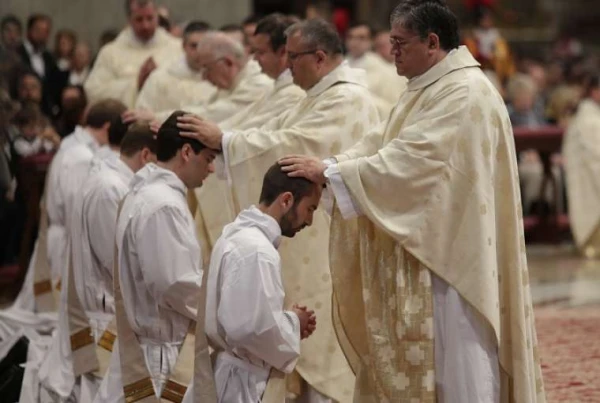
Denver, Colo., Feb 15, 2020 / 04:00 am (CNA).- After the suicide of a Missouri priest last month, psychologists talked with CNA about the issues priests can face when they need help with caring for their mental heatlh.
Fr. Evan Harkins of Kansas City took his own life in late January, leaving parishioners and friends across the country mourning the beloved priest.
Shortly after Harkin’s death, Bishop Vann Johnston of Kansas City-St. Joseph said the priest had a “sunny” personality, but had begun to struggle with anxiety and his physical health.
The bishop said the priest’s decision to end his life might have been connected to his medication.
He said Harkins had developed serious stomach and gastrointestinal issues, which seemed to cause him anxiety.
“He was given a prescription drug to deal with the anxiety and was experiencing some of the extreme negative side effects of this drug including terrible nightmares, among other things,” Johnston explained.
Though the factors leading to his death are no doubt comlicated, the priest’s death has begun a discussion about the mental health needs of priests, and the stigmas that surround them.
Dr. Melinda Moore is a Licensed Psychologist and Assistant Professor in the Department of Psychology at Eastern Kentucky University and has studied Collaborative Assessment and Management of Suicidality (CAMS).
Moore told CNA that suicide prevention steps are incredibly important. She pointed to studies that show how a single individual’s suicide can have a devastating effect that ripples throughout the community.
“We’ve got 48,000 Americans who are dying by suicide every year. … [These are] Americans who are killing themselves and leaving entire families, networks, communities devastated by their deaths. We know that for every person who dies by suicide, there are 135 people exposed. Out of those 135, forty-eight people will be seriously impacted by the death.”
“What we know is these people who are impacted significantly, they have higher rates of depression, anxiety, suicidal ideation, and another study showed suicide attempt. So not only are these 40,000 Americans killing themselves every year, they’re leaving all this collateral damage that amounts to over 2 million people every year,” she said.
Suicide among priests, and pastors of other Christian denominations, occurs more commonly than expected, Moore said. However, she said religious leaders often face stigmas about seeking psychological help.
“Priests are no different from the rest of us. The difference is that priests and other clergy oftentimes are idealized and held to a standard where they feel like they can’t ask for help. They are the individuals that other people come to for help, and so they themselves feel like they can’t seek help.”
Moore said suicide is not always tied to mental illness. But she said people who commit suicide often encounter three feelings – not belonging, being a burden to others, and the sense that that could carry out lethal self-harm.
“They oftentimes feel like they’re a burden, and then they also sometimes feel like they no longer belong to a community that they once belonged to … It’s like they really feel like people would be better off if they weren’t alive, that they are a burden to their loved ones, ” Moore said.
“Lastly, there’s this thing called acquired capability to enact lethal self-harm. It’s sort of a fearlessness in the face of death. It actually takes a lot of courage to kill yourself,” she added.
Dr. Christina Lynch was director of psychological services at St. John Vianney Theological Seminary in Denver from 2007 until she retired about a month ago. Lynch is still a supervising psychologist for the seminary, and is an advisor for the Catholic Psychotherapy Association (CPA), which she previously served as president.
Lynch told CNA that stigmas among priests regarding psychology differ depending on several factors, like location, age, and community. She said counseling may be looked down upon by older generations, noting that millennials are more sympathetic to it.
Lynch also said a sense of shame about getting psychological help may worsen if the priest or seminarian does not view the therapy setting as confidential or safe.
Shame among priests about seeking help gets worse among priests if mental health care is not supported by the bishop or laity. Lynch applauded the decision of Bishop James Conley of Lincoln, who announced in December that he was taking a leave of absence to focus on mental health.
Lynch also said the laity have a unique opportunity to support priests, even through simple actions like inviting them over to dinner.
“If they don’t have support from their bishop, they feel shame or they don’t want to go to counseling. So the support they received from the bishop is really important. I’m sure you read the article by Bishop Conley. I’ve heard from so many priests since then that this just gave them courage.”
“The laity have a role to play with the parish priest. They need to be praying for them, be friends with them. A lot of times laity are afraid to be really friends with their priests … They need to be attentive to their priests and make sure they’re supporting them … The more support a priest is going to get from everybody instead of criticism, the better it is going to be for them.”
Dr. Cynthia Hunt, a Catholic psychologist, is a board advisor for the Catholic Medical Association and has also served as Chief of the Department of Psychiatry at the Community Hospital of the Monterey Peninsula.
Hunt said that stigmas about mental therapy are pervasive among clergy. She highlighted several reasons why priests might consider therapy a difficult process to access.
“There seems to be a shame surrounding the very human need for assistance in the mental health realm,” she said.
“Some difficulties which might bar priests from accessing therapy include their desire for more privacy (not wanting to sit in a waiting room), issues of shame, as noted above, as well as the desire to ‘work things out on their own’.”
“Priests may consider their depression or anxiety a ‘flaw’ in their character. They also may not recognize the severity of their symptoms or realize that there is treatment,” Hunt added.
Hunt said that anxiety and depression can be as common among priests as it is among the general population. She said hereditary traits may contribute to a priest’s emotional issues, and addictions, like alcohol abuse, can exacerbate the problems.
The psychologist highlighted the options that priests can take to address these concerns.
“Priests may obtain therapy from a variety of disciplines including Licensed Clinical Social Workers, Marriage Family Therapists, psychologists, psychiatrists, and other licensed professional counselors. The type of therapy can be tailored to the needs of the priest to include but not limited to psychodynamic Therapy, trauma-informed therapy, cognitive behavioral therapy, interpersonal therapy, and affirmation therapy,” she said.
While rural areas may face a lack of counselors, Hunt noted, there has been an increase in telemedicine, where priests can access therapy through video-platforms.
Hunt said psychological healing is best addressed through a holistic approach – a combination of biological, psychological, social and spiritual efforts. She said that while medication is not always necessary, it can be helpful, especially when coupled with counseling.
However, she added that some medications, like Selective Serotonin Reuptake Inhibitors (SSRIs), have an occasional side effect, and people may continue to have recurring anxiety and depression throughout their life.
“SSRIs improve many symptoms of anxiety and depression through their biochemical action on neurotransmitters such as serotonin and others … With more balance again in the neurotransmitter system, many symptoms improve including but not limited to panic, chronic anxiety levels, low mood, sleep or appetite issues, fatigue, lack of enjoyment of things once enjoyed and suicidal thinking,” she said.
“As with all medications, there can be side effects. In the case of SSRIs these tend to be quite mild and short-lived such as nausea and headache. There are very rare but serious effects which can include increased agitation, restlessness or suicidal thinking.”
In order to address the possibility of suicide among priests, Dr. Moore told CNA that dioceses should focus strongly on education regarding suicide awareness and suicide prevention methods.
She said the topic should be addressed at the pulpit, and dioceses should also make more resources available, including the suicide hotline number and health care professionals. She also said priests should educate themselves through books designed to address their needs. Hunt mentioned “Preventing Suicide: A Handbook for Pastors, Chaplains and Pastoral Counselors” by Karen Mason.
For her part, Moore applauded initiatives the Diocese of Lexington, Kentucky has begun to support suicide prevention and mental health. She the dioceses has provided resources and sought to be more sympathetic to the deceased and their families.
“[I am] very pleased that the Diocese of Lexington, which is led by Bishop John Stowe, has been very much an ally in putting out messages around being attuned and being sensitive to people who are in crisis … but then also those people who’ve lost a loved one to suicide, making sure that the loved one who died is not demonized, and that the loved ones are provided resources.”
Father Anthony Sciarappa, the parochial vicar of Holy Spirit Parish of Lawrence County, Pennsylvania, told CNA about his experience with therapy and mental health. He said, during his first year of seminary, he struggled with anxiety and depression.
“We had lots of events as seminarians where we put on our seminary uniform and we were supposed to meet with people, talk with people and all that was overwhelming. I would be physically, like, ill and sick, just paralyzed with that.”
“I have been suffering from anxiety and depression and I thought that’s just how everyone lives and that was just normal,” he said.
Sciarrappa’s bishop lived at the seminary where he studied. About six months into Scriarappa’s formation, the bishop, having spoken with the seminary faculty, encouraged the young seminarian to enter into therapy.
“When the bishop told me, I think I just started crying and his office right there, because it was just so overwhelming to be faced with the fact that I do need help,” he said.
It was a difficult concept to grasp, he noted, because therapy and mental illness were not topics typically discussed during his childhood. He said, among other stigmas, he considered therapy to be a tool for crazy people.
“I didn’t know anybody who had done this before. It wasn’t something that was ever just talked about in my circles growing up,” he said.
He went to a therapist for about three years. He went back to counseling during major seminary in Washington D.C. He described therapy as both a difficult and valuable process.
During counseling, Sciarappa said, he had to work through “core wounds” and the issues affected by habits learned during childhood. He said, “going through that is really hard work.”
“There were so many days I’d be exhausted after everything, but once [I brought] those things into the light I could make more sense of my life.”
It got easier as he progressed through the process, Sciarappa noted, stating that he began to acknowledge the fruits of therapy and witness its impact on his health. He said, because of therapy, he learned the tools and skills to cope with depression and anxiety. He said it helped to better understand himself and what to expect from these kinds of struggles
“It was like mechanisms and how to cope and strategies,” he said. “Now we see what’s going on with the problem and why that’s going on. For me, finding out why I struggled with this then helped me deal with it more and more.”
When asked about how to best priests can maintain mental health, Sciarappa stressed the importance of outside support, including spiritual direction, close friendships, and a priest support group to which he belongs.
The priestly support group meets once a month at one of the member’s rectories. At each meeting, there are two moderators, one a trained therapist, to help the team keep on track.
He said the group discusses personal struggles, like loneliness, but also struggles particular to priests, including the clerical abuse scandals, and priest relocation. Sciarappa said it is significant to have peers to confide in. It is not appropriate to be as open with parishioners, he added, noting it is nevertheless valuable to have community among the laity.
“It’s so important to have a brother priest so he can talk honestly about stuff, about difficulties, about insecurities,” he said. “I’m not going to spill my guts out to the random parishioner– that would be unhealthy for them and for me.”
“I think it’s [valuable to have] supportive, close friends, priests, laypeople. That’s the biggest thing,” he said. “I’ll talk about different things in those different circles or talk about them in different ways, but that way nothing that is going on stays in the darkness.”
Sciarappa said it’s difficult to enter into these suffering places, recognizing one’s need for help and therapy. However, he said the experience has also given him more empathy and allowed him to truly experience the grace of God.
“It’s given me tools where I can recognize it in other people. The big thing … it’s made me a more empathetic person,” he said.
“Going through that suffering and having Christ redeem it and heal me more and more, when I speak to people about hope, when I speak to people [about] how healing can happen, I can speak about it from a place of experience. It’s not theoretical, I really mean it. And that’s going to change the way you preach. That’s going to change the way you talk to people.”
 […]
[…]






Satan’s agents are hard at work to upend and destroy Christ’s followers. Make no mistake about the reality of Satan nor his power. Satan tried to destroy Christ but, failing that, he’ll settle for destroying anyone who aspires to follow Him
While hosting the Charlie Kirk program after Charlie Kirk’s assassination, Vice President Vance cited polls showing that 24% OF SELF DESCRIBED VERY LIBERAL BELIEVE IT IS ACCEPTABLE TO BE HAPPY ABOUT THE DEATH OF A POLITICAL OPPONENT, WHILE ONLY 3% OF SELF DESCRIBED VERY CONSERVATIVES AGREE, 26% OF YOUNG POLITICAL LIBERALS AGREE THAT POLITICAL VIOLENCE IS SOMETIMES JUSTIFIED, ONLY 7% OF YOUNG CONSERVATIVES SAY SAME.
https://x.com/i/broadcasts/1OwGWegpplDxQ
The politicians who mist recently sowed the seeds of the political assassination militia movement are Barry Sotero (aka Barack Obama) and Joseph Biden.
Obama with his agitprop: “I want you to get in their face;” and “We are going to reward our friends and punish our enemies.” And Obama with his psycho-sexual-disintegration -political-creed: “Love is love.”
Biden with his agitprop: “Trump is a threat to our democracy.” And Biden with his psycho-sexual-disintegration-feast-day called “The Trans Day of Visibility,” pronounced on Easter Sunday (if I recall correctly it was Easter 2024).
Their agitprop for violence and psycho-sexual-disintegration was the permission to act received by the Christian School girl-trans-to-be-boy child murderer, the recent Annunciation School trans-to-be-girl child murderer, and the political assassin Tyler Robinson, disoriented sex partner of his trans-to-be-girl male sex partner.
These 2 men, and their like-minded political media messengers like Matthew Dowd of MSNBC, etc, etc, etc are the establishment elites who cultivated the assassination culture on the left, a culture in which polls now report has the approval of about 50% of the people self-identified as “liberal.”
As the candid left-wing comedian and social commentator Bill Maher just noted in his show: “Right-wingers still want to talk with people about things. It’s the left-wingers who don’t want speech.”
He was referring to his appreciation for Charlie Kirk, who he invited as a guest on his show, and whom he said he liked. (Just as he said he liked Trump when he spoke with him at dinner.)
Or as Charlie Kirk repeatedly declared:
“When married couples stop talking together the next step is divorce, when we as citizens stop talking together, the next step is violence and civil war.”
CiM” A tour de force of truth-telling.
Utah Gov. Spencer Cox’s immediate pivot to the identity of the alleged shooter’s transgender partner is a cynical distraction, designed to appease a MAGA base eager to shift blame anywhere but inward. The truth is far more uncomfortable: a radicalized young man, raised in a conservative home, killed a hardline right-wing activist at a right-wing college in a deep red state—not because he was leftist, but because, perhaps, Kirk wasn’t extreme enough. Robinson’s transgender roommate is cooperating; she’s not the story. The story is that Charlie Kirk built a platform of hatred, indoctrination, and division—rhetoric that poisons young minds, including, ironically, his killer’s. To ignore the damage Kirk did is to whitewash a toxic legacy. No, violence is never justified—but making Kirk a martyr or saint because he cloaked extremism in Christian language is morally bankrupt. If Republicans truly seek justice, they must first look within, not scapegoat the most vulnerable.
Thank you, Deacon CNN, for your take. For another perspective, rooted in actual documents, texts, conversations, see the recent NRO piece, Accused Charlie Kirk Shooter Texted Trans Lover: ‘I Had Enough of His Hatred’”. Which includes:
You write: “The story is that Charlie Kirk built a platform of hatred, indoctrination, and division.” Hmmm. As opposed to the love, unity, and transparency shown by the Left over the past 25 to 250 years?
You are a cliche covered in stereotype sauce and heavily flavored with complete bunk.
It should be noted that there are lots of pushback from readers skeptical about the texts supposedly from Tyler Robinson and his lover. I’m certainly open to the possibility they are fake, but I have no way to judge that. The problem is that the state is now in the hands of a regime entirely built on lies and the undermining of law and law enforcement in service of its ends. So the manipulation of evidence (like, oh, the Epstein files) is par for the course and it will be extremely difficult to know what is real and what is fake. Without a public statement from the shooter himself for the cameras on live TV it will be hard to know what is really happening. Hopefully, the trial will clarify things.
“… but I have no way to judge that.”
But you already did.
“The problem is that the state is now in the hands of a regime entirely built on lies and the undermining of law and law enforcement in service of its ends.”
I didn’t know Utah law enforcement and courts were so corrupt. Good to know. (Ahem.)
Deacon Dom, your line of thinking is, as usual, perverse. You don’t miss an opportunity to score political points. It was warped, hostile, perverse, brainwashed thinking that murdered Charlie Kirk. It’s time for reflection and prayer – not more political vitriol.
“She”, Deacon Dom?
Love that is not properly grounded would not be Love, for Love is always rightly ordered to the inherent personal and relational Dignity of the persons existing in a relationship of Love, and Virtue requires The Truth Of Love. Faith that is ordered to Jesus The Christ, being rightly ordered, could not be excessive or fanatical, and Hope that is ordered to The Cross Of Christ, and thus our Redemption and Salvation, being rightly ordered, could never be excessive or in vain. – Google Search
Prayers for Charlie Kirk, his family, his friends, and our Country. Prayers for the families that are suffering with the heartbreak that comes with a body dysphoria that denies the essence of being a beloved son or daughter, and are being denied the proper care to affirm their children as beloved sons and daughters.🙏✝️💕🌹
“Robinson’s transgender roommate is cooperating; she’s not the story.”
Robinson’s roommate is a he, not a she.
And nay be in fact THE story.
All evidence suggests that Mr. Robinson lived with a sexual partner he called a girl (like you did) but is really a boy. We are learning that Mr. Robinson was motivated to murder Mr. Kirk to stop Mr. Kirk from saying that men, like the boyfriend of Mr. Robinson, are not girls. “Facts are stubborn things.” (John Adams)
If sodomy and trans ideology are not objectively wrong, why was the murder of Mr. Kirk wrong? Deacon Dom says that murder is wrong but other objective sins are not sins. Why should Mr. Robinson have listened to you? Are you the word of truth and life? No, when Mr. Robinson is taught to reject some teachings of God by false teachers, we cannot be surprised when Mr. Robinson rejects all the teachings of God. “If you love me, keep (all of) my commandments.” (John 14:15)
It’s a good thing DD is not in school; otherwise, he might get busted for plagiarism, since his posts/screeds are nothing more substantive than the typical DNC/NPR/MSNBC talking points, almost to a letter. It’s also quite a revealing example of projection. Once leftist ideology hijacks people’s thinking, they go about accusing other people of being the very thing that they are themselves. Their lack of basic self-awareness prevents them from seeing this, however. The irony of DD accusing people of platforming hate is ironic, although the irony is lost on people like him.
DD;
(With thanks to Dear Abby) – You have a point but – if you keep your hat on – perhaps no one will notice.
Cardinal Müeller’s reflection on Charlie Kirk.
Diane Montagna: Your Eminence, you know the United States well. Would you like comment on the assassination of Charlie Kirk?
Cardinal Müller: Charlie Kirk was the victim of an atheistic ideology, whose followers erupted in satanic celebration over the heinous murder of an exemplary husband and family man. The devil always takes possession of those who hate life and truth. For, according to the words of the Lord Jesus Christ, the devil is a “murderer from the beginning” and the “father of lies” (John 8:44). And only those who hear the words of God are of God (cf. John 8:47).
Charlie Kirk was a devout Christian. From a supernatural perspective, he died not as the victim of a political assassination, but as a martyr for Jesus Christ—not in the sense of those who are canonized, but as one who bore witness (from the Greek martyros) through his life. He gave his life in following his Lord, as a sacrifice for the truth that man is made in God’s image, male and female, and in opposition to the lies and self-mutilation promoted by so-called “trans-ideology” and “gender-affirming care.” He upheld and lived in defense of the beauty and sanctity of marriage and family, as ordained by God the Creator, and stood up for the dignity of every human life from conception to natural death.
Diane Montagna: As I’m sure you’re aware, Charlie Kirk’s wife was Catholic, and his close friends have revealed that he attended Mass and was praying the Rosary.
Cardinal Müller: Yes, and he recently praised Holy Mary as a model and “solution” to the ills of our day. By her “yes” to the Incarnation of God, she became the Mother of Jesus, the only Redeemer of humanity, who alone delivers us from lies, sin and death, and all murderous ideologies.
We ask the Lord Jesus and Holy Mary to bring comfort to Charlie’s wife and children.
From Diane Montagna’s substack.
Thank you Mr. Gibbons for reprinting this. I disagreed with the President that Mr. Kirk should be called a martyr, thinking of a martyr as one canonized. Cardinal Müller, as a master of Catholic theology, has made the proper distinctions to clarify this. Works for me.
God’s peace to all, especially Mr. Kirk and his family.
Dom:
You should alert James Comey that you cracked the case. He’ll run it to ground for you.
And remember your team motto: “Science is real, and Bruce Jenner is a girl.”
The “transgender partner” is a smoke screen fabricated out of thin air to push a lie. A dangerous lie that is meant to tear this country to shreds. It’s more than a little depressing ro see how all too readily some are champing at the bit to prove this narrative instead of asking questions that matter.
In doing some forensic digging, it has been uncovered that there is no such real person named Lance Twiggs. There is, however, a videogame character who is a commander in a game called Battlefield who is named Commander Lance Twiggs.
This really isn’t that hard to figure out. The video game references everywhere. The memes on the bullets. This was entirely the work of a Groyper radicalized individual. Anyone who says otherwise is either being dishonest on purpose to sell a narrative or they possess an uncurious mind and are resistant to truth.
🗿
No, this is not a lie. But once you’ve stumbled down the rabbit-hole of believing that evidence collected during the investigation has been “fabricated,” then I suppose you’re free to come up with whatever alternative explanation you prefer.
You are very obviously the one dabbling in alternative explanations Mary quite Contrary. How very strange you have spent the past decade schreeching about the MSM lies but now you swallow them with more gusto than a truck stop lady of the night.
“How very strange you have spent the past decade schreeching about the MSM.” No clue, dude …
No, I am looking at the evidence that has been released to the public. I have no theories of my own. I wouldn’t even try to construct an actual theory unless I had direct access to the evidence.
Hiowever, I HAVE been coming across scores of interesting and often imaginative theories about the Kirk assassination,Tyler Robinson, etc., although they start to sound similar after a while, as though a given set elements are being recombined with a few new touches here and there. Your theory falls right into that pattern.