


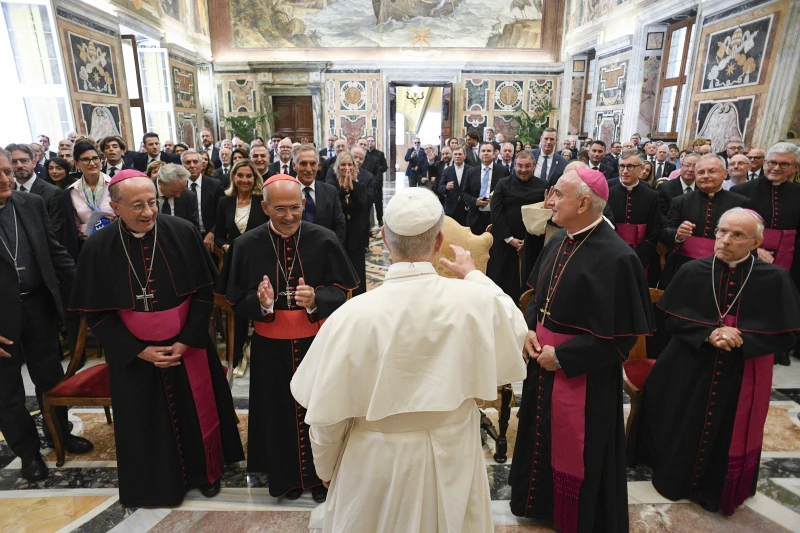
Vatican City, Sep 13, 2025 / 12:30 pm (CNA).
Pope Leo XIV on Saturday urged Catholic theologians to embrace a “theology of wisdom” capable of addressing urgent global challenges, from environmental crises to the ethical questions posed by artificial intelligence (AI).
In his address to participants of an international seminar organized by the Pontifical Academy of Theology, the pope said that “environmental sustainability and the care of creation are essential commitments to ensure the survival of the human race” and have a direct impact on peaceful human coexistence.
Leo emphasized that theology is at the heart of the Church’s missionary work, but must be “incarnate, imbued with the human pains, joys, expectations and hopes of the women and men of our time.” Citing the examples of St. Augustine and St. Thomas Aquinas, he said the great masters of the past modeled a synthesis of faith and reason that can guide theology today.
Turning to contemporary matters, Pope Leo warned that the Church must not limit itself to moral reflections when considering AI. “An exclusively ethical approach to the complex world of artificial intelligence is not enough,” he said, stressing the need for an anthropological vision rooted in human dignity. “What is a human being? What is his or her inherent dignity, which is irreconcilable with a digital android?”
Leo recalled 2023 legislation by his predecessor Pope Francis that reformed the academy, highlighting its three “faces”: academic rigor, contemplative wisdom, and solidarity expressed in acts of charity. Theology, Leo said, should remain rooted in an encounter with Christ while engaging philosophy, science, economics, law, literature, and the arts. Dialogue within the Church must also lead to dialogue with other cultures and religions, so that theology may serve both the Church and the wider world, the pope said.
If you value the news and views Catholic World Report provides, please consider donating to support our efforts. Your contribution will help us continue to make CWR available to all readers worldwide for free, without a subscription. Thank you for your generosity!
Click here for more information on donating to CWR. Click here to sign up for our newsletter.



We read: “What is a human being? What is his or her inherent dignity, which is irreconcilable with a digital android?”
Yes, the incarnate Jesus Christ is analogue, not digital. But, we have the progressiveness of first placing Pachamama in a niche in St. Peter’s Basilica alongside the real Eucharistic Presence, and of displacing binary human relationships with a “third option” of alphabetical pronouns, and then the symbolic “coexistence” of rainbow banners within the church of St. Gesu and then in St. Peter’s in what used to be the “eternal city.”
Is LGBTQ penetration of the Church a consequence of transformer toys and then narcissist computer gaming and a digitally disintegrated “universe”? In addition to upending what is cerebral, digitized AI erodes what is created and physical. So, what now of the “survival of the human race,” as in what are “human” and “human race”?
Just words! In practice, Nominalism is the new orthodoxy. About elementary governance within the Mystical Body of Christ, souls are waiting for the other shoe to fall.
Yes to all your rhetorical questions. Although you don’t need my support for your persuasions. And for a short time all seemed so bright.
Our beloved Pope Leo XIV instructs Catholic theologians to root their work in an encounter with Christ, whilst engaging with philosophy, science, economics, law, literature, the arts, and with other cultures and religions.
The Catechism of the Catholic Church defines theology as: “The study of God based on revelation.” It also repeatedly emphasises the transcendent mystery of God.
In my lowly position, I would rather have read our earthly leader had instructed our theologians to be rooted in an uncompromising devotion and submission to King Jesus Christ, seeking always to be a theologian to whom The Father is revealed by Christ our LORD, as Saint Matthew gives us at 11:27.
“Everything has been entrusted to Me by My Father; and no one knows The Son except The Father, just as no one knows The Father except The Son and those to whom The Son chooses to reveal Him.”
Maybe this is what the Catechism means when it defines authentic Catholic theology as being based on revelation.
Since when has The Church forgotten that divine revelation is given to overcome the lying deceits that are inherent in a universe whose prince is a liar from the start and a thief and murderer and destroyer (see, e.g., John 8:44; 10:10; 12:31). It seems problematic to ignore that aspect of ‘Creation’ alltogether.
The greatest part of Jesus’ earthly ministry was devoted to overcoming the evils that have infected ‘Creation’, and to teaching His disciples (and us) how to do that.
Theologians have fresh opportunities to be creative, constructive and relevant. Remaining on the back foot and calling the shots is replete with short comings. Life keeps evolving all the time, faster than ever before. Pilgrims on the move cannot remain static but are expected to move ahead with eyes, minds and hearts wide open. Day by day the need for an anthropological vision rooted in human dignity keeps challenging our theologians here, there, and everywhere. It’s a healthy challenge to be embraced whole-heartedly.
It’s pleasing to find a Catholic theologian who knows what he’s talking about:
Catholic Theology: An Introduction
Cajetan Cuddy, O.P.
August 15, 2024
The opening paragraph of the Catechism of the Catholic Church summarizes the whole of the Christian life and, thereby, the purpose of Catholic theology:
God, infinitely perfect and blessed in himself, in a plan of sheer goodness freely created man to make him share in his own blessed life. For this reason, at every time and in every place, God draws close to man. He calls man to seek him, to know him, to love him with all his strength. He calls together all men, scattered and divided by sin, into the unity of his family, the Church. To accomplish this, when the fullness of time had come, God sent his Son as Redeemer and Savior. In his Son and through him, he invites men to become, in the Holy Spirit, his adopted children and thus heirs of his blessed life. (CCC no. 1)
The profound significance of the very first word of the Catechism is difficult to overestimate. As an authoritative summary of Catholic faith and morals (CCC no. 11), the Catechism begins with God. Why? God is the beginning and the end of Christian doctrine. Likewise, God is the center of sacred theology. A Christian life without God is impossible. Moreover, Catholic theology without God is unintelligible.
In these carefully selected and arranged words, the Catechism highlights the fact that God is “infinitely perfect and blessed in himself.” God does not suffer from any needs or privations. He is perfection. Thus, the existence of creatures does not originate from any insufficiency within God. Rather, all creatures—including rational creatures, whether men or angels—proceed from God’s “plan of sheer goodness.” Creatures exist because God is infinitely good.
God created to share his goodness with his creatures. He did not create in order to receive something that he lacked. He “freely created man to make him share in his [God’s] own blessed life.” God’s loving wisdom accounts for the creation of the human person. Moreover, his good and loving wisdom informs the inherent structures of creation in general and the nature of the human person in particular. Because God created man to share himself with man, “at every time and in every place, God draws close to man.”
There are no barriers between God and the human person. The Christian faith denies any conceptions about God that would posit spatial or affective distance between God and creatures. The God who creates sustains his creation in existence. The Christian faith utterly rejects deistic conceptions of the deity and of creation. God is not an absent watchmaker.
Consequently, God “calls man to seek him, to know him, to love him with all his strength.” God’s presence to his creatures is such that he enables human persons not only to be known or loved by God, but also to know and to love God themselves. No creature can self-create. Moreover, as a creature of God, the human person is created for God. Thus, the created reality of humanity is not simply passive in nature. It is part of the primordial vocation of the human person to pursue God through the active powers of knowing and loving.
The human orientation to God is expressed even in the human experience of things other than God. All truth is God’s truth. All truthful knowledge is ultimately oriented to God because all of reality bears a God-oriented shape and direction. And the human person is uniquely called to pursue God in a specifically rational way through knowledge and love. In its very first paragraph, the Catechism provides a roadmap for the whole of human life and the whole of Catholic thought. In other words, this single paragraph gives a concise account of the essence of Catholic theology.
………………………………..
…………………..
How widely among Catholics, is it appreciated that just as there is SCIENCE and there is SCIENCE FICTION, so too there is THEOLOGY and there is THEOLOGY FICTION.
The most serious problem arises: for whilst the sport of Science Fiction is unlikely to genocide human souls, that is exactly what the sport of Theology Fiction does.
Theology Fiction – sadly a popular genre – can be inherently soul-genociding; our willfully blind shepherds (see 2 Corinthians 4:4) leading leeming-like sheep into the pit (see Matthew 15:14 & Luke 6:39)..
There is manifestly no respect for Deuteronomy 27, nor fear of its divine curses;
e.g. “A cures on one who leads a blind man astray . . .”
What hope is there then for the average Catholic?
Every hope, when our Pope, Cardinal, Archbishop, Bishop, Priests, Deacons, Religious, and Lay Leaders are steeped in The New Testament and The Catechism of the Catholic Church – that is, have their eyes wide-open, and their hearts obedient to the teachings of Jesus Christ – our One & Only True Teacher, and so, are full of The Holy Spirit, manifest in their lives.
Let no theologian suggest GOD has left us sheep without help. It’s all there!
Correction
‘e.g. “A curse on one who leads a blind man astray . . .”’
Dear Dr John Grondelski has given us some relevant observations on what real, ‘non-grasping’, Christ-following Catholicism looks like.
https://www.newoxfordreview.org/the-need-to-stop-grasping/
We might add that the far-from-uncommon Catholic method of sermonizing people to change, no matter how well argued, rarely works. People may get dismissive, self-delusional or worse: guilty, hypocritical, or even cynical.
REAL change comes from being filled with GOD’s Holy Spirit, who counsells us from within, helping us move towards a sanctity of Christ-like self-emptyingness we can never achieve by will-power or by so-called ‘spiritual disciplines’.
How, then, does a Catholic get full of The Holy Spirit of GOD? Our LORD Jesus Christ and His holy Apostles plainly taught us -“Obey the Commandments of GOD with love, and GOD will make His home in you!” No pentecostal/charismatic shortcuts! Just OBEY!
The glory of being in-dwelt by GOD’s Holy Spirit is that, year-by-year we find we’re indeed becoming a different person: a MUCH wiser, more-loving person! No sweat!
As this truly beautifully-sung song says:”NOT BY ME BUT BY CHRIST IN ME!”
CityAlight – ‘不是我,是基督住我心’ (现场) [feat. Christie Kwek] – YouTube
In short: Do your best to learn & lovingly obey GOD’s commands – you’ll be filled by The Holy Spirit of GOD – you will be able to give up grasping and step-by-step you’ll start to become like Christ our LORD.
The alternative is to ignore GOD’s commands, sin, & become a slave of sin; left on our own, devoid of The Help, Advocacy, Counsel, Comfort, & Friendship of The Holy Spirit of GOD.
As Moses urged Israel: “For goodness sake, chose Life not death.”
Do theologians who dimiss the commandments have any understanding of this . . ?