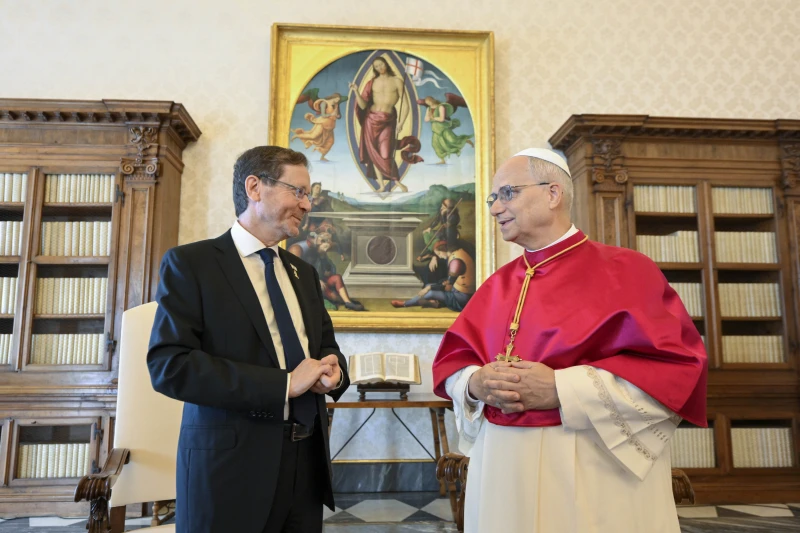
Pope Leo XIV meets with Israel President Isaac Herzog in a private audience at the Vatican on Sept. 4, 2025. / Credit: Vatican Media
Vatican City, Sep 4, 2025 / 12:14 pm (CNA).
Pope Leo XIV discussed the conflict in Gaza, including a two-state solution, with Israel President Isaac Herzog in a private audience at the Vatican on Thursday morning.
According to a Vatican statement after the meeting, the talks focused on the political and social situation in the Middle East and the need to guarantee “a future for the Palestinian people and peace and stability in the region, with the Holy See reiterating the two-state solution as the only way out of the ongoing war.”
The Israeli president also met with Vatican Secretary of State Cardinal Pietro Parolin and Vatican Secretary for Relations with States Archbishop Paul Gallagher.
The Sept. 4 Vatican audience was the first closed-door meeting between Leo and Herzog, 64, who has been Israel’s president since 2021.
Pope Leo XIV meets with Israel President Isaac Herzog in a private audience at the Vatican on Thursday, Sept. 4, 2025. The talks focused on the political and social situation in the Middle East and the need to guarantee “a future for the Palestinian people and peace and stability in the region, with the Holy See reiterating the two-state solution as the only way out of the ongoing war.” Credit: Vatican Media
In a post on X following the encounter, Herzog thanked Leo for a “warm welcome today at the Vatican” and said he looked forward to strengthening Israel’s cooperation with the Holy See “for a better future of justice and compassion.”
The Vatican communique on Leo’s meeting with Herzog — a longer and much more detailed statement than those usually issued after audiences with heads of state — repeated Pope Leo’s regular public pleas for a resumption of negotiations, a permanent ceasefire, the release of Israeli hostages, respect for humanitarian law, and the safe entry of aid into Gaza.
The Vatican said the hope was also expressed that the “legitimate aspirations” of both Israeli and Palestinian people can be guaranteed.
“Reference was also made to the situation in the West Bank and the important question of the city of Jerusalem” and to issues in the relations between Israeli state authorities and the local Church, the statement added.
In addition to a two-state solution for Palestine, Vatican diplomacy has called for an international status for the city of Jerusalem, where the Latin patriarch, Cardinal Pierbattista Pizzaballa, is the Catholic leader of not only Israel but also the Palestinian Territories of Gaza and the West Bank.
During a visit to the town of Taybeh in the West Bank in July, Pizzaballa and other Church leaders said they hold Israeli authorities responsible for “facilitating and enabling” attacks on Palestinian Christians by Israeli settlers.
Israeli President Isaac Herzog meets with Vatican Secretary of State Cardinal Pietro Parolin and Secretary for Relations with States Archbishop Paul Gallagher (in back) on Thursday, Sept. 4, 2025. Credit: Vatican Media
Thursday’s conversation between Leo and Herzog also touched on the importance of ensuring the continued presence of Christian communities throughout the Middle East, the Vatican said.
After the talks, a statement from Herzog said the pope’s reception of Israel’s president reflected “the great significance of the relationship between the Holy See and the State of Israel, and of course with the Jewish people, and the importance of the very sensitive issues and challenges we experience today.”
There was some tension surrounding the meeting due to a Sept. 2 statement from Herzog’s office stating that the president’s one-day visit to the Vatican came at the invitation of Pope Leo. The Vatican contradicted that claim hours later with a statement that “it is the Holy See’s practice to agree to requests for an audience with the pope from heads of state and government; it is not its practice to extend invitations to them.”
Vatican-Israel relations were marked by tension toward the end of the last pontificate owing to Pope Francis’ criticism of Israel’s campaign in Gaza, which was sparked by the Oct. 7, 2023, massacre of Israeli citizens and others by Hamas militants.
Pope Francis called Israel’s actions in Gaza “terrorism” and on two occasions said what was happening there might qualify as genocide.
Pope Leo has taken a more restrained approach, calling for ceasefires and the release of hostages and emphasizing the need for dignified humanitarian aid and respect for law.
If you value the news and views Catholic World Report provides, please consider donating to support our efforts. Your contribution will help us continue to make CWR available to all readers worldwide for free, without a subscription. Thank you for your generosity!
Click here for more information on donating to CWR. Click here to sign up for our newsletter.
Pope Francis celebrates Mass in St. Peter’s Square for Easter 2022 / Daniel Ibanez/CNA
Rome Newsroom, Apr 1, 2023 / 05:00 am (CNA).
Palm Sunday marks the start of one of the most full and beautiful liturgical periods of the Catholic Church year.
It is also one of the busiest liturgical periods at the Vatican, where Pope Francis has been scheduled to preside over nine Masses, liturgies, and devotions between April 2 and Easter Monday, April 10.
With Pope Francis having been hospitalized on March 29 for a respiratory infection, it was unclear if he would be well enough to participate in any or some of the liturgies.
Vatican spokesman Matteo Bruni confirmed on April 1 as Pope Francis was discharged from the hospital that the pope is still planning to be present for Palm Sunday Mass on April 2. Pope Francis will preside over the liturgies with a cardinal celebrating at the altar.
Here is the Vatican’s full schedule for Holy Week and Easter 2023:
Palm Sunday
Daniel Ibáñez/CNA.
On Sunday morning, April 2, Pope Francis is scheduled to preside over Mass for Palm Sunday, also known as Passion Sunday or the Commemoration of the Lord’s entrance into Jerusalem.
The Mass, which will be in St. Peter’s Square at 10 a.m. local time, will kick off with a grand procession of deacons, priests, bishops, cardinals, and laypeople carrying palms.
The procession includes olive tree branches, palm fronds, and the large, weaved palms called “parmureli,” all blessed by Pope Francis.
Holy Thursday
Vatican Media.
Pope Francis is set to start Holy Thursday with a Chrism Mass in St. Peter’s Basilica at 9:30 a.m. in the presence of cardinals, bishops, and priests living in Rome.
During the Mass, Pope Francis, as the bishop of Rome, will bless the oil of the sick, the oil of catechumens, and the chrism oil to be used in the diocese during the coming year.
In the evening, the pope will offer Mass at the juvenile detention center “Casal del Marmo,” the same detention center where he offered Holy Thursday Mass in 2013, shortly after his election.
Pope Francis washes inmates’ feet at Rome’s Regina Coeli Prison on Holy Thursday, March 29, 2018. Vatican Media.
In 2022, the pope offered the Mass at a prison in Civitavecchia, a port city about 50 miles northwest of Rome. After the homily, Francis washed the feet of 12 inmates, representing the disciples.
Good Friday
Continuing the liturgies of the Triduum, Pope Francis is also scheduled to preside over a celebration for the Passion of the Lord on Good Friday at 5 p.m. in St. Peter’s Basilica.
During this liturgy, which is not a Mass, instead of the pope papal preacher Cardinal Raniero Cantalamessa preaches on Christ’s crucifixion.
Vatican Media.
In the evening, Francis will lead the Stations of the Cross devotion at the Colosseum at 9:15 p.m.
Holy Saturday
On Holy Saturday, Pope Francis is set to preside over the Easter Vigil at 7:30 p.m. in St. Peter’s Basilica.
The Easter Vigil, which takes place on Holy Saturday night, “is the greatest and most noble of all solemnities,” according to the Roman Missal.
Vatican Media
The liturgy begins in darkness with the blessing of the new fire and the preparation of the paschal candle. At the Vatican, cardinals, bishops, and priests process through the dark basilica carrying lit candles to signify the light of Christ coming to dispel the darkness.
Pope Francis also typically baptizes new Catholics at this Mass.
Easter Sunday
The morning of Easter Sunday, Pope Francis will preside over Mass in St. Peter’s Square at 10 a.m. on a flower-decked parvise.
After Mass, he will give the annual Easter urbi et orbi blessing from the central balcony of St. Peter’s Basilica.
Pope Francis gives the Urbi et Orbi blessing for Easter 2022. Vatican News
“Urbi et orbi” means “to the city [of Rome] and to the world” and is a special apostolic blessing given by the pope every year on Easter Sunday, Christmas, and other special occasions.
In 2022, local authorities estimated 100,000 people were present for the blessing.
Easter Monday
Pope Francis will mark Easter Monday, also called “Monday of the Angel,” by praying the Angelus at noon from a window of the Apostolic Palace.
The Angelus is a traditional prayer honoring the Virgin Mary. Pope Francis leads the prayer and gives a brief reflection every Sunday and on important Marian and other feast days.
Pallbearers carry the wooden coffin of Pope Francis, marked with a cross, into St. Peter’s Square for the funeral Mass on April 26, 2025. / Credit: Daniel Ibáñez/CNA
Vatican City, Apr 26, 2025 / 05:03 am (CNA).
More than 200,000 people filled St. Peter’s Square for the funeral of Pope Francis on Saturday as the world said goodbye to the first Latin American pope who led the Catholic Church for the past 12 years.
Under the bright Roman sun and amid crowds extending down the Via della Conciliazione, the funeral Mass unfolded within the great colonnade of St. Peter’s Basilica. Heads of state, religious leaders, and pilgrims from across the globe gathered for the historic farewell.
An aerial view of St. Peter’s Square filled with thousands of mourners, clergy, and dignitaries gathered for Pope Francis’s funeral Mass under clear blue skies in Vatican City on April 26, 2025.`. Credit: Daniel Ibáñez/CNA
Cardinal Giovanni Battista Re, the dean of the College of Cardinals, presided over the Mass, delivering a homily that paid tribute to Francis’ missionary vision, human warmth, spontaneity, witness to mercy, and “charisma of welcome and listening.”
“Evangelization was the guiding principle of his pontificate,” Re said.
Pope Francis “often used the image of the Church as a ‘field hospital’ after a battle in which many were wounded; a Church determined to take care of the problems of people and the great anxieties that tear the contemporary world apart; a Church capable of bending down to every person, regardless of their beliefs or condition, and healing their wounds.”
As bells tolled solemnly, the funeral rite began with the intonation of the entrance antiphon: “Eternal rest grant unto him, O Lord, and let perpetual light shine upon him.”
The late pope’s closed plain wooden coffin lay in front of the altar throughout the Mass.
A view of the coffin of Pope Francis resting before the altar at the funeral Mass on St. Peter’s Square, April 26, 2025. Credit: Daniel Ibáñez/CNA
“In this majestic Saint Peter’s Square, where Pope Francis celebrated the Eucharist so many times and presided over great gatherings over the past twelve years, we are gathered with sad hearts in prayer around his mortal remains,” Re said.
“With our prayers, we now entrust the soul of our beloved Pontiff to God, that he may grant him eternal happiness in the bright and glorious gaze of his immense love,” he added.
View of St. Peter’s Basilica during the Funeral Mass of Pope Francis on April 26, 2025. Peter Gagnon / EWTN
Among the more than 50 heads of state present were U.S. President Donald Trump and First Lady Melania Trump, alongside former President Joe Biden. Also in attendance were Ukrainian President Volodymyr Zelensky, Argentine President Javier Milei, Italian Prime Minister Giorgia Meloni, French President Emmanuel Macron, and European Commission President Ursula von der Leyen.
Philippine President Ferdinand Marcos Jr. and Brazilian President Luiz Inácio Lula da Silva joined the throng of international dignitaries along with representatives of religious traditions from around the world.
Royal families also paid their respects, with Prince William representing King Charles III and Spanish King Felipe VI and Queen Letizia seated near the altar.
Pilgrims arrived before sunrise to claim their spots in St. Peter’s Square for the Mass with the first in line camping out the night before.
The funeral followed the Ordo Exsequiarum Romani Pontificis, the official liturgical order for papal funerals, which was updated at Pope Francis’ own request in 2024. Scripture readings included Acts 10:34-43, Philippians 3:20–4:1, Psalm 22, and the Gospel of John 21:15-19 — a passage in which the risen Christ tells Peter: “Feed my sheep.”
More than 200 cardinals and 750 bishops and priests concelebrated the funeral Mass. More than 4,000 journalists representing 1,800 media outlets reported on the event. All told, the Holy See said more than 250,000 mourners attended.
In his homily, Cardinal Re reflected on key moments in Pope Francis’ pontificate from his risk-defying trip to Iraq to visit Christians communities persecuted by the Islamic State to his Mass on the border between Mexico and the United States during his journey to Mexico.
“Faced with the raging wars of recent years, with their inhuman horrors and countless deaths and destruction, Pope Francis incessantly raised his voice imploring peace and calling for reason and honest negotiation to find possible solutions,” the cardinal said, causing the crowd to erupt in spontaneous applause.
Pope Francis’ coffin lies in St. Peter’s Square during the papal funeral Mass on Saturday, April 26, 2025. Credit: EWTN News
“Pope Francis always placed the Gospel of mercy at the center, repeatedly emphasizing that God never tires of forgiving us. He forgives, whatever the situation might be of the person who asks for forgiveness and returns to the right path,” Re reflected. “Mercy and the joy of the Gospel are two key words for Pope Francis.”
The cardinal presided over the final commendation and farewell for Pope Francis, praying: “Dear brothers and sisters, let us commend to God’s tender mercy the soul of Pope Francis, bishop of the Catholic Church, who confirmed his brothers and sisters in the faith of the resurrection.”
“Let us pray to God our Father through Jesus Christ and in the Holy Spirit; may he deliver him from death, welcome him to eternal peace and raise up him on the last day,” he said.
After the crowd chanted the Litany of Saints in Latin, Cardinal Baldassare Reina, vicar general of the Diocese of Rome, offered a final prayer: “O God, faithful rewarder of souls, grant that your departed servant and our bishop, Pope Francis, whom you made successor of Peter and shepherd of your Church, may happily enjoy forever in your presence in heaven the mysteries of your grace and compassion, which he faithfully ministered on earth.”
A poignant moment followed as Eastern Catholic patriarchs, major archbishops, and metropolitans from the “sui iuris” Churches approached the coffin while a choir chanted a Greek prayer from the Byzantine Funeral Office.
Re blessed the coffin with holy water and incense as the choir sang in Latin: “I know that my Redeemer lives: on the last day I shall rise again.”
At the end of the Mass, the traditional antiphon “In Paradisum” was sung in Latin, asking for the angels to guide the pope’s soul to heaven.
“May the angels lead you into paradise; may the martyrs come and welcome you and take you to the holy city, the new and eternal Jerusalem. May choirs of angels welcome you and with Lazarus, who is poor no longer, may you have eternal rest.”
In keeping with his wishes, Pope Francis will not be buried in the Vatican grottoes alongside his predecessors. Instead, his body will be taken in procession through the streets of Rome in a vehicle to the Basilica of St. Mary Major, a church he visited over 100 times in his lifetime to pray before an icon of the Virgin Mary, “Salus Populi Romani,” particularly before and after his papal journeys.
Pope Francis’ wooden coffin is transported on the popemobile through the streets of Rome as crowds of faithful line the procession route from St. Peter’s Basilica to the Basilica of Santa Maria Maggiore, April 26, 2025. Credit: Daniel Ibáñez/CNA
In Rome’s most important Marian basilica, Pope Francis will be laid to rest in a simple tomb marked with a single word: Franciscus.
Remembering Pope Francis
Jorge Mario Bergoglio was born on Dec. 17, 1936, in Buenos Aires, Argentina, and entered the Society of Jesus at age 21. Following his ordination in 1969, he served as a Jesuit provincial, seminary rector, and professor before St. John Paul II appointed him auxiliary bishop of Buenos Aires in 1992. He became archbishop of the Argentine capital in 1998 and was created cardinal in 2001.
The surprise election of Cardinal Bergoglio on March 13, 2013, at age 76 marked several historic firsts: He became the first Jesuit pope, the first from the Americas, and the first to choose the name Francis, inspired by St. Francis of Assisi’s devotion to poverty, peace, and creation.
His 12-year pontificate was characterized by a focus on mercy, care for creation, and attention to what he called the “peripheries” of both the Church and society. He made 47 apostolic journeys outside Italy, though he never visited his native Argentina.
During his tenure, Pope Francis canonized 942 saints — more than any other pope in history — including his predecessors John XXIII, Paul VI, and John Paul II. He published four encyclicals and seven apostolic exhortations while promulgating 75 motu proprio documents.
Throughout his papacy, Francis significantly reshaped the College of Cardinals through 10 consistories, creating 163 new cardinals. His appointments reflected his vision of a global Church, elevating prelates from the peripheries and creating cardinals in places that had never before had one, including Mongolia and South Sudan.
Health challenges marked the pope’s final years. He underwent surgery in July 2021 and in June 2023. In November 2023, he suffered from pulmonary inflammation, and in February 2025, he was hospitalized at Rome’s Gemelli Hospital for bronchitis and a respiratory infection.
His papacy faced unprecedented challenges, including the global COVID-19 pandemic, during which he offered historic moments of prayer for humanity, notably the extraordinary urbi et orbi blessing in an empty St. Peter’s Square in March 2020. He also repeatedly called for peace amid conflicts in Ukraine and the Holy Land.
Francis convoked four synods, including the Synod on Synodality, whose second session concluded in October 2024. He implemented significant reforms of the Roman Curia and took several steps to address the clergy abuse crisis, including the 2019 motu proprio Vos Estis Lux Mundi.
Pope Francis’ funeral marks the first day in the Catholic Church’s traditional nine-day mourning period that will include nine days of requiem Masses to be offered for the repose of his soul.
“Pope Francis used to conclude his speeches and meetings by saying, ‘Do not forget to pray for me,’ Re recalled at the end of his homily.
“Dear Pope Francis, we now ask you to pray for us. May you bless the Church, bless Rome, and bless the whole world from heaven as you did last Sunday from the balcony of this Basilica in a final embrace with all the people of God, but also embrace humanity that seeks the truth with a sincere heart and holds high the torch of hope.”
Vatican City, Nov 13, 2017 / 06:41 am (CNA/EWTN News).- After an earthquake along the border of Iraqi-Iranian border left some 340 people dead and another 4,000 injured, Pope Francis voiced his sorrow for the loss of life and offered prayer for the dead and for rescue efforts.
In identical telegrams signed by Vatican Secretary of State Cardinal Pietro Parolin and sent to leaders in both Iran and Iraq, Pope Francis said he was “deeply saddened” by news of the quake, and assured all those affected of his “prayerful solidarity.”
Voicing sorrow to the families of the victims, the Pope offered prayer for the deceased and entrusted them to God’s mercy. He also prayed for the injured and the emergency personnel and civil authorities engaged in rescue efforts.
He closed the telegram asking God for the “divine blessings of consolation and strength.”
The Pope’s telegram came just one day after a 7.3 magnitude earthquake struck the border region between Iran and Iraq, with aftershocks felt in Pakistan, Lebanon, Kuwait and Turkey.
According to CNN, most of the deaths are from Iran. The agency reports that so far 336 deaths have been confirmed in Iran, with another 3,950 injured, while in the northern Kurdish region of Iraq seven deaths have been reported along with 300 injuries.
Rescue operations are underway in both countries, and Iran has already declared a 3-day period of mourning.
The quake is the strongest to hit the region in recent years, though not the most deadly. Iran, which sits along a major fault line between the Arabian and Eurasian tectonic plates, has experienced a number of earthquakes, with the most deadly being a 6.6 quake in 2003 that struck the city of Bam and killed some 26,000 people.
A decade earlier, in June 1990, roughly 37,000 people were killed in a major quake that leveled the cities of Rudbar, Manjil and Lushan.
Leave a Reply