



A few days after our wedding, I gave up on charting my cycle. Whatever God wants, we said. Let the babies come!
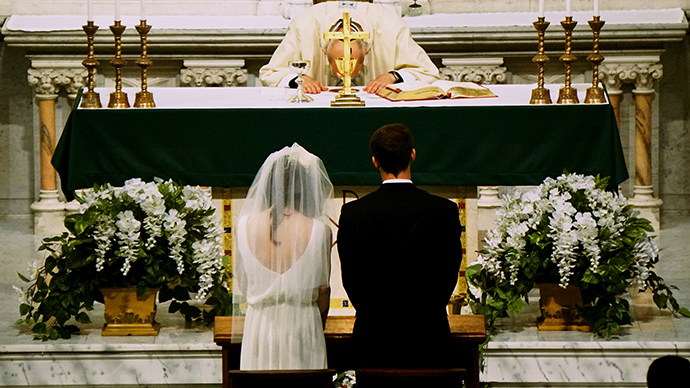
But less than two years later, my husband and I knelt before the altar in St. Lucy’s Church, home of the National Shrine of St. Gerard, in Newark, NJ. Many Catholics turn to St. Gerard with their intentions concerning pregnancy and childbirth. We had a big petition to surrender at the foot of the Cross that day. But God–in His wonderful, incomprehensible, mysterious Providence–did not choose to grant us a miracle on this particular occasion (at least, not in the way we might have hoped).
The surrendering of our fertility would not end with a baby. A few days later, I underwent a medical hysterectomy for uterine and ovarian cancer.
A “sign of contradiction”
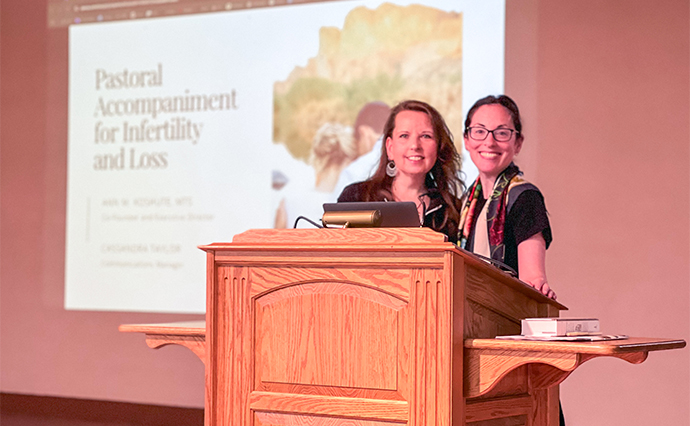
Now, years later, I am a team member of Springs in the Desert, a Catholic infertility ministry. We provide resources and support for dioceses and parishes, healthcare providers, and NFP coaches, so that they can better accompany couples who carry this heavy cross.
Our focus, however, is on the husbands and wives who form our community. We work to break through the isolation that we feel—in our families, workplaces, and yes, even in our parishes — when infertility and loss become an unexpected part of our stories.
Of course, for the Springs in the Desert team, our thoughts turn to these couples when reading an article such as “Bucking the Trend, Large Catholic Families Reflect the Beautiful Fruits of Fertility,” published recently by National Catholic Register. The article praises couples who, radically open to the gift of life, accept the many children they are blessed with as a beautiful sign of contradiction in a nation and a world in which the birthrate is in crisis.
But couples who are blessed with many children present only one side of what it means to be open to life. On the other side are the couples who carry the silent, painful, and often hidden cross of infertility: up to 1 in 5, according to the CDC.
“Couples struggling with infertility are also signs of contradiction in a culture that sees the child as a right rather than a gift,” notes Springs in the Desert Executive Director Ann Koshute, MTS, “and suffering of any kind to be unnecessary when there are technical means of ‘producing’ what is so greatly desired.”
Perceptions of family size must include the reality of infertility
The “epidemic of loneliness and grief among childless people” that the article warns against is not some abstract future event. Based on our experience working with couples, it is happening now. And unless we broaden our general understanding of what it means to be a faithful Catholic family, this epidemic will only get worse as infertility rates continue to rise.
Here are some things we invite readers to take into account when forming their own idea of what a Catholic family should look like.
• Children are a gift. As the article (and Catechism §2378) rightly notes, children are a gift, and at Springs, we often talk about how there is nothing anyone can do to deserve the gift of a child. This is as true for large families as it is for small ones. The family of two, however, is left with the good desire to become parents while reckoning with the question of why God has not chosen to bless them with a child at this time.
Sometimes the desire to be parents–in combination with pressure from family, friends, and others–can seem overwhelming, but the gift of a child should not be forced; in fact, desperation for one can cause couples to take matters into their own hands and pursue illicit artificial reproductive technologies, such as in-vitro fertilization (IVF).
The Church and those of us who fill the pews must accompany large families, but also accompany couples to whom a child, or as many children as they would like (in the case of secondary infertility), has not been given. To do that, the truth of the giftedness of the child—and that they are not a Catholic status symbol—must be more deeply understood.
• Families of all sizes can be holy. Catholic couples often struggle when they come up against the widely held ideal of the big Catholic family. These are not couples who, as the poll quoted in the article states, “‘just don’t want’ kids and … want to ‘focus on other things.’” These are couples who, as newlyweds, perhaps even dreamed of having a pew full of children of their own, but find themselves living out a cycle of hope and grief while waiting for a baby. Sometimes these couples, enduring months or years of infertility, have even received well-intentioned reminders that it is wrong to use contraception.
Others are indeed parents but have tragically lost one or more children during pregnancy. Catholics are not excluded from the larger statistical picture that “1 in 5 (19%) of married women aged 15 to 49 with no prior births are unable to get pregnant after 1 year of trying” (CDC) and “10% to 20% of known pregnancies end in miscarriage” (Mayo Clinic).
Of course, at Springs in the Desert, we do not advocate for a child-free-by-choice lifestyle, but there are plenty of families of two (or three or four) who would love to have more children but are accepting of the will of God.
“Those who have smaller families due to infertility, loss, life-threatening health conditions, or other circumstances beyond their control, often keenly feel the subtle–and not so subtle–message that they are ‘less than’ in the eyes of others in the Church,” says Springs team member Cassi Durnan. “The assumptions people make as to the reasons they don’t have a large family can be very painful.”
Couples and smaller families cannot be truly welcomed and accompanied if they are, even subconsciously, being held up against the measuring stick of a certain number of children.
• Openness to life means openness to all kinds of fruitfulness. The Register article praises “parishes around the country that are rejecting this trend — parishes where families tend to be large, where parish life is vibrant and expanding, and where many husbands and wives … embrace what the Catechism of the Catholic Church calls an ‘openness to life.’ These are communities where faithful Catholic families are defying not merely national or global fertility trends, but those within the Catholic population itself.”
Here we must point out that Catholic couples struggling with infertility also embrace “an ‘openness to life,’” even through the pain of infertility and the (sometimes heightened) possibility of miscarriage. But as they walk this path, the fact that God has not blessed them with a (living) child does not mean that they should not also be considered a “faithful Catholic family.”
Indeed, these couples live out their fruitfulness every day, spiritually mothering and fathering their family members, friends, students, fellow parishioners, and community members, and “performing demanding services for others,” as the Catechism notes in §2379. When welcomed into the life of the parish, they are a key part of the communal life that the article praises as “vibrant and expanding.” They have so many gifts to give to the Church, and–when not excluded–do give them happily and generously.
I think of friends of ours who have dedicated themselves to youth and young adult ministry in their parish. I think of a couple who both work for the Church, pouring themselves into their work and passion for marriage ministry. I think of fellow team members who are involved in Engaged Encounter, helping to encourage and foster faithful marriages for the Church. I think of the surrender my husband and I made, and continue to make, to the Lord.
Additionally, couples who are blessed with children are not done being fruitful in their parishes and communities just because they have kids! We are all called to embrace the continuing call to be open to life and accept the opportunities that God sends our way.
• Our marriages are a witness. “The Church and world need the witness of families with children, who reflect a Christlike total gift of self and sacrifice,” adds Koshute, “but the Church and the world also need the witness of those couples longing for children, or who want to expand their families but are unable to. These marriages–small, yet authentic families–witness to the good of marriage as such, not taking the gift of children for granted. These marriages are no less important and fruitful, even if the life they give doesn’t take up a pew on Sunday.”
Marriage is the bedrock of Catholic families of every size. Our marriages witness to our fellow parishioners not only that children are an undeserved gift, but that the call to be life-giving can be lived out in different ways according to God’s good plan for us.
“Part of accepting God’s will is being open to the fact that the beautiful way in which you are called to parenthood may look completely different than you imagined,” Durnan reflected. “It may not be expressed physically in children that are born of your own bodies, but it will be no less beautiful.”
Walking the path of infertility and loss together
As infertility rates unfortunately continue to rise, we will continue to work towards a greater awareness of this sensitive and important issue. We also hope to come to a deeper understanding of what it means to be fruitful in marriage. Couples blessed with many children are courageously living out their trust in God, in the knowledge that He will always provide. But we must remember that, in a different way, couples without children are doing the same–and often experiencing deep hurt as they long to be understood by their fellow Catholics.
We, as part of the body of Christ, are called to holiness—and also called to help each other walk the narrow paths of life toward that day when “there shall be no more death or mourning, wailing or pain” (Rev 21:4).
The cross of infertility is a mysterious one, but it is statistically certain that each reader knows someone who is carrying it. Will you be a Simon of Cyrene to that person today?
If you value the news and views Catholic World Report provides, please consider donating to support our efforts. Your contribution will help us continue to make CWR available to all readers worldwide for free, without a subscription. Thank you for your generosity!
Click here for more information on donating to CWR. Click here to sign up for our newsletter.

Thank you. Know that many follow and support this beautiful work.
I was a parishioner of St Lucy’s for many years, under the saintly Father Granato. We saw many miracles there. It seems God is with you, although conception did not happen, the Holy Spirit has guided you..You never mentioned adoption? Your story while touching seems to be concerned with “fertility” infertility, our faith says God
is in control.
While at times this is difficult to comprehend, we hope that the church will guide us..I would have liked to read more in your article about adoption, or the possibility of religious life, and that God wants this for a reason, his will not ours.
I must admit there is a negative to the
article with the words “cross” and infertility. My Grandmother lost at least two children in childbirth, she had two beautiful girls, but my grandfather always yearned for a son.. God’s will!
We live in precarious times, Yes we need families if God wants that, we also need chaste, virginal religious lives and priests. There are too many children out there with no homes, no parents, no family..
The Church needs to develop good Catholic family homes and intentional communities to love these children.. Maybe God is speaking are we listening..
God Bless you and your husband.
Saint Lucy and Saint Gerard and Saint Monica
pray for us.
There may be reasons why God is allowing this to happen,
The author’s article does not refer to religious life because the point is about how we as Catholics contextualize the sacrament of marriage for those who are already married and suffering the Cross of Infertility. We are being invited by the author to embrace Catholic married infertile couples in their Cross this has nothing to do with the call to consecrated life. She also said that this is a mystery from God , so it is unnecessary and insensitive to insinuate that the Cross she is carrying is justified. It is an invitation to us all to walk together as a Church with Catholic marriages with families of all sizes.
There are a lot of unwanted children in the world. She doesn’t mention it once. We all have crossed, actually God blessed her by not having a child prior to finding out her illness, which seemed to be corrected.. I don’t read a lot about God on this story, although He was there working.. God is speaking in this story, however we want our way, that may not be God’s way, in the meantime there are thousands of homeless children who need family, love and community this is where our focus should be..God Bless.
Yes, there are indeed a lot of unwanted children in the world. But fostering and adopting do not and cannot heal the very real pain and wounds of infertility. And pursuing adoption (or fostering) as a way to make up or compensate for infertility can lead to even more pain and difficulties. One should, in my experience, grabble with the reality of infertility without using adoption/fostering as a sort of “fix” or bandaid.
Being directly familiar with infertility and having gone through five adoptions, I can say that the latter, in some cases, were just as painful as infertility. As when, for instance, you are chosen to be adoptive parents by the birth mother, you jump through all of the many hoops (agency, state, etc), undergo numerous interviews and fill out endless forms (and this was 20 years ago, so it’s likely more involved now), and then, having met the newborn child and preparing to take her home, are told that, no, it’s not happening. Why? Because the birth mother, who has struggled with drug addiction and told you and then agency numerous times that she knows she cannot raise the new child along with her older children, decides to change her mind.
And then, of course, well-meaning people tell you, “That’s better anyway; children should be with their real parents.” See the problem? It can often be a damned if you do, damned if you don’t type of situation.
Furthermore, I know several families who, not able to have children and desiring to parent, have taken in 2, 3, or 4 siblings. Only to soon discover that one of more of them has serious mental emotional problems, to the point, in some cases, that the parents begin to fear for the safety of the siblings and themselves. And, yes, I’ve also been there.
So, to be clear, I think adoption—an act of selfless love in a fallen world—is a good and beautiful thing, an echo of God’s own unique offer and gift of divine adoption through Jesus Christ. But it’s not a fix, and it does not ever address the pain of infertility. And, if pursued for the wrong reasons, can probably lead to more pain and difficulties.
Finally, essays such as this are important because, to be blunt, far too many people are clueless about how prevalent fertility is today. My wife and I had many well-meaning but, frankly, insensitive people say things to us when we had been married a couple of years: “Well, are you gonna get going on having kids?” And, believe it or not, someone said to me: “What’s the problem, Carl? Is the equipment not working?” This was while my wife and I were pursuing every licit and moral means by which to have children (and, yes, a doctor recommended IVF to us and was shocked when we immediately declined. “But I have lots of Catholic patients who do it,” he said. Of course he did).
My late husband and I were Evangelical Protestant for the first 47 years of our life. E Protestant churches are generally supportive of artificial birth control, so we never considered having more children after our two daughters were born and my husband obtained a vasectomy . We didn’t think that choice was sinful or selfish. By the time we were received into the Catholic Church, I was beginning menopause . I hope that cradle Catholics will remember that most Evangelical Protestants, even though they are anti abortion, still believe that there is no sin in using birth control (although many Evangelicals are abandoning the chemical birth control and other methods that work by destroying a fertilized ovum). If they are still young when they come into the Church, they may decide to try to increase the size of their family but if they were sterilized when they were younger after they had their one or two children, they are in all likelihood out of luck unless they spend a lot of money attempting to reverse the sterility (a course of action that some E Protestants try).
Beautifully well written and poured out from a heart truly walking the path. I’m so grateful to see this.
Thank you Carl I had to reread your article a couple of times and I am glad I did. I hope someday we can meet and sit and talk over coffee about some of these issues in more detail, and how we can influence the Catholic Church community to begin to listen
to God in today’s world with today’s issues and today’s problems and how we can try to address them the best we can for children, families and couples.
However when I originally wrote what I wrote there was no disrespect it was just sharing
my thoughts and feelings on what I read.. I was very touched to know that she had prayed at St Lucy’s Church which is a powerful Church of prayer and miracles.When I was there we had a saintly priest and why his canonization is not being pushed I don’t know, Monsignor Granato and he could tell you stories of miracle after miracle of the people he met on many issues.. I was also touched that she had an illness that was very dangerous, so God was with her. thank God that she didn’t conceive a child and then find out about this illness it would have created major complications. She seems to be okay now and moving forward however this is my opinion it’s not enough we need to establish communities of Catholics and Christians living together and uniting and building strong family “intentional communities” so that we can raise children educate build a community life and not only children alone but also bring in the elderly and take care of them..
If the church can finally do this there will be a paradigm shift in our way of thinking we are no longer isolated little individuals living in our little plot in white suburbia with our little income, this is a time that we need to start uniting and forming communities we live in a dangerous world and God is letting us know in his way but we don’t listen or pray enough we don’t even stay after Mass on Sundays to fellowship and have coffee with our brother and sister.
today’s people can’t stand looking at one another so Carl I hope to see you someday I hope we can have coffee I hope you can send me your email maybe I can email you and ask you a couple of things personally thank you God bless.
Thank you. From someone who has been there, who journeyed from miscarriage to miscarriage with 15 years of infertility between the two. This was before anyone talked about such matters openly. I’m old, nearing 70, and the cross is still heavy. It always will be. I thank God for his help carrying it. And for the other blessings He has granted me and my husband.
Geraldine, thanks so much for sharing a bit of your story. I am so sorry for your losses. I have never been pregnant, so I don’t know your loss from the inside, but I agree that infertility is a cross that remains. After 14 years of marriage, I am grateful that God has brough life to me and my husband through it, and given us the opportunity to be fruitful in ways we couldn’t have imagined. Please do come to Springs in the Desert and read our blog, listen to the podcast, and send us a prayer request anytime. It would be our honor to walk with you, anytime you need a reminder that you’re not alone. God bless you!!