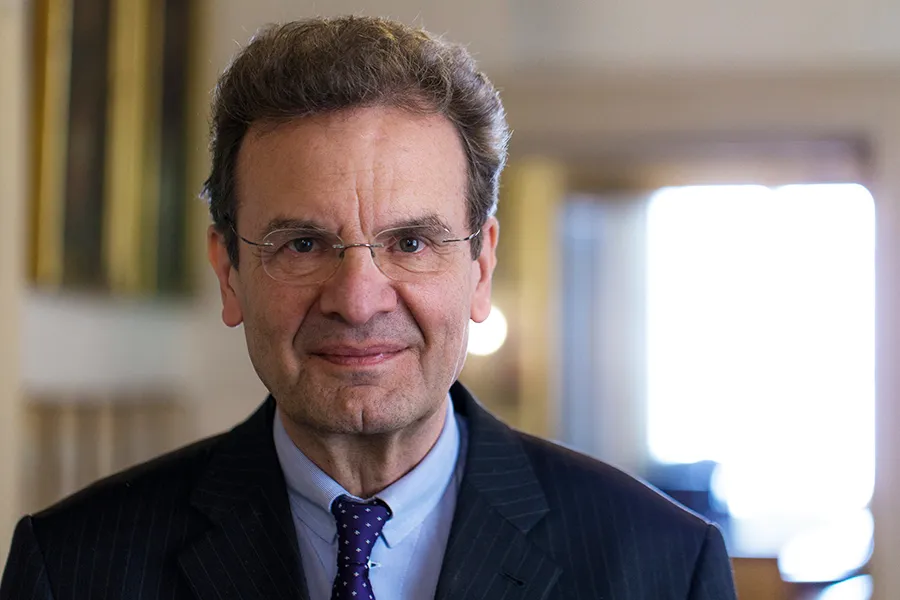
Rome, Italy, Mar 29, 2017 / 04:10 pm (CNA).- After what has been a tumultuous few months for the Order of Malta, Grand Chancellor Albrecht von Boeselager has opened up about the process of reform and the work they are currently doing to help migrants, refugees and those displaced by war and poverty.
“This crisis has been a bit challenging for me personally,” Boeselager told CNA March 29. While the order itself undergoes an intense spiritual reform after a recent crisis involving the Vatican shook up their leadership, Boeselager said, “I hope spiritual renewal will come out of it for me too.”
However, despite the difficulties the reformation of the order currently presents, the Grand Chancellor stressed the importance of staying on task, and not letting their humanitarian work, specifically with migrants and refugees, be set aside.
Boeselager spoke to CNA during a sit-down interview just over a month after outlining the order’s priorities following his reinstatement as Grand Chancellor and the resignation of their former Grand Master, Matthew Festing, at the request of Pope Francis.
Tensions in the order initially spiked after Boeselager, whose brother Georg von Boeselager was appointed a member of the Board of Superintendents of the IOR Dec. 15, was ousted from his position as Grand Chancellor in December. That prompted the Holy See to establish an investigative group to look into the circumstances surrounding his dismissal.
A public row between the order and the Holy See ensued, eventually resulting in Festing’s resignation upon the Pope’s request, the reinstatement of Boeselager as Grand Chancellor, and the appointment of a papal delegate to oversee the “spiritual reform” of the order until a new Grand Master is elected during an April 29 convocation.
In his interview with CNA, Boeselager speaks not only of the current state of the reform, but also provides some background on his own history with the order and highlights the important humanitarian work they are doing with migrants and refugees, which forms the backbone of the order’s activities.
Please read below CNA’s full interview with the Grand Chancellor:
One of the main priorities of the order that you outlined in your press conference in January was humanitarian work with migrants and refugees. Can you explain some of the initiatives the order is currently doing with migrants and refugees specifically?
The order is very much involved in the care of migrants and refugees in different parts of the world, in countries from where they come, on their way and in countries where they wish to go to. So we are active in the countries surrounding Syria: Turkey, Iraq and Lebanon, to help refugees from Syria and also, if security allows, displaced people within Syria. We are active in South Sudan, which is in a big crisis at the moment, and in other countries where there are migrants and refugees or problems of displacement of people. Often it’s internally displaced people. In Asia, in Thailand, we care for Rohingya refugees. In almost all the hotspots for migrants and refugees we are active. Here in Italy, our medical personnel serves on the Italian board to provide medical care to those saved in the Mediterranean, and in Austria, Germany, Hungry, France, we care for refugees that arrive in these countries.
Do you see any specific challenge that might arise with the increased migrant flow into Europe?
In fact at the moment, since about 12 months, the flow has reduced very much, so I don’t see at the moment a crisis of numbers in general. In the mid ’90s 0.5 percent of the population in Europe were refugees or asylum seekers and at the moment it’s 0.4 percent, so it’s less than before. I think in Europe it’s more of a crisis of leadership and communication than a crisis of receiving refugees or migrants at the moment. But that does not mean that we are not faced with a great challenge, because Africa is on the move, one can say, and we certainly need a more long-term policy to deal with the challenges which will certainly be coming.
On this point, I wanted to ask about a meeting you had last week on the situation in Libya. What were some of the major points brought up in that discussion?
The political situation in Libya is at the moment again deteriorating, and human trafficking as become a big business in Libya, and all of the parties in Libya, I think, are aware that this is an additional threat to the stability of the country. So on this issue they agree, but they are helpless to deal with it. Many migrants are held in detention centers, which recently someone compared to concentration camps. I’ve never been to one of those camps so I cannot judge by myself, but what we hear from the migrants we serve coming from Libya are terrible stories, so everything that can be done to mitigate the situation should be done. Even if the steps forward are very small, we should not give up and that’s why we try now for the third time to convene a meeting with representatives from Libya and from other international organizations to start discussing what can be done to help. We are at the moment also giving training to the Libyan coast guard. That has been discussed in our ranks for long, because normally we are very hesitant to get directly involved in military or police actions, but giving training to these people who in the future will rescue people from the Mediterranean I think is necessary, and we hope that we can build trust toward the institution in Libya so in the future we may be able to help.
In the communique you guys sent out about the meeting it said some new collaborations were discussed. What would some of these collaborations look like?
We hope that in the not-too-far future security would allow us to go into Libya and to start medical care for migrants in Libya.
Moving to the topic of the spiritual reform the Order is currently undergoing, what would you say is the ultimate goal of this reform in light of everything that has happened?
I think starting with the term ecclesia semper reformanda, we need to start with the person, personal reform and reflection on our way all the time. I think in a bigger time, steps, also institutional reforms, have to be considered. So it’s in this frame of permanent reflection; I think in Lent it’s a good time to reflect on these things. We have to look at the recent crisis, try to access where institutional weaknesses were at the base of the crisis, so it was more personal controversies which caused the crisis, and to see where we can reform the order so that we can go forward with more strength to fulfill our mission. The Holy Father has put a special focus in his letter on the First Class of the order, so those are the members of the order who have professed the three vows. Unfortunately there are only a few in the order – this is a situation we are living with for more than 200 years, so that’s not new for the order. And to see mainly what could be done or what’s necessary to allow more vocations to the First Class.
So would you say this idea of ecclesia semper reformanda was perhaps what Pope Francis had in mind when he spoke of a specifically “spiritual” reform?
Yes, yes.
What are some of the current steps being taken as this reform takes place?
The next immediate step is to elect a new successor of Fra Matthew in just four weeks, so in a month. So that’s where we concentrate on at the moment, to prepare this election. But we have already started to collect, just to collect from the order, from the membership, where they see a need for reform. We are not yet evaluating them, we are just assembling them and sorting them, and after the election we will first decide how to structure the process, which steps we take to organize the process and then start discussing issues of reform. This will take some time because we have to do it in great transparency, and transparency means communication and time so that nobody can have the impression that something is cooked in a secret kitchen.
Part of what was also mentioned in the Pope’s letter was the need to re-visit specific parts of the order’s constitution. What are the parts that might need to be changed or revised in some way?
It’s a bit early to say exactly what will come out. As the Pope mentioned, specifically the First Class, maybe something needs to be changed there, but that’s something especially the First Class members have to reflect on themselves, that’s not our matter. The recent crisis has shown some weaknesses in the check and balances and the governance, so we have to look at governance issues and I’m pretty sure that we will have to do some reforms in this regard. And maybe we have also to look at issues of training and preparation of members in the different classes, to strengthen their background.
Is there a specific outcome that you in your role as Grand Chancellor are hoping to achieve?
In my role as Grand Chancellor I see my duty to help moderate this process and trying to help to bring peace and unity in the order. So I will at the moment will help so that all these suggestions will be fairly considered and brought together, but not take a special direction, because I think that’s not my role at the moment
Moving forward, what do you see your role as? Could you possibly be elected Grand Master at the Council Complete of State April 29?
That’s fortunately impossible, because I am not a member of the First Class. The Grand Master has to be a member of the professed with solemn vows and the professed members of the order are the members who constitute the order as a religious order, and the head of the order has to be chosen from among them.
So you’ll continue as you are then?
I think this special feature will not change.
I also wanted to ask you some personal questions about your own background. Can you explain a bit of your own story and how you came into contact with the order?
My father and my mother were members of the order. My father in fact started the initiative to bring sick and handicapped to Lourdes after the Second World War. So these annual pilgrimages of my parents were part of our normal family life because it always took some preparation. With four children it took also a special moment we didn’t like so much when our parents went away for 10 days or so. Then I remember the first, most spectacular operation of the order in 1956 during the Hungarian crisis, when the order started to rescue refugees coming from Hungry and the Hungarian-Austrian border. Our dining room and the office of my father were the same room, and my father coordinated the interventions from Germany. So I still remember this as a very specific time in my youth, so the order was part of my youth. After my military service I went for the first time to Lourdes a bit sceptical, like sometimes children are when they are doing something their parents have done all the time. So I was observing a bit, and then (as I was) serving in front of the bath in Lourdes, one of the helpers in the bath came out and said ‘I need help inside’ and just dragged me in without asking. So I came into a cabin where the really severely (sick people) were taken into the bath and there were two Dominican fathers who literally kissed the sore bones of the sick and that really took me. Since then I have gone every year perhaps with one exception.
So you would say this was really the moment that inspired you to make a greater commitment with the Order of Malta?
Yes, absolutely. Lourdes is, I would say, the spiritual heart of the order. If you talk of reform, I think the experience of Lourdes for many members is a real source of renewal. Reform is not a theoretical process. Reform has as a condition personal renewal and reform, and I think Lourdes is the deepest source for us and for me too.
Is there a sense of personal renewal that you are hoping for moving forward?
I think this crisis has been a bit challenging for me personally, and I hope spiritual renewal will come out of it for me, too.
Anian Christoph Wimmer contributed to this report.
 […]
[…]




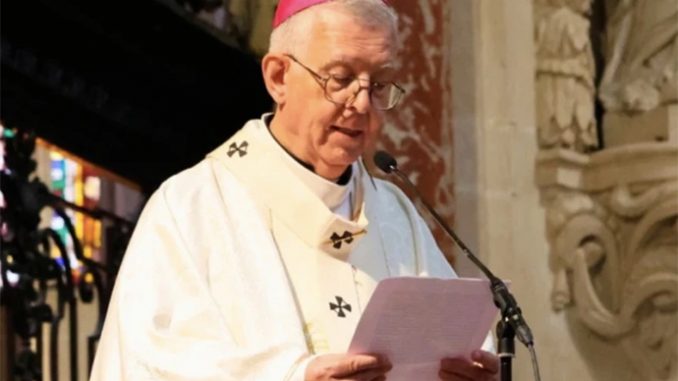


The Archbishop asked:
“How can we find the right attitude that does not force us to take one side to the detriment of the other? How can we keep the primary focus on the victims without forever rejecting the guilty?”
Allow me:
Remove Father Dominique Spina from the priesthood for raping a boy. Then Mr. Spina can do whatever. Problem solved.
Better still:
The Archbishop could remove himself from the episcopacy, thereby sparing himself the delicate task of rescuing a rapist.
Best of all:
Pope Leo removes Archbishop Guy from the episcopacy for gross negligence to act as a spiritual father. Perhaps the Pope can find a paper pushing job for him in the Secretary of State…
Yes, the Archbishop himself should be removed, but of course will not. It is horrible to see the Church hierarchy and many priests ignore and just dance around the straightforward commands of Scripture and great Christian thinkers like St. Augustine:
Romans 1:26-27
New International Version
26 Because of this, God gave them over to shameful lusts. Even their women exchanged natural sexual relations for unnatural ones. 27 In the same way the men also abandoned natural relations with women and were inflamed with lust for one another. Men committed shameful acts with other men, and received in themselves the due penalty for their error.
1 Corinthians 6:9-11
New International Version
9 Or do you not know that wrongdoers will not inherit the kingdom of God? Do not be deceived: Neither the sexually immoral nor idolaters nor adulterers nor men who have sex with men[a]
10 nor thieves nor the greedy nor drunkards nor slanderers nor swindlers will inherit the kingdom of God.
11 And that is what some of you were. But you were washed, you were sanctified, you were justified in the name of the Lord Jesus Christ and by the Spirit of our God.
AND SAINT AUGUSTINE
“Those sins which are against nature, like those of the men of Sodom, are in all times and places to be detested and punished. Even if all nations committed such sins, they should all alike be held guilty by God’s law” (Confessions 3.8).
This is what normal thinking Catholic men say. But when they receive Holy Orders today, some seem to think it means pardoning evil AND PRETENDING LIKE IT NEVER HAPPENED. Until the Church gets real about expelling these men from the priesthood, NOTHING will be fixed. But I am beginning to think the bigger problem will be expelling these weak-minded men from the episcopate.
“Others in the end saw it as a sign of hope for abusers who had served their time and are experiencing the great trial of being totally shunned by society. For that I must ask forgiveness from the one I named and in whom I have confidence, for not having known how to find the right place to which he is entitled,” the archbishop further explained. 🤮
Speaking of “arousing suspicions,” bitter experience suggests that the Archbishop is not simply “weak-minded.” His simpering excuses are likely more than an act to survive. He chose to make a rapist his Chancellor. That’s audacious. Why? One reason would be blackmail. Another is that he and Fr. Spina are united, let’s say, at a minimum in their desire to normalize sex with children. 💋
It’s ecclesial idiocy that prompts me to make a move I’ve considered and studied
for the past few years: leaving the institutional Catholic Church and becoming
LCMS Lutheran.
How can a bishop be this incompetent and ignorant?
I think both the bishop and priest need to go.
It’s a disgrace.
In a healthy age of the Church, both would have been hung by outraged laymen.
“we have learned to look at these events first from the point of view of the people who were their victims and who suffer the consequences for the rest of their lives.”
Let us get this straight. So you contend that previously it was impossible to know that raping a child was an intrinsic evil? Or do you side with those “theologians” who say there are no intrinsic evils?
“Others in the end saw it as a sign of hope for abusers who had served their time and are experiencing the great trial of being totally shunned by society.”
Served their time?? How do criminal penalties absolve moral culpability and the need for repentance? And shunned by society? Anyone who embarrasses the Catholic Church has a great future in Hollywood.
“How can we find the right attitude that does not force us to take one side to the detriment of the other? How can we keep the primary focus on the victims without forever rejecting the guilty?”
I have an idea. Why not make an effort to discover the Catholic religion?
Too little, too late. Archbishop de Kirimel should fall on his sword and resign for even considering hiring a pedophile child rapist.
Let me get this straight. A priest who breaks the seal of Confession is automatically excommunicated, but a priest who rapes maintains his faculties and gets selected as chancellor for an archdiocese as “a sign of hope for abusers.” Maybe the latter should receive the same consequence as the former; maybe then the Faithful, to say nothing of the world at large, will believe that Church hierarchs actually care about the victims of abuse.
“For that I must ask forgiveness from the one I named and in whom I have confidence, for not having known how to find the right place to which he is entitled,” the archbishop further explained.”
What an interesting statement from the bishop. I wonder what might be the right place to which the rapist might be entitled.
This “apology” is effectively a way of saying, poor me; I made an innocent error by making an unpopular decision. But this priest is a fine man, made especially stellar as a symbol to all abusers. Yep, abusers everywhere will learn that they can become venerated if their abuse eventually becomes high profile.
We all complain about how the secular world hates the Church. But I nonetheless hope someday a prosecutor will arrest, try, and send to prison a bishop for aiding and abetting. What will it take to wake them up?
Up until quite recently in our state people who abused children that way were eligible for residency on death row.
I’m not a fan of capital punishment but it demonstrates how seriously a society takes crimes committed against minors. That seriousness seems to be lacking in this particular French archdiocese.
As with so many bishops who tolerated abuse, even in the U.S., this is not a question of
forgiveness. It is a question of competence and fitness for office.
These high clergy always hang on to office, never having the integrity
or the decency to resign.
The gospel of Jesus Christ is built upon the firm foundation of divine forgiveness. While it is a foundational truth of our faith that God’s mercy is sufficient for the atonement of all our sins, this divine prerogative does not fall within the purview of human authority. This distinction is critical when confronting grave offenses, particularly the egregious violation of a young boy by one entrusted with the sacred office of the priesthood.
Such an act is a profound betrayal of the pastoral covenant and a spiritual violence that renders a priest unfit to serve in any pastoral capacity. The dignity of the sacred office demands that such a person be removed completely from it, either to a life of perpetual penance in a monastery or through definitive removal from the priesthood. This is not a matter of human judgment superseding God’s mercy, but rather of upholding the integrity of the priesthood and ensuring the safety of the flock.
The actions of Archbishop Kirimel represent a grievous failure of pastoral duty. By choosing to overlook the deep spiritual and emotional harm inflicted upon the victim(s) and the wider community who bore witness to this sin, he has wounded the Church’s witness and fractured the trust of the faithful. Such a dereliction of office undermines confidence in the Church’s pastoral care, which is intended to be a source of healing and not further injury.
Generally, aside from lack of conviction, there seems an underlying affinity with the abuser cleric. We’ve developed into an institution in which effeminacy and same sex attraction is a commonly accepted behavior trait. Not until that’s effectively addressed does it appear it will end. How to address it in our already effeminized culture is the difficulty. Perhaps another St Peter Damian elevated to supreme pontiff.
Agree wholeheartedly, Father Morello. The cancer within the Church must be excised. We all know what that cancer is; only some have the conviction of faith to say it aloud – homosexuality.
I did not want to comment that article because what to comment? Isn’t it all clear? One does not need to be a Catholic to know how to deal with this situation. And it is so shocking to see that a Catholic (archbishop) does not know that. This is a dead end.
But I will say this: you are right, a normal man (no matter of what faith or without a faith), when he deals with such a situation, intuitively knows that he must protect the weak and abused. He even does not know that, it is an instinct which makes a man a man. All those crimes are done by men who have no true maleness. They are pathetic. It is a very small comfort for victims to know that but nevertheless it may help some: those men are pathetic weaklings.
How much longer do the laity have to suffer the abuse by priests and bishops before the laity rises up and takes each offender out into the public square and tars and feathers them? How much longer? I know that I, for one, have reached my threshold of tolerance.
Bishops who are morally corrupt cannot even understand the optics of absolute corruption. This clown should be removed from the episcopacy and forced into penance and silence.
One of the previous letter writers said homosexuality is the problem. No, homosexual acts are the problem. Homosexuality is a cross for the bearer, and if embraced as a cross can lead to sainthood. This doesn’t, however, imply that homosexuals can or should be priests. Homosexuals should not be ordained.
Thomas Heenan: Agreed. When I say that homosexuality is the problem I mean acts that are homosexual in nature and/or a disposition to make homosexuality a normative variant of sexuality which it is not. Those who do carry this burden and for whom it might be the source of grace in the struggle against homosexual acts, I would say are “same sex attracted.”