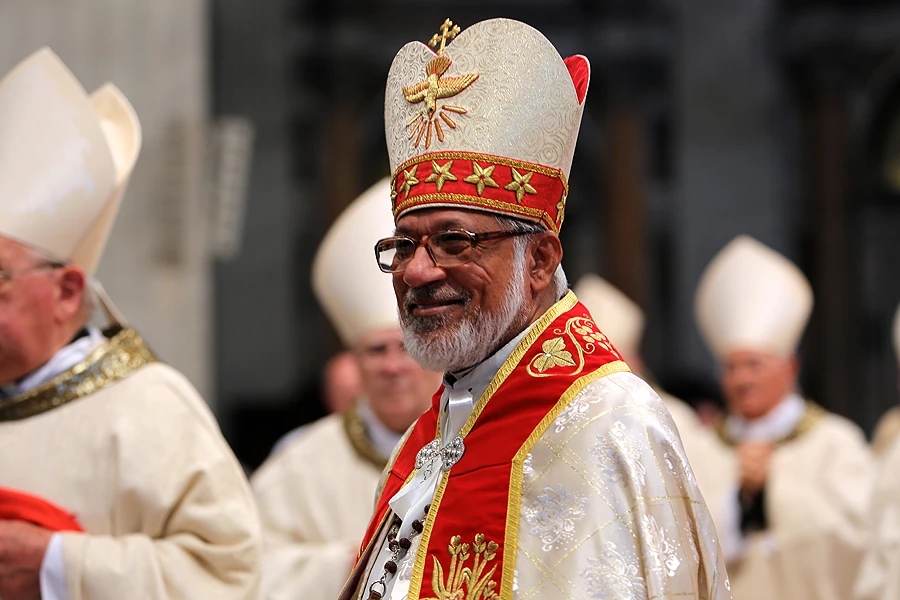
Vatican City, Oct 10, 2017 / 11:24 am (CNA/EWTN News).- Pope Francis on Tuesday said the variety of Catholic Churches and rites in India is a richness for the country that ought to be strengthened, and as a means of doing so, he expanded the reach of one of the country’s indigenous Churches.
The decision moves toward a greater allowance for several bishops from distinct Catholic Churches in India having a presence in the same territory.
“In a world where large numbers of Christians are forced to migrate, overlapping jurisdictions have become customary and are increasingly effective tools for ensuring the pastoral care of the faithful while also ensuring full respect for their ecclesial traditions,” Pope Francis wrote in an Oct. 10 letter addressed to India’s bishops.
He said the diversity of ecclesial life in the country “shines with great splendor throughout lands and nations.”
Two Catholic Churches based in India’s Kerala state trace their origins to the preaching of the Apostle Thomas: the Syro-Malabar Church, which follows the East Syrian or Chaldean rite; and the Syro-Malankara Church, of the West Syrian or Antiochian rite.
The Latin rite Catholic Church also has a large presence throughout India, having been introduced to the country by missionaries in the 16th century.
The various Catholic rites in India, Pope Francis said, constitute a historic Christian presence in India “that is both rich and beautiful, complex and unique.”
“It is essential for the Catholic Church to reveal her face in all its beauty to the world, in the richness of her various traditions,” he said, and noted how the Second Vatican Council sought to “protect and preserve the treasure of the particular traditions of each Church,” an ongoing mission today.
His letter accompanied an announcement on the establishment of two new eparchies (the equivalent of a diocese in the Latin Church) for the Syro-Malabar Church.
The establishment of the eparchies of Shamshabad (in Uttar Pradesh) and Hosur (in Tamil Nadu) was announced along with the name of their first respective bishops: Bishop Raphael Thattil, until now Auxiliary Bishop of the Syro-Malabar Archdiocese of Trichur, and Fr. Sebastian Pozholiparampil, a priest of the Syro-Malabar Diocee of Irinjalakuda. The Shamshabad eparchy will include the entire country of India not already included in existing Syro-Malabar eparchies.
Pope Francis also extended the boundaries of the eparchies of Ramanathapuram and Thuckalay, both of which are located in Tamil Nadu state.
In addition to his role as bishop, Thattil also serves as apostolic visitor for Syro-Malabar faithful in India who live outside of their own territory, reporting his observations to Rome.
Pope Francis’ decision to establish new eparchies for the Syro-Malabar Church and widen its jurisdiction to essentially all of India mirrors a similar decision he made in August with the Syro-Malankara Church, when he reinforced their own presence with the establishment of a new eparchy and an apostolic visitor to the Syro-Malankara Church in Europe and Oceania.
The establishment of the eparchies also takes place as the Congregation for the Oriental Churches celebrates its centenary with a variety of activities in Rome, culminating in Mass with Pope Francis at the Basilica of St. Mary Major Oct. 12.
In his letter, Pope Francis noted that “In India, even after many centuries, Christians are only a small proportion of the population and, consequently, there is a particular need to demonstrate unity and to avoid any semblance of division.”
He stated that when the Syro-Malabar Church expanded with missionary eparchies to parts of northern and central India, “it was generally thought by the Latin Bishops that there should be just one jurisdiction, that is, one bishop in a particular territory. These eparchies, created from Latin dioceses, today have exclusive jurisdiction over those territories, both of the Latin and Syro-Malabar faithful.”
“However, both in the traditional territories of the Eastern Churches, as well as in the vast area of the so-called diaspora (where these faithful have long been established), a fruitful and harmonious cooperation between Catholic bishops of the different sui iuris Churches within the same territory has taken place.”
Overlapping jurisdictions in India “should not longer be problematic,” the Pope wrote, noting that they have already existed in Kerala for some time, and his own expansion of the Syro-Malankara Church in recent years.
“These developments show that, albeit not without problems, the presence of a number of bishops in the same area does not compromise the mission of the Church. On the contrary, these steps have given greater impetus to the local Churches for their pastoral and missionary efforts.”
He voiced hope that his decision to broaden the reach of the Syro-Malabar Church would be “welcomed with a generous and peaceful spirit, although it may be a source of apprehension for some, since many Syro-Malabars, deprived of pastoral care in their own rite, are at present fully involved in the life of the Latin Church
Francis stressed his conviction that “there is no need for concern: the Church’s life should not be disrupted by such a provision.”
“Indeed it must not be negatively interpreted as imposing upon the faithful a requirement to leave the communities which have welcomed them, sometimes for many generations, and to which they have contributed in various ways. It should rather be seen as an invitation as well as an opportunity for growth in faith and communion with their sui iuris Church, in order to preserve the precious heritage of their rite and to pass it on to future generations.”
“The path of the Catholic Church in India cannot be that of isolation and separation, but rather of respect and cooperation,” he said, adding that the presence of several bishops of various rites “will surely offer an eloquent witness to a vibrant and marvelous communion.”
Francis closed his letter urging the Catholic Churches in India “to be generous and courageous as they witness to the Gospel in the spirit of fraternity and mutual love.”
“For the Syro-Malabar Church, this continues the valued work of their priests and religious in the Latin context, and sustains their availability for those Syro-Malabar faithful who, although choosing to attend Latin parishes, may request some assistance from their Church of origin. The Latin rite Church can continue to generously offer hospitality to members of the Syro-Malabar communities who do not have church buildings of their own.”
He said that “with the growth of spiritual friendship and mutual assistance, any tension or apprehension should be swiftly overcome. May this extension of the pastoral area of the Syro-Malabar Church in no way be perceived as a growth in power and domination, but as a call to deeper communion, which should never be perceived as uniformity.”
 […]
[…]






Pope Leo and everyone else just need to relax. It was an accident. If you doubt that, you’re an anti-Semite.
If you doubt such sarcasm is antisemitic, you’re antisemitic.
WOW, 🤯 that was blunt!!! It’s possible to love the Jews but condemn the State of Israel! And many Jews do it!
Tony W. Arn’t you open to a dissenting opinion?
Because we know that shrapnel never causes collateral damage…
I can assure you that I am not an antisemite and having a missile strike a Catholic church full of innocent people is not acceptable. What kind of people have we become when we can shrug off this type of collateral damage as “an accident.”
Shrapnel does not a missile make.
How many churches were damaged by the allies during WW2? War is heck.
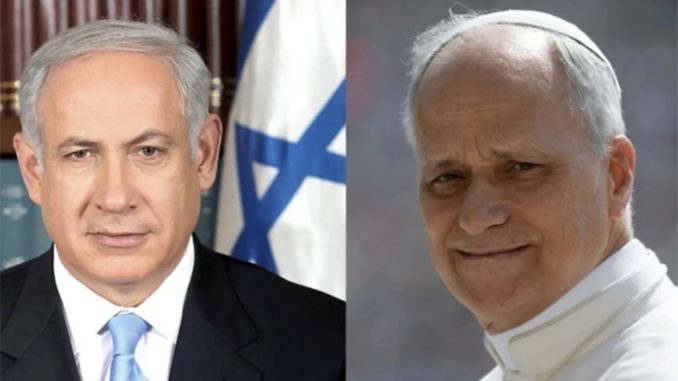
So Netanyahu called Pope Leo, eh?
Would it be too much trouble to let us know what Netanyahu said to him?
Yes, bineyman, it’s reported that a call was made but then tells us nothing of substance. A waste of precious ink.
I wonder why Leo XIV doesn’t ask Netanyahu to send his foreign minister to Castelgondolfo for a meeting with the leader of Hamas to end the ighting? Leo should invite the leader of Hamas.
“Fragments of a projectile”? Looks like a direct hit. The Church is completely destroyed. Well they’ve been itching to get rid of it since the war started. Never mind, There’s probably somebody sheltering there who might say something rude about Tel Aviv in the future. Prevention is better than cure, eh? Come to think of it, there’s probably people in Tierra del Fuego or Timbuctu who might also say rude things. Perhaps they need a few bombs too. Words are so hard to bear. Oh dear.
Yes, it was a direct hit from an explosive (i.e. shrapnel-filled) tank shell.
Israel is employing its usual diabolical sophistry (“the unaimed shrapnel did it!”) to excuse itself.
Diabolical?
If the problem that developed in Nigeria is because of a direct deliberate withholding of intelligence by Israelis, noticing it as it becomes apparent would not be from “hating Israel” or from being a “hate Israel firster”. If the US also has been withholding it doesn’t mean reacting against that is being hateful of the US.
I am skeptical of Israel’s explanation of the attack being an “accident”. They gave the same excuse, when they deliberately and intentionally attacked the USS Liberty and killed our sailors.
Why does the American media give so little coverage to these all
too frequent “mistakes” by the Israeli military forces”?
The Judophobia is strong in this comment section.
Pius XII did say we were all spiritual Semites, but he rejected Zionism, and Tel Aviv’s jurisdiction over Jerusalem, which remain the Church’s positions to this day. The Church began diplomatic relations with Tel Aviv a few decades ago (as did the Palestinians), but only as recognition of a political situation on the ground, not as a Jewish state per se. Catholics (unlike certain evangelical groups) ought to keep to the Church’s official, constant position on this issue; it’s based on faith, not politics. The Church has supported a two state solution (outside Jerusalem) ever since it became an option. The continuation of the war in Gaza for years after Gaza’s foray outside itself was defeated, has only one purpose – to make a two state solution impossible. But a just war does not entitle even an aggrieved party to annihilate another nation by ethnic cleansing.
But the main question the Christian West should be asking is: what about our sacred places? What about the Christians in Palestine? That should be the focus of our tears and anger.
I do not particularly care to embrace the political positions of any pontiff, as they are far outside the realm of his infallibility and are frequently outside the realm of good sense.
(Incidentally, you are thinking of Pius XI, not XII, as the pontiff of “spiritually we are all Semites”.)
In a word, “the Church’s” (really “the Vatican’s”) position on Zionism and the two-state solution and jurisdiction over Jerusalem is not authoritative for Catholics and enjoys all the sense of the Vatican’s position on the United Nations. A two-state solution was feasible eighty years ago and was rejected by the Arabs. The idea that it will work now is pure geopolitical folly. Israel has a better historical claim to Judea and Samaria than it does to the Mediterranean coast, and any Palestinian state would unquestionably be either a state sponsor of terror or ineffective in stopping it.
You parrot the common blood libel of “ethnic cleansing” (and it is blood libel), blissfully ignorant of the requirements of urban warfare and apparently of the large Arab Israeli population.
The war in Gaza is to destroy one of the most notorious terror organizations in the world. It is every bit as jest as the Allied crusade against Nazism or Japanese militarism.
It is furthermore fallacious to claim that the war in Gaza has or will make a two-state solution impossible. Hamas made it impossible by showing what a Palestinian state would do.
Thank you Spiritual Semite for stating the facts of the matter with brevity and clarity. Hamas, by their shocking actions over many years now have clearly demonstrated with hideous clarity that the ‘2 state solution’ is an absolute impossibility. A lot of contributors to this thread need to ask themselves why it is that to this day no Arab state has taken in a single refugee from Gaza.
Good post, Mr. Cervantes, an excellent summary.
There is no ethnic cleansing taking place, and it’s inappropriate to make that false accusation. The Palestinians have consistently rejected a two state solution, so their situation is largely their own doing.
It almost never fails.
Let’s not call it a phobia, but what it is: hatred.
It’s a disorder I believe. Scapegoats provide a rationalization for our failures. It’s easier to blame others for life’s disappointments and our own weaknesses.
I had a family member who ended up like that. Everything wrong with the world became the fault of Jews and immigrants. It’s sad.
I really hope the pope will also urge the release of Israeli civilian hostages.
I stand corrected. Saying a two-state solution is impossible because of the regime in the smaller part of Palestine, Gaza, is Luke saying that a German star was forever impossible because of the Nazi regime. Hamas was defeated is conventional warfare a few weeks into the conflict. That it is still able to conduct guerilla warfare is no teaspn the ethnically cleanse Gaza. If you affirm this, then you affirm that the English would have been right to ethnically cleanse the Irish, who continued for many generations to conduct rather deadly guerilla campaigns against the occupation and its local allies. These campaigns repeatedly killed far more than the 400 civilians and 300 soldiers Hamas did three years ago, and which you seem to consider a kind of Year Zero.
The Catholic Church’s position on Zionism and Zionism’s jurisdiction over Jerusalem isn’t politics, as you claim. Catholicism can’t identify the OT people with a Mitteleuropan political movement based on secular nationalism. Nor would it identify the OT state with contemporary Orthodox Judaism. The only claim Tel Aviv can have is its might is right notion, which the Vatican accommodates with its support for a two-state solution. This solution is politics, yes, and leaves untouched the Church’s position on Zionism and jurisdiction over Jerusalem.
Your second paragraph is risible bunk. The Church has no authority whatever to declaim on a geopolitical solution to the Zionist question. If anything, she can only affirm the special relationship of the Jewish nation to its land.
Your first paragraph repeats again the malicious lie that Israel is interested in “ethnically cleansing” Gaza, then compounds this with the military nonsense that counterinsurgency must under my view necessitate or justify such “cleansing.” This is preposterous. Military operations can and do, however, often necessitate urban warfare to uproot an entrenched enemy. You ought to familiarize yourself with military history.
“Catholicism can’t identify the OT people with a Mitteleuropan political movement based on secular nationalism. Nor would it identify the OT state with contemporary Orthodox Judaism. ”
**********
I don’t think Israelis are over-concerned about what some Catholics may believe about this. Attempting to assimilate & placate the prevailing class is what doomed many German Jews. It was a fool’s errand. Jews have always been the perfect scapegoat & Israel has been the only place they can feel relatively safe. Even there they still have to watch their backs.
The discussion with the other writer only concerned Catholic views on the issue. We are allowed to have views and discuss them? Thanks there.
The Vatican is a sovereign state which recognise other states if it chooses.The Church can and must try to intervene in secular affairs when higher principles are seriously violated by civil societies. It always has.
Netanyahoo’s Deight at Trump’s proposal to deport Gaza’s population only confirmed what his policies on the ground are doing. Do you agree that the removal of Gaza’s population to other countries would be immoral?
I can’t tell who your question is addressed to Mr Cervantes, but I personally believe Gaza should be completely evacuated. It’s unsafe for human habitation. To keep civilians there in harm’s way is immoral. But every civilian death scores Hamas propaganda points so they have no incentive to encourage the people to leave.
It’s unlikely any people would consent to being ethnically cleansed. The bravery of the Palestinians is incredible.
Jews have survived a very long history of attempts to exterminate and “ethnically cleanse ” them. They’ve know the reality of those words. Not the political invention.
Gaza needs to be evacuated ASAP and the hostages released. But Hamas has no incentive to do that because their sources of revenue would dry up.
The incredibly brave Palestinians of Gaza don’t need to be ethnically cleansed.
To call the Palestinians “brave” is, in the main, a despicable misuse of the word. The true bravery lies with the Israeli people and their righteous war.
The voluntary emigration of Palestinians from Gaza is certainly not immoral and would be excellent politics.
If you seriously believe their exit would be voluntary, there’s little point discussing the issue. But do you believe the removal of Gaza’s population to other countries would be moral? Last chance to give a straight answer.