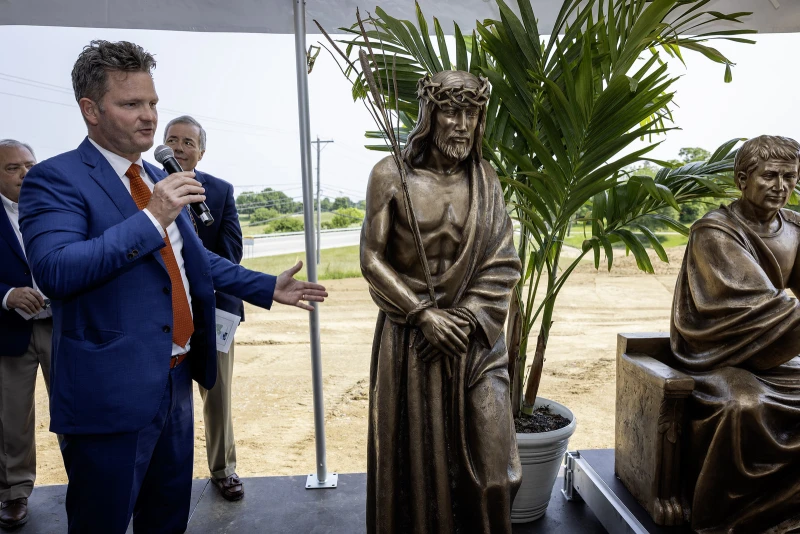
A life-sized statue of Christ is displayed at the site of the Stations of the Cross garden in Maysville, Kentucky, Tuesday, June 3, 2025. / Credit: Tammie Brown Photography
CNA Staff, Jun 22, 2025 / 06:00 am (CNA).
Catholics in northeastern Kentucky will soon be able to follow the passion of Christ in life-sized form thanks to the efforts of a longtime state politician.
Jerry Lundergan, a fixture in Kentucky Democratic politics for decades, is aiming to have the Stations of the Cross and meditation garden in Maysville open by Easter of next year.
He told CNA he purchased the property about 15 years ago. The parcel of land is next to St. Patrick’s Cemetery; Lundergan himself attended St. Patrick School in Maysville from first through 12th grades.
“The cemetery’s always been very important to me, because that’s where my great-great grandparents, my grandparents, my parents, all my aunts and uncles — they’re all buried there,” he said. Several members of the Clooney family, including George Clooney’s aunt Rosemary, are buried there as well, he noted.
The reproduction of the Via Dolorosa curves through the property of the life-sized Stations of the Cross, in Maysville, Kentucky, Tuesday, June 3, 2025. Credit: Tammie Brown Photography
Lundergan said he had dreams of turning the property into a meditation garden in honor of the Blessed Virgin, to whom he’s always had a special devotion.
But “I never did do it,” he admitted. “It was my plan, but you get busy doing other things, and a dream you had sort of fades away.”
Several years ago, shortly after getting out of prison for campaign finance violations, Lundergan said he decided to finally get the property built. He and his wife spoke with others around the country who developed meditation gardens. While speaking to a friend in Ohio who runs a religious goods store, Lundergan said she asked him if he had ever considered a Stations of the Cross installation.
“In church, they’re little 2-by-2 plaques molded to the wall,” Lundergan said. “That’s not what I wanted to do. I wanted a nice garden where you can walk, with a few statues, and you end up at a grotto for the Blessed Mother.”
His friend suggested the idea that instead of plaques, the stations be made as fully life-sized sculptures.
“Now, that got my attention,” he said with a laugh.
A life-sized reproduction of Pontius Pilate washing his hands sits in the Stations of the Cross display in Maysville, Kentucky, Tuesday, June 3, 2025. Credit: Tammie Brown Photography
Italian-made sculptures on a Via Dolorosa
Armed with that vision, Lundergan said he sought out a sculptor who could bring full-sized depictions of Christ’s passion and crucifixion to life.
“We chose Reto Demetz,” he said. The Demetz Art Studio bills itself as “one of the worldwide leading studios that manufactures ecclesiastical art.” The business is located in Gardena, Italy, though Lundergan said that Reto Demetz has been to Maysville twice.
In addition to the sculptures, the garden will feature a pathway that imitates the Via Dolorosa, the “Way of Suffering” that Christ walked in Jerusalem while carrying his cross toward his crucifixion.
“We also came up with the idea that we would build a cross in the center of the garden,” Lundergan said. The cross will consist of “four steel columns, seven stories tall,” with the columns representing the four Gospels.
Notably, the cross will be built and positioned in such a way that, during the Easter season, it will project shadows onto the 13th Station of the Cross depicting Christ’s crucifixion.
Nine of the stations have already been sculpted and shipped to Maysville, Lundergan said. The aim is to have the facility open by Easter 2026.
Jerry Lundergan (left) and others pose with statutes of Christ and Pontius Pilate in Maysville, Kentucky, Tuesday, June 3, 2025. Credit: Tammie Brown Photography
Lundergan acknowledged that he’s “done very well in life, financially.” The property and installation, he said, will be given back to the Diocese of Covington. “My hope is that once we give it back [that] they’ll use that money for the upkeep of the garden and the cemetery, and then the church and the Catholic school.”
He said he aspires for visitors to the installation to “see the torture and the suffering Jesus experienced on this walk, and how he gave up his life for us.”
“It’s my hope that this garden is open to any denomination,” he said. “If you believe in the Crucifixion, you’ll want to come see it. Methodist, Baptist, anybody — it’s not just for Catholics.”
“This is for everybody that really wants to rethink their purpose here on Earth,” he said. “Why we’re here, and why we should be preparing ourselves for life afterward.”
If you value the news and views Catholic World Report provides, please consider donating to support our efforts. Your contribution will help us continue to make CWR available to all readers worldwide for free, without a subscription. Thank you for your generosity!
Click here for more information on donating to CWR. Click here to sign up for our newsletter.
Washington D.C., May 18, 2023 / 09:45 am (CNA).
A report that reviewed the policies of 75 major American corporations found rampant disregard for religious freedom and free speech in virtually every comp… […]
Buffalo, N.Y., Nov 2, 2018 / 05:01 pm (CNA).- The Bishop of Buffalo said Friday that although he admits he mishandled allegations of sexual abuse involving adults, he maintains that his “record handling misconduct allegations with children is good.”
Bishop Richard Malone said the diocese has never failed an annual audit determining if the diocese is in compliance with the 2002 Charter for the Protection of Young People.
“I still will say until my dying day: I have not made that mistake in dealing with allegations with children…My mistakes were when [allegations] came in involving an adult,” the bishop said.
Malone spoke Nov. 2 on local radio station WBEN, apologizing to victims and telling radio hosts that he does not plan to resign, despite the presence this morning of several protestors outside diocesan headquarters calling for his resignation. Malone is more than two years away from submitting his resignation on his 75th birthday, as required by canon law.
“There have been times through this whole horrible scenario when I’ve been embarrassed to be a bishop,” Malone said.
“The leadership of the Church has often not responded adequately to this crisis, and in response to victims, and I do get it…I just tell people of faith to focus on Jesus, and count on that.”
Questions about past cases
Malone was questioned about the case of Fr. Art Smith, who was placed on leave in 2011 after the mother of a boy at St. Mary of the Lake school complained that the priest was sending inappropriate Facebook messages to her son.
While Malone’s predecessor suspended Smith, Malone reinstated him in 2012, after the accused priest spent time in a Philadelphia treatment center, according to an investigation by local news station WKBW.
“Maybe I could have looked at it in a different way,” Malone said.
“We had decided with Art Smith— because, again, the Facebook incident did not rise technically to be sexual abuse— to keep him in some limited ministry,” Malone told WBEN.
Malone pointed out that he did not again assign Smith to a parish setting. Despite this, the WKBW investigation revealed that while working in nursing home, Smith heard confessions at a diocesan Catholic youth conference attended by hundreds of teenagers in 2013. There were also reports of inappropriate conduct with adults in the nursing home.
“That backfired, too, because even sending him to work in a nursing home…nothing happened with children, but there were some inappropriate actions with adults. So we were dealing with him, but not in a way that I would do now. I admit my failure there,” the bishop said.
He also signed off for Smith to become a chaplain on a cruise ship in 2015, and the bishop said now he is “kicking [himself] for that.”
In another case discussed up by the WBEN hosts, Father Robert Yetter was accused of misconduct during 2017-18. After an allegation surfacted, he met with Buffalo auxiliary bishop Edward Grosz, who referred him for counseling.
After another allegation was leveled against Yetter in Aug. 2018, Malone placed him on administrative leave, but reportedly wrote in an email: “We have no obligation, I believe, to report to [the media] or anyone else on adult misconduct allegations.” Neither canon law nor the state law of New York would have required Malone formally to report an allegation of sexual contact with an adult by a cleric.
Responding to a whistleblower
During the Nov. 2 interview, Malone also was asked about a recent “60 Minutes” interview with former diocesan employee Siobhan O’Connor, who leaked internal documents from the bishop’s office that purported to show that the diocese knowingly omitted some priests from a list it published in March of clergy credibly accused of sexual abuse.
Malone said he believed no laws were broken when the documents were leaked, and that he trusted O’Connor followed her conscience in doing what she did.
Malone also responded to a specific claim made in the “60 Minutes” report, saying he does not know of any priests currently in ministry in the diocese who have “allegations of any sort of assault” against children.
“I will maintain with the clearest of consciences that there are not eight or nine priests [in the diocese] with allegations of abuse of a minor. “60 Minutes” reported that, and it is false,” Malone said.
“Tell us who they are. If they’re out there and they’re guilty of abuse, tell me and I’ll pull them out.”
Recent and current investigations
Malone did not specify whether he was considering allegations against currently active priests that had not been deemed credible.
The diocese conducted an investigation in June resulting in three priests being being placed on administrative leave, but allegations against Fr. Dennis Riter were found not to be credible, according to local media, and he was returned to ministry at a parish in Dunkirk, New York.
Independent investigator Scott Riordan and the diocesan review board conducted the investigation, but reportedly did not give a public explanation as to why the allegations were not found to be credible.
In June lawyers representing Riter’s alleged victims called his reinstatement a “startling and dangerous decision” and the alleged victims filed a lawsuit against the bishop and the diocese, claiming the diocese was engaged in an effort to hide the names of accused priests from the public.
The diocese announced Oct. 31 that it had placed Fr. Michael Juran on administrative leave after receiving a credible allegation of sexual abuse against him. The current lay investigator for the diocese, Steven Halter, was an FBI special agent for more than 27 years and worked with the Buffalo FBI Evidence Response Team to investigate the 9/11 terrorist attacks.
Malone said that since 2001, all diocese have been required to report all credible allegations of sexual abuse to the Vatican, but added that before he became bishop in 2012, that didn’t always happen in the Buffalo diocese. He said he wished to ask his predecessors why that was the case.
Before Nov. 2, the diocese was not required to report by local prosecutors to civil authorities any allegation of sexual abuse made more than five years after it happened, and more than five years after the victim’s 18th birthday. The Erie County District Attorney has now changed changed a 2003 memorandum of understanding with the diocese, and it is required to report those cases.
Legatus President Stephen Henley is pictured here speaking at the organization’s 2025 annual conference last month in Naples, Florida. / Credit: Courtesy of Legatus
Miami, Fla., Mar 13, 2025 / 07:20 am (CNA).
In today’s culture, often hostile to expressions of faith, many Catholics struggle with how to hold true to their values within the workplace. That’s why, in 1987, Domino’s Pizza founder Tom Monaghan started the Catholic organization Legatus.
From the Latin word for “ambassador,” Legatus aims to empower Catholic presidents, CEOs, and managing partners to become what St. Paul coined “ambassadors for Christ,” explained Stephen Henley, president of Legatus.
Offering peer support groups, networking, speakers, pilgrimages, and an annual international summit, Legatus’s goal is to “inspire members to live out their faith in all aspects of their life.” There are currently about 90 Legatus chapters in North America.
Chapter meetings are held once a month, providing the opportunity for members and their spouses to participate in confession and Mass, the recitation of the rosary, a cocktail reception dinner, and a speaker’s presentation.
“All of this is to help fortify the members’ marriage, the peer support group, the networking of this group, and then embolden them to go out and live their faith,” said Henley. “Tom felt that if we can bring together these Catholic CEOs, how much more can we change society with these people that have high impact and high influence?”
In interviews with Catholic News Agency, Hawkins, Dean Abela, and Henley covered three tips for bringing the Catholic worldview into the workplace.
Commit to your priorities
Dean Andrew Abela’s Catholic faith wasn’t always as important to him as it is now. As a teenager, he even stopped practicing.
“I came back in my mid-20s, funnily enough, while I was in business school,” he recalled. As a student in 1991, he encountered Pope John Paul II’s new encyclical letter Centesimus Annus, and the pope’s reflection on economics changed the trajectory of his life.
“Just a few months after, I returned to the Church,” he said. “When I reverted to the faith, I wanted to know what my newly rediscovered Catholic faith meant for a life in business.”
Andrew Abela is dean of the Busch School of Business at The Catholic University of America. Credit: Legatus
After working for companies including Procter & Gamble, McKinsey & Company, and the Corporate Executive Board, in 2002 Dean Abela eventually began teaching at the Catholic University of America. He is also a consultant to Fortune 100 corporations.
“The reason I left business and switched to academia was that I wanted to dedicate myself full-time to studying questions about what it means to be a faithful Catholic in the workplace,” he explained.
A member of Legatus since 2000, Dean Abela mentioned that members can follow what the organization terms a “spiritual plan” to attend daily Mass, recite the rosary daily, and do monthly confession.
Known as Tres Magna, or the “Big Three,” this plan was inspired by Miami Dolphins head coach Don Shula, who “attributed the perfect season to him going to daily Mass,” explained Stephen Henley. “Tom [Monaghan] thought, well, if he can go, there’s no reason why I can’t go.”
“Daily Mass, daily rosary, and monthly confession will align your life and priorities,” added Henley.
Find a supportive community
When Kristan Hawkins first encountered Legatus, she was not a Catholic. Hawkins was raised an Evangelical. After Students for Life’s 2006 launch, she began speaking at Legatus events.
In 2014, Hawkins decided to visit the Basilica of Our Lady of Guadalupe in Mexico City, “a pilgrimage Legatus had sponsored.” “I was the only Protestant there,” she recalled. “I decided there that I was going to enter RCIA.”
She became a full-fledged member of Legatus soon after becoming Catholic.
“As a pro-life activist who starts a pro-life organization, I want to save babies, I want to end abortion, I want to help as many families and women. You don’t start a non-profit because you’re necessarily a great business leader or have all these skills. You started this non-profit, this mission, because you want to see this mission accomplished,” Hawkins said. “For me, that’s one of the powerful benefits of being in Legatus, is having friends and mentors who were successful in the for-profit world who I can call on and ask questions.”
Students for Life of America President Kristan Hawkins. Credit: Legatus
“It’s very powerful and important to have those relationships. For me, in the work I’m doing, it’s a constant spiritual attack,” she added. “One of the best things about Legatus is I can call any of my Legatus friends at any moment, and they’ll be there for you. They know the power of the work we do and the resistance we face.”
Dean Abela also finds a sense of community in Legatus and also strives to build a supportive Catholic community at the Catholic University of America.
“We share with students the principles of Catholic social doctrine, things like human dignity and solidarity, and try to embed these principles into all of our classes,” he explained. “We’re also increasingly trying to give them opportunities to practice different virtues as part of their studies and schoolwork.”
For instance, Dean Abela explained, “To teach graduate students about decision-making, we go through a couple of survivor simulations, where you crash land in the north of Canada and you have to decide what you’re going to do. We have them go through decision-making exercises explicitly practicing the virtue of prudence or practical wisdom, the habit of making wise decisions. We break apart the components of practical wisdom, which include things like alertness, preparedness, and reasoning, and we have them try to exercise those as part of the decision-making process.”
These skills built in the classroom can be applied not only in business, but also in students’ personal lives.
Model the behavior you expect from others and celebrate your co-workers’ integrity
For Henley, giving authentic witness to the Catholic faith in the workplace can start with a simple “hello.”
“First, live the golden rule,” he said. “When you’re walking down the hall, say hello to the janitor, to the executive, and to everyone in between. It matters a lot.”
He added: “Another practical thing: take the opportunity to pray before meals. If you’re going on business lunches, you’ll be surprised at how many people say, ‘Yeah of course, let’s pray.’ It’s more common than not for people to pray before meals. The fact that you’re doing it shows that you’re a bold leader and that you’re spiritual.”
Dean Abela agrees that these types of habits make all the difference, and were the subject of the presentation he made of his book Superhabits: The Universal System for a Successful Life last month during the 2025 Legatus Summit.
“The main focus of the book is understanding that things like diligence, honesty, and resilience are not genetic characteristics. They are habits that anyone can acquire through practice,” Dean Abela explained. “Companies can focus on one of the most important virtues and give employees opportunities to practice those virtues.”
For instance, Dean Abela explained the GrowVirtue App, an AI-driven app “based on the work of the book,” which organizations can use to evaluate which virtues their company has already made a habit of, which virtues they might target, and tips for how to make progress.
“The important thing is that the company would choose a virtue that they think would be directly beneficial to the company right now,” said Dean Abela. “Although personal results are private, the whole company can see what employees as a whole are weakest in. So, if you’re trying to grow in customer service, you might encourage the virtue of friendship or friendliness.”
Dean Abela discussed the value of recognizing virtue both inside and outside the company.
“See examples in action or read about examples,” he suggested. “You can have employees watch videos or you can share articles that demonstrate examples of a particular virtue in action. And you can make sure senior folks are role models for junior employees.”
“Most importantly, give the employees the opportunity to practice the virtues, and give feedback,” he added. “When companies give awards, they tend to do this more with core values. They should shift to core virtues and give it to people who are exemplars of that virtue.”
Ultimately, the goal for Catholics is to live authentic lives that draw others to Christ.
“Stay true to who you are, don’t give in,” said Hawkins. “They’ll know you by your fruits. I think that’s very important. You don’t have to work in the pro-life movement or specifically in an apostolate to be a good Catholic, a faithful Christian in the workplace. You can do that in any job, in any position you have – in McDonald’s or in a Fortune 500 company.”
Leave a Reply
