


CNA Newsroom, Jun 19, 2025 / 10:06 am (CNA).
Pope Leo XIV has named Bishop Shane Mackinlay — an influential voice in the Synod on Synodality — as the next archbishop of Brisbane, Australia.
The 60-year-old prelate succeeds Archbishop Mark Coleridge, who is retiring after 13 years of episcopal leadership.
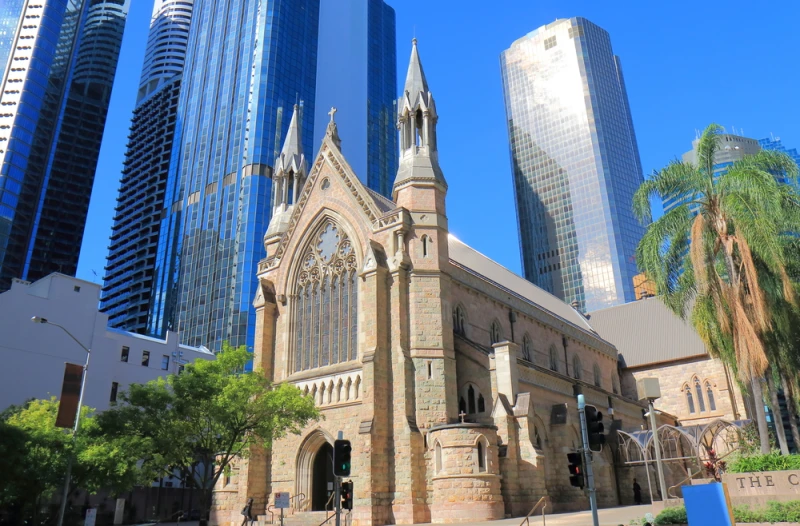
Mackinlay will be installed at St. Stephen’s Cathedral on Sept. 11, taking pastoral responsibility for Australia’s second-largest diocese, which includes over 684,000 Catholics across 94 parishes in southeastern Queensland.
During his first visit to Brisbane following the announcement, Mackinlay emphasized the importance of missionary clarity in a society increasingly indifferent to religious belief.
“We need to be clear and unembarrassed about our faith — and about why it matters to us,” he told the Catholic Leader.
Quoting Christ’s invitation to the first disciples, he added: “I don’t think we should be telling people what to do. We should be inviting people to come and see, and offering a witness that is attractive and compelling.”
A synodal voice in the global Church
Born in Melbourne in 1965, Mackinlay studied physics at Monash University. He later pursued doctoral studies in philosophy at the Catholic University of Leuven in Belgium, where he completed his dissertation on hermeneutics.
Ordained a priest for the Diocese of Ballarat in 1991, Mackinlay served in parish ministry before being appointed master of Catholic Theological College in Melbourne, a role he held from 2011 to 2019. That year, Pope Francis named him bishop of Sandhurst, based in Bendigo.
Mackinlay has played an increasingly visible role in synodal processes. As a prominent member of Australia’s Fifth Plenary Council and a delegate to the Synod on Synodality in Rome, he was elected by his fellow bishops to the Commission for the Synthesis Report — the body tasked with drafting the final synod document.
Mackinlay has expressed willingness to engage with questions under discernment, including the possibility of admitting women to the diaconate. He told the National Catholic Reporter in 2023 that he would “welcome” such a development if it were eventually approved by competent ecclesial authority.
On questions related to pastoral outreach, Mackinlay emphasized fidelity to the Church’s doctrine alongside authentic personal accompaniment. Reflecting on discussions concerning Catholics who identify as LGBT, he stated that there was a “very clear reaffirmation of the Church’s doctrine and teachings” at the synod, while also recognizing the need for pastoral care that respects individual dignity and encourages conversion in light of Christ’s truth.
In 2023, Mackinlay participated as an official observer of the German Synodal Way.
In an interview with German Catholic media outlet Domradio in April of this year, he expressed “great respect” for the approach of the controversial German process and praised the Synodal Way’s “findings and documents” as “a very enriching source for the theology of the coming years and decades.”
Firepower and competence
Brisbane’s retiring archbishop welcomed the appointment of his successor, describing Mackinlay as “an unusually gifted man” whose strengths lie in both intellectual clarity and administrative competence.
“He has a fine mind and will bring intellectual firepower to his ministry,” Coleridge said. “He will be able to dialogue intelligently with a culture that, at many points, is distant from Christian understandings.”
Archbishop Timothy Costelloe, president of the Australian Catholic Bishops Conference, also welcomed the appointment, noting Mackinlay’s theological background, experience in seminary formation, and his leadership in Sandhurst.
If you value the news and views Catholic World Report provides, please consider donating to support our efforts. Your contribution will help us continue to make CWR available to all readers worldwide for free, without a subscription. Thank you for your generosity!
Click here for more information on donating to CWR. Click here to sign up for our newsletter.


Sounds a bit on the sketchy side
Stan above – Ditto. Time will tell.
“In an interview with German Catholic media outlet Domradio in April of this year, he [Mackinlay] expressed great respect for the approach of the controversial German [Der Synodaler Weg] process and praised the Synodal Way’s findings and documents as a very enriching source for the theology of the coming years and decades” (AC Wimmer for CNA).
CNA’s Bavarian Anion Christoph Wimmer knows a Synodaler Weg guy when he sees one.
It’s hard to digest this appointment. Tell me His Holiness Leo is not a dyed in the wool Bergoglio disciple. Tell me that, as suggested, he isn’t smilingly, silently letting his Bergoglioism slip through under our lying eyes.
Sorry, I cannot tell you this because of the growing body of the facts – tiny, grey area facts but being seen together they create a coherent picture. For example, the bishop Shane Mackinlay who was promoted to be the archbishop of Brisbane did the following:
“BENDIGO, Australia (LifeSiteNews, 23 April 2025) — An Australian cathedral will be hosting an obscene art exhibit that features a Hindu idol with the bishop’s approval beginning this week.
The “Transcendence” exhibit, part of “The Wands” series of exhibits, features a Hindu deity with five “wands” and resembles a tarot card. With Bishop Shane Mackinlay’s permission, the exhibit is scheduled to be on display at Bendigo’s Sacred Heart Cathedral for the next three months.
The “Transcendence” exhibit is meant to “embody the tension between the earthly materiality and the spiritual,” according to “The Wands” website.”
This event caused quite a stir among Catholics over there (and a few Orthodox as well). What is interesting: the figurine was placed directly beneath the Stations of the Cross while representing its own stations – thus creating parallels, “Christian truth” – “something else”, the letter being impotent without the former. It is like a constant parasitic reference. Interestingly it was done in the Sacred Heart Cathedral and the bishop Shane Mackinlay was made the archbishop in the month of the Sacred Heart – I am not saying that was done deliberately at all but it adds to the collage. It is always a collage created by incoherent actions of the people who lost a sense of what is appropriate for the Church and what is not. They should have known but they don’t; being confronted they just don’t get it. It puzzled me until I understood that most of such people display an impairment of empathy and attachment. If one is attached to Christ, he will not condone something that offends Him; if he is attached to/cares about his parishioners, he will not condone it as well. This lack of empathy/feelings shows itself literally every sickness in the Church: in child abuse, in prosecution of TLM goers, etc.
Recently, there was a sacrilegious performance in the Roman Catholic Cathedral in Westphalia, which involved dancers dressed as neopagan priests/priestesses walking/playing with/“partaking from” dead chicken dressed in diapers treating them both as “meat” and as children. There was also a clear reference to the Eucharist (“flesh”). It was very cleverly done; I could make a paper about the symbolism of that performance. Basically, it was about a triumph of death: doing away with the very notion of children – parenthood and, most importantly, with psychological normality/an attachment. It was a triumph of psychopathy over an attachment and love, incredibly necrophiliac. However, it would be nothing really if it was not taken a place in the catholic cathedral, in front of the consecrated altar, next to the paschal candle which symbolizes Christ – and with the local archbishop and other prelates who did not protest. Judging by the photos and video, he did not mind it at all. Thus, in effect catholic clergy took a place in a necrophiliac performance. Without them there it would not be as potent.
Some Catholics later demanded re-consecration of the cathedral and rightly so; as far as I know their demand was not granted. The chancery later issued some weak squeak “we are sorry for upsetting religious feeling”. Hence, they (including the archbishop) saw no offense to God and to the sacred place by that performance. Implicitly they said “we are OK but we are sorry that some of you got upset”. Speaking otherwise, they confirmed both that God is dead and they themselves are dead. All that was accomplished via their inability to feel/lack an attachment to God about whom they preach and to the people to whom they preach their synodal way”. They are indeed walking dead. (Noteworthy, the performance was targeting not just Christianity but the Life as such hence no need to be Christian to protest.)
And so, the new archbishop of Brisbane is very fond of the “German synodal way” which involves sacrilege as a part of its practice (there are abundant materials about what is going on in German churches; much involves images). In fact, he himself condoned it.
I am not thrilled with this news (of the election of the archbishop) at all. However, I had no doubts about Pope Leo since the very day despite his “niceness”.
He features a dual facial expression of serenity and discontent. That impression was disturbing. At first I thought it was imagined, my prejudiced cynicism. What followed is the seriously pensive, smiling man saying the right things making horrendous appointments beginning with Cdl Baldissare Reina, a devotee of Pope Francis as grand chancellor of the John Paul II Theological Institute for Marriage and Family Sciences.
That followed by the appointment of Msgr Renzo Pegoraro, Paglia’s duplicate assistant as president of the Pontifical Academy for Life. Now the appointment of Shane Mackinlay as archbishop to Brisbane.
What he presents in appearance and says contrasts direly with appointments to the dicasteries that affect the family. The very center of cultural life and Church. Needless to say I’m troubled by this man. I agree with your observations Anna.
Wishing His Grace Bishop Shane Mackinlay and his flock divine blessings.