




CNA Staff, May 29, 2025 / 12:42 pm (CNA).
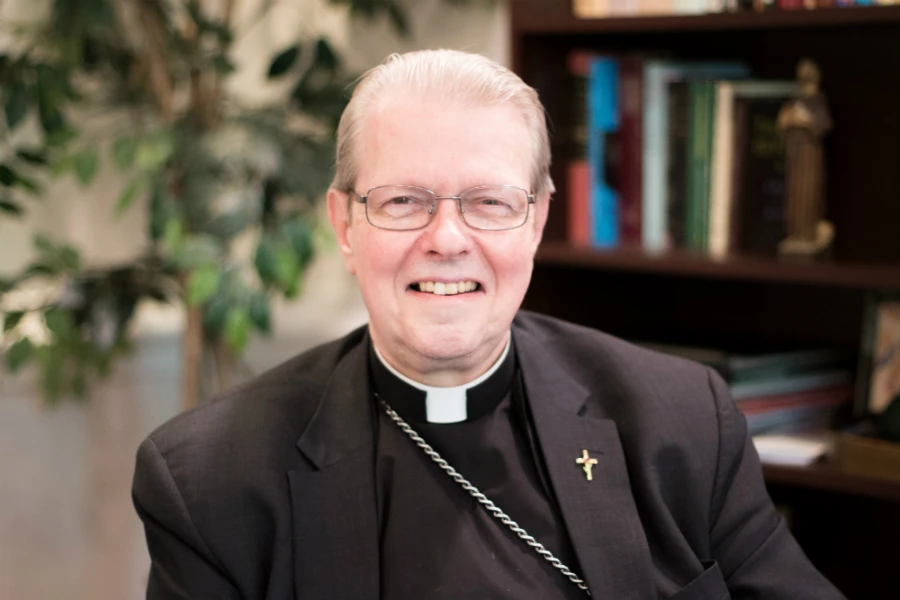
A leaked draft from Charlotte, North Carolina, Bishop Michael Martin, OFM Conv, shows the prelate’s far-reaching and highly detailed intent to crack down on what he describes as “older liturgical practices” in order to bring about “a more uniform celebration of the Mass” in the diocese.
The lengthy letter was first published by the blog Rorate Caeli; officials with the diocese subsequently confirmed the authenticity of the letter to the National Catholic Register, CNA’s sister news partner.
The letter, which references Pope Francis in the present tense, appears to have been written prior to the late pontiff’s death last month.
Its leak, meanwhile, comes after the Charlotte Diocese announced that it would significantly restrict the practice of the Traditional Latin Mass, limiting it to a single chapel in what Martin said was a bid to “promote the concord and unity of the Church.”
Regulations on altar candles, women’s veils, and more
The document details an extensive list of behaviors and practices that Martin said would be tightly regulated or else abolished going forward in an effort at “purifying and unifying the celebration of the Mass.”
Among the directives: Celebrants are to place candles “arranged around the altar” during Mass “since placing them on the altar will always obstruct the vision of the faithful.”
As well, priests are directed to not offer “vesting or devesting prayers” either before or after Mass, as there is “no option given in the current liturgical books” for such practices. Rather, “prayerful preparation before Mass and thanksgiving after Mass is to take place in some other way.”
Women who choose to wear veils during Mass “are not to do so when they are assisting in any official capacity,” such as when lectoring or cantoring, the document states.
Parishes will be forbidden from using bells to signal the start of Mass, the directives say; rather, a “verbal welcome” by the lector “followed by an indication of the hymn to be sung and an invitation to stand” should be normative at all Masses.
At times the document seems to run afoul of other, authoritative Church directives. Martin at one point writes that the Church “does not … call for the Latin language to be used widely in the liturgy,” and that the ancient language “diminishes the role of the laity in the Mass.” Yet guidance from the U.S. Conference of Catholic Bishops explicitly states that “care should be taken to foster the role of Latin in the liturgy,” with the bishops even going so far to state that singers and choir directors should “deepen their familiarity with the Latin language.”
The bishop’s order that candles are “always to be arranged around the altar,” meanwhile, explicitly cites the General Instruction on the Roman Missal (GIRM), but the relevant portion of that document does not forbid placing candles at the front of the altar.
The intensively detailed list has drawn criticism and backlash from some commentators. Matthew Hazell, a British liturgy scholar, told the Register that Martin’s perspective was consistent with what Pope Benedict XVI famously described as a “hermeneutic of discontinuity and rupture.”
“Rather than allow the novus ordo to be celebrated in a manner in keeping with its own rubrics and with the Church’s tradition, Bishop Martin seems to see it as an entirely new creation that cannot even be seen to have anything in common with what came before,” Hazell told the Register.
Father Paul Hedman, a priest from the Archdiocese of St. Paul and Minneapolis, similarly criticized the directives, writing on X that the document appears to be “banning things explicitly allowed in the GIRM and explicitly called for in Vatican II.”
“He denigrates the practice of using water and wine for purification of the vessels,” Hedman wrote, but the GIRM “explicitly allows this.”
The bishop “presumes the ability to regulate the private prayer of the priest before Mass,” the priest wrote further. “This is simply ridiculous and — I do not use this [word] lightly — tyrannical.”
Though the guidelines have generated intense debate and criticism, the diocese told the Register that the document was “an early draft” and is still being debated by diocesan leadership.
“It represented a starting point to update our liturgical norms and methods of catechesis for receiving the Eucharist,” a diocesan spokeswoman said, adding that the directives will be “thoroughly reviewed” prior to their official promulgation.
If you value the news and views Catholic World Report provides, please consider donating to support our efforts. Your contribution will help us continue to make CWR available to all readers worldwide for free, without a subscription. Thank you for your generosity!
Click here for more information on donating to CWR. Click here to sign up for our newsletter.



Dr. Mirus at Catholic Culture weighs in, and I offer a sample:
“I am willing to wager a good deal that Bishop Martin is a vigorous proponent of the adaptation and indigenization of the liturgy for cultures which have strong attachments to different ways of doing things. Therefore, I will assume without presenting arguments that there is something he vigorously dislikes about any attachment to the liturgical form which has been the most universal form ever in the history of the Church. It would be unwarranted to draw further inferences, but it seems to me that at least a related question is permissible: Have we seen, historically speaking, that this particular animus very often goes hand-in-hand with a dislike of various aspects of Catholic faith and morals which have been even more universal throughout the history of the Church?”
https://www.catholicculture.org/commentary/bishop-martin-and-personal-liturgical-preferences/
Pope Leo should reassign Bishop Martin to Gaza and replace him with Bishop Strickland.
That would be very interesting.
🙂
Especially since one of Cardinal Prevost’s first actions as head of the Bishops Dicastery was to retire Bp Strickland.
I wonder what the pope was thinking when he assigned him. It sounds a lot like the new Archbishop got. he she dowm all the Latin church in the archdiocese of Detroit and had devicec up the archdiocese inot four sections and it you want to go to a Latin mass you have to go to 4 very small churches that fit anywhere for i00 people or less to mayby 6oo at best.
It is time for Pope Leo to act against any bishop who would move to suppress the Catholic Mass.
One wonders – is Bishop Martin related to Fr. James Martin?
Grace a Dieu I don’t live there and my pity and prayers go to the Catholics who do live there.
This is the work of Cupich & Co. (and, ultimately, Bergoglio). The People of God must rise up and stop the deconstruction of our Catholic Faith by a handful of hateful, often homosexual, prelates and priests.
The old latin forms were the first established by men long ago. That does not mean that they are the ONLY permissable forms. Today they are valued predominantly by those in rebellion against Vatican II. People who fear change. Whatever is alive constantly changes. Only death is static with no further change.
“Today they are valued predominantly by those in rebellion against Vatican II.”
Vatican II: “Particular law remaining in force, the use of the Latin language is to be preserved in the Latin rites.” (Sacrosanctum Concilium, 36. 1., the Council’s “Constitution on the Sacred Liturgy”).
“Whatever is alive constantly changes.”
Yet God, who is the Source and Author of all life, does not change. “I the Lord do not change” (Mal 3:6).
And the very nature of liturgy does not change, even if there are certain variations in language, rubrics, etc., that can change (similar to how dogma does not change, but disciplines can change, depending on various factors). Thus: “For the liturgy is made up of immutable elements divinely instituted, and of elements subject to change” (SC, 21).
It’s best to know a bit about what you are discussing before opining too broadly and irresponsibly.
About “whatever is alive constantly changes,” Cardinal Newman (the “father of Vatican II”) changed all that:
“In a higher world it is otherwise, but here below to live is to change [!], and to be perfect is to have changed often. [BUT, from the preceding sentences!] “[great ideas, or principles] reappear under new forms. It changes with [controversies] IN ORDER TO REMAIN THE SAME” (“The Development of Christian Doctrine,” Ch. 1, Sec. 1).
SUMMARY: Constant change is the deepest rut of all.
Yo!
Can you prove that nothing changes after death?
On the purely physical/material level, many changes occur to a human body after death. The Catholic doctrine of purgatory teaches that human souls are purified of stains of sin after death. The Church also teaches of pains of hell and various levels of beatitude attending one’s entrance into heaven.
Carl’s conclusion is seconded.
“People who fear change” do not exist, and people who fear the reality that truth never changes fear the wrath of God, thus they have a need to create the fiction that the mind of God, the source of all truth, is fungible. They fear honoring unchanging received truth, innate to our existence, for good reason.
this bishop seems to be controlled by the evil one
Micromanagement and could be considered mean spirited.
I have not attended a Latin Mass in more than 60 years, so I dont have a dog in this fight. But I am not opposed to the Latin Mass and I would say this Bishop is way out of line. A Bishop should not be a dictator. And thus far no Pope has outlawed this Mass. So who does this Bishop think he is?
I hope the people of his diocese shut their wallets VERY tightly immediately, and vote with their feet to attend Mass elsewhere. Eventually the Vatican will want to know why that diocese is going bankrupt. Hopefully then they will remove him from his present office and send him to a monastery to think for a while about the damage he is doing to the church. It is amazing that one prideful Bishop can prevent thousands of Catholics from using their preferred form of worship.
This document by the bishop is simply the true face of Synodality. Every bishop will create a new mass and interpretation of the Catholic faith based on the lived experience of the people of God. Faith based on the rule of the mob.
German Archbishop authorizes blasphemous dance at ancient cathedral:
https://www.breitbart.com/europe/2025/05/30/fowl-behavior-chickens-in-diapers-dance-performance-at-westphalia-cathedral-blasted-as-blasphemous/
Chickens in Diapers Dance Performance at Westphalia Cathedral Blasted as ‘Blasphemous’
I hope that those people who are restricted from attending the great Latin mass rise up and march down to that cathedral and protests against that out of order bishop . How dares he to stop a good thing He will pay for his extreme mistake and he should be forced to retire . Keep your money in your wallets for good deeds do not give to his parish. When he can’t pay the bills he will bend to the will of the flock . Amen
I could write a book to express my anger, but reactions for which I would hope, at the least, invite the question, are there no feminists in N.C who would take the opportunity to tell the bishop how vile is his condescension that would presume to tell women how to dress?
We have a sign outside the entrance of our church that tells both men and women how to dress. I’m all for dress codes in sacred places but usually those encourage modesty and decorum. It seems very odd to insist on the opposite.
I understand your point. I was keying on his contempt for the very idea of his implicit contempt for veils.
I constructed that sentence wrong, which I shouldn’t do when I’m half asleep. The bishop obviously doesn’t have contempt for his own ideas. He should be more prudent, but he seems to be lacking here. I simply meant to critique his contempt for veils worn by women, unworthy for a bishop.