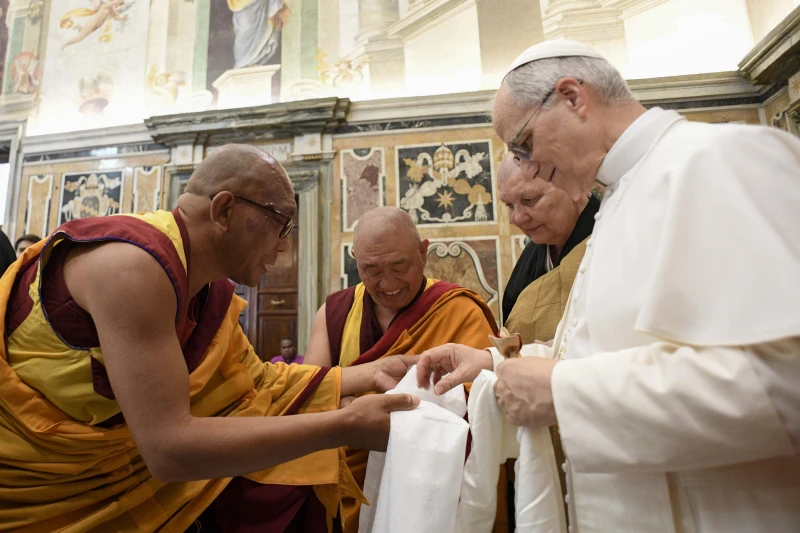
Pope Leo XIV greets Buddhist monks in a meeting with representatives of other Christian churches, ecclessial communities, and other religions on May 19, 2025, at the Vatican. / Credit: Vatican Media
Rome Newsroom, May 27, 2025 / 15:36 pm (CNA).
The Vatican commenced its eighth Buddhist-Christian Colloquium on Tuesday in Cambodia, bringing together representatives of both religions to discuss the promotion of peace in Asia.
Prefect for the Dicastery for Interreligious Dialogue Cardinal George Koovakad delivered a short speech on the first day of the May 27–29 conference on “Buddhists and Christians Working Together for Peace through Reconciliation and Resilience,” highlighting the significance of the two religions’ common commitment to peace, Vatican News reported.
“Together, as Buddhists and Christians, let us explore how reconciliation and resilience can help shape peaceful and compassionate societies,” Koovakad said on Tuesday.
Approximately 150 people from Cambodia and abroad are participating in the three-day meeting organized by the Vatican’s Dicastery for Interreligious Dialogue, the Apostolic Vicariate of Phnom Penh, Saint Paul Institute, Preah Sihanouk Raja Buddhist University, and the MAGGA Jesuit Research Center.
Among the Catholic conference participants are bishops and priests from 16 Asian nations, including Mongolia, Vietnam, Myanmar, South Korea, Taiwan, and Sri Lanka.
Throughout the three-day conference, Christians and Buddhists have the opportunity to reflect on the stories of peace, reconciliation, and resilience found in the Bible’s Old and New Testaments and in Buddhist writings, including the Pāḷi Tipiṭaka and the Mahayana Sutras.
A statement released by the dicastery earlier this week said this year’s meeting is a “timely reminder of the power of religion” in fostering healing and hope in a world ravaged by conflict and violence.
According to the dicastery’s statement, Cambodia was chosen to host the international interreligious gathering to honor the legacy of the late Maha Ghosananda, a Buddhist monk who spiritually ministered to refugees during the country’s 1975–1979 Khmer Rouge communist regime led by Pol Pot.
Since 1995, the Vatican has held a series of Buddhist-Christian meetings in different countries to advance mutual understanding and collaboration between the Church and non-Christian religions in the spirit of Pope Paul VI’s Second Vatican Council declaration Nostra Aetate released in 1965.
The last Buddhist-Christian Colloquium in 2023 was held in Bangkok and focused on the theme of “healing a wounded humanity and the earth.”
If you value the news and views Catholic World Report provides, please consider donating to support our efforts. Your contribution will help us continue to make CWR available to all readers worldwide for free, without a subscription. Thank you for your generosity!
Click here for more information on donating to CWR. Click here to sign up for our newsletter.
Bishop Stephen Chow’s ordination as bishop in Hong Kong’s Cathedral of the Immaculate Conception Dec. 5, 2021 / Screenshot from livestream
Rome Newsroom, Dec 4, 2021 / 03:00 am (CNA).
Bishop Stephen Chow Sau-yan was ordained a bishop in Hong Kong’s Cathedral of the Immaculate Conception on Saturday.
“As a successor to the Apostles by the grace of Almighty God, I request your constant prayers that I may always be loyal to God’s will as a shepherd to the People of God in Hong Kong, and faithfully carry out my duties,” Chow said at the Mass on Dec. 4.
Cardinal John Tong Hon, the apostolic administrator of Hong Kong, presided over the Mass. Cardinal Joseph Zen and auxiliary Bishop Joseph Ha were co-celebrants.
“Through the Bishop’s wisdom and prudence, it is Christ himself who leads you in your earthly pilgrimage toward eternal happiness,” Tong said in his homily, according to the diocese of Hong Kong.
“He has been entrusted with the task of bearing witness to the truth of the Gospel, and with the ministry of the Spirit and of justice,” he said.
During the Mass, Chow laid face down on the floor in total surrender to God as the congregation recited the Litany of the Saints in Cantonese.
Bishop Chow said in a brief speech at the end of the Mass that he wanted to help “foster healing and connections” in the Catholic community in his “beloved hometown.”
“As the bishop, it is my desire to be a bridge between the government and the church in Hong Kong and between the Catholic Church, fellow Christian denominations, and other religions,” he said.
“It is through sincere connection with one another, including within our own diocese that emphatic understanding can be established, appreciation can be fostered, respect and trust can be deepened, and hopefully collaboration can become a living culture in our community.”
Chow also read aloud an excerpt from a letter that he recently received from Archbishop Terrence Prendergast, S.J. The archbishop emeritus of Ottawa-Cornwall wrote: “Given the history of the church in China and Hong Kong, Catholicism can no longer be seen as a foreign religion, but as integral to Hong Kong society.”
More than 6,000 people tuned in live to watch Chow’s consecration Mass on YouTube.
Among those watching the livestream were priests and seminarians in Italy from the Pontifical Institute of Foreign Missions (PIME), who have launched a prayer campaign for the newly consecrated bishop.
Father Gianni Criveller, who is helping to organize the campaign at the PIME missionary seminary in the Italian city of Monza, told UCA News that he knows that Bishop Chow will face “great difficulties and challenges.”
“The long-awaited consecration of the bishop calls for prayer and solidarity. Bishop Stephen has a very difficult task ahead of him humanly. In fact, it seems nearly impossible. However, we believe in the power of prayer and in the communion of those who entrust their lives to the Lord Jesus,” he said.
Pope Francis appointed Chow to be bishop of Hong Kong in May. Before his appointment, Hong Kong had been without a permanent bishop since January 2019.
Chow, 62, previously served as the provincial of the Jesuits’ Chinese Province. In that role, he led the Jesuit order in Taiwan, Hong Kong, Macau, and mainland China as the Vatican-China deal was first signed and during the crackdown on Hong Kong’s democracy protest movement.
Born in Hong Kong in 1959, Chow went on to study in the United States, earning a bachelor’s and master’s degree in psychology from the University of Minnesota, before entering the Society of Jesus in Dublin, Ireland at the age of 25.
During his Jesuit novitiate, he obtained a licentiate in philosophy in Ireland and then returned in 1988 to Hong Kong, where he was ordained to the priesthood on July 16, 1994.
Chow continued his studies at Loyola University in Chicago, where he earned a master’s degree in organizational development in 1995. He spent the next five years working as a campus minister, vocations director, and ethics teacher at Wah Yan College in Kowloon and Hong Kong.
In 2000, Chow began a doctoral program at Harvard University’s Graduate School of Education studying development and psychology. He graduated with a Doctorate in Education in 2006.
The following year, he made his final vows in the Jesuit order and worked as an assistant professor at the University of Hong Kong from 2008 to 2015 and Jesuit Formator from 2009 to 2017. He also served as the president of the Chinese Jesuit Province’s education commission since 2009 and the Hong Kong Diocesan Council for Education since 2017.
Chow began his role as provincial of the Chinese Province of the Society of Jesus on Jan. 1, 2018.
Hong Kong is a special administrative region of China. Hong Kongers have historically enjoyed freedom of worship and evangelization, while in mainland China, by contrast, there is a long history of persecution for Christians who run afoul of the government.
With the 2020 passage of new “national security laws,” the Chinese government seized more power to suppress pro-democracy protests in Hong Kong, which it sees as a direct challenge to its power.
Hong Kong’s National Security Law is broad in its definitions of terrorism, sedition, and foreign collusion. Under the law, a person who is convicted of the aforementioned crimes will receive a minimum of 10 years in prison, with the possibility of a life sentence.
On April 16, authorities in Hong Kong sentenced several Catholic pro-democracy figures, including lawyer Martin Lee and media tycoon Jimmy Lai, to prison sentences under the new security law.
“Hong Kong is going through perhaps the most dramatic phase of its history and has almost disappeared from the radar of international attention. However, those who love Hong Kong have not forgotten it,” Criveller said.
CNA Staff, Feb 26, 2021 / 06:05 am (CNA).- Australia’s Catholic bishops on Thursday issued a working document ahead of the first assembly of a landmark plenary council in October.
The text, released on Feb. 25, will inform discussions … […]
Manila, Philippines, Mar 20, 2017 / 08:01 pm (CNA/EWTN News).- Remember what Jesus’ cross stands for, and don’t misuse the Bible to justify the death penalty, the Philippines’ Catholic bishops have said.
“To the people who use the Bible to defend the death penalty, need we point out how many other crimes against humanity have been justified, using the same Bible?” the country’s bishops asked.
“We humbly enjoin them to interpret the Scriptures properly, to read them as a progressive revelation of God’s will to humankind, with its ultimate fulfillment in Jesus Christ, God’s definitive Word to the world.”
Their words came in a March 19 pastoral statement on the death penalty signed by Archbishop Socrates B. Villegas of Lingayen Dagupan, president of the Catholic Bishops’ Conference of the Philippines. The statement was read at all Masses in the country on Sunday.
Jesus came not to abolish the law, but fulfill it, the bishops explained: “Jesus was never an advocate of any form of ‘legal killing’. He defended the adulterous woman against those who demanded her blood and challenged those who were without sin among them to be the first to cast a stone on her.”
The letter opened with a quotation from St. Paul’s Letter to the Romans: “God proved his love for us that while we were still sinners, Christ died for us.”
The death penalty was abolished in the Philippines in 2006. At present President Rodrigo Duterte, who is also leading a brutal crackdown on drugs, has advocated its restoration.
In their letter, the Catholic bishops recounted the passage of a House of Representatives bill that would restore the death penalty.
“It was Ash Wednesday when members of the lower House, on the second reading of the death penalty bill, outvoted by voice-voting the nays with their ayes. Ironically, they were captured on television shouting in favor of death with their foreheads marked with crosses made of ashes,” the bishops said.
“Could they have forgotten what that cross meant?”
They questioned whether the legislators had missed that the crosses on their foreheads “were supposed to serve as a loud statement of faith in the God who, for love of us, chose to give up his life for our salvation, rather than see us perish.”
According to the bishops, the saying of the Bible, “an eye for an eye, a tooth for a tooth” was challenged by Jesus, who advocated non-retaliation of evil for evil and justice founded on mercy.
“Even with the best of intentions, capital punishment has never been proven effective as a deterrent to crime,” they continued. “Obviously it is easier to eliminate criminals than to get rid of the root causes of criminality in society. Capital punishment and a flawed legal system are always a lethal mix. “
The statement also spoke about the victims.
“We are not deaf to the cries of the victims of heinous crimes. The victims and their victimizers are both our brothers and sisters. The victim and the opressor are both children of God,” they said.
They said the guilty should repent and make reparation for their sins. The bishops offered love, compassion and hope to crime victims.
The death penalty will be applied more to the poor, who cannot afford adequate legal defenses, the bishops said.
“As a law, death penalty directly contradicts the principle of inalienability of the basic human right to life, which is enshrined in most constitutions of countries that signed the universal declaration of human rights,” they said.
The Philippines bishops called for prayers for the country’s legislators.
“Let us offer all our Masses for them, asking our Crucified Lord who offered his whole life, body and blood, for the salvation of sinners, to touch their consciences and lead them to abolish capital punishment once and for all,” they said.
Leave a Reply
