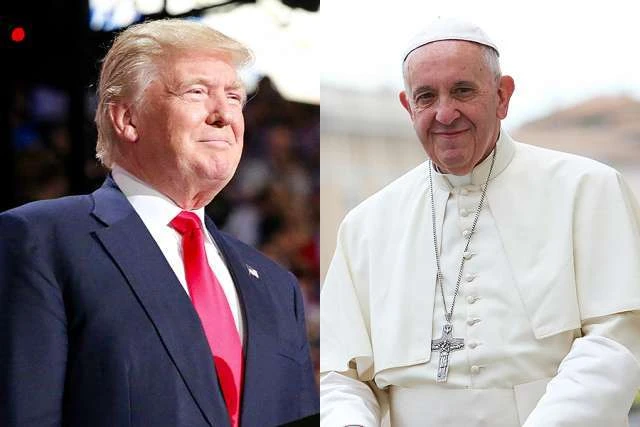
Vatican City, Jan 20, 2017 / 10:58 am (CNA/EWTN News).- Pope Francis congratulated Donald Trump on his inauguration as the 45th president of the United States on Friday, praying that God will grant him wisdom and strength.
“At a time when our human family is beset by grave humanitarian crises demanding farsighted and united political responses, I pray that your decisions will be guided by the rich spiritual and ethical values that have shaped the history of the American people and your nation’s commitment to the advancement of human dignity and freedom worldwide,” the Pope wrote in his Jan. 20 message sent to Trump.
“Under your leadership, may America’s stature continue to be measured above all by its concern for the poor, the outcast and those in need who, like Lazarus, stand before our door. With these sentiments, I ask the Lord to grant you and your family, and all the beloved American people, his blessings of peace, concord and every material and spiritual prosperity.”
During his inaugural address, Trump vowed to be a voice for the “forgotten people” of the United States. “We assembled here today are issuing a new decree to be heard in every city, in every foreign capital and in every hall of power. From this day forward, a new vision will govern our land. From this day forward, it’s going to be only America first – America first,” Trump stated.
“We will seek friendship and goodwill with the nations of the world. But we do so with the understanding that it is the right of all nations to put their own interests first,” the new president said. “We do not seek to impose our way of life on anyone but rather to let it shine as an example. We will shine for everyone to follow.”
In November Trump pulled off what was for many a surprising victory in the U.S. presidential election. Though he was widely seen as the underdog, Trump came out on top with 289 electoral votes, well over the required 270 needed to win.
While the tone of Francis’ congratulatory note was warm and optimistic, many, Catholics in particular, fear there could be tension between the Pope and the new president when it comes to immigration.
Reservations about the topic trail back to comments Pope Francis made during his Feb. 19 inflight news conference en route from Juarez to Rome responding to criticism of Trump, who had called Francis “political” and threatened to build a wall along the U.S.-Mexican border.
“A person who thinks only about building walls, wherever they may be, and not building bridges, is not Christian. This is not in the Gospel,” the Pope had said, prompting former Vatican spokesman Fr. Federico Lombardi to release a statement the next day assuring the Pope’s comment “was never intended to be, in any way, a personal attack or an indication of how to vote.”
Pope Francis has been an outspoken supporter of migrants’ rights and the need to build bridges rather than walls.
During his visit to Mexico, he celebrated Mass near the U.S.-Mexico border, where Trump’s wall would go up, in a show of support to the many South and Central American migrants, including thousands of unaccompanied minors, cross each day, many of whom are seeking to escape situations of poverty, drugs and violence.
After news of Trump’s election broke in Europe, Vatican Secretary of State Cardinal Pietro Parolin offered his prayers that the president-elect would promote peace in a world torn by conflict, but said that when it comes to immigration, we can’t predict the future.
“We take note with respect the will of the American people in this exercise of democracy which they tell me was characterized by a large turnout. Then we congratulate the new president, so that his government can be truly fruitful,” the cardinal told Vatican Radio Nov. 9.
He assured of his prayers, “so that the Lord illuminate him and sustain him in the service of his homeland, naturally, but also of the peace and wellbeing of the world…today it is needed for everyone to work to change the global situation, which is a situation of serious laceration and grave conflict.”
When asked how the Vatican responded to Trump’s inflammatory comments about building a wall, Cardinal Parolin said we must wait to “see how the president moves.”
“Normally they say: it’s one thing to be a candidate, it’s another thing to be president, to have a responsibility,” he said.
But when it comes to specific issues and how Trump will act on them, “we will see what choices he makes and according to that you can also make a judgment,” Parolin said, adding that “it seems premature to make judgments.”
Although Trump’s fiery campaign rhetoric has been problematic in the past, outgoing U.S. Ambassador to the Holy See Ken Hackett told CNA last week that he believes the new president will leave that sort of language behind.
“It would only be speculation, but what I do expect is that the rhetoric of the campaign will be put behind him and the reality of governing will kick in very soon,” he said.
Governing “calls you to be your best, to weigh decisions, to listen to advice, to play the role on the world’s stage that the United States has played and is capable of playing,” he said, voicing optimism that that “good will prevail” and Trump will “take the best advice that’s offered to him.”
When asked whether he anticipates the topic being problematic for relations between the Trump administration and the Holy See, Hackett said “no government agrees with another government on everything.”
However, there’s “no more dynamic, moral leader in the world than Pope Francis at this moment in time, so I think you better find a way to engage, and I’m sure the Trump administration will.”
 […]
[…]




I think that, instead of singing hymns, we would have more success getting the congregation to participate if we brought soccer balls to Mass and kicked them up and down the aisles. And the parishes wouldn’t need to pay for a pipe organ and its maintenance, or any other keyboard or instrument, or a cantor or a music minister!
Sadly, I’m actually serious about this.
I am a pianist/organist who has played all my life since childhood in Protestant churches and in several Catholic parishes in my hometown. When I moved to a new Big City after my husband passed away, I assumed that these “City Folks” would be great singers and musicians, but they’re aren’t, and neither are the suburb or rural folks.
I don’t think anyone sings anymore except when they sing along with their popular music.
I think getting Catholics in the congregation to “sing out!” is like trying to train cats! (I love cats and have a cat of my own.) Protestants at least try to warble along with their Praise and Worship team, but many of them don’t sing, either.
And even the large Catholic churches have tiny choirs (and very few men!) compared to the numbers of people sitting in the pews! Shouldn’t a parish that has several thousand members have at least a hundred people singing the choir!
Catholic friends tell me, “I sing!” But do they, really? I LOVE TO SING, and often, people, especially the children, in my parish turn around to stare at me when I am singing in a full voice, on pitch, and often singing the alto part (which isn’t written in our “missalette” hymns–grrr!!!! None of the parts are written out. Apparently, the hymnals, with four-part music scores, are too expensive and I’ve also heard that they’re “too heavy”. Sigh.
Once (just once), I heard a gentleman behind me singing the melody in a beautiful baritone voice, and after Mass, I told him he was a good singer. He sighed and told me, “This parish used to have a schola that all us schoolboys were part of, and we sang Gregorian chant and Latin, as well as the hymns in parts, and we loved singing. But now…” and he sighed again.
I wasn’t surprised. Once in my home parish, when my husband was still alive, and our daughters were home from college, all four of us sang the Mass hymns, and we sang all the parts (for those Catholics who don’t know what “parts” are–soprano, alto, tenor, bass)–and all the people in front of us turned around and stared at us!
Sadly, my current 150-year-old church nave has absolutely perfect acoustics. What a shame that the congregation doesn’t sing! It especially grieves me when I see the children just standing there. Their parents don’t even open the missalette to read the words of the hymn and show them to their children but just seem to be waiting until the hymn is over and they can sit down again.
When my daughters were growing up, I used to have them stand on the pews, and I would hold the hymnals open for them when they were too small to hold them and sing to THEM (as well as to God!) during the hymns so that they would learn the melody and the words. Since I was one of the pianists, I would have the schedule of hymns in advance and would often teach them to my daughters at home so they would know them on Sunday.
Both of my daughters were good singers because I TAUGHT them to sing and taught them the hymns, beginning with singing to them when they were babies, teaching them fun children’s songs when they were toddlers, keeping them away from pop and country music until they were older, and teaching them other music skills as they grew up. One of my daughters makes her living as a stage manager–she got her first job as stage manager of a professional ballet company because she knew how to read music! My other daughter is in a medical career, but she cantors at her large parish, and still plays piano, violin, and guitar just to relax!
My grandson, who will turn 4 soon, has already “written” 2 songs (ha ha!) and he often sings in a very loud monotone, but he’s getting there! He definitely loves music!
Amazing how many adults don’t know how to read music these days! And it’s even more amazing that kids can play soccer, but can’t read music, sing in a head voice, or have never sung in a choir because THEIR PARISH SCHOOL DOESN’T OFFER MUSIC!!!, and if they did, the children would choose a sports elective instead of a music elective.
No WONDER Hollywood and much of the professional entertainment world is so atheistic these days! (There are notable exceptions.)
I really hope that this music ignorance and avoidance will change in Catholic parishes as more Protestants convert to Catholicism (like my family did). It’s a shame that we have to drive into the city to the Basilica to hear good music–but even then, the congregation doesn’t sing. I don’t think they know how to sing. I don’t think many Catholics know how to sing. It’s really sad, considering that Paul and Silas sang hymns when they were imprisoned in chains, and that as the Early Church martyrs were marched into the arena, they sang hymns. I guess we’ll kick that soccer ball around on our way to the lions.
Latin Mass scholas are still in operation . I used to sing in one and we have an all male schola at our local Latin Mass down the road.
You’re blessed!
We are blessed here indeed Mrs. Sharon.
If our TLM community can leave the conspiracy narratives alone and just focus on Our Lord and the Mass we’ll be great shape. I love the music but had to take a break from some of the craziness.
People who feel demeaned and disregarded by the shepherds can start listening to some weird stuff. Hopefully our new pope will make the TLM more widely available and things will get back to normal.
When you force people to worship in bunkers is it any wonder when they adopt a bunker mentality?
🙂
I am guessing the younger generations are generally not trained in music well. (Schools in our area have cut those programs so administrators can be hired and the IT departments can be upgraded). I know I am not well trained. As a child, I was partially hard of hearing due to allergies. I remember being given a pitch test in elementary school. I did not receive a good score, and consequently was not invited into (or allowed into) the elementary’s school music program, which meant I didn’t take band or orchestra in Junior high or high school.
I can read standard music notation in both treble, clef, and alto clef (due to private piano and guitar instruction), but if you asked me to sing without the actual notes being played, I could not do that.
A month ago I strained my vocal chords and soft palate trying to do a Good Friday chant with the parish. Our parish is most elderly, and the voices are not strong. A gentleman in the parish reminds of this every now and then. He, of course, is well trained musically with a very good voice.
I agree with you that many students bypass music electives in schools (both public and parochial schools, and also home schools), often so that they can concentrate on the much-touted STEM courses and their guarantee of a high-paying job, and of course, on sports (with the hope of their parents that their child will earn a college scholarship if they are good in their sport(s).
It’s a shame that “money” is the motivation behind interest in STEM subjects.
Home-schooled students generally are either placed in music lessons or local choirs by parents, or the parents teach the music, which can work well if the parent is musical, but badly if the parent has no idea what they are doing. Many homeschool co-ops hire a music teacher, but even in home schools, if there are “electives,” many of the children select either STEM classes or Physical Education classes, not music.
I can understand the lack of requirement for music education in high school, but there is absolutely no excuse, IMO, especially in Catholic and other Christian schools (Protestant) for not having music (and other arts) taught in elementary school from Kindergarten through at least the 5th grade, and ideally, into Middle School as the boys (and girls, too, to a lesser extent) experience puberty and the “change” in their voices.
What we are seeing in churches, IMO, is the result of no music education, or inadequate music education. E.g., in several of the schools in my former city, the schoolchildren were learning to sing “Hip Hop” music and rap music, and bypassing the traditional music education that teaches them how to read a music score and how to sing in parts (usually only 2 parts in 5th through 8th grades in part because most of the boys have unchanged voices or are beginning to experience the awkwardness of voice change).
Thankfully, there are areas of the U.S. that still value music education and offer various music opportunities in the community. E.g., in my hometown, there is a Music Academy where many children and teens (especially those who are home-schooled) learn to sing and also play various musical instruments. Also, there are local community choirs that children and/or teens can join. The problem with these is that they generally cost a lot of money, which means that many children and teens do not have the financial resources to access these sources of music education. There are scholarships available, but these are not abundant, and are generally awarded to promising students, not just children and teens who want to sing in a choir. Sometimes churches offer children’s and teen choirs–African American churches generally do this with great success, and speaking of that, has anyone noticed how many talented musical superstars are African American in the U.S.–and most of them will tell fans that they got their musical start in CHURCH!?
We are short-changing our children and teens by not offering children’s and teens choirs in our parishes–thank goodness, some parishes still give children and teens the opportunity to sing in a choir at the Masses, but many don’t. I am not a certified music teacher, but I’ve had a lot of experience with children and music and have also written children’s songs (not published). I’m also a very good accompanist (piano). There are a lot of people in churches and parishes who are capable of leading a children’s or even teen choir, even if the singers just sing in unison.
My personal opinion is that without children’s and teen choirs, we will continue to see Mass music decline in quality and participation. Some people mistakenly blame the “banal” or “heretical” songs in the missalettes, and although I agree that we need to take a serious look at our missalettes and eliminate quite a few of the hymns that have questionable words or awkward tunes (with large intervals which are difficult to sin), but the silence that occurs in the congregation during the Mass hymns has more to do with lack of ability to read a musical line and sing on pitch in a head voice (not an octave below the score that makes the singing “growly”!)–skills that most children and teens (and adults, too!) are generally capable of doing with a little instruction. Of course, although I hate to suggest it, but I also think many adults believe that the Mass music just slows the Mass down and prevents them from enjoying their Sunday off work, hence their willingness to attend a Mass that has no music at all.
Shame on us for neglecting the praise of our God in our singing and playing of musical instruments during Mass! Psalm 150–maybe it should become a “Project” for Catholic parishes in the U.S.A!
I’ve sung in choirs all my life and have never sung the Regina Coeli.
You can bet I’ve looked it up now!
Singing the Regina Caeli is like experiencing a bit of Heaven. The tone, the Latin, and knowing it’s honoring the Queen of Heaven adds that special ‘umph’ to it. Plus, the Regina Caeli takes the place of the Angelus during the Easter Season.
The Regina Coeli (Caeli?) takes the place of the Angelus during the Easter season? Didn’t know that either.
Still so much to learn, so little time!