Pope Leo XIV meets with Italian tennis star Jannick Sinner on May 14, 2025, at the Vatican. / Credit: Vatican Media
CNA Staff, May 14, 2025 / 14:48 pm (CNA).
Pope Leo XIV met Italian tennis star Jannik Sinner at the Vatican on Wednesday.
Photos shared by Vatican News show the newly elected pope, who has described himself as “quite the amateur tennis player,” warmly greeting the 23-year-old Italian and his family as well as the president of the Italian Tennis Federation, Alberto Binaghi.
Sinner, who is ranked No. 1 in the world, is from a predominantly German-speaking region in Italy’s far north. He became the first Italian man to win a major tennis title since 1976 when he bested Daniil Medvedev at the Australian Open in 2024, earning kudos from the late Pope Francis.
Sinner is currently competing in the 2025 Italian Open, taking place in Rome.
Greeting the pope in a room off the Vatican’s Paul VI Audience Hall, Sinner presented Pope Leo with a tennis racket and ball and asked the pope in Italian if he wanted to play.
The pope responded: “Here we’ll break something. Best not to!”
Leo also joked that “Wimbledon would let” him compete in his white cassock, a reference to the famous rule at the All England Club tennis tournament that players must wear white.
The pope had previously been asked by journalists about whether he would like to play tennis again — perhaps a charity match — and “seemed game” but quipped that “we can’t invite Sinner,” in an apparent pun on the English meaning of Sinner’s last name, the AP reported Monday.
When asked about the pope’s comment, Sinner genially responded that it’s “a good thing for us tennis players” that Leo likes the sport and expressed openness to hitting with the pontiff in the future.
If you value the news and views Catholic World Report provides, please consider donating to support our efforts. Your contribution will help us continue to make CWR available to all readers worldwide for free, without a subscription. Thank you for your generosity!
Click here for more information on donating to CWR. Click here to sign up for our newsletter.
Vatican City, Mar 3, 2017 / 09:01 am (CNA/EWTN News).- Pope Francis and members of the Roman Curia leave Sunday to begin their annual five-day retreat on the spiritual exercises of St. Ignatius; since 2014, held at the Casa Divin Maestro retreat house.
Casa Divin Maestro, nestled away in the woods on Lake Albano, is just a short distance from the Papal summer residence at Castel Gandolfo in the town of Ariccia, some 16 miles outside of Rome.
One view from the retreat house encompasses the lake and the town of Castel Gandolfo; even the dome of St. Peter’s Basilica is visible in the distance.
The peace and serenity of the location reflects the mood Pope Francis wants to set for the entire retreat, Fr. Olinto Crespi told CNA.
“We know that the Pope does not rotate much: room, chapel, dining room. He speaks very little, even at the table. There is always a background of music and he himself stays silent,” he said. It is like “the real exercises of the school of St. Ignatius.”
Head of the household at Casa Divin Maestro, Fr. Crespi is one of five Pauline priests acting as “hosts” of the Holy Father and the Curia during the retreat. They are all “new” he said, so it will be the first time for all of them hosting the Holy Father.
The practice of the Pope going on retreat with the heads of Vatican dicasteries each Lent began some 80 years ago under Pope Paul XI. The spiritual exercises were held in the Vatican, but beginning in Lent 2014, Pope Francis chose to hold the retreat outside of Rome.
“Doing the exercises in the Vatican, at the time the meditation was given, each prelate went into his office. Therefore the Jesuit Pope wanted the exercises to be made in an atmosphere of recollection and prayer and they will do only the exercises,” Fr. Crespi said.
The five-day long retreat will include preaching on the Gospel of Matthew by Franciscan Fr. Giulio Michelini, selected by the Pope to preach for the occasion.
A typical day during the retreat begins with Mass followed by breakfast, Fr. Crespi said. They will then return to the chapel for the preaching by Fr. Michelini. After lunch they return to the chapel.
While many other groups that hold events at the house will gather in the auditorium, Fr. Crespi said that Pope Francis “wants to be alone in the chapel.”
“And this says further the climate that Francis wants to create,” he said. Even the Pauline Fathers of the retreat house “are asked not to disturb.”
The house has a good telephone line and good Wi-Fi, Fr. Crespi said, so there may be some time for cardinals to do a little work during the week if needed, but “the Pope himself sees very little. He is very reserved.”
Before Francis began going to Casa Divin Maestro for his annual spiritual exercises, the house was not unknown in the Vatican or to cardinals. Fr. Crespi believes that either the Pope heard of the place through word of mouth or perhaps he had even been there himself while still a cardinal.
“Even the Swiss Guards were here for a retreat,” he said. They would go on runs in the woods in the early mornings, which, he joked, “certainly the cardinals do not do.”
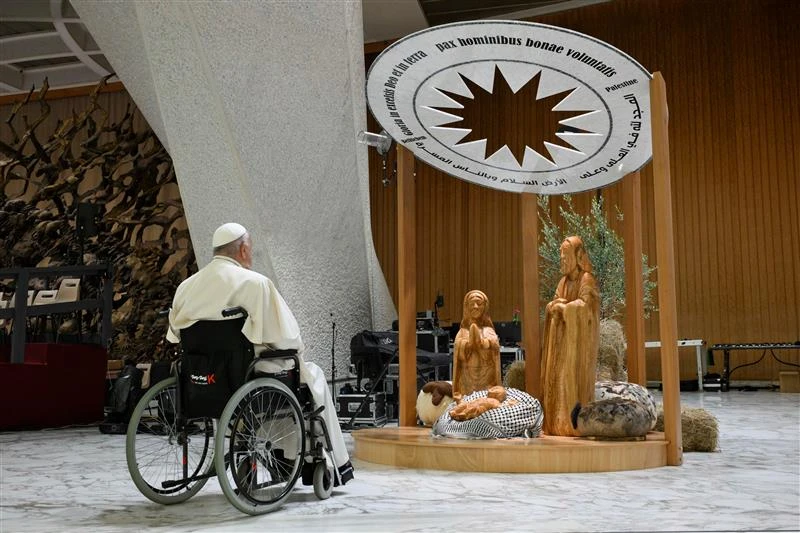
Pope Francis stops for a brief prayer in front of the Bethlehem Nativity in the Vatican’s Paul VI Hall during its presentation and a meeting with some of the people involved in its creation on Dec. 7, 2024. / Credit: Vatican Media
Vatican City, Dec 13, 2024 / 12:50 pm (CNA).
A Nativity scene made by artisans from Bethlehem was the source of controversy this week for including a Palestinian keffiyeh with the child Jesus in the manger — but according to the project’s organizer, the headscarf was a last-minute decision meant only to represent Palestinians.
The keffiyeh was visible during the presentation of the Bethlehem Nativity to Pope Francis in the Vatican’s Paul VI Hall on Dec. 7. By Dec. 11, four days later, the headscarf, manger, and Jesus sculpture had been removed from the scene without explanation.
Amid the Israel-Hamas war, the black-and-white checkered keffiyeh has become a symbol for the Palestinian cause. But Johny Andonia, a 39-year-old artist from Bethlehem who led the project, said it is just a symbol to represent or show the “existence” of Palestinians.
Matteo Bruni, director of the Holy See Press Office, told CNA the Vatican follows the tradition of placing the infant Jesus in the Nativity scene on the night of Christmas Eve. It is typical for the whole scene to be first presented to the pope before the Jesus statue is then removed, leaving behind the empty manger until the official start of Christmas.
Speaking to CNA by phone from Cyprus, where he has an art residency until May, Andonia said he did not expect the scale of the reaction to the keffiyeh, which he also signed off on, after it was approved by people at the Vatican during the Nativity’s installation on Dec. 5.
Johny Andonia. Credit: Beata Michalska
“It came about in a spontaneous way, actually, because we learned that the child baby Jesus has to be covered or even absent until the 24th of December, and [the on-the-ground coordinator] suggested to cover it with a keffiyeh,” the artist said on Dec. 13.
“And they said no, no, not to cover him. And then he asked, can I put it then under [the child Jesus] and the people … in charge at that time accepted laying the keffiyeh under the baby Jesus, and this is how it came about.”
Andonia said he does not agree with commentary from some quarters that the keffiyeh indicates violence or the eradication of others. “It’s only about recognition,” he said. “This keffiyeh represents the people who had presented the Nativity scene.”
He added that he does not think the Vatican will put the keffiyeh back when the manger and child Jesus are returned on Christmas Eve.
The Associated Press reported that the Israeli Embassy to the Holy See had declined to comment on whether it had complained about the keffiyeh or had asked for it to be removed.
Andonia, who is a physical artist and painter, was born in Jerusalem but has lived all his life in Bethlehem. He is a teacher at Dar al-Kalima University College of Art and Culture in Bethlehem.
After being contacted in April 2023 by the Palestinian Embassy to the Holy See in Rome about the idea for a Nativity from Bethlehem to be featured at the Vatican, Andonia said he decided to reach out to local artisans to create the structure from traditional materials, which he said have deep roots in the area, especially olive wood and mother-of-pearl.
The round, almost 10-foot-high installation, the work of over 30 artisans from Bethlehem, also incorporates stone, ceramics, glass, felt, and fabric.
Some evidence shows that the use of olive wood in Bethlehem dates back to the fourth century during the construction of the Basilica of the Nativity, Adonia said. And Franciscan monks introduced the use of mother-of-pearl in craftmaking to the area in the 17th century.
The Nativity is “a gift from the Bethlehemites,” he said.
Though not a religious person himself, the artist said being the bridge between the Vatican and the Bethlehem artisans has, nonetheless, been deeply meaningful for him.
“Most of [the people involved] were people of faith, and having their work at the Vatican with the pope, that was something [significant] for them,” he said.
“I’ve lived my life looking at people creating Nativity scenes, and they are proud of it, so it also meant something to me to be a part of it and give that opportunity to the individuals, and to support them even financially. The project was funded by the Palestinian Authorities, so it was also kind of a [financial] help, in this current situation, for them.”






‘Love the Sinner not the sin’ is a time-tested injunction in all religions.