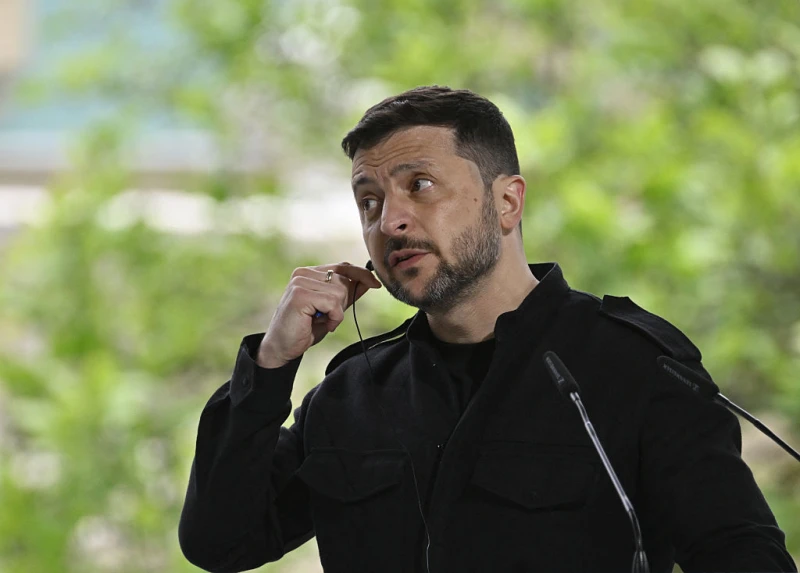
Ukrainian President Volodymyr Zelenskyy attends a press conference after a meeting of European leaders in the Ukrainian capital Kyiv on May 10, 2025. / Credit: GENYA SAVILOV/AFP via Getty Images
Vatican City, May 12, 2025 / 12:04 pm (CNA).
Pope Leo XIV and Ukrainian President Volodymyr Zelenskyy have spoken on the phone following the pontiff’s plea for lasting peace in the country, the Vatican said Monday.
Matteo Bruni, director of the Holy See Press Office, confirmed that the two leaders had spoken after the pope expressed concern for Ukraine during his Sunday address delivered from the central loggia of St. Peter’s Basilica.
“I carry in my heart the sufferings of the beloved Ukrainian people,” Pope Leo said on Sunday after singing the Regina Coeli prayer with approximately 100,000 people.
“May everything possible be done to reach an authentic, just, and lasting peace, as soon as possible,” the Holy Father continued. “Let all the prisoners be freed and the children return to their own families.”
On Monday morning, Zelenskyy shared a photo on X of him purportedly having a telephone call with the new head of the Catholic Church from his office.
“I spoke with Pope Leo XIV,” the Ukrainian president wrote on X. “It was our first conversation but already a very warm and truly substantive one.”
After expressing gratitude to the Holy Father “for his support for Ukraine and all our people,” Zelenskyy said he and the pope specifically discussed the plight of thousands of children deported by Russia.
“Ukraine counts on the Vatican’s assistance in bringing them home to their families,” Zelenskyy wrote on X.
Reiterating Ukraine’s commitment to work toward a “full and unconditional ceasefire” and the end of the war with Russia, the president said he also invited the Holy Father “to make an apostolic visit to Ukraine” during the phone call.
“Such a visit would bring real hope to all believers and to all our people,” he said. “We agreed to stay in contact and plan [an] in-person meeting in the near future.”
If you value the news and views Catholic World Report provides, please consider donating to support our efforts. Your contribution will help us continue to make CWR available to all readers worldwide for free, without a subscription. Thank you for your generosity!
Click here for more information on donating to CWR. Click here to sign up for our newsletter.
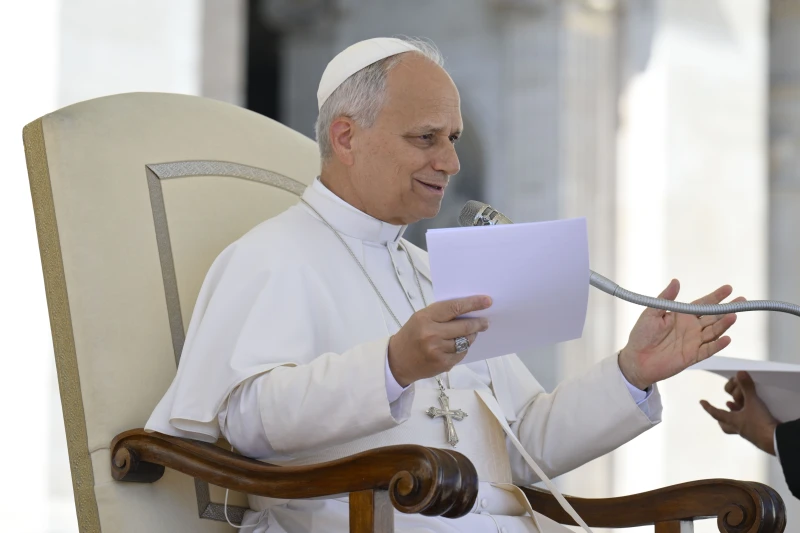
Pope Leo XIV addresses thousands of Church and civil lawyers, judges, and others who work in the legal environment during the Jubilee of Workers of Justice, part of the yearlong Jubilee of Hope, in St. Peter’s Square on Sept. 20, 2025. / Credit: Vatican Media.
Vatican City, Sep 20, 2025 / 10:30 am (CNA).
Forgiveness is fundamental to the virtue of justice, Pope Leo XIV said to thousands of legal professionals gathered in Rome for the Jubilee of Workers of Justice on Saturday.
“It is the power of forgiveness, which is proper to the commandment of love, that emerges as a constitutive element of a justice capable of combining the supernatural with the human,” the pope said in St. Peter’s Square on Sept. 20.
Leo, who has a doctorate in Church law, explained that the evangelical virtue of justice is not a distraction from human justice, but “questions and redesigns it: It provokes it to go even further, because it pushes it towards the search for reconciliation.”
“Evil, in fact, must not only be punished, but also repaired, and to this end, a profound gaze toward the good of individuals and the common good is necessary,” he urged Church and civil lawyers, judges, and others who work in the legal environment.
“This is an arduous task, but not impossible for those who, aware that they are performing a more demanding service than others, are committed to leading an irreproachable life,” the pope added.
Pope Leo XIV addresses thousands of legal professionals gathered in St. Peter’s Square for the Jubilee of Workers of Justice on Sept. 20, 2025. Credit: Vatican Media.
An estimated 20,000 people from 100 countries took part in the Jubilee of Workers of Justice, part of the yearlong Jubilee of Hope, including a large number of pilgrims from the United States and Canada. U.S. Supreme Court Justice Samuel Alito was also in attendance.
Joshua McCaig, a lawyer and founding president of the Catholic Bar Association, traveled to Rome for the jubilee with a delegation of over 50 legal professionals from the U.S.
He told EWTN News he hopes the event “will be an opportunity for us all to reflect on what more we can do for the common good.”
“The Catholic Church brings resources, brings hope, brings community, brings values that are instilled in the teachings of Jesus Christ to help all individuals — but also those in the legal profession — further develop an understanding of how this world should be and the role we should play in it,” he said.
Before the audience with the pope, Archbishop Juan Ignacio Arrieta, secretary of the Dicastery for Legislative Texts, gave a lecture on the theme of “Iustitia Imago Dei: the operator of justice, instrument of hope.”
“Those who administer justice in the Church must also be pastors. … They must respect justice, but they are pastors who must also watch over the good of souls,” Arrieta told EWTN News this week.
In his message, Pope Leo emphasized that the function of justice “is indispensable both for the orderly development of society and as a cardinal virtue that inspires and guides the conscience of every man and woman.”
“Striving for justice, therefore, requires being able to love it as a reality that can only be achieved through constant attention, radical disinterest, and assiduous discernment,” he said.
He noted that the Jubilee of Workers of Justice is a chance to also reflect on an overlooked aspect of justice, the reality that many countries and people “hunger and thirst for justice” because their living conditions are gravely unjust and inhuman.
The pontiff cited St. Augustine, calling the saint’s words “timeless truths” to apply to the current international situation.
“’Without justice,’” the pope quoted, “’the state cannot be administered; it is impossible to have law in a state where there is no true justice. An act performed according to law is certainly performed according to justice, and it is impossible to perform an act according to law that is performed against justice […] A state where there is no justice is not a state. Justice is, in fact, the virtue that distributes to each his due. Therefore, it is not human justice that takes man away from the true God.’”
“May the challenging words of St. Augustine inspire each of us to always express the exercise of justice in the service of the people to the best of our ability, with our gaze turned to God, so as to fully respect justice, law, and the dignity of persons,” Leo said.
Matteo Ciofi, EWTN News Nightly Vatican producer, and Victoria Cardiel, Vatican Correspondent for ACI Prensa/EWTN News, contributed to this report.
Vatican City, Nov 26, 2017 / 06:07 am (CNA/EWTN News).- On Sunday Pope Francis said that when the Final Judgment comes, what will matter most is how much we loved God and others, especially through daily, concrete acts of charity toward those most in need.
“At the end of our life we will be judged on love, that is, on our concrete commitment to love and serve Jesus in the least of our brothers and the needy,” the Pope said Nov. 26.
“Jesus will come at the end of time to judge all the nations, but he (also) comes to us every day, in so many ways, and asks us to welcome him.”
Pope Francis spoke to around 30,000 people gathered in St. Peter’s Square before leading the Angelus prayer. Celebrating the Solemnity of Christ the King, the Pope offered a reflection on the Last Judgment and Jesus’ “criteria” for entering the Kingdom of Heaven.
He explained how at the second coming, when Jesus appears “in divine glory,” he will summon all of humanity to him, separating the righteous from the unrighteous. And to the righteous he will say: “Come, blessed of my Father, receive as inheritance the kingdom prepared for you since the creation of the world.”
This is because: “I was hungry and you gave me food, I was thirsty and you gave me drink, I was a stranger and you welcomed me, naked and you dressed me, sick and you visited me, I was in prison and you came to see me.”
Francis noted how when Jesus speaks about the Final Judgment to his disciples, the men are surprised by his words, because they don’t remember meeting Jesus, let alone helping him in this way. So Jesus explains what he meant: “All you did to one of these the least of my brothers, you did to me.”
“This word never ceases to hit us,” Pope Francis said, “because it reveals to what extent God’s love comes to us: to the point of being identified with us, but not when we are well, when we are healthy and happy, no, but when we are in need.”
In this way Jesus reveals “the decisive criterion of his judgment,” the Pope said, which is “concrete love for the neighbor in distress.”
We should ask the Virgin Mary to help us to not only meet Jesus in his Word and in the Eucharist, he continued, but “at the same time in the brothers and sisters suffering from hunger, illness, oppression, and injustice.”
“May our hearts welcome him into our life today, for we are welcomed by him into the eternity of his Kingdom of Light and Peace.”
After the Angelus Pope Francis expressed his sorrow for the attack on a mosque in Sinai, Egypt on Nov. 24 which killed more than 230 people and wounded hundreds more.
“I continue to pray for the many victims, for the wounded and for the whole community, so severely affected. God frees us from these tragedies and sustains the efforts of all those who work for peace, concord, and coexistence,” he said.
Just as those people were praying at the time of the attack, he then asked for a moment of silent prayer for those affected by the attack.
The Pope also recalled the beatification of Bl. Catalina de María Rodríguez, founder of the Congregation of Hermanas Esclavas of Corazón de Jesús, in Argentina on Saturday.
She lived in the 19th century and was first married. But when she became widowed she decided to consecrate herself to God and dedicate herself “to the spiritual and material care of the poorest and most vulnerable women.”
“We praise the Lord for this ‘passionate woman of the Heart of Jesus and of humanity,’” he said.
The prefect for the Dicastery for Bishops explained how it performs its functions, what qualities the pope encourages in bishops, and the nature of their role in governing the local Church. […]





Leave a Reply