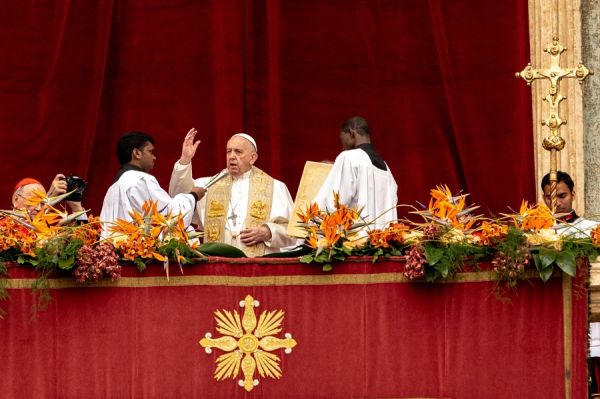
Vatican City, Apr 21, 2019 / 04:56 am (CNA).- Christ’s resurrection ushers in a new world – one of peace, love, and fraternity, Pope Francis said on Easter Sunday, as he prayed for the many people who are suffering throughout the world.
“Christ is alive and he remains with us. Risen, he shows us the light of his face, and he does not abandon all those experiencing hardship, pain and sorrow,” Pope Francis said April 21.
“Yet Easter is also the beginning of the new world, set free from the slavery of sin and death: the world open at last to the Kingdom of God, a Kingdom of love, peace and fraternity.”
Pope Francis gave the traditional Urbi et Orbi blessing from the central loggia of St. Peter’s Basilica following Easter Sunday Mass in St. Peter’s Square.
He forwent giving a homily at Mass this year, and instead paused for a moment of silent reflection following the Gospel.
“Urbi et Orbi” means “To the City [of Rome] and to the World” and is a special apostolic blessing given by the pope every year on Easter Sunday, Christmas, and other special occasions.
Christ’s resurrection is “the principle of new life for every man and every woman,” the pope said in his blessing, explaining that “true renewal always begins from the heart, from the conscience.”
Francis prayed for the many people throughout the world living in places experiencing conflict, tension, and violence.
Beginning with Syria, he said there is a risk of becoming resigned and indifferent to the ongoing conflict in that country and emphasized that now is the time for a renewed commitment to a political solution for the humanitarian crisis in the country.
People there are hoping for “freedom, peace and justice,” he said, urging solutions for a safe re-entry to the country for those who have been displaced, especially in Lebanon and Jordan.
The pope prayed for Christians in the Middle East, particularly in Yemen, that they would continue to “patiently persevere in their witness to the Risen Lord and to the victory of life over death.”
“May the light of Easter illumine all government leaders and peoples in the Middle East, beginning with Israelis and Palestinians, and spur them to alleviate such great suffering and to pursue a future of peace and stability,” he stated.
He begged for an end to conflict and bloodshed in Libya, and for peace on the entire African conflict, particularly in the countries of Burkina Faso, Mali, Niger, Nigeria, Cameroon, Sudan, and South Sudan.
Recalling the spiritual retreat held at the Vatican earlier this month for several religious and political leaders of South Sudan, he prayed for the opening of “a new page” in the history of the country.
Francis prayed for the peace of Easter to bring comfort to the people of the eastern regions of Ukraine.
For the American continent, he invoked the joy of the resurrection for all those experiencing difficult political and economic situations.
Underlining the situations in Venezuela and Nicaragua, he asked the Lord to “grant that all those with political responsibilities may work to end social injustices, abuses and acts of violence, and take the concrete steps needed to heal divisions and offer the population the help they need.”
Let there be an end to the arms race and to the “troubling spread of weaponry,” he added.
“Before the many sufferings of our time, may the Lord of life not find us cold and indifferent. May he make us builders of bridges, not walls,” Francis stated.
He added: “May the Risen Christ, who flung open the doors of the tomb, open our hearts to the needs of the disadvantaged, the vulnerable, the poor, the unemployed, the marginalized, and all those who knock at our door in search of bread, refuge, and the recognition of their dignity.”
“Today the Church renews the proclamation made by the first disciples: ‘Jesus is risen!’ And from mouth to mouth, from heart to heart, there resounds a call to praise: ‘Alleluia, Alleluia!’” he rejoiced.
Quoting from Christus vivit, his recently-published apostolic exhortation on young people, the pope said “Christ is alive and he wants you to be alive! He is in you, he is with you and he never abandons you.”
“However far you may wander, he is always there, the Risen One. He calls you and he waits for your to return to him and start over again.”
At the end of the blessing, Pope Francis expressed his sorrow for several bombings which took place in churches and hotels in Sri Lanka Sunday morning. More than 100 people were killed and hundreds injured in explosions at three luxury hotels and three churches.
St. Anthony’s Shrine in Colombo and St. Sebastian’s Catholic parish in Negombo were targeted, as well as the evangelical Zion Church in Batticaolo.
Francis entrusted to the Lord those who have died and been wounded, and all who are suffering because of the attack: “I wish to express my affectionate closeness to the Christian community, struck while it was gathered in prayer, and to all the victims of such cruel violence,” he said.
The pope wished all those gathered in St. Peter’s Square, and all those participating via radio or television, a happy Easter, noting that it was on Easter Sunday 70 years ago that a pope spoke for the first time on television.
Venerable Pope Pius XII addressed the viewers of French TV, “underlining how the eyes of the Successor of Peter and the faithful could also meet through a new means of communication,” he said.
“This occasion offers me the opportunity to encourage Christian communities to use all the tools that the technique makes available to announce the good news of the risen Christ.”
Francis also thanked the donors of the flowers in St. Peter’s Basilica and Square, which came from the Netherlands and Slovenia.
“Enlightened by the light of Easter, we carry the scent of the Risen Christ into the solitude, into the misery, into the suffering of so many of our brothers, reversing the stone of indifference,” he concluded.
A plenary indulgence, or the remittance of temporal punishment due to sins which have already been forgiven, is granted to those who participate in the Urbi et Orbi blessing in person or through radio, television, or the internet.
The usual conditions for a plenary indulgence must be met: the individual must be in the state of grace and have complete detachment from sin. The person must also pray for the pope’s intentions and sacramentally confess their sins and receive Communion up to about twenty days before or after the indulgenced act.
 […]
[…]





A supportive side note about this year’s Jubilee of Hope–and the 1700th anniversary of Nicaea….
It’s a good time to recall both our encounter with the irreducible nature of the Trinitarian God and the irreducible nature of ourselves as Man as totally united and embodied souls. So, three incarnational thoughts, and a Question:
FIRST, Joseph Cardinal Ratzinger gave us this several decades ago in “Introduction to Christianity”:
“For the Christian, the interplay of faith and reason is most evident in the doctrine that a Trinitarian God is revealed by a definitive encounter with Christ in human history. The doctrine of the Trinity did not arise out of speculation about God, out of an attempt by philosophical thinking to figure out what the fount of all being was like; it developed out of the effort to digest historical experiences [an event]…”
SECOND, now, 2025 years after that singular event—and 1700 years after Nicaea, the Church is confronted by a secularist, fluid, and Arian-like redefinition of the human person as also no longer including the complementary union of binary man and woman in the vocation of marriage. The discounting of our inborn and universal natural law as also involving receptivity to supernatural grace. (Instead, the informal half-blessing of irregular couples as “couples” of every stripe–a wedge dividing the unity of the Church itself?)
THIRD, providentially today, just as with the writing of St. Athanasius (De Incarnatione Verbi Dei, c. 317) shortly prior to Nicaea (325), in 1993 St. Pope John Paul II already explicitly incorporates the permanence of our inborn natural law and moral absolutes directly into the Magisterium of the unified Church:
“The relationship between faith and morality shines forth with all its brilliance in the unconditional respect due to the insistent demands of the personal dignity of every man, demands protected by those moral norms which prohibit without exception actions which are intrinsically evil [….] The Church is no way the author or the arbiter of this norm [….] This is the first time, in fact, that the Magisterium of the Church [!] has set forth in detail the fundamental elements of this teaching, and presented the principles for the pastoral discernment necessary in practical and cultural situations which are complex and even crucial” (Veritatis Splendor, n. 90, 95, 115).
QUESTION: how will the hopeful conclave choose, as between this living Magisterium versus the hopeless fluidities of invertebrate der synodale weg/synodalism?
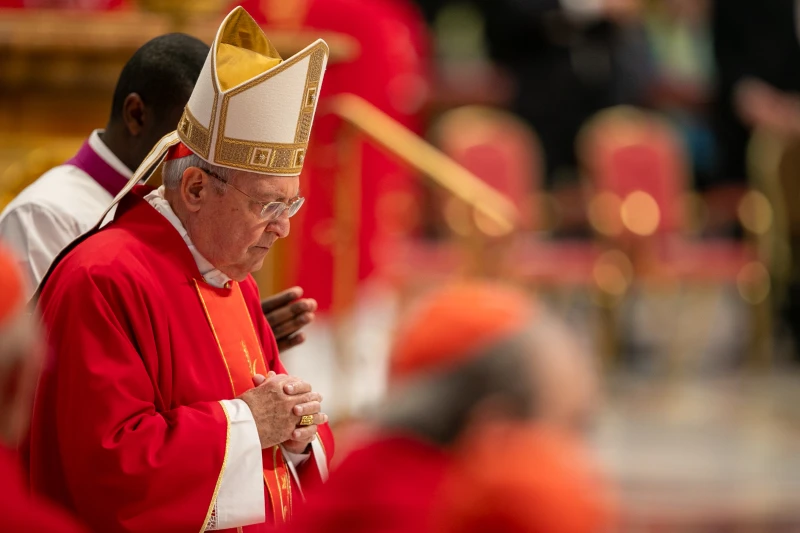
Note the photo: Donald Wuerl and Wilton Gregory together again. Lord, spare us from apostate Popes.
The Cardinal Wuerl story quite possibly is not the image many assume…
In the mid-1980s and as a deputized auxiliary bishop, Wuerl was part of the solution (including a formal Visitation) to the ongoing drift in the Archdiocese of Seattle. He was disrespected by the entrenched establishment and by the media. Later, at Pittsburgh, he traveled to Rome to convince higher-ups not to reverse one of his many (I think 18 or 19 in all) disciplinary actions against sexual abuses within his new diocese. (His pragmatic mistake—as I recall—was to not also clean out the closet of historical abuses from before his tenure.)
Wuerl is the author of the excellent handbook: “New Evangelization: Passing on the Catholic Faith Today” (Our Sunday Visitor, 2013). As the American cardinal invited to Rome as relator to launch the 2012 Year of Faith, he summarized well our current moment: “It is as if a tsunami of secular influence has swept across the cultural landscape, taking with it such societal markers as marriage, family, the concept of the common good and objective right and wrong.”
Not bad, for an “apostate.”