


CNA Newsroom, Apr 12, 2025 / 05:34 am (CNA).
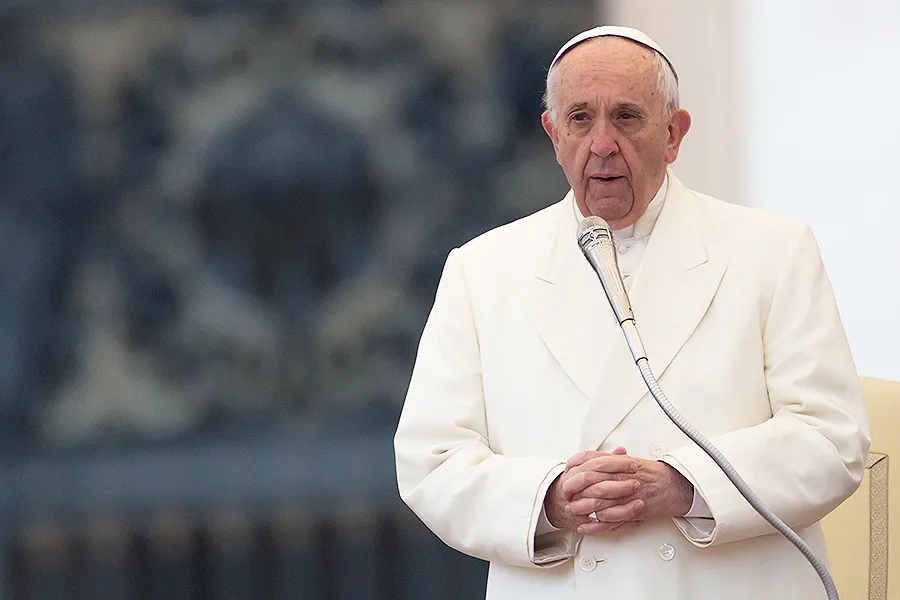
Pope Francis encouraged university students linked to Opus Dei to share “the Gospel of Jesus Christ, dead and risen” with everyone during this jubilee year in a message to participants of an international congress in Rome.
In a Spanish language letter released by the Holy See on Saturday, the pope greeted young people attending the International UNIV Congress 2025, which is taking place in Rome from April 12-20 during Holy Week.
“The International UNIV Congress that you are holding in Rome brings you together these days in the celebration of a double jubilee event: Holy Year 2025 and the centenary of the priestly ordination of St. Josemaría Escrivá,” the pope wrote in the letter dated April 8.
The Holy Father noted these occasions offer “many reasons to give thanks to God and to continue walking with enthusiasm in faith, diligent in charity and persevering in hope.”
The pope said he joins in the students’ joy and accompanies them with his prayer, “asking the Lord that this time of pilgrimage and fraternal encounter may impel you to bring to everyone the Gospel of Jesus Christ, dead and risen, as an announcement of the hope that fulfills promises, leads to glory and, founded on love, does not disappoint.”
He concluded by asking for prayers and imparting his blessing: “May Jesus bless you and Holy Virgin care for you. And I ask you, please, do not forget to pray for me.”
The UNIV Congress began in 1968, inspired by St. Josemaría Escrivá, founder of Opus Dei. According to information from the organization, Escrivá “dreamed of an international meeting of university students from five continents who would ask themselves big questions” to help improve the world.
Each year, students participate in this experience during Holy Week in Rome, where they can “listen to experts and join problem-solving forums, as well as attend the Easter Triduum ceremonies” and meet with the Prelate of Opus Dei, Monsignor Fernando Ocáriz.
If you value the news and views Catholic World Report provides, please consider donating to support our efforts. Your contribution will help us continue to make CWR available to all readers worldwide for free, without a subscription. Thank you for your generosity!
Click here for more information on donating to CWR. Click here to sign up for our newsletter.




Two points and a Question:
FIRST, in at least partly bridging between the City of God and the City of Man, St. Augustine concludes:
“To sum up. Where justice is wanting, in the sense that the civil community does not take its orders from the one supreme God, and follow them out with the help of His grace; where sacrifice is offered to any save Him alone; where, consequently, the civil community is not such that everyone obeys God in this respect; where the soul does not control the body, and reason our evil urges, as proper order and faith require; where neither the individuals nor the whole community, ‘the people,’ live by that faith of the just which works through that charity which loves God as He should be loved and one’s neighbor as oneself—where this kind of justice is lacking, I maintain, there does not exist ‘a multitude bound together by a mutual recognition of rights and a mutual co-operation for the common good'[!]. This being so, there is no proper ‘people’—if Scipio’s definition is correct—nor a commonwealth. For, where there is no ‘people,’ there is no ‘people’s’ weal” (“The City of God,” Book XIX, Ch. 23).
SECOND, related to the “people” and the “people’s’ weal,” we might recall a book review of Malichi Martin’s “The Jesuits” (1987):
“…In 1965 [Jesuit General Pedro] Arrupe decided to do battle with Pope Paul VI [….] At General Council 31 [1964-5] the Jesuits decided to transform Paul VI’s commission to fight atheism into the socio-political struggle of the masses. The spiritual and supernatural element in Jesuit Catholicism had been excised [….] General Council 32 [1974-5] converted the Society of Jesus from an arm of the Church engaged in indispensable apostolic works to ‘faith in the service of justice,’ i.e., revolution against the socio-economic-political structure of the capitalist West [….] They succeeded in amalgamating nature with revelation” [!] (Rev. Gerard Steckler, SJ, in “Faith and Reason, 1988).
QUESTION: for the perennial Catholic Church, as such and as a whole, how to encourage Escrivá’s dream “of an international meeting of university students from five continents”—without concurrently and “synodally” possibly eliding any clear memory of the role and responsibilities of each diocesan bishop, personally and institutionally–within the Eucharistic Church and its Apostolic Succession–as always irreducible [!] to diocesan and national “synods” and then “continental synods”? And, even an intercontinental “Ecclesial Assembly” announced for 2028?
Is the doctrinal role of the historic Jesuits being subliminally displaced by synodally progressive messaging, as alongside Opus Dei? How better to coherently leaven this world with the theological virtues championed by Pope Francis: Faith, Hope, and Charity?
They are in it for a long haul. Students are at the forefront in the remaking and reshaping of the world. Their best is yet to come.