Nairobi, Kenya, Oct 13, 2019 / 08:02 am (CNA).- On Saturday, Kenyan marathoner Eliud Kipchoge broke a finishing tape, and a barrier long-thought to be completely unbreakable. Kipchoge became the first person to run a marathon in less than two hours, finishing a 26.2 mile course in Vienna in 1 hour 59 minutes 40 seconds.
HISTORY! pic.twitter.com/qjLfofhL5s
— Eliud Kipchoge (@EliudKipchoge) October 12, 2019
Sometime after the run was over, away from the spotlight, Kipchoge did what he is reported to do after every race: he knelt down, bent his forehead to the ground, and made the sign of the cross, in thanksgiving for a good run.
In his hometown, his friends and family say that Kipchoge’s extraordinary accomplishment might have something to do with his deep Catholic faith.
Kipchoge’s cousin, Fr. Kennedy Kipchumba, told ACI Africa Saturday that the runner’s accomplishment was “a moment of joy and jubilation, with a summary of: God fulfills His promise.”
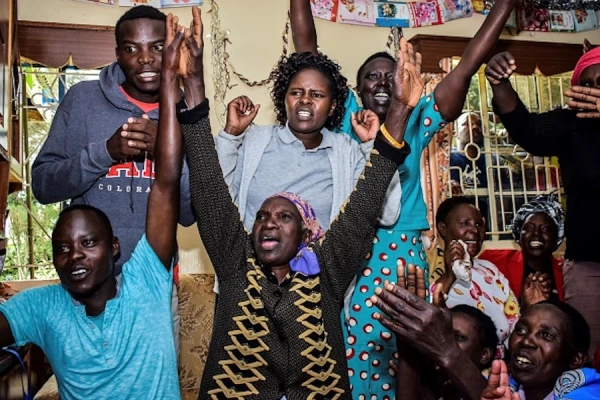
“I was part of the close to 3,000 people who were following the race from a big screen and with all of them, we ended up bowing to God to thank him for this much he offered to us,” Fr. Kipchumba said.
After Kipchoge’s feat, his family, included several priests, celebrated Mass in thanksgiving.
“Everybody came to Church, to say thank you to God. We celebrated Mass to thank God. We celebrated as a community; we had the family, Fr. Benjamin Oroiyo who is also a family member, Fr. Benedict Rono and we were also joined by the Deputy Governor of Nandi County, area Member of Parliament, among other local leaders,” Fr. Kipchumba said.
The Mass was celebrated in a small village chapel, St. Peter’s Kapsisiwa, an “outstation” of St. Joseph’s Sangalo Parish in the Diocese of Eldoret.
Kipchoge, 34, was raised in the small village of Kapsisiwa, 200 miles from Kenya’s capital, Nairobi. The area around Kapsisiwa is a highland of rolling green hills, where Kipchoge began running as a child. The runner now lives with his wife in the west Kenyan city of Eldoret, close to his hometown.
“The main person in the family is the mother, whom we brought from her house” for the Mass, Kipchumba explained.
Kipchoge’s mother, Janeth Rotich, is seen as a moral and spiritual supporter of her son.
“I wake up at 3 a.m. every day to pray for Kipchoge. I pray the rosary,” she has told local reporters.
Kipchoge left Kenya on the Feast of Our Lady of the Rosary, Monday, Oct. 7 to attempt a sub-2 hour marathon in Vienna. But before he left, the parish he attends when in Nairobi offered Mass for him.
On the eve of his departure, special prayers were offered for him by the congregation of St. Paul’s University Catholic Church.
“Kipchoge is a friend of students’ choir at St. Paul’s University Chapel. Last Sunday we had Mass celebration for Eliud Kipchoge,” the chaplain of Nairobi University, Fr. Peter Kaigua told ACI Africa Saturday.
Kaigua described the historic marathoner, Kipchoge as “an inspiration to the youths, a mentor to the young people and a humble man; through him the young people get to know that their dreams can be met.”
“Before offering Mass for him last week, we used to talk about him in the university with students. We therefore opted to offer him Mass before going for the marathon race so that God can help him realize his dream,” Kaigua added.
“The day for Mass, young people had t-shirts printed in his name,” Kaigua told ACI Africa.
During the Mass, Kaigua said that Kipchoge’s run “will push his body and his mind to unknown levels and if he ever needed God, and Mother Mary and all the Saints, this is the time — that is why we are here, praying hard. As Eliud also famously said, ‘you cannot train alone and expect to make a fast time… 100 percent of me is nothing compared to one percent of the team.’ We are, therefore, going to be Eliud’s pacemakers in prayer.”
“The university acted as his ‘spiritual pacesetter.’ His winning is a sign that prayer for young people has been answered,” the priest told ACI Africa.
When Kipchoge crossed the finish line, he said that felt himself to be “the happiest man to run under two hours to inspire many people; to tell people that no human is limited, you can do it.”
“I am expecting more athletes from all over the world to run under two hours,” he added.
Priest, religious, and laity in his native Kenya have praised Kiphchoge as a man of great inspiration. Some interpreting his success in the context of the Church’s “Extraordinary Missionary Month,” whose theme is “Baptized and Sent.”
“Eliud Kipchoge, baptized and sent! I saw his mother with a white Rosary on her neck. This is just how faith is handed on in the family set up. The mother passes it on to the child,” Fr. Samuel Nyattaya of Kenya’s Kisumu Archdiocese told ACI Africa.
The priest said he felt “so happily surprised at the demonstration of his Catholic faith!”
“I believe that God is happy to see us putting efforts to maximize our potential. God must have been so happy to see this courageous Kenyan encouraging the entire world with his belief,” Sr. Sr. Margaret Mutiso, a member of the Daughters of Sacred Heart, told ACI Africa.
Kipchoge “is advocating for a peaceful world where all live together in harmony and we’re not limited to do that,” she added.
For his part, Kaigua said that the university parish in Nairobi is already “planning to celebrate another Mass for him in his presence immediately, as soon as he is back in the country.”
The priest, and the marathoner, surely have something to thank God for.
A version of this story was first published by ACI Africa, CNA’s African news partner. It has been adapted by CNA.
 […]
[…]






Don’t start wars and the consequences can be avoided. Obviously that reality didn’t cross the minds of Islamic terrorists and their supporters.
I think the whole purpose of October 7th was to disrupt peace attempts & power structure in the region. The well being & best interests of Gazan residents was not the terrorists or Iran’s first concern. It never has been.
Nor is the well-being & best interests of people ever the first concern of that which remains the ultimate motivator of Islamic terrorists, which is Islam, the religion of barbarity. Moreover, Islamic terrorists are not simply “radical Muslims” as dishonest apologists for Islam continue to gaslight the rest of the world about instead of telling the truth about Islam that is published in black and white in all of their authoritative documents. Islamic terrorists are faithful practitioners of Islam in their actions of brutal violence they inflict on others based on that aspect of Jihad which calls for violence to further the goals of Islam, which is the entire world under the rule and domination of Islam.
Of course, the reality of Islam and the fact that gullible people are easily misled about Islam due to some favorable encounters with individual Muslims does not justify in any way any abuse or violence visited directly upon non-combatants, and to the extent this is being done in Gaza by anyone is morally reprehensible.
Tell me how you are not reacting exactly as the Hamas terrorists calculated. Show how you are not playing directly into their hands.
Tell us, why are you supporting and defending Hamas?
Gaza residents elected Hamas. Now we are beginning to see some regret and resistance to their tyranny among Gazans.
Be careful to whom you provide support.
Hamas is the ruling party in Gaza.
Calls for the destruction of Israel can be found in Hamas’ founding documents.
There is no peace because peace is not the objective of Hamas. Never has been.
In fact Israel used to occupy Gaza. They gave it up some 30 or so years ago in hopes of securing peace.
Upon taking possession, the Palestinians immediately started to lob rockets from Gaza into Israeli cities.
The Catholic pastor cannot say what needs to be said: That there will be no peace in the Middle East until the Muslim leaders there want peace.
What was that quote? I think Golda Mier said it: There will be no peace until the Palestinians love their children more than they hate us (the Jews)?
Hear, hear!!
(meant to reply to this post first time around fyi)
That has nothing to do with the Christians or the many Muslims who have nothing to do with Hamas. The Baptist Church and Holy Family Catholic Church have had a long presence in Gaza without any problems from their neighbors.
Advise the Ishmaelites to repudiate their Fatwa against their infidels that includes Western civilization in particular with a special venom reserved for the Jews between the river and the sea.
Does anyone know a truly reliable charity that will forward aid and donations to the poor Christians in Gaza and Fr. Romanelli? Is it even possible to get aid to them?
Thanks
Over an eight-year period, I resided in the United Arab Emirates and Qatar, during which time I traveled extensively throughout the Middle East and North Africa. This experience afforded me the opportunity to engage with diverse Muslim communities, observe their cultural practices, and develop a nuanced understanding of the region. While my interactions were predominantly positive, and I have undertaken studies of Islamic texts, including the Qur’an and Sahih al-Bukhari, I do not claim expertise in Islamic theology or jurisprudence.
The assertion that ‘an Islamic terrorist is nothing less than a faithful Muslim’ presents a problematic generalization. While some interpretations of Islamic texts may be used to justify violence, it is crucial to acknowledge the diversity of Islamic thought and practice. The term ‘radical’ may be imprecise, but it attempts to differentiate between those who adhere to interpretations that condone violence and those who do not. The claim that moderate Muslims exhibit ‘laxness’ in their adherence to Islamic teachings is a subjective assessment that requires careful consideration of varying theological perspectives. It is a simplification to suggest that the adoption of a ‘faithful path’ inevitably leads to the acceptance of terrorism, ignoring the complex interplay of socio-political, economic, and individual factors that contribute to radicalization.
That’s what the Salafis believe. However, there are other disciplines of Islam. I lived in Cairo in 2005 for almost 5 1/2 months on a research project working with a group of Christians and Muslims who all socialized together. The Muslims were of the Hanifi school of thought. When the Copts were at Mass it would be a Muslim couple who would drive me to English language Roman Catholic Mass.
Through the years I kept up with these people. Thanks to the internet during the reign of the Islamist Morsi the I was able to witness the “people’s uprising” against this Islamist regime. When Christians worshiped Muslims came from all over Cairo and locked arms standing outside, surrounding the church to see that none of Morsi’s cohorts could enter. I’m sure you could search for the uprising against Morsi.
Unfortunately, the Christians in central Egypt were and are still suffering under Salafi rule.
Re Hamas rule: Fatah won the election. The elected Fatah leaders were dragged up onto roof tops and hurled off by Hamas which also happened in Egypt under Morsi’s brief rule. By the way, the most powerful supporter of Morsi and the Muslim Brotherhood was Barak Obama who was president at the time.
Life is never black and white; it is full of intricacies and contradictions.
For some doses of reality, Catholic World Report readers can check the following from a most informative website:
https://thereligionofpeace.com/pages/articles/jesus-muhammad.aspx
https://thereligionofpeace.com/pages/myths/index.aspx
https://thereligionofpeace.com/pages/games/index.aspx
>>>>>
“Fantasy Islam: A game in which an audience of non-Muslims wish with all their hearts that Islam was a ‘Religion of Peace,’ and a Muslim strives to fulfill that wish by presenting a personal version of Islam that has little foundation in Islamic Doctrine.” -Dr. Stephen M. Kirby
“terrorist group Hamas and Israel” should be reworded to “terrorist group Israel and Hamas”
May God bless Israel & God’s chosen people at Passover.
May the Church start praying for Israel’s conversion.
The Church seems to be more involved in the Gaza war. Iran is more emboldened by the delay of religious attention. The Pope’s appeals are 2 years old. That is a long time given the disaster at hand and the loss of thousands of innocent lives.
I have suggested that all religions assemble to present a united front and confront the murderous “religious” Ayatollah to help him understand his mortal sin and plead with him for sanity.
The Pope made “frequent calls” to the parish in Gaza?? Thats nice. But I wonder if he made frequent calls to the families whose children were murdered or kidnapped on October 7th? Somehow I doubt it. And I wonder if he ever pondered how it came to pass that this place is the LAST surviving Catholic/Christian parish in all of Gaza? I’m pretty sure its because almost every last Christian was driven out of the place.