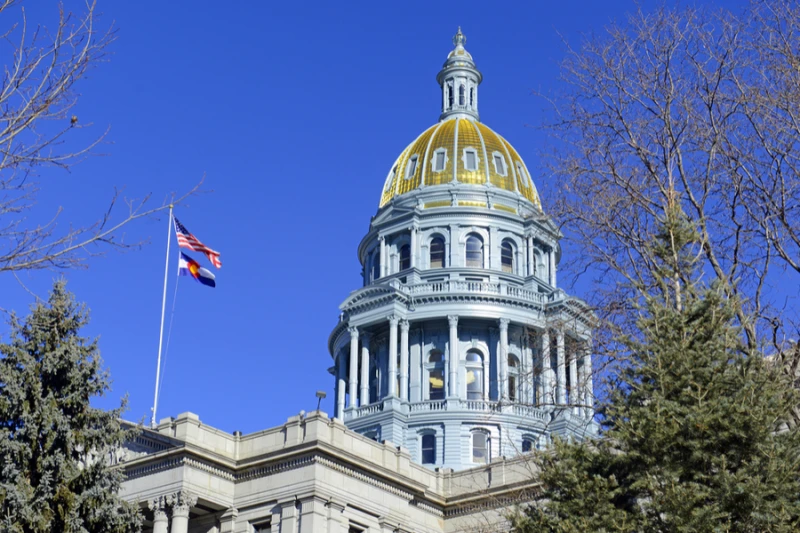
The Colorado Capitol in Denver. / Credit: robert cicchetti/Shutterstock
Denver, Colo., Apr 9, 2025 / 17:41 pm (CNA).
The Colorado Catholic bishops are urging state Gov. Jared Polis to veto a bill that would put at least $1.5 million of public funding annually toward Medicaid-covered abortions.
The Tuesday open letter — co-signed by Archbishop Samuel Aquila and Auxiliary Bishop Jorge Rodriguez of the Archdiocese of Denver, Bishop James Golka of Colorado Springs, and Bishop Stephen Berg of Pueblo — urged the governor “to consider the millions of Coloradans who do not want their hard-earned tax dollars to be used in the destruction of human life.”
The legislation would require the state Department of Health Care Policy and Financing to cover abortions for Medicaid and Child Health Plan Plus participants. The bill passed the state House earlier this week and the state Senate in March.
In the letter, the Colorado bishops expressed their “deep disappointment and grave concern” over the bill, saying it “violates the dignity of human life,” “disregards the safety of women,” and neglects “the conscience rights of millions of Coloradans who do not want to pay for abortion.”
“Every human life, from conception to natural death, is a sacred gift from God,” the bishops continued. “No act of law can change this truth, nor can it erase our moral obligation to defend the most vulnerable among us.”
The bishops called the bill “a tragedy for Colorado.”
Rather than supporting “life-affirming alternatives,” the bill “prioritizes public funding of abortion at the expense of the lives of preborn children, the health of their mothers, and the conscience rights” of pro-life Coloradans, the bishops noted.
The legislation follows the passage of Amendment 79 in November 2024, which enshrined a right to abortion in the Colorado Constitution.
The bishops cited the financial impact of the bill, noting that “the electorate was informed by the legislative blue book and media that Amendment 79 would not cost the state money.”
A “fiscal note” of the bill argued that the government would save money due to the number of “averted births,” a claim the bishops decried as “abhorrent.”
“Such a statement is an egregious reflection of the inhumane mentality behind the bill,” the bishops wrote.
The bishops maintained that the so-called “averted births” wouldn’t save money.
“The fiscal note drastically underestimates the cost of abortion,” they wrote, noting that legislators used the average cost for first-trimester abortions — and not the more expensive late-term abortion costs — in its calculations.
Michael New, a senior associate scholar at the pro-life Charlotte Lozier Institute and assistant professor of practice at the Busch School of Business at The Catholic University of America, called the arguments for the bill “bad economics and even worse ethics.”
“[T]he federal government subsidizes other health services covered by Colorado’s Medicaid program. Colorado taxpayers pay for only a fraction of the cost of Medicaid births,” New wrote at National Review earlier this month.
“Indeed, contrary to the assertion of Colorado Democrats, covering elective abortion would cost Colorado taxpayers money.”
In his estimate, if passed, the bill would increase the number of abortions in Colorado by more than 1,800 annually.
Nineteen states allow Medicaid programs to use state taxpayer dollars to cover elective abortions.
If you value the news and views Catholic World Report provides, please consider donating to support our efforts. Your contribution will help us continue to make CWR available to all readers worldwide for free, without a subscription. Thank you for your generosity!
Click here for more information on donating to CWR. Click here to sign up for our newsletter.
An artist’s rendering of the affordable apartment complex soon to be built by Our Lady Queen of Angels Housing alliance in Los Angeles. / Courtesy of Our Lady Queen of Angels Housing alliance
St. Louis, Mo., Aug 26, 2024 / 06:30 am (CNA).
Los Angeles is one of the most expensive cities in the United States, with an average home price almost touching a million dollars in 2024 — a landscape that crowds out not only the poor, but also young families with children. The high cost of housing is one of the primary reasons why tens of thousands of people live on the streets of LA, and most of those who are housed are “rent burdened,” which means they spend more than 30% of their income just keeping a roof over their heads.
In the face of such challenges, the Archdiocese of Los Angeles recently announced it will provide land for a new housing development dedicated to serving community college students and young people exiting the foster care system.
Amy Anderson, executive director of Our Lady Queen of Angels Housing alliance and a former chief of housing for the City of Los Angeles, told EWTN News that a group of Catholic lay leaders from the business and philanthropic community reached out to the archdiocese with a vision for creating an independent, nonprofit affordable housing development organization.
“Our vision is to really collaborate with the archdiocese and [use] the resources potentially available from the archdiocese to create homes that are affordable to a wide range of populations and incomes,” Anderson told “EWTN News Nightly” anchor Tracy Sabol.
She said they hope to break ground on the project, known as the Willowbrook development, “about a year from now.”
“The archdiocese is a fantastic partner. They are providing the land for our first development, which is already in process, and we’re working really closely with them to identify additional opportunities.”
The proposed building, which will be located steps from Los Angeles Community College, will feature 74 affordable housing units, as well as “on-site supportive services” for young people transitioning out of foster care — a population that often ends up experiencing homelessness.
The land, located at 4665 Willow Brook Ave just a few miles from the Hollywood Sign, currently hosts a Catholic Charities building, which will move its operations to another site to make way for the apartments.
“Through Catholic Charities and our ministries on Skid Row [an LA street where many unhoused people live] and elsewhere, we have been working for many years to provide shelter and services for our homeless brothers and sisters,” Archbishop Jose Gomez said in a statement to LAist.
“With this new initiative we see exciting possibilities to make more affordable housing available, especially for families and young people.”
Making land work for mission
The Catholic Church is often cited as the largest non-governmental owner of land in the entire world, with an estimated 177 million acres owned by Catholic entities.
Maddy Johnson, program manager for the Church Properties Initiative at the University of Notre Dame’s Fitzgerald Institute for Real Estate (FIRE), noted that the Church as a large landowner is not a new phenomenon, but there is a need today to adapt to modern challenges like regulations, zoning, and the importance of caring for the natural environment.
Many Catholic dioceses and religious orders have properties in their possession that aren’t fulfilling their original purpose, including disused natural land and parking lots, as well as shuttered convents and schools. Sometimes, Johnson said, a diocese or religious order doesn’t even realize the full extent of what they own.
“How can the Church make good strategic decisions, strategic and mission-aligned decisions, if it doesn’t know what properties it’s responsible for?” she said.
The Church of St. Agatha and St. James in Philadelphia, with The Chestnut in the foreground, a housing unit developed on property ground-leased from the church. Courtesy of Maddy Johnson/Church Properties Initiative
Since real estate management is not the Church’s core competency, FIRE aims to “provide a space for peer learning” to educate and equip Church leaders to make better use of their properties in service of the Church’s mission.
To this end, they offer an undergraduate minor at Notre Dame that aims to teach students how to help the Church make strategic real estate decisions that align with the Church’s mission. The Institute also organizes a quarterly networking call with diocesan real estate directors, as well as an annual conference to allow Catholic leaders to convene, share best practices, and learn from each other.
Fr. Patrick Reidy, C.S.C., a professor at Notre Dame Law School and faculty co-director of the Church Properties Initiative, conducts a workshop for diocesan leaders on Notre Dame’s campus in summer 2023. Courtesy of David J. Murphy/Church Properties Initiative
In many cases, Catholic entities that have worked with FIRE have been able to repurpose properties in a way that not only provides income for the church, but also fills a need in the community.
Johnson said the Church is called to respond to the modern problems society faces — one of which is a lack of housing options, especially for the poor.
“Throughout its history, there have been so many different iterations of how the Church expresses its mission…through education, healthcare — those are the ones that we’ve gotten really used to,” Johnson said.
“In our day and age, could it be the need for affordable housing?…that’s a charitable human need in the area that’s not being met.”
Unlocking potential in California
Queen of Angels Housing’s first development, which has been in the works for several years, is being made possible now by a newly-passed state law in California that aims to make it easier for churches to repurpose their land into housing.
California’s SB 4, the Affordable Housing on Faith Lands Act, was signed into law in October 2023. It streamlines some of the trickiest parts of the process of turning church-owned land into housing — the parts most people don’t really think about. These can include permitting and zoning restrictions, which restrict the types of buildings that can be built in a given area and can be difficult and time-consuming to overcome. SB 4 even includes a provision allowing for denser housing on church-owned property than the zoning ordinances would normally allow.
Yes in God’s Backyard
The law coming to fruition in California is part of a larger movement informally dubbed “Yes in God’s Backyard,” or YIGBY — a riff on the term “Not in My Backyard” (NIMBY), a phenomenon whereby neighbors take issue with and oppose new developments.
Several Catholic real estate professionals with ties to California expressed excitement about the possibilities that SB 4 has created in the Golden State.
Steve Cameron, a Catholic real estate developer in Orange County, told CNA that he is currently working with the Diocese of Orange, which abuts the LA archdiocese, to inventory properties that could be repurposed for residential use.
He said their focus is on building apartment buildings and townhomes, primarily for rental rather than for sale, in an attempt to address the severe housing shortage and high costs in Southern California.
Unlike some dioceses, the Orange diocese has an electronic GIS (geographic information system) database showing all the properties it owns. Prepared by a civil engineering firm, the database includes details such as parcel numbers, acreage, title information, and demographic reports, which facilitate the planning and development process.
“Strategically, what we’re doing is we’re inventorying all of the property that the diocese and the parishes own, and trying to understand where there might be underutilized property that would make sense to develop some residential use,” Cameron said.
Cameron said he can’t yet share details about the housing projects they’re working on, but said they are looking to the Archdiocese of Los Angeles and the Queen of Angels housing project as a model for how to take advantage of the new incentives created by SB 4.
“I think it’s great, and it’s exciting that they’re taking the lead and that they are able to find an opportunistic way to repurpose an underutilized property to meet the housing shortage in California,” he said.
“[We] look at them as a role model for what we’re trying to accomplish here in the Diocese of Orange.”
Holy Name Cathedral in Chicago with One Chicago Square in the background, a residential tower constructed on the former cathedral parking lot, which was sold in 2019. Courtesy of Maddy Johnson/Church Properties Initiative
John Meyer, a former president of the California-based Napa Institute who now works in real estate with J2 Development, emphasized the importance of viewing the Church’s vast real estate holdings as an asset rather than a liability.
Meyer said he is currently working with two Catholic entities on the East Coast on ground lease projects, one of which will fund the construction of a new Catholic Student Center at a university. He told CNA he often advises Catholic entities to lease the land they own rather than selling it, allowing the church to maintain ownership of the property while generating income.
Naturally, he noted, any real estate project the Church undertakes ought to align with the Church’s mission of spreading the Gospel, and not merely be a means of making money.
“Any time we look at the Church’s real estate decisions, it’s got to be intertwined with mission and values,” he said.
“We’re not just developing for the sake of developing. What we want to do is we want to create value for the Church, and we also want to create value for the community. So working closely with the municipality to make sure that needs are met, and to be a good neighbor, is important.”
He said Church leaders should strongly consider taking advantage of incentives in various states such as California for projects like affordable housing, which align with the Church’s mission and provide both social and financial benefits.
“Priests and bishops aren’t ordained to do these things, and sometimes they have people in their diocese that have these abilities, and sometimes they don’t,” Meyer said.
“This [new law] in California has created an incentive that we can take advantage of, so we need to take advantage of that incentive…it’s allowing us to unlock potential value in land while at the same time serving a social good that’s part of the mission of the Church.”
Greek Parliament Building in Athens, Greece. / Credit: Andrey Starostin/Shutterstock
CNA Staff, Feb 16, 2024 / 15:00 pm (CNA).
Greece this week legalized same-sex marriage at the national level, becoming the first officially Orthodox Christian … […]
Washington, D.C. Newsroom, Aug 26, 2020 / 09:45 am (CNA).- Faith and social issues took center stage on night two of the Republican National Convention, as speakers said the Trump administration had worked to advance the cause of religious freedom, promoting pro-life causes, and criminal justice reform.
Among the speakers was pro-life activist and former Planned Parenthood employee Abby Johnson who condemned her former employer’s racist heritage. She noted that 80% of Planned Parenthood’s abortion facilities are located near minority neighborhoods, and that the founder of Planned Parenthood, Margaret Sanger, was a eugenicist.
Trump, she said “has done more for the unborn than any other president” and is “the most pro-life president we’ve ever had.
Johnson graphically described a second-trimester abortion she says she witnessed while working for Planned Parenthood, saying that she saw “an unborn baby fighting back, desperate to move away from the suction … The last thing I saw was a spine twirling around in the mother’s womb before succumbing to the force of the suction.”
Seeing that abortion, she said, caused her to quit her job and leave the abortion industry.
Most Americans, said Johnson, do not understand the “barbarity” of abortion.
“They don’t know about the ‘products of conception’ room in abortion clinics, where infant corpses are pieced back together to ensure nothing remains in the mother’s wombs; or that we joked and called it the ‘pieces of children’ room,” she said.
“See, for me, abortion is real. I know what it sounds like. I know what abortion smells like. Did you know abortion even had a smell?” Johnson herself had two abortions prior to her pro-life conversion.
In her speech, Johnson referred to Biden and Harris as “two radical, anti-life activists.” The Democratic Party platform called, for the first time, for abortion to be codified in federal law, and repeated the 2016 platform’s call for a repeal of the Hyde Amendment forbidding taxpayer dollars for abortions.
The Republican Party has not changed its the 2016 platform, which calls for abortion to be illegal, but did release a list of 50 bullet points outlining the priorities of a second term of the Trump presidency. Those points do not mention abortion policy, though Johnson emphasized that in her view, Trump’s second term will feature continued efforts on restricting legal protection for abortion.
Cissie Graham Lynch, the granddaughter of evangelist Billy Graham, spoke Tuesday night on the importance of the free exercise of religion “in our schools, and in our jobs, and yes, even in the public square.”
“Our founders did not envision a quiet, hidden faith: they fought to ensure that the voices of faith were always welcomed; not silenced, not bullied,” she said. Lynch said that during the Obama/Biden administration, “these freedoms were under attack.”
Lynch cited the examples of the HHS contraceptive mandate, which she said was an attempt to “force religious organizations to pay for abortion-inducing drugs,” and efforts to force adoption agencies to violate their religious beliefs in who they worked with.
“Democrats pressured schools to allow boys to compete in girls sports and use girls locker rooms,” she said, referring to transgender activists. “Those are the facts.”
With the election of Donald Trump, she said, “people of faith suddenly had a fierce advocate in the White House,” noting that he appointed judges who “respect the First Amendment” and withdrew policies that violated conscience rights.
“The Biden-Harris vision leaves no room for people of faith,” Lynch said. “Whether you’re a baker or florist or a football coach, they will force the choice between being obedient to God or to caesar–because the radical left’s God is government power.”
One of the more emotional moments of the night was the story of Jon Ponder, a convicted bank robber. While in prison, Ponder turned his life around through a chaplaincy program. Upon release, Ponder founded a nonprofit organization Hope for Prisoners, and befriended the FBI agent who arrested him.
Hope for Prisoners works to assist prisoners with reentry into society, and provides leadership training, financial advice, professional development, and technology training.
“My hope for America is that all people regardless of race, color, class or background will take advantage of the fact that we live in a nation of second chances,” said Ponder on Tuesday. Trump called his story “a beautiful testament to the power of redemption.”
At the end of the segment, Trump pardoned Ponder for his bank robbery conviction, which is a federal crime. Ponder had previously been granted clemency in Nevada on battery charges.
Also featured on Tuesday night was Nick Sandmann, who, as a student at Covington Catholic High School, was the subject of a media firestorm after an out-of-context clip went viral showing him smiling at a Native American demonstrator in front of the Lincoln Memorial after the March for Life earlier this year. Sandmann spoke on the topics of cancel culture and the need for media accountability and honesty.
Colorado has become East California because of all the California Democrats who have moved there to escape the California hellscape. But those idiots brought their voting habits with them. Like locusts moving from field to field, destroying where they settle.
The way back to ensuring the safety of unborn children may lie in an appeal to the obligations in the Thirteenth Amendment that forbids across all states the ownership of human beings.
Under the Thirteenth Amendment, it remains always and solely the solemn duty of the U.S. Congress (not the Supreme Court and not the individual states) to provide overriding legislation to abolish chattel abortion throughout the United States.
Abortion must not simply be regulated by each individual state on Blackmun’s old nonsensical may, if it chooses basis (Roe v. Wade 150, 154, 163, 164, 165). Maltreatment of our posterity as chattels to be aborted at the discretion of their “owners” must be [completely] abolished “within the United States, or any place subject to their jurisdiction.”
Under the Thirteenth Amendment, then, it is the duty of the Congress to pass legislation to abolish across all States the targeting for abortion of children in their mothers’ wombs — to abolish their grievous mistreatment as chattels.
There is a need to work urgently for clear-sighted, cross-party majorities in both the House and the Senate, good women and good men who possess the intellectual integrity and the steadfast will to recognize and confront the fundamental injustice of routinized killing of the unborn in their mothers’ wombs.
It is time to abolish chattel abortion — to exercise with bold integrity the unequivocal power and the duty set out in Section 2 of the Thirteenth Amendment which enables the Congress to enforce by appropriate legislation the abolition of all forms of ownership abuse of human beings.
Indeed, the Constitution absolutely forbids the mistreating of “our Posterity” as our property. The Thirteenth Amendment requires Congress to enforce by appropriate legislation the abolition of all forms of ownership of human beings.
Pretty weird that a Catholic Hospital in Iowa is trying to claim that a fetus is not a person so they don’t have to pay out damages to a woman who’s baby they murdered. So far every Catholic News site has been disturbingly silent about this. I assume my comment will go to moderation and never get published because I am telling a truth that makes Catholics look very bad hypocrites.








Colorado has become East California because of all the California Democrats who have moved there to escape the California hellscape. But those idiots brought their voting habits with them. Like locusts moving from field to field, destroying where they settle.
The way back to ensuring the safety of unborn children may lie in an appeal to the obligations in the Thirteenth Amendment that forbids across all states the ownership of human beings.
Under the Thirteenth Amendment, it remains always and solely the solemn duty of the U.S. Congress (not the Supreme Court and not the individual states) to provide overriding legislation to abolish chattel abortion throughout the United States.
Abortion must not simply be regulated by each individual state on Blackmun’s old nonsensical may, if it chooses basis (Roe v. Wade 150, 154, 163, 164, 165). Maltreatment of our posterity as chattels to be aborted at the discretion of their “owners” must be [completely] abolished “within the United States, or any place subject to their jurisdiction.”
Under the Thirteenth Amendment, then, it is the duty of the Congress to pass legislation to abolish across all States the targeting for abortion of children in their mothers’ wombs — to abolish their grievous mistreatment as chattels.
There is a need to work urgently for clear-sighted, cross-party majorities in both the House and the Senate, good women and good men who possess the intellectual integrity and the steadfast will to recognize and confront the fundamental injustice of routinized killing of the unborn in their mothers’ wombs.
It is time to abolish chattel abortion — to exercise with bold integrity the unequivocal power and the duty set out in Section 2 of the Thirteenth Amendment which enables the Congress to enforce by appropriate legislation the abolition of all forms of ownership abuse of human beings.
Indeed, the Constitution absolutely forbids the mistreating of “our Posterity” as our property. The Thirteenth Amendment requires Congress to enforce by appropriate legislation the abolition of all forms of ownership of human beings.
Pretty weird that a Catholic Hospital in Iowa is trying to claim that a fetus is not a person so they don’t have to pay out damages to a woman who’s baby they murdered. So far every Catholic News site has been disturbingly silent about this. I assume my comment will go to moderation and never get published because I am telling a truth that makes Catholics look very bad hypocrites.
https://iowacapitaldispatch.com/2025/04/09/aiming-to-limit-damages-catholic-hospital-argues-a-fetus-isnt-the-same-as-a-person/