


Vatican City, Mar 27, 2025 / 19:00 pm (CNA).
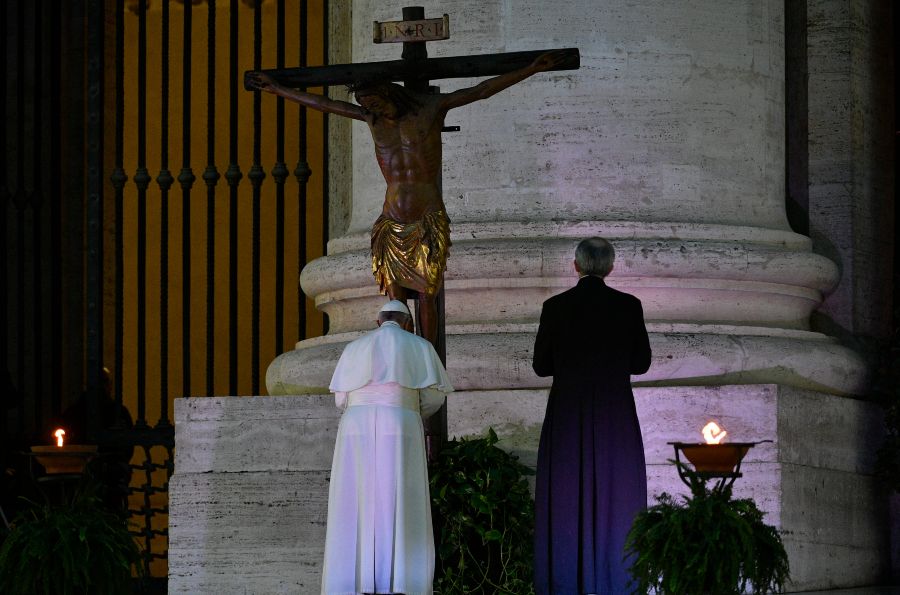
Pope Francis’ historic “Statio Orbis” blessing during the height of the COVID-19 pandemic remains relevant for the Church as it did five years ago. Before an empty and rain-covered St. Peter’s Square, Pope Francis held Eucharistic adoration and gave an extraordinary urbi et orbi blessing, praying for the world during the coronavirus pandemic.
The Holy Hour on March 27, 2020, included a reading from the Gospel and a meditation by Pope Francis, who spoke about faith and trust in God during a time when people fear for their lives, as did the disciples when their boat was caught in a violent storm.

During the special moment of prayer on March 27, 2020, the Holy Father spoke about faith amid crisis — “Why are you afraid? Have you no faith?”
These powerful words were a papal refrain throughout his 2020 address before an empty St. Peter’s Square.
“‘Why are you afraid? Have you no faith?’ Lord, your word this evening strikes us and regards us, all of us. In this world, that you love more than we do, we have gone ahead at breakneck speed, feeling powerful and able to do anything. Greedy for profit, we let ourselves get caught up in things and lured away by haste,” he prayed.
Pope Francis implored people to believe in God’s presence during the time of COVID-19 when he spoke of Jesus’ reaction to the cry of the disciples: “Teacher, do you not care if we perish?” recorded in chapter 4 of St. Mark’s Gospel.
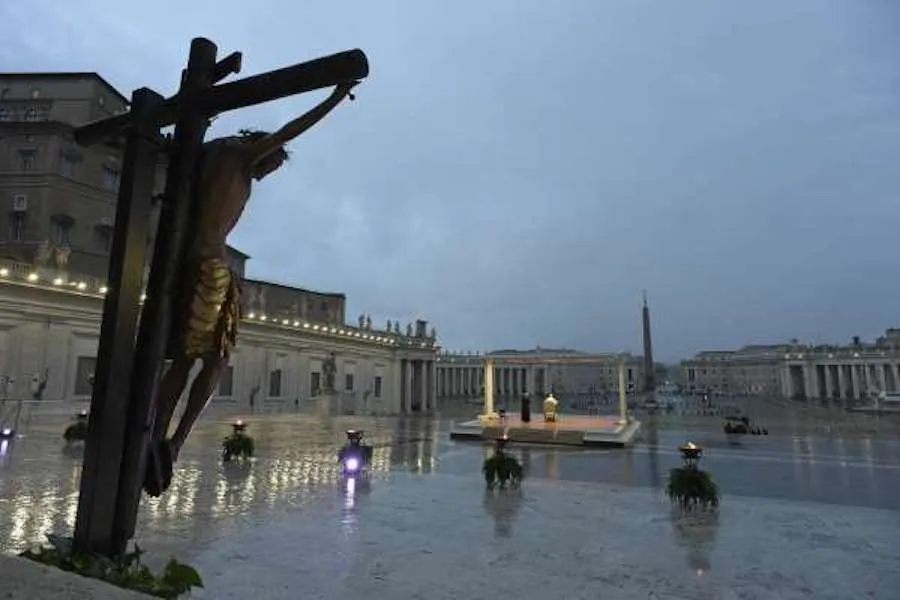
The pandemic’s impact on the life of the Church is yet to be fully researched and understood.
Recent studies from around the world suggest a decline in Church attendance in some regions. A new Pew study shows thousands of people have chosen to leave behind the religion of their childhood in some of the traditionally Catholic countries such as Italy and Spain.
At the same time, the study acknowledges the report’s figures “are not necessarily representative of the entire world’s population.”
A growing Church
While religious belief and practice may seem to be weakening in some parts of the world, the Holy Father’s “Statio Orbis” prayer five years ago can still resonate with millions of people of faith who trust and hope in God’s presence in times of world suffering and hardship.
According to the Vatican’s 2025 Annuario Pontificio, the Catholic Church has grown worldwide after the COVID-19 pandemic, with the highest growth recorded in Africa.
Between 2022 and 2023, the global Catholic population has grown from approximately 1.39 billion Catholics to 1.406 billion in the last two years. In Africa alone, the Catholic population increased by 3.31%, from 272 million in 2022 to 281 million in 2023.
As Pope Francis said on this day five years ago: “You ask us not to be afraid. Yet our faith is weak and we are fearful. But you, Lord, will not leave us at the mercy of the storm. Tell us again: ‘Do not be afraid’ (Mt 28:5). And we, together with Peter, ‘cast all our anxieties onto you, for you care about us’ (cf. 1 Pt 5:7).”
If you value the news and views Catholic World Report provides, please consider donating to support our efforts. Your contribution will help us continue to make CWR available to all readers worldwide for free, without a subscription. Thank you for your generosity!
Click here for more information on donating to CWR. Click here to sign up for our newsletter.

That was a moving moment. What I fear is that we have not “moved” beyond it. We will sentimentally remember the Pope in that picture (and maybe defer from being critical because he’s sick) but this trip down memory lane has to be joined to the purification of memory. And THAT involves an honest, public, and broadly participatory (even more than “synodal”) input that asks and assesses the performance of the “field hospital” (that fled the battlefield for at least a half a year in most places), whether the protocols followed were good, and what we will do the next time something like this threatens. THAT kind of discussion doesn’t seem to be forthcoming (COVID isn’t even mentioned in the Synodal Final Document, a risible omission considering it closed the ecclesial communion, participation, and mission for months if not a year). If it isn’t, these pictures are nice but they’re kind of like Facebook: “We thought we’d share a memory with you….”
Unfortunately, when it came to Covid, many at the highest levels of Church leadership appeared to have no more faith than anyone else– and today’s bishops should be leading the call for accountability for the sins of 2020-2023, except that many of them are among the guilty. We need to make sure that the abuses of power in secular government and the cowardice of Church leaders is not repeated.
I posted this over at NC Register. (Rather obviously, I did not defer because the Pope is not doing well physically. Five years later, I’m still salty about this.)
.
“Why are you afraid? Have you no faith?”
.
Seriously? It wasn’t the laity that closed the parishes, withheld the Eucharist, refused to celebrate weddings, denied Last Rites, demanded everyone be vaccinated with an experimental vaccine. Not that a lot of folks would not have come to Mass if parishes had not been closed–many would have stayed home, but many would have gone. Many would have joined together to pray the rosary in front of a Monstrance holding the Blessed Sacrament if that had been an option.
.
But it wasn’t. This is on the Hierarchy, and to the best of my knowledge, there has been no acknowledgement or apology.
Well said, MrsHess.
The photo at the top says more than a thousand words. What the solitary man said may have been recorded but no one was present to listen. And now, who cares?
I don’t claim to be good at math, but if y’all will check my figures, I’d appreciate that. The Church in Africa grew by 9 million members from 2022 to 2023, while the rest of the world added only another 7 million?? Can we conclude that the historical home of Christendom continue to shed Christians while the number of Catholics grows and apparently thrives in traditional missionary land.
It’s known. Confidence, faith, and fearless minds add life to our life span.
🕊️ Thoughtful reflections here—COVID challenged the Church deeply, not just spiritually but institutionally. 😔🙏 A sincere, open reckoning is needed to heal, learn, and ensure we never close the doors on the faithful again. ⛪💔 #FaithAndAccountability #ChurchAfterCovid
⛪🌧️ That unforgettable moment in the rain still speaks volumes today — faith over fear. Thank you, Pope Francis, for reminding us to trust in God’s presence through every storm. 🙏🌍 #StatioOrbis #DoNotBeAfraid
“Why are you afraid? Have you no faith?”
Sad the man who participated in locking down of parishes and preventing the Mass. And participated in mandatory masks, forced vaccination schemes and vaccine pass ports.