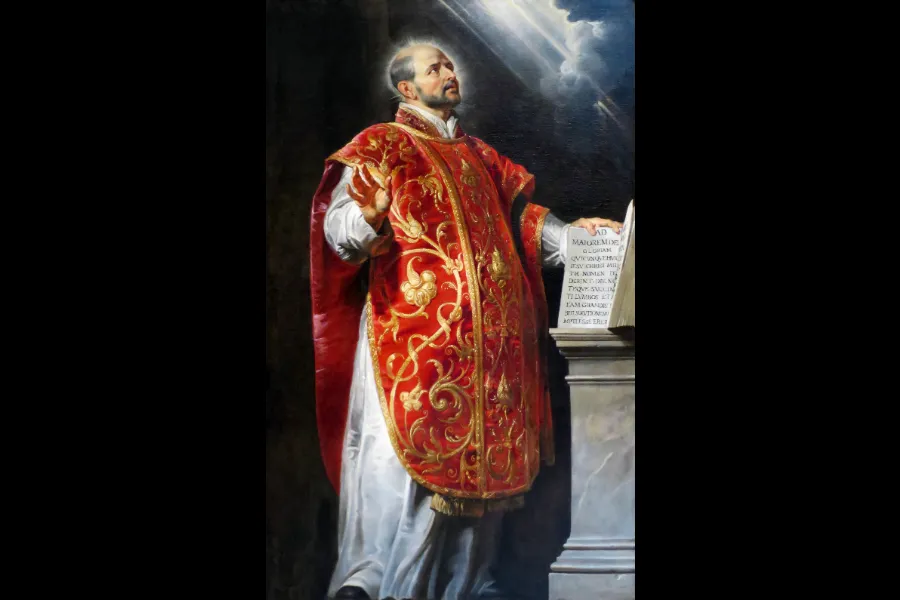
Rome, Italy, Jun 25, 2017 / 04:00 pm (CNA/EWTN News).- Discernment is one of the words Pope Francis repeats most, especially when speaking to priests and seminarians.
He often expresses his desire for greater formation in discernment – a concept that may seem obscure without an understanding its importance to the Pope’s Jesuit formation.
“When a Jesuit says ‘discernment,’ they’re employing a term that has a very rich spiritual tradition within the Society of Jesus, so you can presume a lot in that,” Fr. Brian Reedy, SJ, told CNA in an interview.
Fr. Reedy is a US Navy Reserve chaplain and is pursuing a doctorate in philosophical theology from the Pontifical Gregorian University. He holds a licentiate in theology from Boston College.
He explained that discernment is something St. Ignatius of Loyola, founder of the Society of Jesus, emphasized profoundly in his Spiritual Exercises, which form the “backbone” of Jesuit spirituality.
In fact, St. Ignatius twice in the spiritual exercises has an extended discourse on how to carry out discernment properly: what it means, what its limitations are, and the rules that govern it.
“One of the things that’s very interesting about discernment is that while it does have a very polyvalent meaning, you can usually presume that when a Jesuit uses the term, when they launch it, it has these rules at least playing the background in their mind,” Reedy said.
So when it comes to Jesuits and discernment, what are the governing rules, and how can we use them to understand Pope Francis?
Rules of Ignatian discernment
One of the first things to keep in mind when it comes to discernment is St. Ignatius’ distinction between categories of people, Fr. Reedy said, explaining there are different rules for people take the faith seriously, and those who do not.
“If you are somebody who is living a life where God is not really on the scene and the teachings of the Church aren’t really important you have one set of rules. But the reverse situation for somebody who does take their faith life very seriously and God is at least sought after … then we have a completely different set of rules,” he said.
Another distinction, he said, is between proper and improper objects of discernment, meaning that “some things you can discern and other things you can’t.”
When it comes to the current discussion on marriage, Fr. Reedy noted that in his spiritual exercises, St. Ignatius himself speaks specifically about discerning marriage after you have contracted marriage “as an example of one of the things you can’t legitimately discern.”
This, he said, is because “after you are married, you can no longer legitimately discern being married or not, because you’ve made the decision; it’s not a proper object.”
What can be discerned, by a tribunal, is whether or not the marriage is valid.
“That’s a different question than discerning whether you want to be in a marriage still,” Fr. Reedy said. “For Ignatius that question doesn’t make any sense; in fact, it’s offensive to the process that you would discern changing a state of life that you have already committed yourself to.”
The same thing goes for priesthood and the religious life, he said, explaining that St. Ignatius uses that example because “once you’ve made that commitment, what you discern is how to live the commitment.”
“That’s what you would actually be discerning, because discernment is, fundamentally in Jesuit spirituality, the application of doctrine and teaching to the practical applications in somebody’s life. So it’s making practical that which is theoretical.”
There are then certain “guiding rules” that help in the carrying out of proper discernment.
One of St. Ignatius’ rules Fr. Reedy cited is that sin can never be discerned, using the example of committing murder.
“You can’t discern to murder,” he said. “In fact, it’s offensive to the process that you are pretending to discern choosing an absolute evil.”
What can be legitimately discerned is whether or not to kill, because “if you and your family were under immediate threat from somebody, then the father could in the moment discern whether it was possible for him to take lethal action. That’s permitted.”
In terms of Catholic moral theology, Fr. Reedy said it exists between the camp of what is “permitted” and what is “transformative,” and that beyond the permitted sign lies what is “forbidden.”
Things that are forbidden cannot be discerned, and “you only ask to be free from them,” he said. From there, the spectrum goes from what is simply permissible on one side, all the way to what is deeply transformative and engages the world like Christ on the other.
“In that realm, between what is permitted to what is transformative, there’s a lot of discernment of legitimate possibilities of things that are not against reason or against God or the Church,” he said, adding that one can never really discern between good and evil, but “only between relative goods.”
One key rule of discernment that is often forgotten is the guiding principle of “thinking with the Church,” Fr. Reedy said. This means that “whatever you discern, you’re not only thinking about the moral law and how that functions, but also specifically thinking with the Church.”
Francis is a man ‘steeped’ in Jesuit tradition
Pope Francis “is completely steeped in Jesuit tradition and is a man completely of the exercises,” Fr. Reedy said, explaining that one of the first things he tells people when he speaks about the Pope is that “you can hear the spiritual exercises active in what he says.”
In listening to Pope Francis “you can hear a Jesuit who has contemplated the life of Jesus,” the priest said, noting that Francis’ pedagogical or didactic style “is very much patterned on Jesus’, who often gave very oblique and obscure answers to questions.”
Christ did this, he said, “to specifically avoid a kind of legalism that just wants a solid answer that can then be manipulated in some way,” whereas true discernment means “you’re not interested in rules for the sake of rules, (or) tools that can be manipulated or used as weapons; what you’re interested in is finding the best, the truest, the most holy, the most transformative.”
In essence, “you’re always looking for what is the spirit of the law: why does the law exist, what it is, what is it trying to do?”
What can be done is to “have people trained in what the rules are, why they exist, and how to help these people engage that system in a way that can contribute toward their holiness, to their growth in conforming to Christ.”
Fr. Reedy said that for him, one problem he sees in the Church right now is that some people, in their interpretation of the Pope’s actions, are “trying to put on the table, calling under the umbrella of discernment, the actual consideration of sins, of evils.”
“I’ve never gotten the sense that that is what Francis is saying,” he reflected, explaining that in his view, given Francis’ background, what he is is trying to do is to “train people in this: in the proper camp of moral reasoning, which extends from permitted all the way to transformative, how to help people function there in a way that can be messy, but also prevent them from crossing the line into what is forbidden.”
But what about Francis’ ambiguity? Is that a Jesuit thing?
Part of the confusion surrounding Pope Francis’ sayings and writings is that his language can frequently be ambiguous and imprecise, leaving people scratching their heads trying to figure out what he actually meant.
But for Fr. Reedy, this isn’t a Jesuit quality so much as it is a personal limitation of the Vicar of Christ.
“Francis is a complicated character. He’s not a precise theologian, so I think some of the ambiguity and imprecision just comes from his own training and background, which the Church just has to be patient with,” he said.
Secondly, the priest said that if we reflect on scripture, we see that the Pope uses a style that is very similar to what Christ himself often used, especially when he senses a “Pharisaical attitude.”
“When he senses that somebody’s asking a question in order to pin something down in a way he fears is going to hurt somebody else” Francis gets obscure, he said, explaining that the Pope is “very sensitive” to having doctrine “turned into a weapon of sorts.”
And so was Christ, he said, noting that “Jesus had very harsh words for those people.” Even though the Pharisees were technically faithful, upstanding Jews, “they also had a problem in the way that the viewed law; they saw the law first and the needs of the people second, and Jesus challenged that and so is Pope Francis.”
“I think people should stop pretending that Jesus was crystal-clear when he said things all the time,” Fr. Reedy said, noted that Christ “specifically said at times that he was intentionally being confusing. He would say that he was using parables so those other people over there wouldn’t understand – he would say that.”
However, even though Christ could at times speak cryptically, he was clear when pressed on important topics, such as the Eucharist and the meaning behind his words “this is my body,” and that to enter eternal life his disciples must “eat my flesh and drink my blood.”
So when it comes to Pope Francis, Fr. Reedy said people have to take into account “the Jesus-like way he teaches,” which he said is often at play in the Pope’s speeches.
But there is also an element of manipulation when it comes to the Pope’s ambiguity which must be addressed.
“I think (the Pope’s) ambiguity is being manipulated,” Fr. Reedy said, explaining that in these cases, “I think we need to continue to push for greater clarity.”
This doesn’t mean we’ll get the clarity immediately, he said, but when it comes to particularly problematic issues “we need clarity. We need a line to be drawn saying we’re not talking about Catholic divorce.”
This isn’t referring to somebody “who was in a valid marriage just rupturing that marriage, pretending it’s dissolvable against the explicit words of Jesus, and just starting a new one and saying that’s okay.”
“We’re not talking about that … I don’t think we are, I don’t think the Pope is,” he said, because if we look to the rules of discernment of St. Ignatius of Loyola, “I don’t think we can legitimately discern that.”
“So I’m confident that that’s not what the Pope is saying and I think that we should continue to ask for clarity, but not rush to clarity so that we can feel good about ourselves.”
What is needed, he said, is “to defend the truth so that we can become good.”
 […]
[…]






Cdl Koch offers a balance between extremes, tradition and progressive radicalism. Our challenge is finding that virtuous mean. A mesmerization within the world’s spirit, worldliness, as distinguished from unwillingness to consider any improvement quoting Benedict XVI, who stated “the magisterial authority of the Church cannot be frozen in 1962.”
Most conservative are inclined to play it safe. If there are better approaches to spreading the faith than the theological basics of faith, hope and charity it’s difficult to identify them with comfort when the Church is under weathering a form of progressive information overload. Nevertheless, for the faithful Catholic [a variable concept] there is reason to give careful thought to ideas despite the source however questionable.
An example would be Pope Francis’ emphasis on a more compassionate rather than legalistic approach. Presently, illegal migration and refugee status as laid out by Archbishop Naumann is one, as evident in the inflexible backlash by apparent arch conservations.
An example is Thomas Aquinas’ doctrine of the virtuous mean. For example, a woman being attacked by a man. We’re morally obliged to protect the weak in such instances. We can be cowardly and do nothing. Or we react and take action to defend the woman. That intervention should not be deadly if at all possible, it should be proportional to the defense of the woman. Such a case regarding the coward is called defective. If the man seeking to protect the woman used deadly force when it wasn’t required it’s excessive. The virtuous mean, is taking the appropriate means proportionate to the defense of the woman. The extremes are sinful.
Civil law in trying cases of intervention, as with the former marine in the subway defense killing, found the defendant not guilty, as it should have. If anyone cannot follow the logic of the virtuous mean it’s likely a reflection of an interior disorder. That can be healed with humble acknowledgment and prayer.
For the further benefit of readers, extremes are either morally good or evil when the subject is itself an intrinsic good or evil. For example, marriage. An intrinsic good. We are either faithful and virtuous or unfaithful and sinful. There is no virtuous mean. False witness is an intrinsic evil. Again, there is no virtuous mean. These instances fall under the virtue Justice, which has no mean.
As regards migration and the law requiring legal migration, migration of itself is not an intrinsic evil. The law allows refugee status, political asylum, generally desperate circumstances and other like conditions. Nations may manage the law as they see fit, just application ultimately determined by divine law. It could be argued in the instance of Archbishop Naumann’s views for or against since the subject matter is not intrinsically evil. It becomes a matter of prudential judgment.
I recommend reading The Ratzinger Report. It says it all!
Yes!
What exactly do “traditionalists” allegedly say that is at odds with a virtuous mean? I hear “trads” making these proper distinctions all the time, yet I never hear any virtue “mean” or otherwise in those who pridefully grab the rhetorical middle by pretending to rise above the fray, displaying superiority, by distancing himself from positions that do not exist in what they criticize. I suppose Francis has now inspired a culture of strawman arguments.
I’ve heard the term “legalism” from theologians for decades, a factor that delayed my conversion, with no one providing a coherent definition. It has upset me for years that there could be Catholic anti-Catholic trivializations. The “traditionalists” I’ve read and listened to are very clear in their orthodox descriptions of Catholic principles while recognizing the realities of compromised culpability, which is the way they consistently present the faith to non-believers. Forty years of pro-life work and counseling, mostly among “trads,” doing the dirty work so to speak, tell a different story than what Cardinal Koch prefers to believe with his reductionisms.
Vatican II, with its limited good, did bring much clarity to Catholic witness, but it serves no purpose to deny that there were sentences sprinkled in various documents that implicitly downplayed essential corruptions of the human condition that are permanent. The world might not want to hear it. Catholics might not want to hear it. But truth never changes. Not in the slightest.
Edward. An example of an acceptable compromise between excess and defect regarding two doctrines, the right of a nation to defend its borders couples with legal migration policy, and the moral obligation we have the persons, human persons who are in a situation of want, yet liable for illegal entry. Catholic bishops in the US are faced with two basic options, do they ignore persons in need, or do they assist with means for survival. Not with the intention of supporting illegal entry.
Defect would be strict adherence to the law and refuse illegal migrants any subsistence. Excess would be to meet their physical needs and oppose legal authority [ICE]. The circumstances and conditions are subject to a prudential judgment.
In the instance of bishops and clergy offering the means for survival there’s no abrogation of the law. Although a greater law, charity towards other human beings in dire need is met. This mean or median does not mitigate the law, but meets the needs of the least of our brothers. Who among us would refuse them water and food, a place to lay down and rest? Who would expect Christ at Judgment to bless the strict observance of the Law and condemn the acts of compassion?
Furthermore, what law exists that prohibits the right for bishops to appeal for leniency and provide exceptions for some well disposed migrants to remain? The idea that this median is called heresy is moral lunacy.
What you say is true. Obviously true. But what “traditionalist” has ever said otherwise? Why do you endorse the strawman contention of Cardinal Koch that creates a false dichotomy of opinion? I know some of the more notable “rad trads” personally, and they are all unhappy with a non-descriminating approach to immigration policy, while noting memories of Reagam’s amnesty and a slower process involving a case by case screening between criminals and cases of legitimate desperation however great the cost.
“So then brethren, stand firm and hold to the traditions which you were taught, whether by word of mouth, or by letter from us.” 2 Thessalonians 2:15
This Cardinal’s stance, equating extreme traditionalism to radical
progressivism and advocating for a middle ground or moderation is one of the main problems of today’s Church. And the rot comes from the very top of the Church.
Revelation 3:15-16 in the Bible, where Jesus addresses the church in Laodicea, stating, “I know your deeds, that you are neither cold nor hot. I wish you were either one or the other! So, because you are lukewarm—neither hot nor cold—I am about to spit you out of my mouth.”
Actually, the problem is not Vatican II. It is with the various interpretations of it that have caused so much squabble. For example, nowadays the powers that be are saying that the old Mass is not acceptable unless you have a FSSP parish while allowing far too many excesses in the Novus Ordo. The council did not invalidate the old Mass, but the current powers sure seem to want to do so. If only they would show the same zeal in fixing some of the uncalled-for practices in the new Mass, like outlawing kneeling to receive communion.
Yeah, thanks for weighing in, Cardinal Koch. Honestly, I could not care less about Vatican II. I am content to let the Holy Spirit and history sort out what that was all about. In the mean time, I will just go on supporting the SSPX, knowing that at least they will never embrace Pachamama.
The fact that progressives and conservatives point to the same documents of VII to justify their position should be enough for Catholics to push the hierarchy for clarity in the documents.
Yes, the document on the new mass calls for Latin to be preserved along with Gregorian chant, but the same document also calls for more vernacular language and contemporary music. This deliberate ambiguity whether about the mass or ecumenism needs to be cleared up so as to present the faith as it has always been believed.
Where does it “call for” contemporary music? Even the vernacular language is “permitted if useful” rather than actually “called for.”
I agree that the documents of the last Council must be clarified. Unfortunately the Modernist era has inflicted many wounds on the documents – especially on the unsuspecting Communio group after Vatican II (some not so unsuspecting?). We have many theologians to “thank” for the progressive sway- and the sooner we forget about Blondel and Loisy the better! Onward and upward!
I think the biggest rupture is through ecumenism. Is the Catholic Faith the One True Faith or just another logo on a coexist bumper sticker?
Asking that question of the members of the parish here they would all agree that Catholicism is the One True Faith though for some, many to most “God is Love” is the sum total of their faith, hope and trust which is objectively true though just not all of the Truth. John 3:16 is the sum total of what is shared in our weekly homilies to the exclusion of the balance of Scripture that suggests there is more to Scripture than John 3:16. The Year A readings from Sunday’s Year C would have been a shock but readily set aside in favor of some version of John 3:16 being shared from the pulpit Sunday.
We read: “the restoration of a healthy balance in the relationship between the faith and the Church on the one hand and the world on the other.”
A “balance,” meaning what. In 1987, the Anglican convert, Fr. George Rutler, said it this way:
“Even among orthodox Catholics, the fallout from dialecticism abounds: it helps explain the clerical tendency to reduce antithetical concepts to ‘leftist’ and ‘rightist’ labels [“the extreme positions of progressives and traditionalists”?]and then to synthesize them to a middle position, a bland philosophy. The clerical form of dialecticism is called the ‘pastoral’ approach; but there is little that is pastoral about it, if one knows what a shepherd is supposed to do” (George William Rutler, “Beyond Modernity: Reflections of a Post-Modern Catholic,” Ignatius, 1987, p. 176).
So, yes truly, that, “the form of the one Church willed by Christ can become visible again.”
Cardinal Koch has been an agonizing disappointment despite moments when he appeared to offer something of credence. But then, that is the way it is these days for so many in ecclesial positions. Ecumenism has proved over fifty years to work but one way. Its virulent spawn, synodalism, has proved its mirror. Only uncritical supportive voices are provided an ear.
Koch should stick with teaching Jesus Christ, Incarnate Son of God, and dispense with the divisive political analyses. We need more churchmen among the leaders of the Catholic Church and fewer sociologists, psychologists, politicians, climatologists, environmentalists, globalists, economists, etc.
The virtuous mean applies to moral, not theological virtues. Doctrinal truth is not found in the middle of anything. Pope John Paul II presumably was not an extreme progressivist according to Cardinal Kurt Koch, but in the name of Vatican II he kissed Korans, and entered synagogues and mosques. Pope Benedict, also in the name of Vatican II, took part in a Lutheran service to celebrate five centuries since Luther’s birth, and preached that division was “our” fault. This is not a return to the origins of the Church as established by Christ, but a series of actions that can and do encourage indifferentism and relativism. Such actions were sternly denied by the Church before Vatican II, right back to it very origins. The post-Vatican II confusion is not “ressourcement” in the Fathers of the Church, but the entry of very mundane Enlightenment attitudes into the Church. The chaos will end when Vatican II is copiously footnoted so that it can only be interpreted as reaffirming the Church of all time, even as it existed immediately prior to it. The fact that Cardinal Koch has an opinion, every Cardinal has another, and every man and his dog yet another opinion of what this Council meant to do demonstrates that the blame for the present chaos must be laid at its feet.
The problem with the Council is not just contextual (a false “spirit”), but textual. Its texts, as they stand, seem to contradict long-standing Church teaching on the Church’s constitution (with the apparent invention of a separate, autonomous ordinary episcopal jurisdiction independent of the Pope’s), ecumenism, and religious liberty. Like the Council of Constance, which sowed confusion for forty years, till Rome got its act together again, the last one will not be the last word on itself; Rome will restore sanity when it becomes truly Roman again.
Miguel Cervantes: Amen!
Miguel Cervantes. It appears you’re referring to my comment above on the virtuous mean. If I’m mistaken in applying that doctrine I’m certainly prepared to learn and correct that. Although, I fail to see what theological doctrine you’re referring to in which I presumably seek to apply a mean.
Note that I did say above [3rd comment down], “For example, marriage. An intrinsic good. We are either faithful and virtuous or unfaithful and sinful. There is no virtuous mean. False witness is an intrinsic evil. Again, there is no virtuous mean. These instances fall under the virtue Justice, which has no mean”.
Father, I’m not sure if you referred to a mean in doctrine, but the Cardinal certainly does, and I intended to criticise him. The traditional Catholics and the progressivists, and the conservatives (who defend the letter of Vatican II and the new concepts it heavily implies, some of which I mentioned) do have different doctrinal ideas. It doesn’t seem merely a matter of emotions, ignorance, or going to extremes. Many ordinary Catholics subscribe to established schools expressing such tendencies. The only comparison I can think of for this long-term process was the Jansenist infestation in France, which only came to an end with the Revolution’s destruction of the ancien regime, which embodied Jansenist tendencies till its end. Only the end of the “Catholic” (conservative) Enlightened despots allowed Rome to finally end the entry of Enlightenment ideas into the Church, which had been going on during the whole eighteenth century. The current tendencies are oddly similar to Jansenism in many ways. Have a look at the propositions of the Synod of Pistoia condemned by Pius and what appeared after Vatican II. As I see it, Rome will have to restore order again, just as Pius VI and Pius VII did. Thank you for writing.
I see Miguel. Thanks for the well thought, informative response.
All very well, but meanwhile the Church in the west at least is crumbling. The powers that be don’t seem to have noticed.
Here in the UK we couldn’t survive without pinching priests from third world countries who are even shorter of priests than we are.
But worry not, let’s keep synodolising, and seeking to exterminate anyone who reminds us what the Church used to be.
Rather than argue ‘yes’, ‘no’, or ‘maybe’, I’d like to see a high, low or medium churchman write a one-page summary of all the essential advances VII is intended to bring to us. Let it not be the thin gruel of “adjusting to the modern world,” which, to me, always connotes copycatting the antagonist world of discord, violence and unavailing sorrow. Is this asking too much?
I think too much is made of reading VATICAN II documents as a single organized unit that is supposed to yield its particular product; for the most avid with the Holy Spirit supposedly feverishly working to exalt this all the time.
A similar thing happens when the Synod of Bishops comes under under consideration but here the Holy Spirit tends not to behave feverishly all the time.
The Koran and Lutheran things would be defect of rectitude NOT “necessarily caused by VATICAN II”. This defect can catch you out in your own home, not taking care.
Maybe Cardinal Koch could just tell us one thing – one single thing – that Vatican II has improved in our lives as Catholics. I’m sure if we were all reminded of that thing, we would gladly embrace it and stop pining for a different Church than the one he and his friends lead.
For starters, the very Documents of VATICAN II. The witness of the Council Fathers.
It’s not like there’s only ONE positive thing that came from it. What you must do is say what you think came from it and what in your view the nexus is between them.
In addition to many good things, there is an unfolding process from the Council of uncovering evil -and their patterns- that took up residence among the Churches.
So, if there are so many good things that came out of the Council, you should be able to specify ONE, correct? And if there is some “evil” that was remedied by the Council, I would really love to hear about that.
Timothy J. Williams you are the originator of the “specify one”.
A number of them now watching you in the face make you more incredulous of the Council and more credulous for your skepticism/denial.
I know some Catholic families that have the practice -habit- of always deliberately skipping past doctrine but frowning when they are forced to look at it -or mocking when explained nicely; and this was going on a long time before the Council. VATICAN II is the call to them not to keep to their ways.
I have nicknamed some of them Pennsylvania Catholics. But that’s just me. The other ones can have nicknames you wouldn’t know about from over there by you. What they have in common is that the more “mature” or advanced in those ways they are, the more cunning and devious their practice can be.
Pope Francis has mistakenly labelled some trads or “conservative types” as frowning Catholics and gattopardoes -how we mustn’t be that way. He has done this as if these folks I describe are free of taint and wickedness. Here then in this very note I have written for you, is an expression of VATICAN II correction of a Pope and correction of misinterpretation/misappropriation of situation.
Give it another shot.
Once again, you offer a bizarre word salad instead of an answer. Please mention one way in which Vatican II enriched or improved the spiritual life of any Catholics anywhere. If the Council was wonderful, that should be an easy request to fulfill, no?
Without pointing fingers at anybody special – CWR.
1P5.
Ordinariate.
Personal Prelature.
FSSP.
You just want to find out what I think! And there’s more to it than that so that the fault is your own. Heads up.
Mother Angelica.
E.W.T.N.
So now you are giving Vatican II credit for orthodox Catholic publishing, much of which is critical of Vatican II? And even credit for the FSSP, which was born out of rejection of the liturgy foisted upon us by the interpreters of Vatican II! With your ability as an illusionist, you would be a star on America’s Got Talent.
You could be right that I shouldn’t speak for those groups -but then neither should you. Your best contention would be to argue that tradition would produce the good anyway; BUT you’ve not got to it yet. You’re clouding these by falling back to “illusionist”.
Tradition produced VATICAN II that produced those in the grace of Christ.
Those groups will have to attest what I measure out here and when they do they will be more convincing than I can be. Unless Christ shares such grace with me as well. So take it easy.
Should what I indicate about those groups turn out to be prophetic, likely I will not be around at that time to remind everybody, “I told Timothy J. Williams so and he wasn’t listening to me. He thought I was just out looking for big times.” Hopefully by then us both will have gotten to heaven where all the trying details of today would be seen for their merits and their conditioning.
Elias Galey: Do you find anything duplicitous in the actual words of any of the documents of VII?? Forget about what dumb theologians actually did in subsequent years, do you find even any potential harm in language that promotes an optimistic view of humanity overcoming original sin through its own initiatives? Does such language such as that which begins Dignitatis Humanae offend you at all, issued just 20 years after revelation of the death camps? Do you consider what damage such foolishness does to Catholic witness?
“A sense of the dignity of the human person has been impressing itself more and more deeply on the consciousness of contemporary man..” D.H. 1.
This article on Koch had an impressive comment yield.
Edward J. Baker, my approach to DH would go like this. In fact I am not “widely read” on it. I read the Council documents and let them weigh one with the other, Church history and the Catechism; and take them to counsels.
Also I must express an appreciation of your various comments and focus.
DH is not offered as a creed nor as a dogmatic statement but as a magisterial guide. It is dealing with the human condition, civic affairs and common good from the standpoint of the dignity of men and sound society and participation. The aim is a guarantee of goodness and nobility for anyone. It does not mean I have to distribute or sell Hindu pamphlets etc. Things we are all familiar with in our respective national settings. If I were a non-Catholic leader it would be most welcome help; as a Catholic I see it speaking about the cardinal virtues which all can perceive and understand. Some very obvious things could never be dignity or religious inclination, like homosexualism and abortion. At the level of law too, such things are anarchical. But I have the advantage as well, though, as a Catholic, where DH is conditioned in the ending paragraphs especially 13 and 14 in Chapter II –just as it should be. Which is to say we remain subject to grace and responsible for its outflow. It does NOT say, for example, “You may never frown.” It condenses a Catholic and Scriptural genius and is not altogether novel.
Some clergy whose lives are lived maturely at this level do share it with you and give upright leads. Some do it wrong and insist you listen to them. Some clergy will only spoon-feed laity and block up, meddle and hamper their way.
This is going to get filled out over time by the Church in her saints. One can call to mind earlier saints who forged paths, your own Katherine Drexel, for instance.
Without doubt, the charge to “legalize homosexual civil union” is against its meaning and goals. (In addition, that, is heretical and latae sententiae.)
It could well be that if you test the Belgian king who now in the spotlight, on DH, in terms of things he prohibited that he should have facilitated and in terms of things on which he was too silent and added to or, intently and knowingly acquiesced in, “because he didn’t start it himself”, he could fail the test.
See Beaulieu below, February 16, 2025 at 6:58 pm, describing an insightful approach via an acuity, such as he has, that reveals both the timeliness of the Council and that it is like to the guiding stars, the Church holding steady above a sea of sweeping change, un-chartability, storms of temporality and partial immersion/inundation, human and supernatural vicissitude.
I say stars in the plural.
Paul VI is the fellow that led the capture of effectiveness.
I just want the Mass my parents and grandparents had. Not a niche Mass. Not a boutique Mass. Just a reverent Mass for everyone of every income level, social status, and political party.
It’s not much help to decry the extremes and laud the virtuous mean, if you never say what constitutes an extreme. Everyone will simply take their preferred position as the mean, and call those who disagree with them “extremists”.
For Catholics, Christ Is our reference point✝️
“It is necessary to seek a third path in the Catholic faith, beyond secularist conformism and separatist fundamentalism” said Cardinal Koch. The idea of Thucydides that the truth lies betwixt and between hardly applies to Apostasy and Survival Catholicism.
In inadequate response to much of the above, here are not one but five good things given by Vatican II. Embryonic, yes, but good for the long term:
FIRST, if formal apostasy, or maybe even Islam, ever annex Rome and St. Peter’s Basilica (as did Islam in with the 6th-century Hagia Sophia after the conquest of Constantinople in 1453), we have clarity that the perennial Catholic Church persists all over the place. The bishops, dispersed around the world, are successors of the apostles—and not the more brittle delegates of the pope. This is partly how Vatican II completed Vatican I which under military assault was only “suspended” and not adjourned.
SECOND, when the secular heresy of post-Christianity normalizes violations of the 6th and 9th Commandments, even to the extent of denying the reality of binary/complementary/ fecund/sacramental human sexuality and of the family, even the problematic Gaudium et Spes teaches (!): “Christ the Lord…by the revelation of the mystery of the Father and His love, fully reveals man to himself [!] and makes his supreme calling clear.”
That is, just as the first ecumenical council (The Council of Nicaea in 325) defended the revealed nature of the Triune GOD, the most recent Vatican II now defends the revealed nature of MAN–as contained within the singular and stupendous “event” (more than a theological idea) of the Incarnation into universal human history.
THIRD, where much of Catholic history is entangled with Western dynasties and even the post-Reformation nation-state system (the Peace of Westphalia, 1648) , Vatican II now defends the human person against the full menu of possible assaults. The Council speaks generically of personal (and institutional!) freedom from coercion (!) “either in the whole of mankind or in a particular country or in a specific community” (the vastly misconstrued Declaration on Religious Freedom, n. 6). “Specific communities” can certainly apply now to the sharpening and spread of Islam (not so much on the radarscope or in the headlines as back in the years of the Council).
FOURTH, of the four Constitutions of the Church, Dei Verbum centers of the “event” of the Incarnation rather than on the originally proposed and secondary paperwork/preparatory schema from past ecclesial bodies; and Lumen Gentium is most clear about what “collegiality” is and what it is not (Chapter 3 and especially the clarifying and seemingly sidelined Prefatory Note published only at the end of the entire document—both the Abbott and the Flanery versions of the Documents).
FIFTH, we all notice that the aftermath of Vatican II surely reminds us of the imperfectability of Man, including men in red hats. So, the post-Christian and Western ideology of inevitable Progress is fully on the rocks, while the mystery of Salvation is still intact.
YES, many agree across the board that these succinct (and “backwardist”?) germs for the real future escaped deft handling by a Synodality which could have been less distracted by controverted (not controversial) “hot button issues” of governance. And, instead, should have done a better job of both reading the signs of the times and respecting some relevant particulars–from Vatican II.
Why not begin with the fact that this anti Christ Synod denies The Sanctity of the marital act within The Sacrament of Holy Matrimony while denying The Sanctity of human life from conception to natural death, obviously is a rupture that , in its darkness , illuminates The True Church Of Christ, and yet, this counterfeit church, is not being anathema, reveals quite clearly that Vatican II, by doing away with The Charitable Anathema, did, in fact, change a Dogma of The Catholic Faith, making it appear as if The Charitable Anathema is not, in essence, charitable, and thus permitting the growth of a counterfeit magisterium, and now, the invalid election of a counterfeit pope, who denies the Sanctity of the marital act within The Sacrament of Holy Matrimony, while refusing to affirm The Sanctity of human life from the moment of conception to natural death, and celebrating many who concur, making it appear, as if respect for the inherent Dignity of the human person is merely a matter of opinion.
God, Save The Papacy!
Pray that those whose competence it is will anathema the anti-church, and illuminate The True Church Of Christ🙏💕✝️🌹
The begin point or root is the witness and call from Jesus Christ Redeemer to holiness and the stress on truth and purity. Instead we are getting obligations about beauty and joy-socialization and what has the definite feel of a paternalizing inclusivity around scanty reference to Christ often simultaneously contradictory about Him and the Church, sometimes but not always said to be justified “as the means to at least advance our presence” foot-in-the-door etc. etc.
The begin point or root is the call from Jesus Christ Redeemer to holiness and the stress on truth and purity. Instead we are getting obligations about beauty and joy-socialization and what has the definite feel of a paternalizing inclusivity around scanty reference to Christ often simultaneously contradictory about Him, etc. etc.
We do not have the details of the so-called China Provisional Agreement. So I wonder what they are, if they would withstand scrutiny of VATICAN II LG and the other dispensations in the Documents!
According to Koch the Council was “finding a third path” but he says nothing about the Provisional Agreement here. Is the Provisional Agreement being held to privately as a type of the-not-clearl-articulated “the third path”? Does it epitomize “the third path”?
Is it really true that the Council was defining or lating out such “a third path”.
And this phrase, “third path”, this conjunction of a) words and b) ideas and c) generalizations, does it contain connotations only some initiates would fully recognize? Does it mean yet something else and/or something further, in Chinese, too?
In “Xi Jingping Thought”?
Would it have anything to do as well with “Sinicization” and “reform of religion in China”? What part did the Three Self Patriotic Association play in the consolidation of Chinese Protestantism, during the last 60 years?
I think this kind of talking-around-talk-around-talking-around, as appears to be going on presently, in a manner of speaking not being noticeably remiss, is not what VATICAN II intended to bring forth or recognize. And it does not seem to bring any clarity about what to do with China and/or the Provisional Agreement.
https://en.wikipedia.org/wiki/Three_Represents
https://en.wikipedia.org/wiki/Three_teachings
https://en.wikipedia.org/wiki/Three_laughs_at_Tiger_Brook
https://en.wikipedia.org/wiki/Vinegar_tasters
https://thetricontinental.org/wenhua-zongheng-2023-4-third-wave-of-socialism/
https://www.britannica.com/topic/third-way/The-constraints-of-a-globalized-world
https://en.wikipedia.org/wiki/Third_Way
https://www.amazon.com/Third-Way-Economic-Development-Monographs/dp/0674247884
https://en.wikipedia.org/wiki/Three-Self_Patriotic_Movement
https://en.wikipedia.org/wiki/Three-self_formula
**********
‘ Among religious groups where the primacy of that identity is resisted, ‘sinicization’ has even entailed the imprisonment of vast numbers of Uighur, Kazakh, and Hui Muslims as well as intractable Christian leaders. Accordingly, ‘sinicization’ is no mere slogan, but a religious policy to enforce three key priorities of the CCP:
– (camera icon) to streamline the bureaucracy for efficient oversight and control of all non-Party spheres and institutions;
– (hands icon) to revive the sway of Party ideology over all aspects of life in China; and
– (x icon) to remove any ‘contradiction’ that might challenge Party ideology and rule.
…..
In March 2018, the National People’s Congress and the Chinese Peoples’ Political Consultative Conference (CPPCC) put in place the necessary ideological, legal, and bureaucratic structure to enforce ‘sinicization’ of religion. It reduced the plethora of official departments that have multiplied with growth of religious followers and affiliated churches, mosques, and temples. For Protestants, the China Christian Council (CCC), the Three-Self Patriotic Association (TSPM), Religious Affairs Bureau (RAB), and the State Administration of Religious Affairs (SARA) have seen their oversight powers transferred to the Party’s United Front Work Department (UFWD).
This has effectively swept clean the differing and overlapping bureaucracy that had diffused and diminished the state’s ability to control Christian growth and influence. Under the new religious policy, the old bureaucracies live on, but now in name only, as their powers over churches and church leaders are now firmly in the hands of the UFWD. ‘
https://lausanne.org/global-analysis/sinicization-religion-china
” ….. we let go of the outcome: a powerful practice in Stoicism. ”
https://mindfulstoic.net/the-three-jewels-of-the-tao-embracing-the-way-of-water/