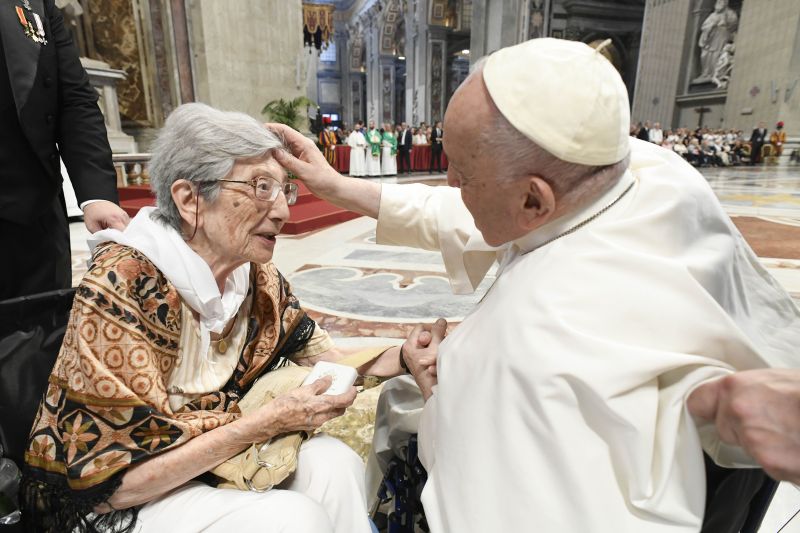
 Pope Francis blesses a woman in St. Peter’s Basilica, where he presided over a special papal Mass on July 23, 2023, marking the third annual World Day for Grandparents and the Elderly. / Vatican Media
Rome Newsroom, Jul 23, 2023 / 07:25 am (CNA).
Calling for “a new bond between the young and old,” Pope Francis marked the third annual World Day for Grandparents and the Elderly with an intergenerational Mass Sunday in St. Peter’s Basilica.
Old age is a “blessed time,” the pope affirmed in his homily, “for it is the season to be reconciled, a time for looking tenderly at the light that has shone despite the shadows, confident in the hope that the good wheat sown by God will prevail over the weeds with which the devil has wanted to plague our hearts.”
“How much we need a new bond between young and old,” Pope Francis said, “so that the sap of those who have a long experience of life behind them will nourish the shoots of hope of those who are growing. In this fruitful exchange we can learn the beauty of life, build a fraternal society, and in the Church, be enabled to encounter one another and dialogue between tradition and the newness of the Spirit.”
Sunday marked the first time Pope Francis presided over the special papal Mass since initiating the World Day of Grandparents and the Elderly in 2021. The celebration is now held on the fourth Sunday of July — the Sunday closest to the July 26 feast of Joachim and Anne, the grandparents of Jesus.
Joining some 6,000 grandparents and older people at the liturgy were young people bound for World Youth Day in Lisbon, Portugal, which begins Aug. 1. Before the final blessing of the Mass, five youths and five elderly people, representing the five continents, processed to the front of the basilica. The elderly people then placed pilgrim’s crosses around the necks of the young people.
Growing together
In his homily, Pope Francis reflected on three parables of Jesus in Sunday’s Gospel from Matthew, focusing on the theme of “growing together.”
“Jesus uses parables to teach us about the kingdom of God. He recounts simple stories that touch the hearts of his listeners,” the pope observed.
“Such language, full of imagery, resembles the language that grandparents often use with their grandchildren, perhaps while holding them on their laps. In this way they pass on a wisdom important for life,” he said.
In the first parable, the farmer commands that the wheat and the weeds be allowed to grow together until harvest time.
“This image,” the Holy Father said, “helps us to see things realistically: In human history, as in each of our lives, there is a mixture of light and shadows, love and selfishness. Good and evil are even intertwined to the point of seeming inseparable.”
Pope Francis said this is a “realistic approach” that helps us to look at history avoiding both “sterile optimism” and “poisonous pessimism.”
“Christians, motivated by the hope of God, are not pessimists; nor do they naïvely live in a fairy tale, pretending not to see evil and saying that ‘all is well.’ No, Christians are realists: they know that there are wheat and weeds in the world,” he said.
Christians recognize this interplay not just in the world at large, but also in their own lives, he continued, realizing that “evil comes also from within us.”
The parable poses the question of what should be done with this situation, and the pope noted how the servants want to pull up the weeds.
“This attitude comes from good intentions, but is impulsive and aggressive,” Pope Francis warned.
“They delude themselves into thinking that they can uproot evil by their own efforts in order to save what is pure,” he continued. “Indeed, we frequently see the temptation of seeking to bring about a ‘pure society,’ a ‘pure Church,’ whereas in working to reach this purity, we risk being impatient, intransigent, even violent toward those who have fallen into error. In this way, together with the weeds we pull up the good wheat and block people from moving forward, from growing and changing.”
Instead, Jesus says the wheat and weeds have to grow together, the Holy Father emphasized.
“How beautiful is this vision of God, his way of teaching us about mercy,” the pope said. “This invites us to be patient with others, to be patient with others and — in our families, in the Church, and in society — to welcome weakness, delay, and limitations, not in order to let ourselves grow accustomed to them or excuse them, but to learn to act with respect, caring for the good wheat gently and patiently.”
In any case, it is God’s work, not ours, to purify the heart and claim the definitive victory over evil, the pope said.
He then noted how this attitude helps us to look back over our lives, especially when we’ve lived longer.
The elderly, he noted, look back over their lives and see “so many beautiful things” but also the “defeats and mistakes.”
“Yet today the Lord offers us a gentle word that invites us to accept the mystery of life with serenity and patience, to leave judgment to him, and not to live regretful and remorseful lives,” he said. “It is as if Jesus wanted to say to us: ‘Look at the good wheat that has sprouted along the path of your life and let it keep growing, entrusting everything to me, for I always forgive: in the end, the good will be stronger than the evil.’”
Pope Francis considered the second and third parables, about the mustard tree and the yeast, as images to encourage the elderly and the young to dwell together.
Scripture calls us to be vigilant so we don’t marginalize the elderly, the pope said, “so that our crowded cities do not become ‘centers of loneliness’; that politics, called to provide for the needs of the most fragile, never forgets the elderly nor allows the market to banish them as ‘unprofitable waste.’
“May we not chase after the utopias of efficiency and performance at full speed, lest we become incapable of slowing down to accompany those who struggle to keep up,” the pope urged. “Please, let us mingle and grow together.”
Three fields
Following the Mass, Pope Francis underscored this theme when he prayed the traditional midday Angelus from a window overlooking St. Peter’s Square, flanked by a grandmother and grandson.
Reiterating the themes from his homily, the pope warned against judging our neighbors or trying to create a perfect world by uprooting the weeds. However, he noted, there is a place where we are free to work, and that is in our hearts.
There, we must have “constant care of the delicate shoots of goodness” as well as dedicate ourselves to “identify and uproot the weeds.”
“There is a good method for this,” he said: “It is the examination of conscience, which serves precisely to verify, in the light of God, what is happening in the field of the heart.”
In summary, he posed three questions for the faithful to ponder.
“Thinking of the field of the world: Do I know how to resist the temptation to ‘bundle all the grass together,’ to sweep others aside with my judgments?” he asked. “Then, thinking of the field of the heart: Am I honest in seeking out the bad weeds in myself, and decisive in throwing them into the fire of God’s mercy?
“And, thinking of the neighbor’s field: Do I have the wisdom to see what is good without being discouraged by the limitations and limits of others?”
In his remarks after the Angelus reflection, Pope Francis mentioned the exceptionally severe monsoon season in South Korea that brought flash flooding last week, killing at least 40 people in the North Gyeongsang province.
He also lamented the ongoing suffering of people trying to migrate, especially through deserts. Referring again to the Mediterranean as a “cemetery,” he prayed that our hearts might be illuminated so that we show more solidarity. This month, migrants from sub-Saharan Africa were chased out of Tunisia to deserts along the border with Libya and Algeria. While several hundred have since been rescued, pockets of people are still stranded.
As he does in every public address, the pope reiterated his appeal for prayer for Ukraine. He noted that last night’s strike in Odessa badly damaged the historic Transfiguration Cathedral, an Orthodox cathedral in the city.
He closed with his traditional request that the faithful pray for him, but added an appeal to pray for all grandparents.
[…]



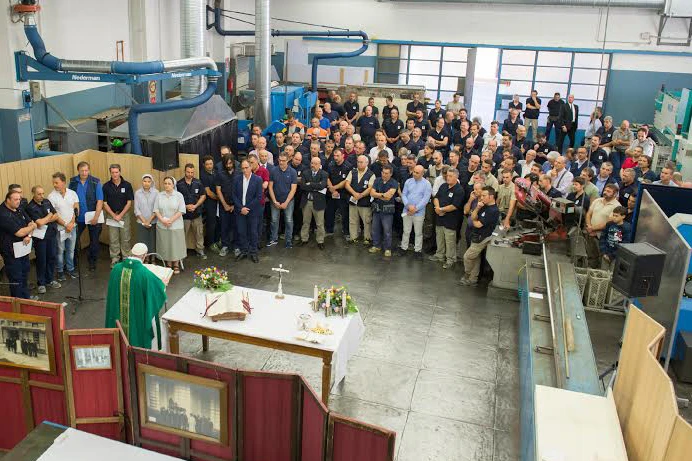
Pope Francis: Tear down these walls!
“Anyone convicted of illegal entry will be banned from entering Vatican territory for a period of up to 15 years. If this sanction is breached, the offender may be punished with a prison sentence of one to five years.”
**********
That’s pretty hardcore.
Unbelievable hypocrisy?
Anything but, given what we have experienced both of ‘unbelievable’ and of ‘hypocrisy’ over the current pontificate.
More like: ‘par for the course’ from this pope.
According to Francis, countries overrun by illegal immigrants are not to do as Francis’ Vatican aims to do through its Pontifical Commission for Vatican City State Decree on persons illegally entering Vatican territory?
Doublespeak again, louder please, so all can hear it unambiguously!
http://www.catholicnewsagency.com/news/259061/catholic-immigration-experts-respond-to-pope-francis-comment-that-repelling-migrants-is-a-grave-sin
Migrants must be granted free access to every neighborhood of Europe, North American and Australia, but there are a few areas that are strictly off-limits: Martha’s Vineyard, Davos, and now, we find out, the Vatican. Francis and company truly love the downtrodden, but from a safe distance. The rest of us get to enjoy a much more intimate experience.
I don’t know about Martha’s Vineyard but a family member worked for a couple from Nantucket Island who said there were quite a few illegal immigrants there. Somebody has to do the cleaning and yardwork, etc. and it’s not practical for workers to ferry back and forth constantly, so they stay on the island.
Large numbers of migrants without employment dumped on Nantucket or Martha’s Vineyard would be a different situation.
The Vatican needs to have tight security for many reasons. I honestly understand this, and support it.
But incoming President Trump, and 77.3 million Americans are wrong for wanting stricter security measures and illegal immigration/deportation crackdowns here in our own country?
Sounds perfectly logical to me.
“I was a stranger, and you did not welcome me.”
The goats are in trouble now …
Strangers are welcomed, but trespassers aren’t, even if said trespassers do not happen to be strangers.
So according to Pope Francis it is a disgrace for the US to apprehend, deport and ban illegal immigrants from the USA. But it is OK for the Vatican to do the same? Do as I say not as I do? And we wonder why the Catholic Church is shrinking?
Catholic Immigration: corrected – There would be no basis for ill feeling toward foreign nationals, if every country accepted the responsibility to pay for their own citizens’ politically defined entitlements and socialization costs. (health, welfare, education and criminal/restitution/incarceration.)
It is the responsibility of every nation to provide for the politically defined health, education, welfare and criminal costs incurred by their citizens while their citizens are in a foreign country. Because of the diversity of means by which the needs of citizens are provided for through out the world, often ranging from high taxation for many benefits to no taxation for no benefits, and because a country’s citizen’s first and primary recourse for the proper and customary administration of defined rights, responsibilities and entitlements is to his own country’s policies and resources, whenever a citizen is “abroad” the host nation shall have the ability to charge a visiting citizen’s home country for expenses which the host nation has incurred to its own citizens due to the needs of the visiting citizen. These costs may also be reimbursed by “sponsoring” groups, insurance companies, or individuals. Enforcement of these payments shall be enacted through the issuance or denial of visas. A host country can deny entry to citizens from a delinquent country. And a country that cannot afford the social costs of another country can place restrictions on the issuance of visas to its citizens for that other country. This law/policy should also state that a child born to a foreign national while in the United States is granted dual citizenship, but that the responsibility for the “entitlement” costs of the child remain with the parents and the home country of the parents until the child turns 18 or becomes a citizen of the host nation alone, which ever comes later. Nothing in this policy should ever prevent charitable organizations from providing care or services to whom ever they choose.
It is a blessing and responsibility of the individual, family and church to take care of the poor, indigent and marginalized, not the government. All blessings come from God. When the individual, family and church are the “free will” source of charity then all are blessed; the giver, the receiver and the common good of the community.iWhen the government is the source of blessings for those in need, then the government becomes the source of blessings; supplanting God, changing a blessing into a “right” (without the corresponding responsibility) of “entitlement” there-in making losers out of all involved by stealing the free will charity of the giver (taxation replaces charity), conditioning the receiver to demand his “right to be taken care of” without owing anyone–even God– a prayer of gratitude, and conditioning the community towards atheistic socialism. The move (back–before 1930 there were no government entitlements! With few exceptions, the church –through her people –was the source of all charity.) to this new “charity of the heart and soul” paradigm must be gradual, but sure, to ensure that the transition allows for the prudent care of those in need. This can best be done by allowing a 100% tax deduction for gifts to charitable organizations, and by removing the ceiling on how much can be donated–as a percentage of income– while cutting back on the duration and degree of entitlements.
This is the opposite of what current representatives are proposing. There have been suggestions that all charitable donations deductions be deleted from the tax code… do you see what a Machiavellian power grab this is, do you see what an atheistic socialist and communistic power maneuver this is? And as a Catholic, who loves the Church deeply, I must tell you many Catholic religious have embraced the false notion that the government — not the church—should be required to take care of the needy. (Caritas in Veritate –Charity in Truth articulates an accurate implementation of these principles)
Well can’t go in the Vatican but the pope is applaud to the US picking up illegal aliens maybe our pope should stay out of politics. I’ve been a catholic for 80 years but this pope so far is far from the best.
And the Pope has the NERVE to try and Tellthe US to NOT enforce its own Immigration Laws????
Pope Francis needs to sit down and sgut up quite frankly.
First, I am a born, baptized, confirmed, and practicing Roman Catholic in the USA. And today, at Mass, we were “instructed” to contact our Congressmen to stand against “mass deportation”. Pope Francis, “people in glass houses (a.k.a. you)” shouldn’t throw stones.
The visiting priest also likened NOT speaking up about “mass deportation” was equivalent to Germans in 1939 not speaking up about concentration camps being built. Am I the only one who sees these 2 events have NOTHING in common?
The U.S. policy of mass deportation is aimed at CRIMINALS who are illegally in MY country. Also, these deportees are being returned ALIVE to their native countries, they are are NOT being exterminated or wrongly treated in any way.
Pope Frances needs to remember that the Vatican started building THEIR walls in the 9th century and has maintained them ever since. Again, “glass houses”! Vatican immigration policies are more stringent than the Untied States policies.
Who cries for the murdered, beaten, extorted, sexually abused, those who are sold into human trafficking, and their families? I do and every other American who had to witness these horrendous acts CAUSED by the 4 years of Biden/Harris open border policies.
Pope Francis, stay in your lane and out of all countries political policies.
It appears to me that Pope Francis was a NIMBY.
Meanwhile, our pope wants the U.S. to have an open door for entry by illegal immigrants. Rules for thee but not for me.