Karachi, Pakistan, Aug 9, 2019 / 10:09 am (CNA).- Catholic and other religious leaders signed a joint resolution Thursday encouraging the Pakistani government to adopt policies to protect religious minorities.
The leaders held a press conference in Karachi Aug. 8 organized by Aid to the Church in Need – Italy and by local advocate Tabassum Yousaf.
In attendence were Fr. Saleh Diego, vicar general of the Archdiocese of Karachi, who represented Cardinal Joseph Coutts. Representatives of the country’s Muslim, Hindu, Sikh, and Baha’i communities were also present and signed the resolution.
The join resolution, sent to prime minister Imran Khan and obtained by CNA, includes 10 recommendations meant to safeguard the rights of minorities and women.
Pakistan’s state religion is Islam, and around 97 percent of the population is Muslim.
The country’s authorities have consistently failed to implement safeguards on behalf of religious minorities, despite numerous policies in favor of economic and physical protections for members of non-Muslim religions.
The first point adopted in the joint resolution urges that the minimum age for marriage be made 18 years; the current marriage age for women is now 16.
The religious minorities also ask for the opportunity for better economic development, which they are not guaranteed at the moment.
The religious leaders encouraged a federal ministry for religious minorities, and the application of a quota for educational scholarships given to minorities.
In 2013 the then-governing party, the Pakistan Muslim League (N), promised a quota for jobs in the educational institutes and the public sector for members of religious minorities. The Pakistan Peoples Party discussed an Equality Commission to monitor job quotas in Sindh.
Both parties are now in the opposition in the national parliament, and the proposed safeguards have not been put into action.
The joint resolution urges protection of minorities’ houses of worship from government seizure; designated minority worship areas in jails, hospitals, and state institutions; and the passage of legislation to prevent religious discrimination in employment, education, and society.
The religious leaders also asked for government subsidies for security at minorities’ schools. In December 2017, Islamic State group-affiliated suicide bombers attacked a Methodist church in Quetta, killing nine people.
The joint resolution said minorities “should be given particular protection” against the abuse of the country’s blasphemy laws.
Pakistan’s blasphemy laws impose strict punishment on those who desecrate the Quran or who defame or insult Muhammad. Although the government has never executed a person under the blasphemy law, accusations alone have inspired mob and vigilante violence.
Blasphemy laws are reportedly used to settle scores or to persecute religious minorities; while non-Muslims constitute only 3 percent of the Pakistani population, 14 percent of blasphemy cases have been levied against them.
Many of those accused of blasphemy are murdered, and advocates of changing the law are also targeted by violence.
The blasphemy laws were introduced between 1980 and 1986. The National Commission for Justice and Peace said over 1,300 people were accused under this law from 1987 until 2014. The Centre for Research and Security Studies reported that at least 65 people have been killed by vigilantes since 1990.
In the joint resolution the religious leaders also noted that “there is no forced conversion according to the Holy Quran.” On that basis, they urged legislation against abduction, sexual violence, and subsequent forced conversion to Islam, which acts they said do not propagate “the true spirit of Islam.”
The joint resolution also called for the elimination from books of material encouraging hatred.
Earlier this year Sam Brownback, the US ambassador-at-large for international religious freedom, applauded Pakistan for showing a willingness to enhance religious liberty, while also recognizing the need for significant improvement.
Brownback met with Pakistani government and religious leaders Feb. 22-23.
“During these meetings, Ambassador Brownback emphasized the importance the United States places on religious freedom, the protection of religious minorities, and respect,” the US embassy in Pakistan stated.
In December 2018, U.S. Secretary of State Mike Pompeo named Pakistan as one of 10 “Countries of Particular Concern,” a designation given to states that engage in or tolerate egregious, ongoing religious freedom violations.
That designation marked the first year that Pakistan had been placed on the list. The previous year, it had been placed on a “Special Watch List.”
 […]
[…]


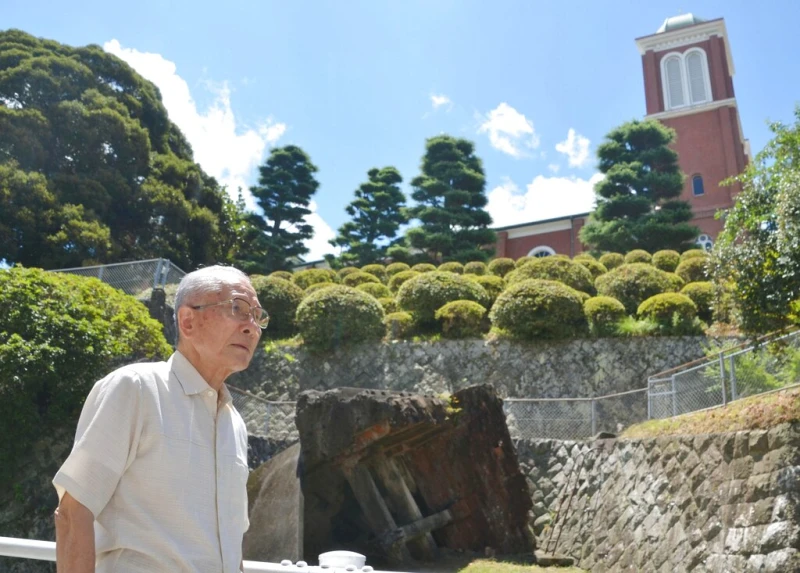



In 2018 another Nagasaki survivor, Mitsugi Moriguchi six years younger than Shigemi Fukahori, visited the 570-square mile desert site in eastern Washington (state), the Hanford Nuclear Reservation, where the Plutonium was produced for the Nagasaki bomb (and for the nuclear arms race from 1945 until the apparent collapse of the Soviet Union in 1990. https://www.pbs.org/newshour/show/nagasaki-survivor-visits-the-u-s-town-that-fueled-his-citys-destruction (the bomber mural depicted on the local high school is a B-17 used in Europe, not a B-29 as used later in the Pacific War; the B-17, a “Day’s Pay,” was funded by Hanford employees).
Moriguchi was justifiably shocked and humiliated to find that the Richland bedroom community’s high school mascot is a mushroom cloud, painted on the gym floor where the souls of the incinerated are under the soles of an uncomprehending younger generation.
Yours truly was born in 1944 in what from that time has been an evacuated ghost town (Hanford) on the still-restricted Hanford Nuclear Reservation. About this complex and fast-moving history and its aftermath, I pause particularly at the late Szilard Letter from the nuclear scientists, sent to President Truman but never delivered, proposing that the use on Japan in August 1945 of a bomb intended to offset the Nazi nuclear program (Germany had surrendered in May), would trigger a long-term nuclear arms race, rather than possibly and only ending the winding-down war in the Pacific. Today, tens of thousands of warheads, and multilateral nuclear proliferation…
Today, together with the Richland high school students, can we even imagine a possible alternative geopolitical history to the past half century and more? Personal and outside-the-bubble reflections on this predicament (turning point?) of modern Technocracy can be found at https://theimaginativeconservative.org/2021/08/meditations-bomb-small-town-cul-de-sac-peter-beaulieu.html
And, what would morally ambivalent AI have said or done?