


Vatican City, Dec 13, 2024 / 16:35 pm (CNA).
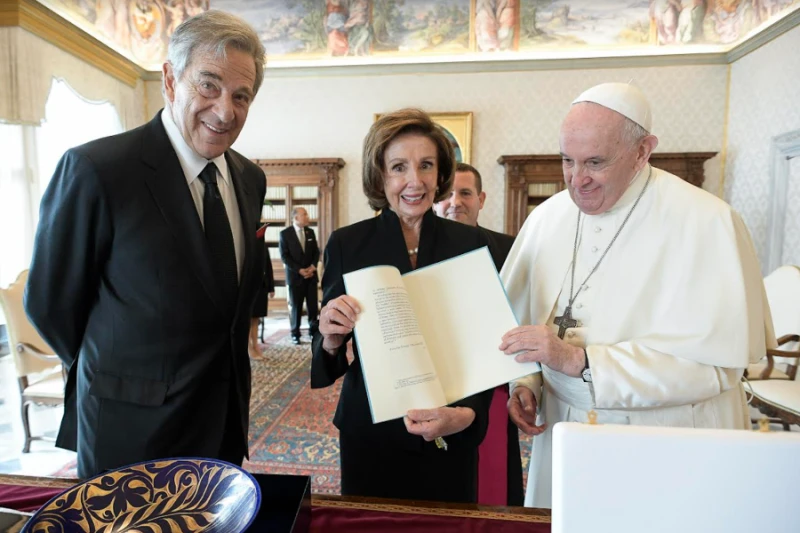
Despite former speaker Nancy Pelosi’s recent statement that she has appealed to the Vatican to overturn the Communion ban imposed on her because of her position on abortion, such recourse is no longer likely to be available to her, a canon law professor told CNA.
Pelosi would have needed to bring her case to Pope Francis within 30 days of San Francisco Archbishop Salvatore Cordileone’s initial imposition of the ban in 2022, said Father Stefan Mückl, an ecclesiastical law professor at the Pontifical University of the Holy Cross in Rome.
In an interview with the National Catholic Reporter published this week, Pelosi said she had sought intervention at the Vatican to get the ban overturned.
“My understanding, as long as Rome has the case, it hasn’t been resolved,” Pelosi told the National Catholic Reporter. “I’ve never been denied. I’ve been to Catholic churches all over the country, and I’ve never been denied.”
It is not clear when Pelosi appealed to the Vatican. The National Catholic Reporter said “she did not respond to a request to speak with her canon lawyer” and that “her spokesmen declined to comment on a personal matter.”
In a 2022 open letter addressed to the former speaker of the House of Representatives, Cordileone prohibited Pelosi from receiving holy Communion because of her public position on abortion. He cited Canon 915 of the Code of Canon Law as applying to her case.
According to Mückl, if Pelosi made an appeal under canon law to the Vatican, she would have needed to have done so within a specific time frame.
“If Mrs. Pelosi has now lodged an ‘appeal’ with the Holy See, this will hardly be a recourse in the canonical sense because such a recourse [would] clearly be out of time,” Mückl told CNA.
“At best it can be assumed that it is a ‘political appeal,’” he said. “A recourse in the technical sense would be time-barred.”
Referring to Canons 1734 and 1735 of the Code of Canon Law, Mückl explained that Pelosi would have had “10 days to seek revocation of a decree by the author [Cordileone], then 30 days for proposing recourse to the hierarchical superior [Pope Francis].”
In response to Pelosi’s comments in the National Catholic Reporter, the archbishop of San Francisco issued a statement Dec. 10 expressing his desire to speak with the politician.
“As a pastor of souls, my overriding concern and chief responsibility is the salvation of souls. And as Ezekiel reminds us, for a pastor to fulfill his calling, he has the duty not only to teach, console, heal, and forgive but also, when necessary, to correct, admonish, and call to conversion,“ Cordileone wrote.
“I therefore earnestly repeat once again my plea to Speaker Pelosi to allow this kind of dialogue to happen,” he added.
According to Mückl, if Pelosi refuses to engage in dialogue with Cordileone, “juridically speaking she has not fulfilled her duty to cooperate.”
Though, Pope Francis is “free to take the matter to himself,” Mückl told CNA. “Whether he would actually do so is difficult to predict.”
If you value the news and views Catholic World Report provides, please consider donating to support our efforts. Your contribution will help us continue to make CWR available to all readers worldwide for free, without a subscription. Thank you for your generosity!
Click here for more information on donating to CWR. Click here to sign up for our newsletter.



Notwithstanding Canonist Fr Mückl, timing has not prevented this pontificate from retaining cases on ice or determining which direction a case may be decided.
For Pope Francis, Nancy Pelosi’s appeal centers on conscience, her appeal is a test case regarding his doctrine on the primacy of conscience as argued in Amoris Laetitia and repeated elsewhere.
The key Argentine Papal exchange of letters, a request by Argentine bishops for clarification on communion for divorced and remarried was given an oblique assent by Francis, his famous “It can’t be understood otherwise” entered into the Acta Apostolicae Sedis [AAS] by Secretary of State Cdl Parolin and declared by him binding doctrine [some Canon lawyers contend whether such an oblique response is actually a clear affirmation]. The upshot of the doctrine’s effect is revealed in Malta, where their bishops followed the Argentine format of careful consultation and discernment and found its application unable to contain the principle of exception to the rule.
Within a short space it was realized that it wasn’t possible, for example if Divorced and remarried parishioners saw communion given to some why should not they. Malta’s bishops then announced the matter was left to the individual’s conscience sans requirement of priestly discernment.
Pope Francis has several options, one to refuse Pelosi, which would seem contrary to the doctrine approved in the AAS. If he did refuse he would appear to defend tradition. If he granted Mrs Pelosi a right to communion he fortifies the AAS doctrine and what occurred in Malta and elsewhere, which would widen the gap between conservation bishops certainly including Cordileone. Or like the Rupnik case he can ice it.
As an opinion it appears a win win win scenario for Pope Francis because whichever of the three options he decides his policy will continue to subvert revealed doctrine. For example, were he to refuse Pelosi’s petition he would appear orthodox, while his locked in policy continues to expand, noting that Mrs Pelosi says she’s permitted Holy Communion anywhere outside the SF Diocese. A seemingly quiet issue that is actually momentous. Because in effect of its notoriety it continues the policy of communion without penance and repentance for sins.