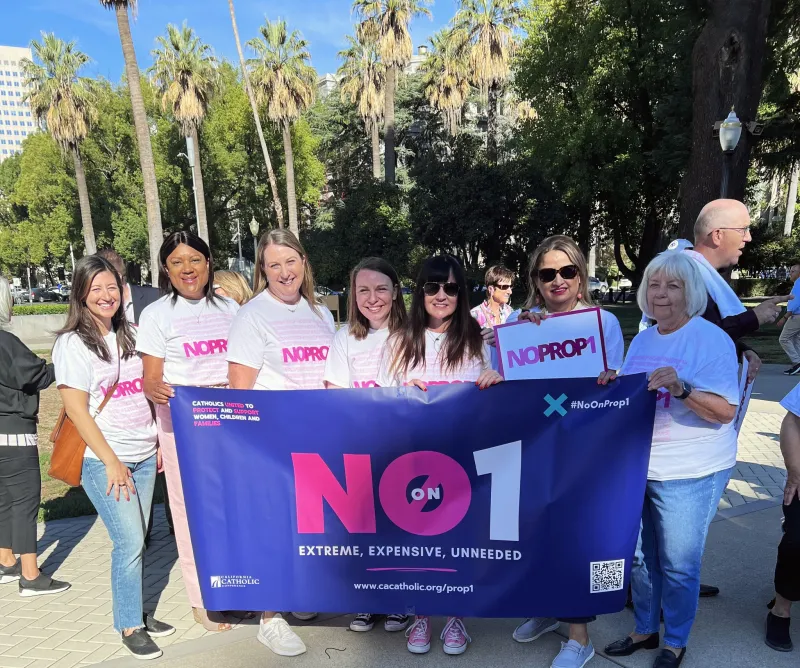
 Participants in a demonstration against Proposition 1 outside the California capitol in Sacramento, Oct. 6, 2022. / Photo courtesy of California’s No on Prop. 1 Campaign
Washington, D.C. Newsroom, Nov 9, 2022 / 09:22 am (CNA).
Ballot initiatives to protect and expand abortion passed across the nation on Election Day.
Americans in five states voted on the issue of abortion during the 2022 midterm elections. Three states — California, Michigan, and Vermont — proposed constitutional amendments to advance abortion. All three passed.
At the same time, citizens in Kentucky weighed a pro-life amendment and Montana voters considered a measure that promises to protect babies who are born alive after attempted abortions. Kentucky voted no to its pro-life measure. Montana’s results are still coming in, with a current majority voting no.
Stephen Billy, who serves as vice president of state affairs at the national pro-life group SBA Pro-Life America, early Wednesday morning stressed that life is still winning.
“Anyone arguing abortion is winning is missing what happened tonight,” he told CNA. “We had strong pro-life candidates at the federal and state level win because they seized on life as a winning issue and exposed the extreme taxpayer-funded abortion until birth policy of their opponents.”
“We know life is a winning issue, we know how to win on life, and we know the American people reject the extreme policy of Planned Parenthood and their candidates,” he added. “Going forward, we have to do better at using our winning strategy and using it to fight back against the millions of dollars Big Abortion puts into ballot initiatives to cause confusion and hide their extreme policy. When the voters see the abortion industry pushing abortion on demand, they reject it — and if we focus on exposing that extreme policy we will win.”
The ballot measures on Election Day follow the Supreme Court’s June decision in Dobbs v. Jackson Women’s Health Organization, which overturned Roe v. Wade and freed states to legislate on abortion. They also come after a pro-life amendment recently failed in Kansas.
California: Proposition 1
Proposition 1 will amend California’s constitution to explicitly protect abortion after citizens voted to pass it.
As of mid-Wednesday morning, the New York Times reported that 65.1% voted yes to Proposition 1 and 34.9% voted no, with 41% of the votes in.
Following the election results, Catherine Hadro, director of media relations for California’s No on Proposition 1 campaign, stressed a disconnect between what Proposition 1 allows and what California voters support.
“We know that more than 80% of Californians reject late-term abortion. They oppose late-term abortion,” she previously told CNA. “And that’s exactly what Proposition 1 would allow.”
The proposition reads: “The state shall not deny or interfere with an individual’s reproductive freedom in their most intimate decisions, which includes their fundamental right to choose to have an abortion and their fundamental right to choose or refuse contraceptives.”
California currently allows abortion for any reason before viability, when a baby can survive outside the womb — generally considered to begin around 24 weeks of pregnancy. After viability, California allows abortion when a woman’s life or health is threatened.
The California Catholic Conference encouraged pro-life voters to say “no” to Proposition 1, calling it “an expensive and misleading ballot measure that allows unlimited late-term abortions — for any reason, at any time, even moments before birth, paid for by tax dollars.”
A campaign for the amendment led by pro-abortion groups, called Yes on Proposition 1, argued that Proposition 1 would “ensure that, in California, people continue to have the power to control their own bodies and personal decisions.”
Michigan: Proposal 3
Michigan’s proposed constitutional amendment, Proposal 3, will advance abortion in that state.
As of mid-Wednesday morning, the New York Times reported that 56% voted yes to the proposal and 44% voted no, with 87% of the votes in.
On the ballot, the amendment is identified as a “proposal to amend the state constitution to establish new individual right to reproductive freedom, including right to make all decisions about pregnancy and abortion; allow state to regulate abortion in some cases; and forbid prosecution of individuals exercising established right.”
In Michigan, women can obtain abortions for any reason before viability. After viability, abortion is permitted to save the woman’s life.
The Citizens to Support MI Women and Children coalition, which includes the Michigan Catholic Conference, advised pro-life citizens to vote no on the amendment. The group said it would “radically distort Michigan’s Constitution to create a new unlimited right to abortion.”
“This poorly-worded amendment would repeal dozens of state laws, including our state’s ban on tax-funded abortions, the partial-birth abortion ban, and fundamentally alter the parent-child relationship by preventing parents from having input on their children’s health,” the group said.
In support of the amendment, Reproductive Freedom for All argued that “in addition to ensuring access to a broad range of reproductive health care, this amendment would make sure no one goes to prison for providing safe medical care.”
Vermont: Article 22/Proposal 5
In Vermont, citizens voted to pass the constitutional amendment Article 22, also known as Proposal 5, which promotes abortion.
As of mid-Wednesday morning, the New York Times reported that 77.4% voted yes to the proposal and 22.6% voted no, with more than 95% of the votes in.
It reads: “That an individual’s right to personal reproductive autonomy is central to the liberty and dignity to determine one’s own life course and shall not be denied or infringed unless justified by a compelling State interest achieved by the least restrictive means.”
Abortion is legal up until birth in the state.
The Roman Catholic Diocese of Burlington, which includes the entire state of Vermont, published a piece in its diocesan bulletin warning that the amendment “promises to enshrine unlimited, unregulated abortion throughout all nine months of pregnancy in our state’s founding document” and “would permanently block any attempt to protect the unborn — even those who can survive outside the womb.”
Vermont Right to Life Committee urged citizens to vote no.
Led by pro-abortion groups, Vermont for Reproductive Liberty Ballot Committee argued: “We need this amendment because important medical decisions should be guided by a patient’s health and well-being, not by a politician’s beliefs.”
Kentucky: Amendment 2
Kentucky voted against a pro-life measure — Amendment 2 — which says the state’s constitution does not protect abortion.
As of mid-Wednesday morning, the New York Times reported that 52.6% voted no to the amendment and 47.4% voted yes, with 88% of the votes in.
It reads: “To protect human life, nothing in this Constitution shall be construed to secure or protect a right to abortion or require the funding of abortion.”
Kentucky currently prohibits abortion with exceptions for saving a woman’s life or preventing serious risk to her physical health.
The Yes for Life alliance, which includes the Catholic Conference of Kentucky, asked pro-life citizens to vote yes. The group said that the amendment’s language “will prevent state judges from asserting their own preferences over the will of legislators and the voters.”
Opposing the amendment, the Protect Kentucky Access coalition claimed that the amendment would “pave the way for the state to ban abortion in all cases.”
Montana: Legislative Referendum 131 (LR-131)
Voters in Montana considered Legislative Referendum 131, which says it will protect babies who are born alive after attempted abortions.
As of Wednesday morning, the New York Times reported that 52.6% voted no to the amendment and 47.7% voted yes, with 80% of the votes in.
It reads: “An act adopting the born-alive infant protection act; providing that infants born alive, including infants born alive after an abortion, are legal persons; requiring health care providers to take necessary actions to preserve the life of a born-alive infant; providing a penalty; providing that the proposed act be submitted to the qualified electors of Montana; and providing an effective date.”
Montana law allows abortion before viability. Abortion is also permitted after viability to save a woman’s life or prevent serious risk to her physical health.
SBA Pro-Life America’s Katie Glenn previously told CNA that she found the ballot initiative in Montana — a state she said has been getting progressively more pro-life — the most interesting.
“I think that one’s different than the other four, which are all very much time-gestational bans, in that this is not a pro-life/pro-choice issue,” she said. “This is about providing lifesaving care to a child who’s already been born.”
Opposing the referendum, Compassion for Montana Families claimed that it “would introduce extreme penalties for medical providers who, at the family’s request, do not take a dying infant away from its parents in order to perform invasive and even painful medical treatments in tragic circumstances where they have no chance of survival.”
[…]






Read his marching orders earlier. “Additionally, the document calls for more lay participation in all ecclesiastical decision making. It specifically calls for more women in leadership roles but does not settle the question about a possible women’s diaconate. It also condemns exclusion based on a person’s ‘marital situation, identity, or sexuality’”.
He can’t be serious. A pastor is condemned if he refuses Trans folks to advise how to pastor his parish? But unfortunately he is. Although what right in heaven or hell does a pontiff have to condemn, or even suggest condemnation [by God?] if a priest declines? In an earlier CNA article “Pope cites ‘Amoris laetitia’ on doctrine in synodal implementation note” Pope Francis urged we apply the doctrines layed out in Amoris Laetitia. Those doctrines are primarily the primacy of conscience and mitigation theory. Amoris does not replace the Gospels.
“Alice: Would you tell me, please, which way I ought to go from here?
The Cheshire Cat: That depends a good deal on where you want to get to.
Alice: I don’t much care where.
The Cheshire Cat: Then it doesn’t much matter which way you go.
Alice: …So long as I get somewhere.
The Cheshire Cat: Oh, you’re sure to do that, if only you walk long enough.”
“Each country or region, moreover, can seek solutions better suited to its culture and sensitive to its traditions and local needs,”
Unless those traditions and local needs involve attending the TLM, then sorry, no synoding for you.
Also can’t wait for the local LGBTQ crowd to suddenly start demanding changes to the mass to suit their needs.
Looks like “synodality” is synonymous to “Realpolitik”.
DOA as far as I’m concerned.
“[The final document] participates in the ordinary magisterium of the successor of Peter, and as such, I ask that it be accepted,” Francis wrote…”
There is a definition of the ordinary magisterium in the CCC (#891 and some other paragraphs). Also I believe in the documents of Vatican II. The teaching magisterium consists of the bishops with the pope. This synod document that the pope signed is not from the bishops, but from a group consisting of bishops, priests, nuns and laity. How could this be part of the magisterium? I don’t believe it can.
Also, the pope asks that it be accepted. If it truly was part of the magisterium I would think that he would state that it must be accepted.
What’s the rush?
The Pachamama Apostasy Cult: “Implement the authoritative indications of the Synod on Synodality document now.”
The Son of the Living God: “All authority in heaven and on earth has been given to me. Get thee behind me….”
The “Synod on Synodality document is part of the authentic teaching of the Bishop of Rome.”
The crowning achievement of the career of the Pontiff Francis is that he has communicated that he is a monumental fraud, and as such he adds something without authenticity to library which likewise is devoid of authenticity.
Zero plus Zero = Zero.
And as a reminder about the shelf life of this man’s “teaching,” Archbishop Scicluna of Malta, sycophant of Pontiff Francis, has established that this particular Pontiff’s teaching apparently gets buried with him, since by the rule-of-Scicluna, his cult only regards the teaching of “this current pope, not previous popes.” But I may be mistaken about Scicluna, he may regard the Pontiff Francis as an oracle, in which case, for Scicluna, and other such sycophants, the Pontiff Francis remains pope forever, even in death, and to him they pledge their loyalty…forever and ever.
It matters not at all what a man proclaims regarding his belief about the existence of God and how he tries to convince himself in some abstract way that he does believe in God.
If a man denies the immutability of truth, he is an atheist, even if he denies the implications of his beliefs to himself.
How much dire can the state of the Church be than to have an atheist for a pope and a prevailing episcopate too spineless to challenge him?
True Edward. Unless our faith is in God, whose existence is perfect and unchanging, pure dynamic, our belief is instead conceptual, imperfect, always subject to revision.
And, yet, about “always subject to revision” is not to be misunderstood as by some synodalers:
“The faithful therefore must shun the opinion, first, that dogmatic formulas (or some categories of them) cannot signify truth in a determinate way, but can only offer changeable approximations to it, which to a certain extent distort or alter it; secondly, that these formulas signify truth only in an indeterminate way, this truth being like a goal that is constantly being sought by means of such approximations. Those who hold such an opinion do not avoid dogmatic relativism and they corrupt the concept of the Church’s infallibility relative to the truth to be taught or held in a determinate way” (“Mysterium Ecclesia: Declaration in Defense of the Catholic Doctrine on the Church Against Certain Errors of the Day,” Congregation for the Doctrine of the Faith, June 24, 1973).
With St. Augustine: “We can say things differently, but we can’t say different things.”
As was the case of what was “believed” by Mary reported at Lk 1:45 as in uncertainty (cf. Lk 1:29, 34).
What do you call a shepherd with no place guide his sheep? Or, put another way, with no clear preference where his sheep end up?
Lately I have been studying Henri de Lubac and how he navigated the period where his theology was scrutinized by the Pope Pius XII. One of my questions is were Jesuits more learned then? Jesuits of today seem to “clot up” on major points of Tradition/Doctrine, if not create new doctrine out of whole cloth.
I want to be loyal to Mother Church and never found to be throwing a rock at the artwork – even when it belongs to Rupnik.
Every time I turn around this trial becomes more challenging, more difficult, if not impossible.
Fuzziness, that is also the Anglican solution to things; and just look where they are!
Ornery wideloopers I’ll say!
Here for once we are not speaking of orientation, but disorientation.
In Francis’ Magisterially Synodal Church: The synodally dialogic church will participate in pagan tradition, and pagan tradition will participate in Francis’ church.
Roman Catholics will continue in the unity of such a church under such a pontiff, but Christ will remain as the Triumphally Suffering Head. Roman Catholics will continue to hold the faith and hope of knowing that Christ our Head lives through, survives, and overcomes death.
Let us make jest of the lazy, ridiculous, the glaringly sad stupidity of any vatican-led holes to hell.
If you do not feel righteous anger over the reign of Jorge Bergoglio, your love for Mother Church is seriously deficient.
Please speak with accurate language. We’re told the document comes from the magisterium of the Bishop of Rome, then Francis tells us it’s of a pontifical magisterium, your commentary says it’s from the magisterium of the Church. What level will the next commentator reach? Will he consider the document as divinely revealed?
I know that a good writer always tries to avoid repetition when writing, but inasmuch as in temporal affairs you can use equivalent terms such as “Biden has decided X” , “Washington has decided X”, and “the United States has decided X”, that’s not how it works in ecclesiastical affairs. The qualifiers of magisterium between the Bishopric of Rome, the Papal office and the Church are not interchangeable just like that. This sort of spurious and deceptive language paves the way for novel doctrines on papal infallibility, and ought to thus utterly be rejected.
The directives are sufficiently vague, and thus can be safely ignored, given that most parishes already have healthy lay participation and are already in obedience to the *magisterial* intent of the document. The intent of the malcontents who were trying to use the synod as a way to democratize the Church is another question, but thankfully their intent doesn’t have to be considered.
Left-leaning bishops will use this as an excuse to make their untenable parishes even more untenable, but overall the effect will be negligible. Carry on.
The Synod was simply a thin cover for normalizing more garbage into the church. I cannot see myself cooperating with a woman deacon nor will I be interacting in a church setting with anyone who is “trans”. Ever. No thanks. I will quit my church ministry first.This Pope has been a complete disaster.
Your report misrepresents the Synodal document on the subject of sexuality when it says: “It also condemns exclusion based on a person’s “marital situation, identity, or sexuality.” The Synodal document does not do that. It only uses the word “sexuality” once, when it says: “Many participants were delighted and surprised to be asked to share their thoughts and to be given the opportunity to have their voices heard in the community. Others continued to express the pain of feeling excluded or judged because of their marital status, identity or sexuality.” That is not a condemnation of exclusion on the basis of “sexuality”. A homosexual, for example, may feel excluded because the Church treats the acts involved in any active homosexual relationship as sinful and does not accord their relationship the same status as a heterosexual relationship. That will and must, of course, continue.
Stephen, given that “ecumenical new church” has ordered the Catholic world to bless gay couples – in the style of James Martin – your final statement only holds true for disobedient Traditionalists whom Bergolio labels “rigid” and is actively persecuting from underground China to downtown Chicago.
“A homosexual, for example, may feel excluded because the Church treats the acts involved in any active homosexual relationship as sinful and does not accord their relationship the same status as a heterosexual relationship. That will and must, of course, continue.”
This is because these demeaning sexual acts, deny the Sanctity of the marital act, within The Sacrament of Holy Matrimony, which is Life-affirming and Life-sustaining and can only be consummated between a man and woman united in marriage as husband and wife. While it is true that some marriages deny the Sanctity of the marital act within The Sacrament of Holy Matrimony, resulting in the engaging in of demeaning sexual acts which are sinful because they deny the inherent Dignity of the human person, all same-sex sexual relationships deny the Sanctity of the marital act within The Sacrament Of Holy Matrimony, and thus demean the inherent Dignity of the human person, and are thus sinful.
I pray that the next Pope will take this document, and along with Amoral Leticia, Traditiones Custodes and Tutti Frutti, toss it on the bonfire. I’m sick and tired of this Synodal garbage which has obsessed this Pontificate even though it’s a colossal waste of time, especially since there are more urgent matters for the Church to be concerned with, like persecution of Christians in China, Nicaragua and Africa, Gender Ideology in the West, and the war in Ukraine.
👉👈
We are all Protestants now PF
In the Church of What’s Happening Now
I reject that PF.
I repeat with apology:
PF is obviously a disciple of the Jesuit hairy tick Teihard de Chardin.
See excellent new book “Theistic Evolution” in which Wolfgang Smith disembowels his multiple anti Christian fantasies. This is what infects our Jesuit pontiff.
Listen to the advice given to St Augustine “ Take and read”.
Hat tip to William Briggs.
“…Jesuit hairy tick…”
Delightful!
A hearty and Happy Thanksgiving to all my fellow Catholic Americans!
Last Saturday, November 23, Gerhard Cardinal Muller provided his personal rejection of the Francis’ Synodal Church Model. His rejection was printed in the First Things Catholic website and is entitled, “The 7 Sins Against the Holy Spirit; A Synodal Tragedy.” That’s right, finally a true “Catholic” Prince of the Church has condemned Francis’ Synod in simple and powerful TRUTHS of the One True Catholic Apostolic Tradition. Cardinal Muller, the former Head of the Congregation of the Faith in Rome, demolishes this new false model with great words of wisdom. He does so in a way that is incisive, precise, and Heavenly! And now that he has officially and publicly pointed out the fact that serious apostasy is at the doorstep of Francis’ Pontificate, then how soon will this heroic and holy prelate suffer white martyrdom, just as Vigano, Strickland and many other holy priest have been. Yes, in a sense it can be said that these souls, orthodox Catholic souls, are now living martyrs for the Catholic Faith.
I strongly encourage Mr. Olson, CWR Editor, an all on this site to read what the Cardinal writes in a five minute read. I can assure you that you will be very hopeful after having read what this saintly man of Christ writes as he truly speaks TRUTH to evil power.
Viva La Christo! and JCALAS Forever!
Presto, Change-O!
Come quickly, Lord Jesus!