




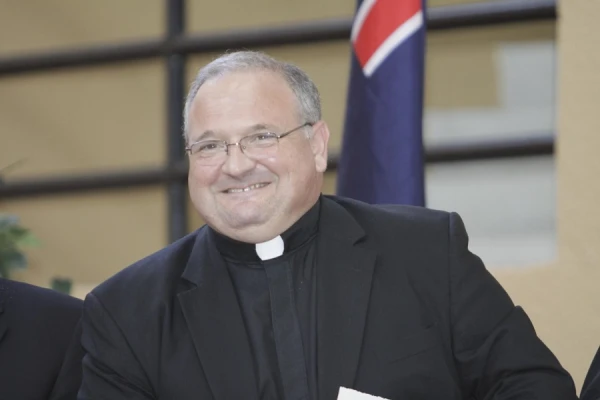
Cardinal Leonardo Steiner, the archbishop of Manaus in Brazil who is participating in the Synod on Synodality, said during a daily press briefing at the synod on Tuesday that “many of our women are true ‘deaconesses’” and pointed out that Pope Francis “has not closed the question” of the ordination of married men.
The cardinal is known for being a defender of the poor, Indigenous people and is also considered “pro-LGBTQ.” In the past, he has stated that “there will be a way” to end mandatory priestly celibacy.
At the 2019 Synod on the Amazon, the Brazilian cardinal also emerged as a staunch defender of the ordination of married men, an issue on which Pope Francis has not given a definitive word, according to what the prelate said Oct. 15.
During the briefing held at the Holy See Press Office, the 74-year-old cardinal said that during that day’s session, corresponding to the third module of the Instrumentum Laboris (working document), the participants of the synod reflected on “the places of the Church.”
The cardinal also commented that the Church must be open “to listening to cultures and religions” so that the Gospel can be “inculturated.”
In Manaus there are nearly 2.3 million people, of which 71,713 (3%) are Indigenous. In total there are 753,357 Indigenous people in the whole Amazon, according to official data from Brazil.
Taking these figures as an example to highlight the cultural differences between the West and the inhabitants of his diocese, the cardinal said that despite the fact that for “more than a hundred years there has been no priests” in the communities, they have organized themselves and continued to pray “with different ways of praying.”
Steiner emphasized that “women participate a lot” and that they are in turn “leaders of our communities.”
‘Why not restore the ordained female diaconate?’
The Brazilian cardinal emphasized that he wishes “that some more distant communities could celebrate some sacraments, for example baptism, without the presence of a priest.”
He continued by saying that “many of our women are true ‘deaconesses’ without this being official.” He also stressed that they would like to call them “deaconesses,” since they are “for all purposes,” although he preferred not to use this term “so as not to create confusion with the ordained ministry.”
For the cardinal, “unfortunately we do not have an adequate word” for their role, but “what they do and their responsibility within our Church is admirable.”
“There are many women who lead the community, who make the word of God known, who gather the community in a moment of prayer and who are active, for example, in prison ministry, in catechesis, in Caritas activities. They are the ones who carry out this activity, they are active alongside street people, they are the ones who represent our Church in many places,” he said.
Steiner emphasized his position in favor of the ordination of women to the diaconate and pointed out the existence of a commission that is “charged with studying this issue.”
“Why not restore the ordained female diaconate? We have already had a Church like this, with this face,” he said, referring to deacons.
“The permanent diaconate for men can go forward with that of women. I think we must reflect a lot on these questions, we must go deeper and we must remember the essential and fundamental role of women in the Church.”
He also stated that “the door should not be opened to a question of gender” but rather that it is “a question of vocations in the Church. The vocation of women within the Church and within our community.”
Responding to one of the journalists present at the press conference, the cardinal pointed out that the Synod on the Amazon “opened the possibility” of holding the Synod on Synodality.
Regarding this “process,” he commented that “a path has been opened from which there is no turning back” since “there is no point of return.”
“It is essential that we all enter into the interior of a movement that is the Church” and to feel the responsibility of the mission through baptism and the grace of God, he said.
The Holy Father ‘has not closed the question’ of ordaining married men
Asked about the ordination of married men, an issue that has “disappeared” from the study groups of this second and last session, the cardinal emphasized that after the Synod on the Amazon “there was disappointment on this subject.”
He nevertheless emphasized that “the Holy Father has not closed the issue” and assured that “in some circumstances it would not be a difficulty.”
He also expressed his hope that Pope Francis “has the capacity to move forward” while indicating that he has not wanted to do so yet due to “his great sensitivity.”
Steiner reiterated that “we must continue to talk” about this issue and that “we must go deeper into the ministerial role,” since “sufficient steps” have not yet been taken.
“In some cultures celibacy is a great difficulty. That’s what I feel,” he explained.
Speaking last Saturday at Fátima, Steiner said he “lays hands” on all those women who exercise the ministry of baptism or other sacraments.
“These are very tense issues in the Church. We must not stop discussing and reflecting. And if at some time we come to the conclusion that in the past there was a female diaconate, why not reintroduce it as the permanent diaconate was reintroduced?” the cardinal reiterated.
This story was first published by ACI Prensa, CNA’s Spanish-language news partner. It has been translated and adapted by CNA.
If you value the news and views Catholic World Report provides, please consider donating to support our efforts. Your contribution will help us continue to make CWR available to all readers worldwide for free, without a subscription. Thank you for your generosity!
Click here for more information on donating to CWR. Click here to sign up for our newsletter.


“‘That’s what I feel,’ he explained.” Yeah, we get it. And I bet a lot of your “deaconesses” are witches too. (At least that’s what I “feel.”)
I remember a Jesuit (forgot his name), saying that theologically speaking, ordaining women is a problem, but ordaining married men is not really a big deal. We have ordained married Episcopal Priests who converted, and to allow Bishops on a case by case basis,to ordain married Deacons. I doubt many people would leave the Church over a few married Deacons being ordained.
And there are the Eastern rite Catholics, who have had married priests since, well, the start.
Agree. Some of the best saints in East & West had dads who were deacons, priests, or bishops even, cf Saints Patrick (his grandfather a priest and dad a deacon) & Gregory Nazianzus (his bishop dad ordained him to the priesthood).
So slapping God in the face over our own caprices is fine so long as it does not upset us?
Dear Cardinal, no such thing as “deaconesses.” You should return to study Church history, sacramental theology, and ecclesiology. Without pointing a finger at this particular cardinal, my experience has taught me that those who hold apostate positions in the Church are oftentimes closeted homosexuals or flagrantly sinful ones.
Perhaps you should look at St Paul’s letter to the Romans at the start of chapter 16.
To attempt to ordain a woman is a grave sin, and thus to confuse the People of God by suggesting or falsely teaching that a woman can receive Holy Orders is a grave sin. It is not as though the diaconate is disconnected to the one priesthood of Christ. I decry any Catholic publication that fails to teach this clearly. State with the boldness and zeal of Pentecost: the cardinal is a heretic. To hold that a woman could be a deacon is a heresy. “Holy Orders is the sacrament through which the mission entrusted by Christ to his apostles continues to be exercised in the Church until the end of time: thus it is the sacrament of apostolic ministry. It includes three degrees: episcopate, presbyterate, and diaconate.”
Catechism of the Catholic Church 1536
Clear case of Liberalism and Sentimentalism proning a Modernist Praxis in opposition to Catholic Truth. Liberalism is a spectrum of different degrees.
Those who push the female deaconesess nonsense are the same dolts who, when Paul’s epistle about the relationship of husbands to wives and wives to husbands is in the Lectionary, distort or totally omit this passage. They simply do not get Christ’s relationship to His Church about which Paul’s exegesis about husband’s relationship to their wives refers. But when it comes to the current crop of Cardinals, look at who we get: McElroy, Tobin, Cupich and Gregory. What excellent choices to pervert the Truth.
Could Cardinal Steiner possibly make the case for a complete Amazonian Rite, sufficiently inculturating as to be stripped of all indigenous pagan elements like Pachamama and the reported/alleged burial of unwanted children? Then, like the distinct Byzantine Rite, there could be a married priesthood contained within a distinct Rite. And, which would also eliminate the expedient of revisionist-historian deaconesses…
But, then, what could the Church as a whole say against a Synodal Weg Rite? Whereby the earlier Germanic invasion of pre-Europe not only helped differentiate the universal Catholic Church from the declining Roman Empire, but now in post-Christian Europe seeks to undermine both the unity of the perennial Catholic Church and the universal Natural Law! (Whose “sociological-scientific foundation,” according to synodal relator-general Cardinal Hollerich, is no longer true.)
So, thinking outside the Amazonian box, what is the actual meaning of these cardinals’ fluid references to this thing called “inculturation”?
“Time is greater than space,” or whatever?
What is the point of discussing women as deaconesses when the UN has already told us that men can be lesbians?
Hopefully, this post clarifies things for this confused Cardinal. I thought that the Pope was going to appoint more pro-trans Bishops?
Ed from New York: Many of our prelates are true buffoons.
I’m not impressed until the Cardinal ordains male lesbians. Pope Francis promised to appoint pro-trans Bishops and this is all the Cardinal can do? Wake up! There is a New Ways Ministry.
The more of the post-Vatican II church I see; the more attractive the SSPX becomes.
Why be so much upset on the pastoral experience of the Cardinal? The Holy Spirit will lead the Church according to the needs of the pastoral context. Why close the minds and hearts? Openness to change is a gift from the Holy Spirit!