

 By
The inaugural Christian Art Conference, organized by a former Sothebyʼs director who is now a priest, sold out Londonʼs Queen Elizabeth II Centre on Nov. 14.

LONDON — A day dedicated to the dialogue between beauty and faith — the idea behind the first Christian Art Conference in London — drew more than 1,200 participants.
On Nov. 14, the Queen Elizabeth II Centre across the street from Westminster Abbey was sold out and filled to the last seat. The lectures, panels, and workshops brought together artists, theologians, church leaders, and Catholic ministries promoting evangelization.
The enormous interest in the first Christian Art Conference in London came as a surprise even to the organizers.
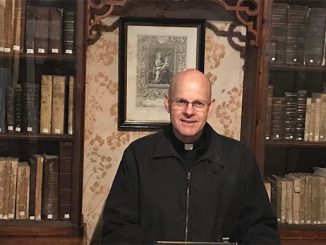
Father Patrick van der Vorst told EWTN News he had not expected the event to sell out three months in advance. “It shows there is a great appetite in the world to talk about God through beauty and to have this soft element of evangelization, to invite people back into the faith through the doors of beauty,” he said.
Combining evangelization with art is nothing new for Van der Vorst. A former director of Sotheby’s Europe, he spent 25 years in the art world before entering seminary at the Pontifical Beda College in Rome in 2019. He was ordained to the priesthood for the Diocese of Westminster on June 24, 2023, and continues to write and speak about art and faith through his website and newsletter, Christian.art, which has more than 100,000 subscribers.
EWTN Great Britain covered the priest’s presentation on why the Church fought to defend sacred images.
Asked what “Christian art” really means, Van der Vorst hesitated at first. “Thatʼs a very big question,” he said. For some it means an overtly Christian image of Our Lord, of Our Lady; for others, he noted, Christian art is simply a very beautiful landscape depicting Godʼs creation.
“Christian art can be a very wide range of things,” he said.
Maybe it is this variety that captures the interest of people. He attributed the positive turnout of the conference to the nature of art itself. “With everything that goes on in the world, thereʼs a lot of negative news. Art brings a bit of joy, a bit of color. This is such an important aspect of our Christian faith, this element of joy,” he explained.
Art and joy, he said, give hope in darker times.
The conference also attracted high-level speakers, including Cardinal Timothy Radcliffe, OP, former Archbishop of Canterbury Rowan Williams, and Baroness Sheila Hollins.
According to Van der Vorst, it was not difficult to persuade them to join this new format, even though many of them do not often speak about art. “So for them, it was also a bit of a challenge to talk about God through the lens of art,” he said, adding: “We are very blessed with having a very good series of speakers.”

Among the keynote speakers was also Bishop Paul Tighe, the secretary for culture of the Dicastery for Culture and Education at the Holy See.
Based in Rome, his work focuses on the Church’s dialogue with contemporary culture and the role of creativity, education, and communication in shaping spiritual life. In his address at the conference, he said that the Church needs artists.
In an interview with EWTN News, he expanded on the point: “In saying the Church needs artists, I was arguing something Pope Paul VI said and that was reiterated by St. John Paul II. If it werenʼt for artists, theologians would have to be artists because words are not enough to communicate the fullness of the Gospel. We need images. We need things that brings it to life in the minds of people.”
St. Paul VI made that appeal in a May 7, 1964, address to artists, and St. John Paul II returned to it in his 1999 letter. Tighe said he believes that the Church also needs artists who do not focus on religious themes: “Those who oblige us to see differently, to see things we donʼt want to look at. To oblige us to confront issues that are concerning and worrying people today.” That is why Tighe said he welcomes Pope Leo XIV’s recent call for an alliance with artists.
“Can we walk together so that we work together to preserve and safeguard our essential humanity? And artists can keep us aligned to that in so many ways,” Tighe said.
The conference closed with Sir Gabriele Finaldi, the director of the National Gallery in London. Formerly deputy director for collections and research at the Prado Museum in Madrid, he has curated major exhibitions internationally and written extensively on Italian and Spanish sacred art. This knowledge he put on display also during the conference, speaking about masterpieces such as Rogier van der Weyden’s “The Descent from the Cross” (c. 1435), now in the Prado.
“The Eucharistic body and the realistic body of Christ meet in this piece of art,” Finaldi told the audience, suggesting that the painter was aware of the mystical reality of the Eucharist when creating this work.

Finaldi’s passion for art’s power to convey faith and hope was evident. “Paintings can save lives,” he asserted and immediately displayed Jules Breton’s “The Song of the Lark” from 1884 on the big screens of the conference hall while recounting a story shared by American actor Bill Murray.
In the early days of his career, Murray was so frustrated and disillusioned that he contemplated ending his life. It was Breton’s work of art, which Murray came across in the Art Institute of Chicago, that made him change his mind. Standing before the painting and seeing the image of a peasant woman facing the heavy work for the day under a rising sun, he felt that — like the dawn in the artwork — he too was a person who got a new chance every new day, Finaldi explained to an intently listening audience.
That sentiment is well known to Monsignor John Armitage, the master of the Guild of Our Lady of Ransom, one of the main sponsors of the conference, which exists to enable evangelization.
“You can see by the sheer numbers of people who go into our national galleries that there is a power in art, which is linked to beauty, truth, and goodness,” Armitage said.
Art inspires, he is convinced — and ultimately, it can point the way to God.
If you value the news and views Catholic World Report provides, please consider donating to support our efforts. Your contribution will help us continue to make CWR available to all readers worldwide for free, without a subscription. Thank you for your generosity!
Click here for more information on donating to CWR. Click here to sign up for our newsletter.

Leave a Reply