


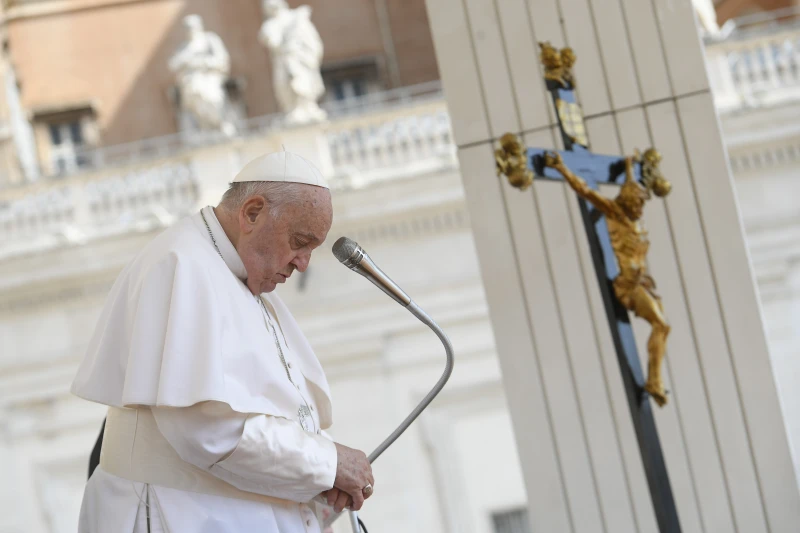
CNA Staff, Aug 1, 2024 / 09:21 am (CNA).
Pope Francis’ prayer intention for the month of August is for political leaders.
“Today, politics doesn’t have a very good reputation: corruption, scandals, and distance from people’s day-to-day lives,” Pope Francis said in a video released July 30.
“But can we move ahead toward universal fraternity without good politics? No,” he continued. “As Paul VI said, politics is one of the highest forms of charity because it seeks the common good.”
“I’m talking about POLITICS with all capital letters, not politicking. I’m talking about politics that listens to what is really going on, that’s at the service of the poor, not the kind that’s holed up in huge buildings with large hallways.”
The Holy Father explained that he’s speaking about the politics “that’s concerned about the unemployed and knows full well how sad a Sunday can be when Monday is just one more day not being able to work. If we look at it this way, politics is much more noble than it appears.”
Pope Francis encouraged the faithful to “be grateful for the many politicians who carry out their duties with a will to serve, not of power, who put all their efforts toward the common good.”
He concluded with a prayer: “Let us pray that political leaders be at the service of their own people, working for integral human development and the common good, taking care of those who have lost their jobs and giving priority to the poorest.”
Pope Francis’ prayer video is promoted by the Pope’s Worldwide Prayer Network, which raises awareness of monthly papal prayer intentions.
If you value the news and views Catholic World Report provides, please consider donating to support our efforts. Your contribution will help us continue to make CWR available to all readers worldwide for free, without a subscription. Thank you for your generosity!
Click here for more information on donating to CWR. Click here to sign up for our newsletter.



Do Catholics want Universal Brotherhood or Catholicism? With all due respect to the active Ministerium you occupy, you might meditate ppBXVI :
“By her nature the Church does not herself engage in politics; rather, She respects the autonomy of the state and its ordering.”
Ignatius Press, God is Love, Annexe. Introduction written by the former holder of the Papal Munus, ppBXVI.
Like all fellow mortals, politicians are human, fragile and mortal. During their brief tenure of humble service to humankind and Planet Earth, they are known to generate good and very ideas. We need to pray for their wellbeing and good health.
Yes on all points. And yet, there falls the shadow…
The problem is that even elected folks who attend to the needs of abstract “humankind” too often do not much care for real people in the concrete. The most egregious example is the Gulag. And, as for “Planet Earth,” this too has merit, but we also pray that politicians can tell the difference between responsible stewardship and an airbrush and one-world ideology.
So, too, the “service of their own people, working for integral human development and the common good.” With “integral human development” defined as the whole person [!] and all persons. And, about the elusive riddle of the rarely-defined “common good,” how to do both Solidarity AND Subsidiarity always together?
Some clues:
CLUE #1: “The common good does not consist in the simple sum of the particular goods of each subject of a social entity. Belonging to everyone and to each person, it is and remains ‘common,’ because it is indivisible and because only together is it possible to attain it, increase it and safeguard its effectiveness, with regard also to the future” (“Compendium of the Social Doctrine of the Church,” 2004, n. 164).
CLUE #2: “Catholic political philosophy asserts that in human nature is the origin of the state. Here it must be stated that ‘human nature’ should be understood in its full philosophical meaning. Human nature does not [!] mean the empirical, psychological nature as the politician or the advertising businessman sees it. The state originates in the bodily and spiritual nature of man. Nature or essence is also the end of man’s activity and striving. Therefore the political status is necessary for the fulfillment of man’s end; the state is an intentional disposition of human nature . . . the state is not a supernatural, immediately divine establishment. Yet, as originating in human nature, divinely established, the state is part and subject of the order of the Creator” (Heinrich Rommen, LL.D., The State in Catholic Thought: A Treatise in Political Philosophy (St. Louis, Mo.: Herder Book Co., 1945), 220-1.
CLUE #3: The common good “embraces the sum of those conditions of social life by which individuals, families, and groups can achieve their own fulfillment [!] in a relatively thorough and ready way” (Rommen).
Subsidiarity is not only the lower and more local levels of government, but also those communities and initiatives other than any level of government or within the domain of politicians.
July 25 I had called on the Holy Father in the CWR Extra, extra! feature of July 24, to condemn the abortion meeting the Jesuits and the Kennedys held between themselves back in the Sixites. See in the Comments in the CWR link.
I said “Correct and condemn it.” This month’s Papal intention could be the correction?
https://www.catholicworldreport.com/2024/07/24/extra-extra-news-and-views-for-wednesday-july-24-2024/