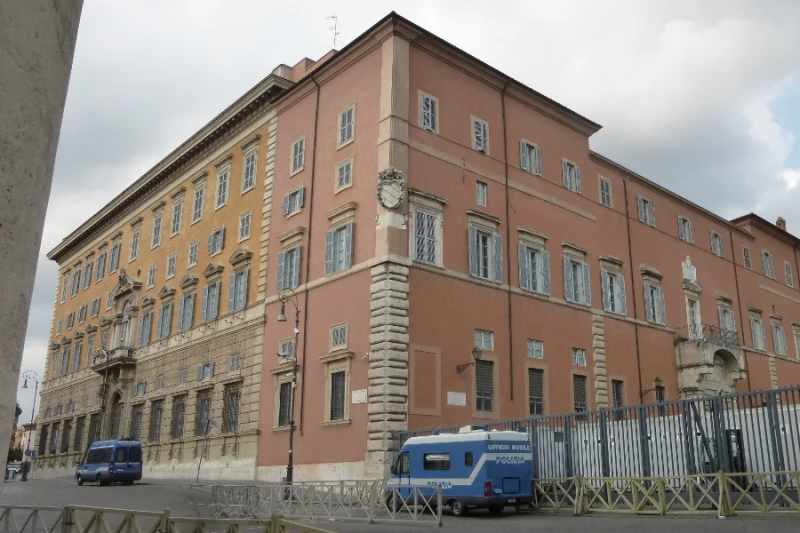
The Palace of the Holy Office, which houses the Dicastery for the Doctrine of the Faith. / Credit: Lalupa via Wikimedia (CC BY-SA 4.0)
ACI Prensa Staff, Jul 31, 2024 / 08:00 am (CNA).
Pope Francis has appointed Monsignor John Joseph Kennedy, currently secretary of the disciplinary section of the Dicastery for the Doctrine of the Faith, as titular bishop of Ossero, Croatia, conferring upon him the personal title of archbishop.
The Holy Father has also appointed Monsignor Philippe Curbelié, undersecretary of the Dicastery for the Doctrine of the Faith, as titular bishop of Utica, Tunisia.
This dicastery, one of the most important in the Vatican, established by Pope Paul III in 1542 to preserve the deposit of faith and the magisterium, is currently headed by Argentine Cardinal Victor Manuel Fernandez.
Other members of the dicastery are the secretary of the doctrinal section, Monsignor Armando Matteo; the adjunct secretary, Archbishop Charles Jude Scicluna; and the promoter of justice, Father Robert Joseph Geisinger.
Philippe Curbelié
Curbelié was born on Aug. 13, 1968, in Neuilly-sur-Seine, France, and was ordained a priest of the Archdiocese of Toulouse on April, 30, 1995. He holds a licentiate in philosophy and a doctorate in dogmatic theology from the Pontifical Gregorian University in Rome.
He has held the following positions in his archdiocese: parochial vicar, spiritual director of the Pius XI University Seminary and St. Cyprien Seminary, and professor of dogmatic theology at the Catholic Institute, where he was also dean of the theology department.
He was also a member of the governing council of the Holy See Agency for the Evaluation and Promotion of the Quality in Ecclesiastical Universities and Faculties.
Since September 2012 he has been an official of the Dicastery for Culture and Education and undersecretary of the Dicastery for the Doctrine of the Faith since July 2022.
John Joseph Kennedy
Kennedy, 53, was born in Dublin on July 15, 1968. He was ordained a priest on July 13, 1993.
He obtained a licentiate and doctorate in canon law from the Pontifical Gregorian University.
Since 2003 he has been an official of the Congregation (now Dicastery) for the Doctrine of the Faith and since 2017 he has been the head of the disciplinary section of the same dicastery.
He has been the secretary for the disciplinary section of the Dicastery for the Doctrine of the Faith since April 2022.
This story was first published by ACI Prensa, CNA’s Spanish-language news partner. It has been translated and adapted by CNA.
If you value the news and views Catholic World Report provides, please consider donating to support our efforts. Your contribution will help us continue to make CWR available to all readers worldwide for free, without a subscription. Thank you for your generosity!
Click here for more information on donating to CWR. Click here to sign up for our newsletter.
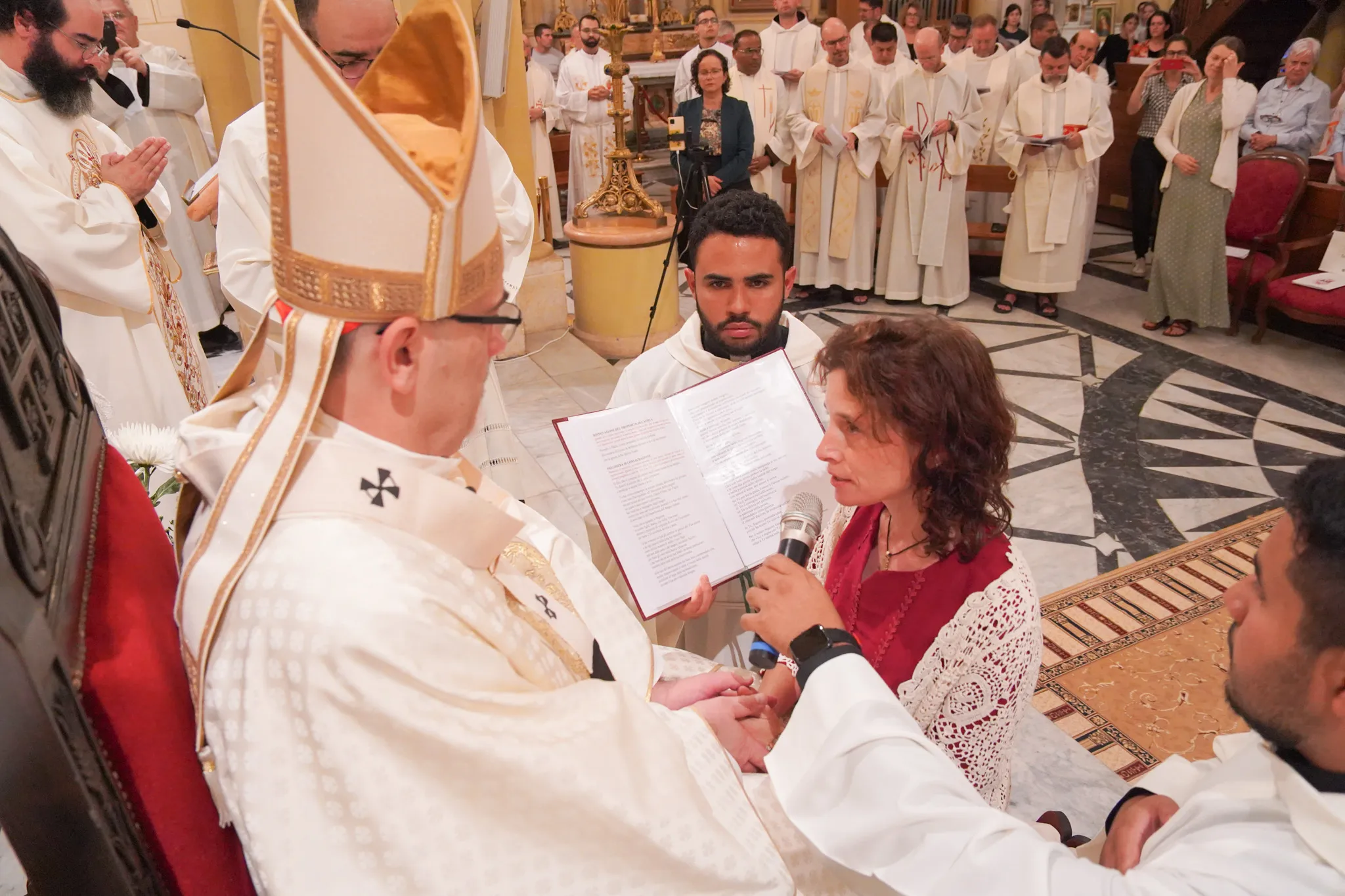
At the end of the Mass of consecration on Nov. 1, 2023, María Ruiz Rodríguez shows the ring symbolizing her membership in the Ordo Virginum. That’s the only outward sign of her consecration. / Credit: Latin Patriarchate of Jerusalem
Jerusalem, Nov 12, 2023 / 07:00 am (CNA).
On the 25th day of the ongoing conflict between Israel and Hamas, the Church in Jerusalem welcomed a new consecrated member into its fold. María Ruiz Rodríguez made her consecration in the Ordo Virginum on Nov. 1, permanently rooting herself in the local ecclesiastical community.
“A thought crossed my mind, a temptation: ‘What purpose does this step serve in the midst of current events? Doesn’t the Church have more urgent matters to attend to than to stop and celebrate the consecration of a humble woman like me?’” Ruiz shared with CNA a few days later. But she said she was immediately aware of something else.
“I told myself: I cannot delay this commitment… In fact, uniting my life with the Church in a time of suffering is even more meaningful,” she said.
Cardinal Pierbattista Pizzaballa, Latin patriarch of Jerusalem, presided over the consecration of María Ruiz Rodríguez in the Ordo Virginum on Nov. 1, 2023, in the Church of the Latin Patriarchate of Jerusalem. With this consecration, Ruiz permanently rooted herself in the local Church. Credit: Marinella Bandini
Ruiz, now 42, is originally from Spain and arrived in Jerusalem in 2018 for a period of discernment. At that time, she was a member of the “Monastic Family of Bethlehem, the Assumption of the Virgin Mary and St. Bruno,” an institute of consecrated life established in France in 1950.
It was Ruiz’s first time in the Holy Land, even though the desire to visit the sacred places in the Holy Land had long been a dream in her heart.
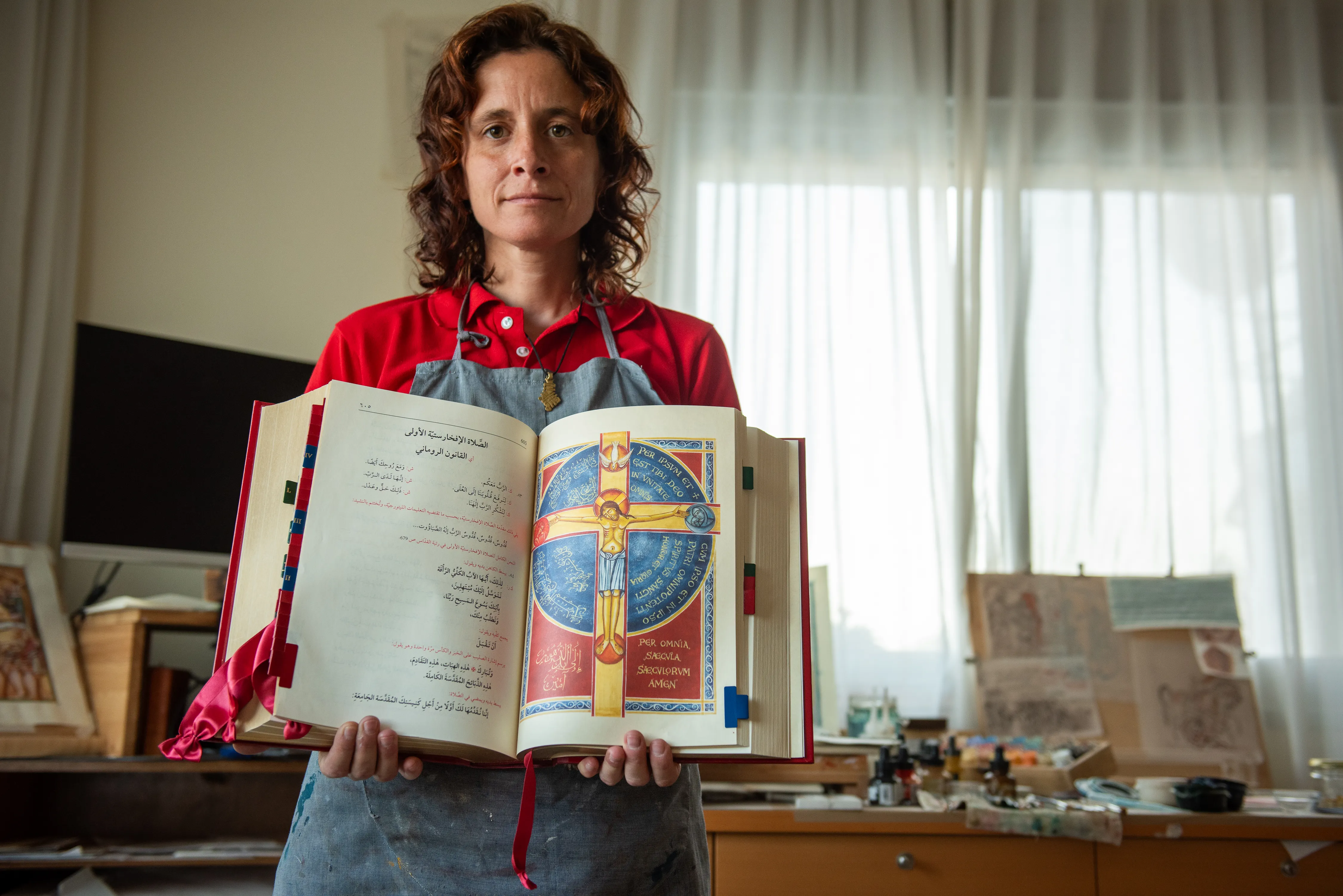
Iconographer María Ruiz Rodríguez with the new Roman Missal in Arabic. The book is open on the page where she depicted the Crucifixion of Jesus. Credit: Marinella Bandini
“For two years, I set aside my savings to make a pilgrimage in 2000, the year of the Great Jubilee. However, in that very year, I entered the convent, so I gave up. I felt that Jesus was saying to me: ‘I am your Holy Land.’ In a way, I had already arrived in Jerusalem,” Ruiz said.
It was in the Holy Land that Ruiz first came into contact with some consecrated women of the Ordo Virginum.
“I was looking for my place and I felt called,” she said.
The Ordo Virginum, Ruiz continued, “is the oldest form of consecration in the Church”. Abandoned over the centuries in favor of the religious life, it was rediscovered with the Second Vatican Council as a form of life that, “in a radically transformed historical context” possesses “a surprising force of attraction” and is “capable of responding not only to the desires of many women to dedicate themselves totally to the Lord and to their neighbors, but also to the concurrent rediscovery by the particular Church of its own identity in communion with the one Body of Christ” (cf. Instruction “Ecclesiae Sponsae Imago” on the “Ordo Virginum”).
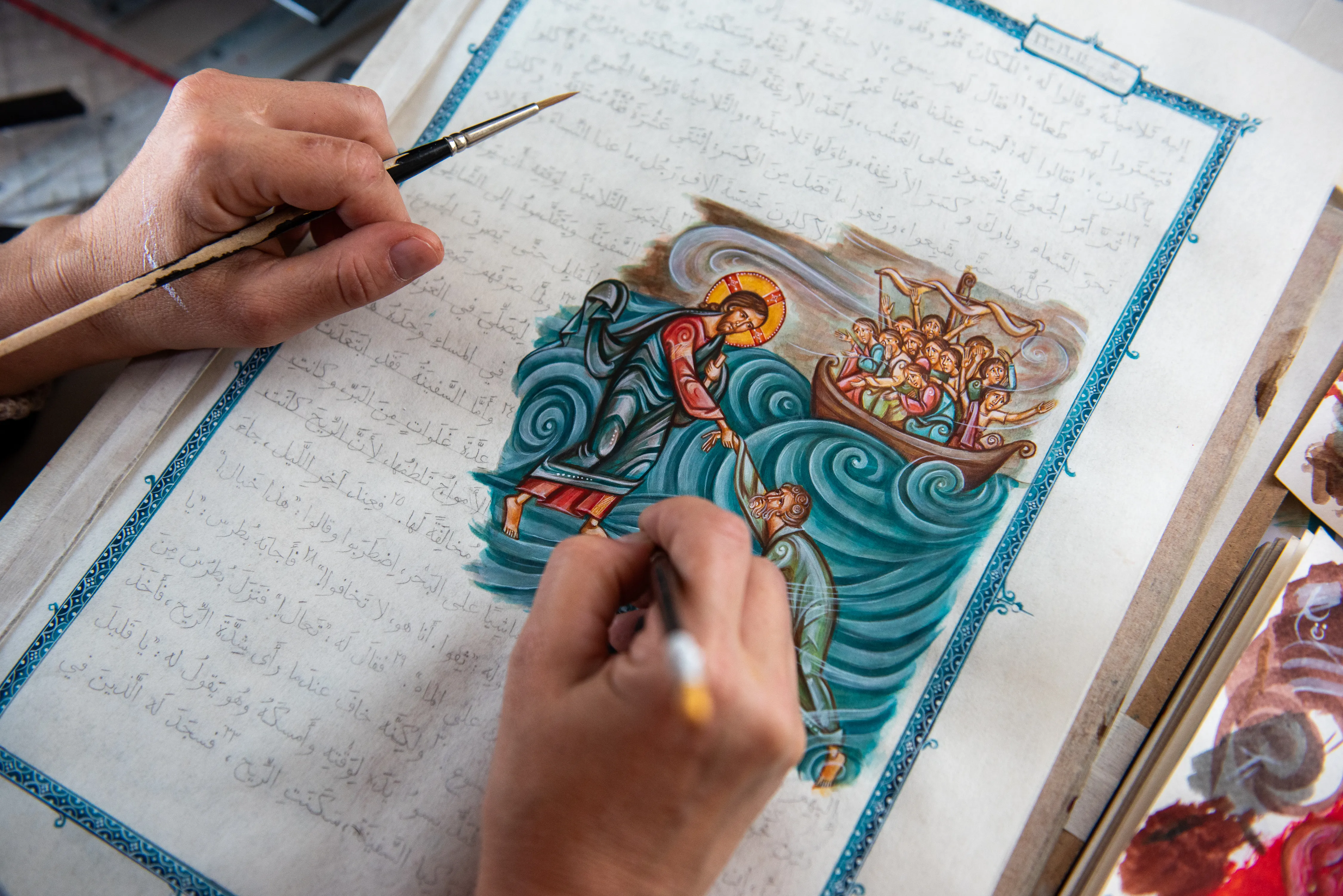
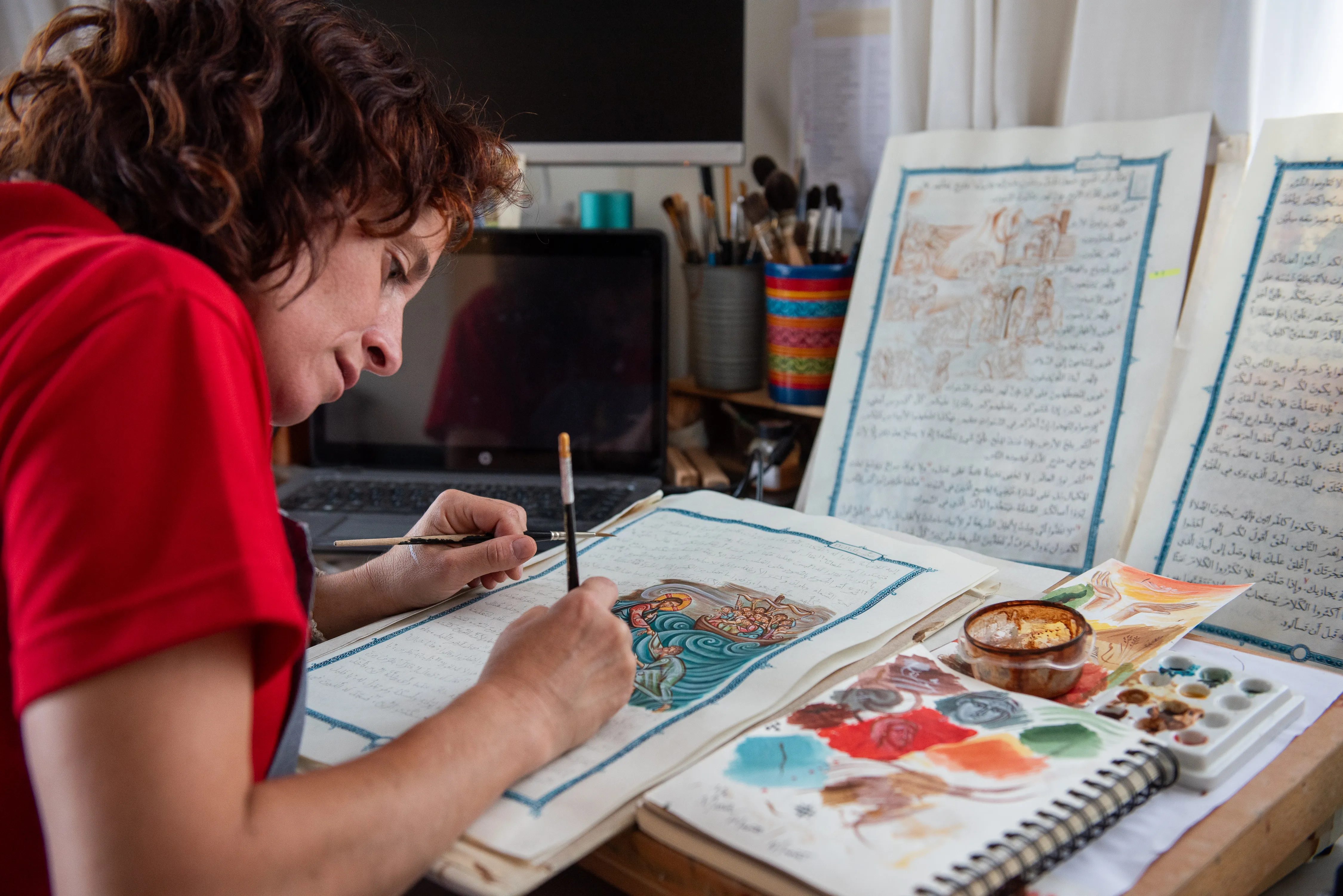
Iconographer María Ruiz Rodríguez at work in her studio. The image depicts Jesus walking on water and taking St. Peter’s sinking hand (Mt 14:22-33). Credit: Marinella Bandini
Consecrated women in the Ordo Virginum choose to live a life of virginity “for the sake of the kingdom of heaven” in a lay form of life. They do not wear religious habits, do not live in communities, have no common statutes or rules, or even superiors. Instead, they maintain a personal reference to the local bishop — in this case, Cardinal Pierbattista Pizzaballa — who acts as guarantor of their journey of discernment and presides over their consecration.
The sole commitment these consecrated women make is the “resolution of chastity,” which they express during the Rite of Consecration. The only symbol they wear is a ring, emphasizing the spousal character of this vocation, which reflects the mystery of the Church as “Bride of Christ.” Engraved in Ruiz’s ring is an inscription in Hebrew meaning “O my life,” referring to Christ, and the date of her consecration.
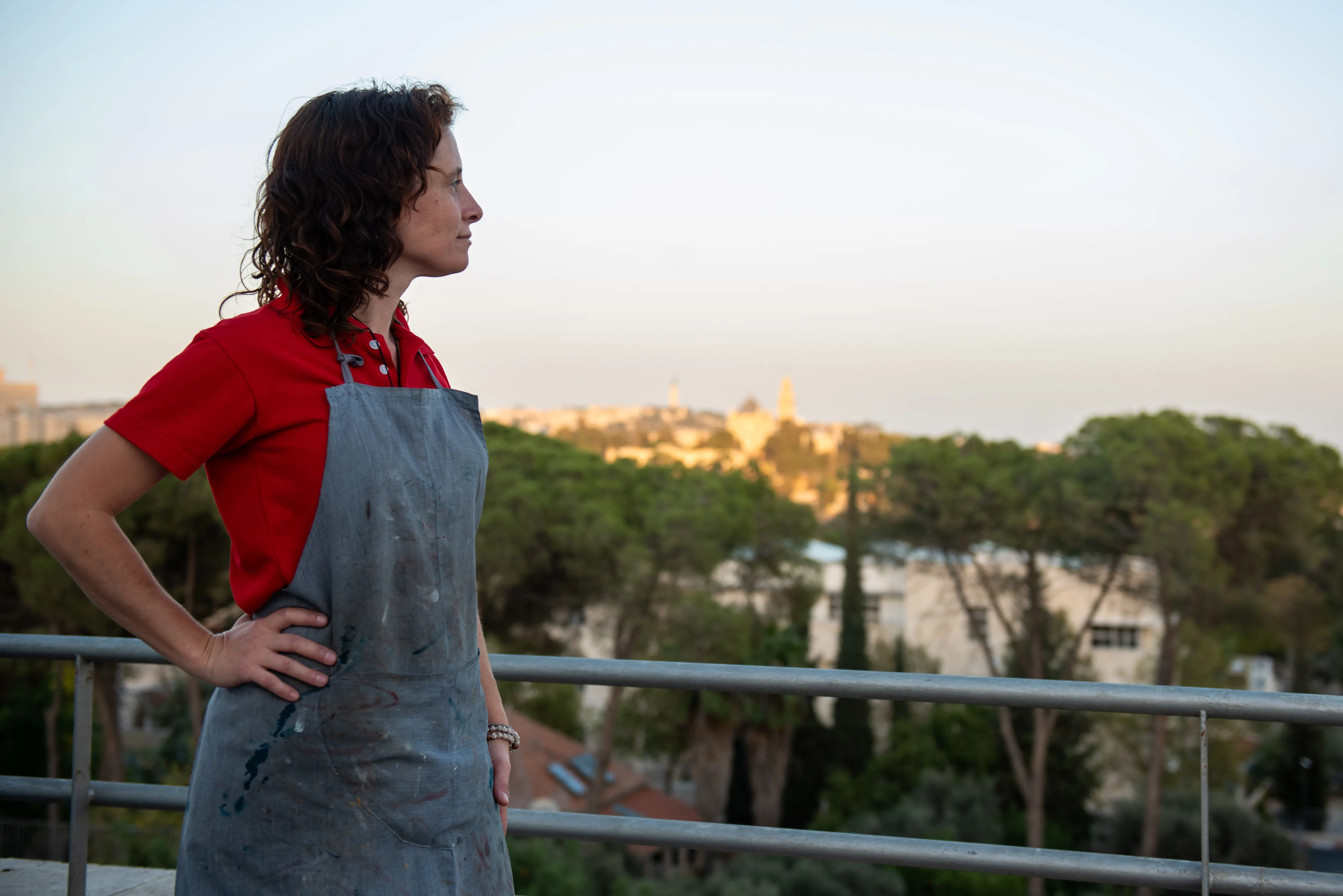
Iconographer María Ruiz Rodríguez on her terrace looking at the horizon. In the background are the walls of Jerusalem and the outline of the Basilica of the Dormition, November 2023. Credit: Marinella Bandini
Women who consecrate themselves in the Ordo Virginum support themselves through their jobs. Ruiz is an iconographer and has been working for the Latin Patriarchate of Jerusalem for about four years. She was drawn into a project aimed at renewing liturgical books — the Missal and the Evangeliary — with her artwork.
“I first approached iconographic art when I was a nun. It was first of all a spiritual journey, a path of prayer. More than an artistic expression, an icon is a profession of faith. Before beginning the work, I invoke the Holy Spirit and ask for forgiveness for my own sins and for those who will venerate these images. I was interested in this dimension of relationship,” Ruiz shared. She spent a year researching the style and colors.
“The patriarch asked me to create something that would speak to local Christians, who are Latin by tradition but Eastern by culture. A style that was uniquely mine yet rich in the entire iconographic tradition of the Church of Jerusalem. The art of Armenian manuscripts certainly had a significant influence on me.”
Iconographer María Ruiz Rodríguez at work in her studio. Currently, Ruíz is in the process of creating the images for the Gospels of Matthew and Mark. Credit: Marinella Bandini
The patriarch takes a personal interest in overseeing Ruiz’s work. “We read the Gospel together and choose which scenes to represent, taking into account the particularity of each evangelist. He particularly enjoys highlighting passages that are less frequently represented in the artistic tradition. This is a project close to his heart,” she told CNA.
Currently, Ruíz is in the process of creating images for the Gospels of Matthew and Mark.
“The process is very laborious and involves multiple stages for each page: the pencil lettering, the crafting of the icons, then the ink lettering and finally the gilding.” The plan is for a volume of about 200 pages with 250 images.
“Making this work in Jerusalem has a special value: I can visit the places where that Gospel was lived” but also “immerse myself in Jewish culture,” she said. “This has opened my eyes to the richness that Judaism brings to Christianity. There is a perfect continuity and at the same time an unprecedented newness in the person of Christ.”
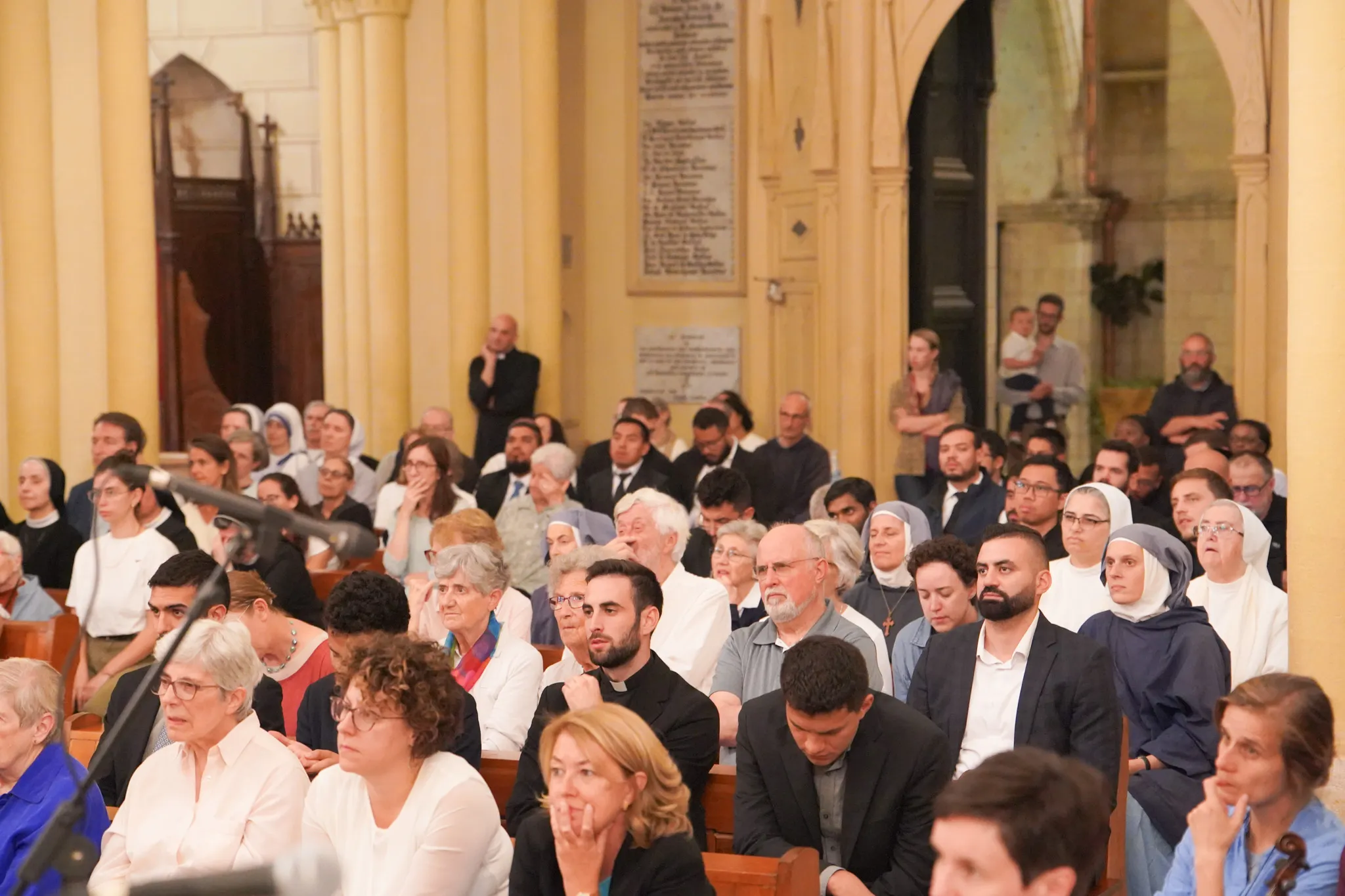
The Church of the Latin Patriarchate of Jerusalem full of people on Nov. 1, 2023, for the Mass of consecration of María Ruiz Rodríguez in the Ordo Virginum. Credit: Latin Patriarchate of Jerusalem
Ruiz learned the local languages — Arabic and Hebrew. The Mass of her consecration brought together within one place all the diverse “souls” of the Jerusalem Church: priests, friars, religious, and laity, Arab Christians and Hebrew-speaking Christians, each hearing the word of God in their own language. There were migrants, foreigners, Jews, and Christians of various denominations.
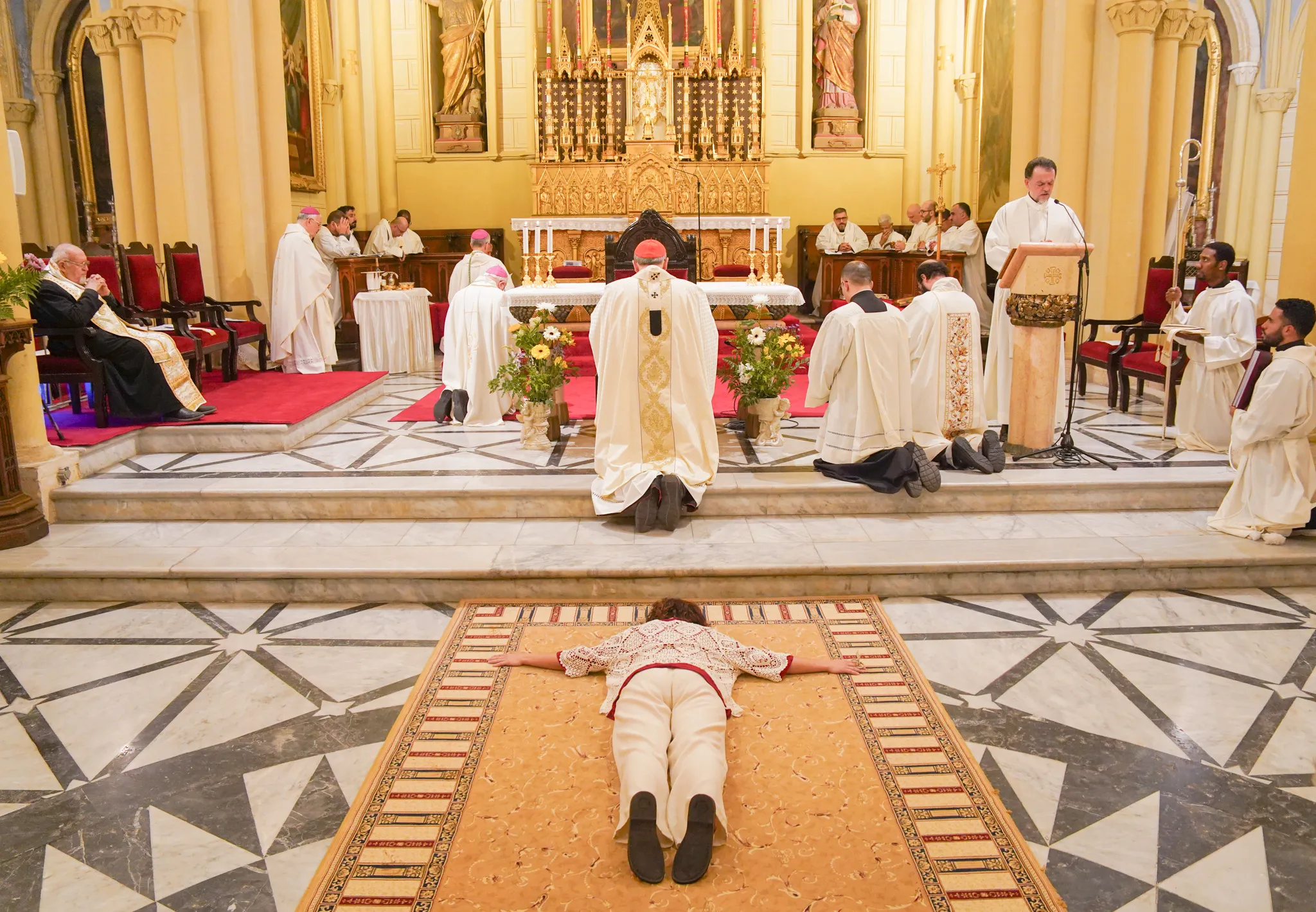
The culminating moment of María Ruiz Rodríguez’s consecration in the Ordo Virginum. The celebration took place on Nov. 1, 2023, in the Church of the Latin Patriarchate of Jerusalem. Credit: Latin Patriarchate of Jerusalem
“I believe my being a foreigner is a blessing for this Church,” Ruiz said. “Why were there such different people in the church that day? Because I am neither Arab nor Jewish, and this allows me to bring both of these peoples into my heart together. In the praise of God we were one people, transcending the divisions that usually separate us. The Church in Jerusalem also needs this, to remember its universal vocation.”
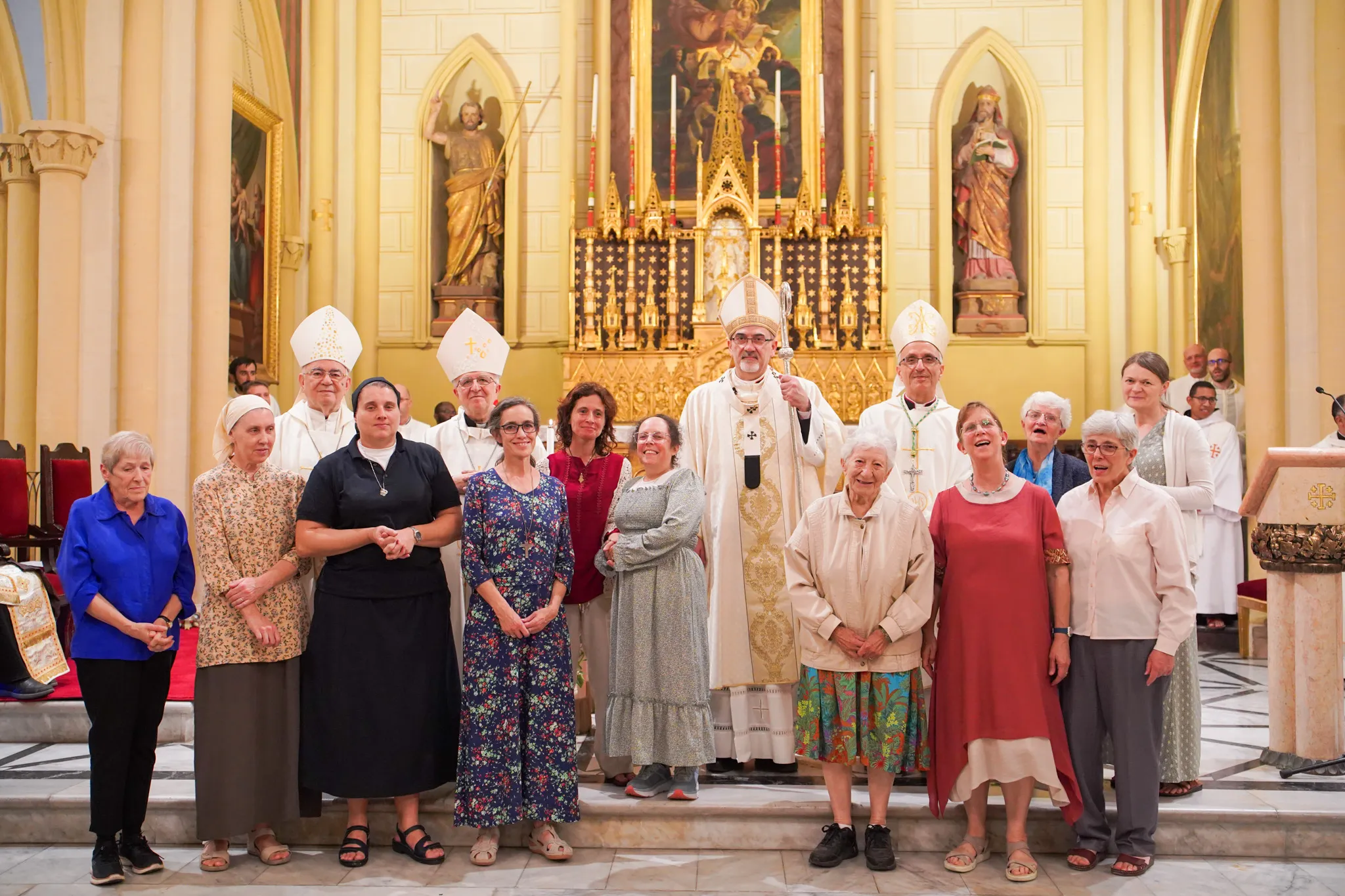
Group photo at the end of the Mass of consecration of María Ruiz Rodríguez in the Ordo Virginum. With her (in the middle, with red shirt) there are other members of the Ordo Virginum, and the bishops of the Latin patriarchate of Jerusalem (from left to right: Giacinto-Boulos Marcuzzo, bishop emeritus; Monsignor William Shomali, general vicar and patriarchal vicar for Jerusalem and Palestine; Cardinal Pierbattista Pizzaballa, Latin patriarch of Jerusalem; Monsignor Rafic Nahra, patriarcal vicar for Israel). Credit: Latin Patriarchate of Jerusalem
With her consecration, Ruiz embarks on her new journey as a “living stone” of the Jerusalem Church: “I am certain that I am finally in the right place. It is not an act of heroism. I am simply where God wants me to be.”
A screenshot of Fridolin Cardinal Ambongo during the March 17 interview with KTO. / Credit: KTO
ACI Africa, Mar 20, 2024 / 09:00 am (CNA).
Fiducia Supplicans, the declaration by the Vatican Dicastery for the Doctrine of Faith (DDF) permitting t… […]
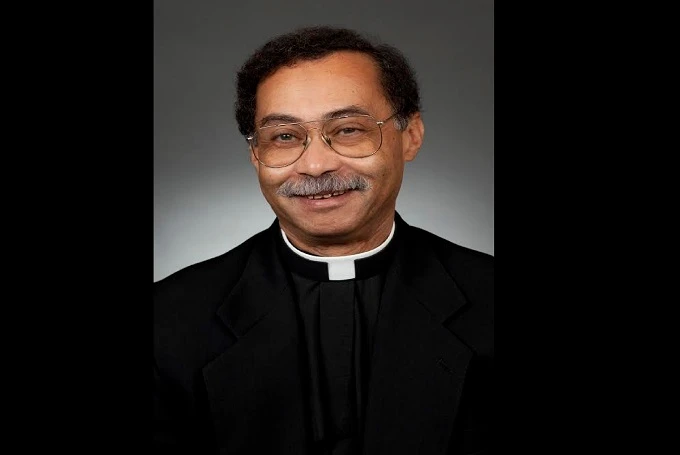
Vatican City, Mar 8, 2017 / 06:13 am (CNA/EWTN News).- On Wednesday the Vatican announced Pope Francis’ appointment of Fr. Roy Edward Campbell, Jr., a former vice-president for Bank of America, as an auxiliary bishop for the Archdiocese of Washington.
“All of us in the Archdiocese are deeply grateful that our Holy Father, Pope Francis, has named Father Roy Campbell to be an auxiliary bishop in our Church of Washington,” Cardinal Donald Wuerl, Archbishop of Washington, said in a statement March 8.
Father Campbell, who was born, raised and who has worked and served in the archdiocese, “brings to his new ministry recognized talent and demonstrated ability. He also bears witness to the great cultural and ethnic richness of the Church of Washington reflected in all of the faithful, lay, religious and clergy.”
“Personally I look forward to continuing to work closely with our new auxiliary bishop, who over the years has made significant contributions to the pastoral life of this archdiocese,” he said.
Fr. Campbell, 69, had a 33-year long career with Bank of America, beginning as a teller and working his way up to vice president and “Project Manager” before taking an early retirement in 2002 to follow a priestly vocation.
Born on Nov. 19, 1947, in southern Maryland, the Campbell was raised in D.C. and was interested in the priesthood as a child, but never committed to entering the seminary.
After high school he attended and graduated from Howard University in 1969 and later received a master’s degree in banking from the University of Virginia, working in the retail banking industry in the Washington-Baltimore area until taking an early retirement in 2002.
He was an active Catholic both in parishes and the broader Washington-area community, serving as a lector and usher and as a member on the Pastoral and Finance Councils at the Shrine of the Sacred Heart.
An encounter with a homeless man in December 1995, prompted him to reflect on his relationship with Jesus, and as a result he entered the archdiocese’s permanent diaconate program in 1999. He entered the seminary in January 2002, and was ordained a priest May 26, 2007.
Since his ordination, bishop-elect Campbell has been parochial vicar and pastor at several parishes. He said in a video interview for the Archdiocese of Washington that “the Lord himself has bestowed upon me through the Holy Father,” a great honor by the appointment.
“The only thing I was looking forward to doing in answering our Lord’s call is to be a priest for his people. To love and serve those who he’s called me to,” he continued.
“And if he’s calling me to serve on a larger scale than a parish, as a bishop, then I know I will have his grace, his direction, and his love to help me do so. So, outside of that, what it will entail, I will find out.”






Leave a Reply