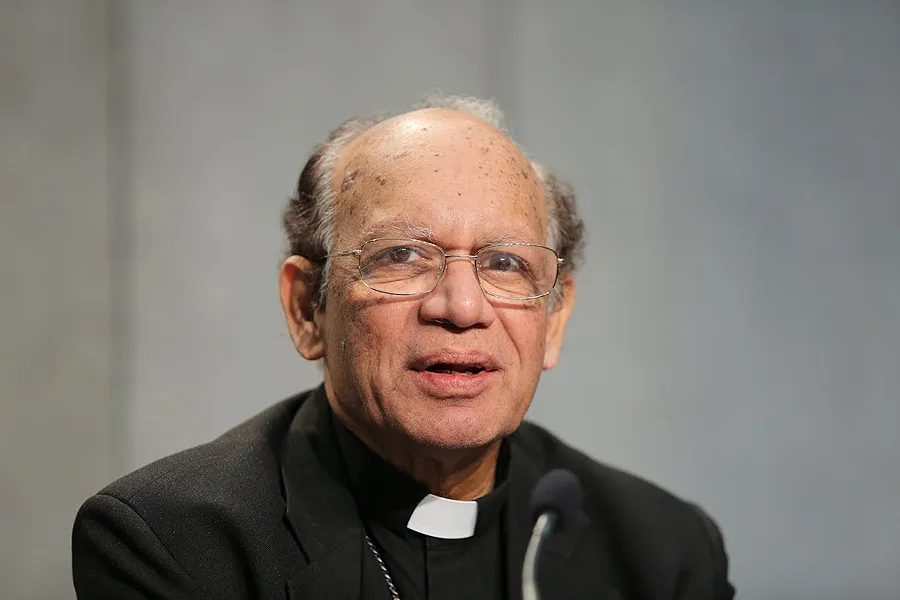
Vatican City, Sep 18, 2017 / 01:57 pm (CNA/EWTN News).- Nearly four years after the Pope established his Council of Cardinal advisers to help him in the task of reforming the Roman Curia, one member of the group said their work is wrapping up, and that it could take only a few more meetings to finish what they set out to do.
The ongoing process of reform “is being done at various stages of development, and I hope we’ll come to an end in all of these matters soon,” Cardinal Oswald Gracias of Bombay told CNA Sept. 14.
“It will take two or three more meetings more,” he said, adding that “by June perhaps we’ll be seeing the end of the tunnel.”
Cardinal Gracias is also President of the Asian Bishops Conference and in 2013 was chosen by the Pope along with eight other prelates from around the world to advise him in matters of Church governance and reform.
He spoke to CNA in a lengthy, sit-down interview after the council – also called the “C9” – concluded their latest round of meetings last week.
As far as the reform goes, Cardinal Gracias said “there won’t be very major changes; it’s the governance of the Church, we can’t just turn everything upside down.” Rather, it will be “a gradual change, a change of mentality, a change of approach, restructuring a bit of the departments so that they are more logically suited to the needs of today.”
He said a key goal of the C9 is to implement the vision of the Second Vatican Council, specifically when it comes to the importance of the role of the laity and women, and incorporating greater synodality and collegiality into the Church’s structures.
From the beginning Pope Francis “had very clear what he wanted this group to do,” the cardinal said. “He had no hesitation, he’s a good leader. He had a clear vision.”
Cardinal Gracias admitted that in the beginning he had doubts as to whether or not they were going in the right direction, and had started to worry what people on the outside might say, since many fruits of the meetings weren’t and likely won’t be immediately visible. He said he also struggled with doubts about the pace at which they were moving, and believed that things were going “too slow.”
“I will confess that once at the beginning I was wondering, ‘are we going in the right direction?’ I asked myself. But now I can see it is,” he said, explaining that Pope Francis’ Christmas speech to the Roman Curia last year was a “tipping point” for him.
More than anything, there is a change in mentality that’s needed, which will take longer than simply reforming the Vatican’s structures, he said, but said the group is “rather confident that it will happen because the Pope is giving very effective leadership.”
In addition to the ongoing curial reform, Cardinal Gracias also spoke about the recent release of Indian priest Fr. Tom Uzhunnalil 18 months after he was abducted in Yemen. He also spoke about the Pope’s upcoming trip to Myanmar and Bangladesh, and when a possible papal trip to India might take place.
Below are excerpts from CNA’s interview with Cardinal Gracias:
You’ve seen Fr. Tom and you were at his meeting with Pope Francis. How is he doing?
I was pleasantly surprised with calmness with which he came out, because he did not know, to my knowledge, that he was being released. But he said I know people have prayed for me, I’m grateful for the people who were praying for me, but he kept on saying ‘Jesus is great, Jesus is great.’ And then he told the Holy Father. It was a very moving moment. As soon as the Holy Father came he prostrated in front of the Holy Father and kissed his feet, and he said, ‘thank you, thank you, thank you. Thank you Holy Father, but just one message I want to give you: Jesus Christ is great. Jesus was with me right through, I could sense the presence of God with me’…And once I thought the Holy Father had tears in his eyes. When Tom kept on speaking about Jesus, this is what he told the Holy Father: please tell the people that Jesus is great! I would say that he’s come out of it with an experience of the presence of the Lord, and I think at that moment the Holy Father had tears in his eyes…I met the Holy Father later that afternoon, and he was telling me how impressed he was. He was also surprised with the calmness of the man, with Tom…He was a man who is perhaps strengthened in the faith after this experience, and not bitter about anything. Particularly about his captors, he was very understanding. It was a special experience, very edifying. He needs rest, certainly, he’ll have a medical exam and he’ll be with his superiors, but eventually he’ll go back (to India). So thank God really. It was an anxious moment for the whole Church in India. We didn’t know what was happening, but we understood that putting more pressure, in the perspective of the government, could make things more difficult for him. (But) he’s not really stressed in any way you can make out. Physically weak, but spiritually strong. When he met the Holy Father, he was weeping right through it. And the Holy Father was very touched, he kissed his hand and blessed him…He felt the comfort and strength of the entire Church. As he said, there was never a moment when he felt abandoned, either by the Church or by God. He kept saying, ‘Jesus is great.’ So he came out spiritually strengthened in that sense. It was a big relief, a big blessing, and the Holy Father was overjoyed. I think the government of Oman did a very splendid job of helping out…they even brought a Salesian to accompany him on the last plane. It was very human of them, so had the comfort of a spiritual companion.
What role did the Holy See play in working out his release?
They only offered help, they kept the issue open and kept sharing. The Holy See was told he was alive, and the Holy See communicated with the Indian government. In Yemen, the political situation is very fragile, and one doesn’t know who is in charge. There are bombardments and all sorts of groups are taking over, so there was always a risk I suppose, that if you tried to liberate him you could have harmed him. But they were always interested, they kept it alive. Every time I came to Rome somebody from the Secretariat of State updated me. The Vatican made sure there was interest. Any information the Holy See had, they shared it with the Indian government, the Omani government, so that was good.
It’s interesting that there is still no word on who is responsible…
It’s not a terrorist attack, it’s a kidnapping. They wouldn’t glory in taking him. That has not come out. I spent about half an hour with him before the Holy Father, and he was speaking continuously. I did not at any point attempt to ask him questions, because I think that would be a stress for him. He has got to share…he wants to share it and then I imagine you feel lighter. He’s probably just got to rest, and rest and rest, physically and then mentally too, he’s got to get it out of his mind. He’s not come out of it a broken man at all. I was afraid of that, that he would come out a broken man, but no…It’s a moment of grace, a moment of faith, a special experience. The high point was when he told the Holy Father, ‘just tell everybody that Jesus is great, Jesus is great.’ Just three simple words. That was like the sum of his whole experience, what he meant and why he meant it…he felt not abandoned, I suppose. I hope recovers. I imagine he needs a couple of months really, or maybe more than a couple of months, to really rest. He needs time with the family also, natural circumstances…I’m not sure about this, but I have a feeling that the Omani government decided to bring him to Rome, because they (wanted) to hand him over to the Vatican. I think it was better for him, because I think if he had gone to India he would have been mobbed by everybody. He just needs space to recover, and for doctors to examine him. Physically to see if he’s alright, and psychologically also, to be investigated. I think it was a wise decision, but I think it was a decision more of the Omani government.
I don’t want to exploit your time, but I wanted to ask a few questions about the process of reform and the C9. You just finished your latest round of meetings…
Yes, we just finished the latest round, the 21st meeting. I can’t imagine we’ve had 21. I didn’t realize it’s 21 already. I think we are working hard. What’s nice is that we’re a cohesive group now. In the beginning we were all (gestures). Now we know each other so well and we work together, and of course trying to implement the Holy Father’s vision of the Church. Also, one of the things we always say, and it’s very clear, before the conclave the cardinals had spoken a lot of their vision of the Church, and we have the texts of what all of the cardinals said, and all the cardinals gave their vision. We picked up from that, the Holy Father picked up from that, his own vision. We’ve focused so far … it’s for a dual purpose that the group was formed: one is to help him help him in the governance of the universal Church, and the second is to revise Pastor bonus, the papal document of St. John Paul II for establishing the Curia and giving the job descriptions and the vision of each dicastery. It’s to revitalize, I suppose that’s what Pope Francis wants us to do, and to have a new mentality which is applying Vatican II also; how to make the Roman Curia at the service of the Holy Father more effectively, but the Churches at the local level, the Churches in the dioceses, how to make the Roman Curia assist the local Churches to be more effective pastorally, so they can be more vibrant in that sense. So I think the holy Father is satisfied with what’s happening. I’m satisfied too with the way we are going ahead. We come for three days and work intensely, we work from 9:00 on the first day to 7:00 (pm) on the last day trying to wrap things up, but lots of work has been done. But it’s coming to the end. I think it will take maybe two or three more meetings until we wrap up our conclusions about the dicasteries. Then of course the Holy Father will study the thing and decide. So we’re going well. The feedback we receive is the Holy Father is happy, he is satisfied, and he has been using the Christmas messages sometimes to give an indication, a little progress report, so this year’s Christmas message (2016). I didn’t realize it, but when I read it I realized it’s practically giving a progress report of what this group has been doing. I hope that it will make an impact. There won’t be very major changes; it’s the governance of the Church, we can’t just turn everything upside down. But a gradual change, a change of mentality, a change of approach, restructuring a bit of the departments so that they are more logically suited to the needs of today, and also of answering the vision of the Second Vatican Council: the importance of lay people, synodality, collegiality, then concern about women, getting more women involved, then giving importance to the local Churches. Then reflecting on the role of episcopal conferences in all this, because that’s another big issue. So all of this is being done at various stages of development, and I hope we’ll come to an end in all of these matters soon. It will take two or three more meetings more, I foresee at least February, June…by June perhaps we’ll be seeing the end of the tunnel.
It’s been a long process…
It’s been a really long process, really, but it’s good. I’ve been in other committees of this sort, in which at the beginning we don’t what we’re doing, where to begin, and they you find your way and you find your vision. But here it was very clear, the Holy Father had very clear what he wanted this group to do…we were not clear in why we were called and what he wanted to do, but gradually we understood his mind. He had no hesitation, he’s a good leader. He had a clear vision and he had his people with him. He’s there with us, he genuinely doesn’t take any other appointments. He’s there except the general audience. There are emergencies of course, this time there were lots of things happening, but he participates and he listens to discussion, and every now and then he raises his hand when he wants to speak. It’s very odd, but now we’re accustomed to it, the Pope raising his hand (laughs) … it’s very valuable, he’s part of the discussion all the way through, completely inserted right in the thick of it. Certainly he doesn’t speak that much, because I think we would feel inhibited and want to go in his direction. So it’s just the right amount and at the right time.
Well he’s very much about the process, isn’t he? He doesn’t want to interrupt the process that’s happening…
Yes, absolutely. And he’s happy. And everybody speaks their mind. We know each other so well, and we know that the Holy Father wants us to speak our minds, so no one is at any stage (overly) conscious that the Pope is there with us, no…but it’s going well, I think it’s going well. I will confess that once at the beginning I was wondering, ‘are we going in the right direction?’ I asked myself. But now I can see it is. He’s a man of deep faith, the Pope. I remember having spoken to him once about the synod, I was sharing him my anxieties on whether the synods were going well, and he told me, ‘Cardinal, I am not worried.’ He told me that. I told him I was worried, I don’t know what direction we’re taking, whether we’ll be able in two synods to give your vision. (He said) ‘I’m not worried. It’ll work out.’ He knows what he wants, he’s a good Jesuit, and the Jesuits know exactly what they want.
At what point were you convinced that things were going in the right direction?
After about seven or eight or nine meetings, I was beginning to wonder. My worry was what will the world say? Everybody knows we’re meeting over here, but we are very limited in what we say are the fruits. What are these eight men – nine, we became nine after the Secretary (of State) joined – the nine cardinals are coming and discussing here, what’s happening? They’re not just coming here for debate. I was worried about the fruits not being seen, and the process being too slow. But then, especially after I heard the Holy Father’s speech (at Christmas 2016), for me that was it. I was like, wow, there has been a lot done. That was absolutely…this past Christmas, it was like a progress report of this group. I’m in the group, right, but I never realized the number of things we had really discussed. Besides modifying the document, the protection of minors, the economy, updates on these things, general principles of collegiality, synodality, we’re thinking about these things. Care of the Curia personnel. It’s everything that the Holy Father…he isn’t like us, who when we go back home we’re fully in the diocese, he has this in mind and he keeps working on this fully afterwards. We go back to our dioceses and are concerned about the local Church, but he certainly follows up with what we say. I’ve seen it several times. He takes the group very seriously. Every now and then he would ask us to take up some point on the agenda to discuss it a bit, which he wants advice on. I think it’s a new system he has started in which he gets feedback from all over the world, and he gets it from the grassroots. I think, anyway, I hope. We come from different continents and we bring in our own experiences. But it is going well. In fact I really, really think there has been a contribution to the Holy Father, and then the Holy Father takes decisions. I have a feeling this is shared by all now. I have no doubt, this would be the general feeling of all about it. The tipping point was really his speech, but already before that, say about six or seven months before that, we began to see really when we reflected that…perhaps the Holy Father knew that that was in our minds. It was in my mind, and maybe I expressed it indirectly. And the Holy Father once commented also, he said ‘we have done this much, so don’t get discouraged.’ So at one stage he sort of answered that doubt in my mind.
You mentioned that there’s also a change of mentality needed. Other than the structural shifts, it seems that the change of mentality will be the more challenging task…
That will take longer. But we hope it will percolate down, because once you have a certain mentality you generally don’t change unless the circumstances change, the ambiance changes. And in a certain sense not changing dramatically. That will I think take longer. But I’m positive that it will happen. We’re very, very hopeful. We’re rather confident that it will happen because the Pope is giving very effective leadership, and every now and then there is a clear message from him. But it will come about and suddenly we’ll realize, oh there has been a change! That’s how it will happen. It won’t come overnight, but at a certain point we’ll realize things have changed. He knows what he wants. And he’s happy. Certainly the indication I can see is this way; the relationship he has with the group and the joy he has in being with the group. He says he feels that it has helped him. Thank God. We do what we can. I don’t know how or why he chose us, but he’s happy. I was very surprised when I got a call from him. I said ‘why me? What have I done?’ I suppose he knows. I don’t know why. I did not know the Holy Father before, we’ve never been in any other committee before. Only at the conclave. I don’t even remember having chatted with him at the conclave, or before the conclave. After the conclave it was true that I was with him. It’s true that after I was with the Pope at Santa Marta for a few days. Then we were having meals together – breakfast, lunch and dinner for four or five days. That’s the time we came to know each other. So we were thrown together for about a week. It struck me that after his election I was at Santa Marta, because there were five or six cardinals. All the American cardinals were there, the European cardinals, all the ones from close by left and came back (for the installation). I stayed for the installation and then went back to India. And then you share, when you speak. He was very comfortable with us, very comfortable with me. But still, he had to make a choice.
Has he mentioned anything about when a visit to India might take place?
He’s very interested. We’re working it out, and I’m very hopeful. He would like to come and we would like to have him, and the government would like to have him. But now we must see his program, the government’s program, but I’m certain he will come. There are no details at all for the moment. I’m rather certainly positive that we will be able to get the Holy Father, he’s interested and I think he’s getting more interested. And the people will be excited…we are looking forward. In the beginning, as soon as he was elected, I asked him, ‘when are you coming to India?’ And he was sort of (disinterested), but gradually he began to like the idea. He’s never been to India before. As a Jesuit I think he was supposed to go to Japan, that’s what he was telling me. He’s going now to Bangladesh and Myanmar. It will be very sensitive. Bangladesh has it’s own problems, I believe they have elections next year, and Myanmar has problems to solve, also the refugee problem at the moment. Of late it is continuously on, I believe yesterday or this morning I saw it on CNN, and BBC is reporting on it. It’s an issue for the world. I’ve been there (Bangladesh) a few times. It’s a nice Church, concentrated mostly in Dhaka, a living faith. I’ve been to Myanmar also, I went as a papal legate there some years back, and I found the Church very vibrant. A simple faith, but I’m happy. I think it will mean a lot to the people. It will also strengthen the people. I think the Church is also very vibrant, it’s not have any specific difficulty, in my impression as a papal legate about two or three years back, but I was very impressed by the faith and the organization. It was vibrant. The Church was small, but strong and alive. It will make a difference for the Churches, and for the governments I expect.
Will you be there?
I plan to go to both places yes. In all of these trips in Asian I’ve come along: Sri Lanka, Korea, the Philippines. At the moment I’m president of the Asian Bishops Conference, so I suppose in that capacity I’ll have to go.
 […]
[…]






Finally he’s annoyed about something he should be annoyed about. Too bad the stupid term homophobic is used to describe this proper reaction. Stupid because it fails to recognize that it is impossible to fear homosexuals, it is only possible to fear the social damage they do and the damage done by those who refuse to acknowledge the damage they do.
Not the most politic choice of words, but on the other hand “a rose is a rose is a rose,” said writer Gertrude Stein, an open lesbian.
They are using the terms which the LGBT propagandists use, because they belong to them.
Dear Edward J Baker – let’s also remember the spiritual damage they do to themselves and to all of us in our beloved Church.
Active homosexuals are in a known state of sin. Perhaps a less derogatory term could have been used but that would not have changed the substance of what he said. Part of his situation of course is the expectation he has set in place that homosexuality will soon be given the stamp of approval. The question I would have if I were the Pope is, which Bishop in this closed meeting betrayed me to the press? The betrayal ironically only proves the point that there are too many gays in the seminaries, as well as in the ranks of the Bishops. Otherwise why the betrayal? To embarrass him? Gays should be welcomed to Mass as fellow believers. They should not be used as moral role models in the priesthood.
“Gays should be welcomed to Mass as fellow believers.” Really, dear LJ?
Inclusion in our Holy Masses is a form of authentication and of inclusion in the community life of our parish.
It should be obvious to all informed Catholics that we are not permitted by The LORD to authenticate unrepentant sin. We’d also be foolish to expose our families to the immoral proselytizing that always accompanies unrepentant homosexuals & others who have chosen sinfully deviant lifestyles.
Yes! I do love the sinner but, yes! I do know that keeping parish community families spiritually & physically safe is of the highest importance.
How should we think of those who claim to be believers but have chosen to reject key parts of our belief system?
Saint James pointed out that even demons are believers in the one God who we worship (James 2:19).
Love is THE way, but it needs to be wise & discerning. There is such a thing as foolishly irresponsible love.
Ever seeking to obey King Jesus Christ; love & blessings from marty
Are you suggesting that people in a state of sin are to be excluded from Christian life or worship until they repent? You will be a long time making converts that way. Unless Catholics go to confession EVERY day, I daresay they are in a state of sin, whether mortal or venial, by time they get to church on Sunday, even if they confess weekly. It is part of the human condition. The question is what would make people think about repenting if they are never exposed to the reason WHY they should? Or exposed to the love of Jesus by hearing the readings at church?. Christ’s critics notably accused him of “eating with sinners”. It didnt appear to bother him. And I would add that while certain gays are flamboyant in their appearance, many sinners in the pews are simply not that obvious: adulterers, thieves, etc. The sinners are there whether we approve of them or not. And we might well count ourselves in their number if we are honest. Current statistics indicate that most Catholics practice abortion and contraception in the same number as non-catholics for example. So again, saying “only non-sinners may apply” is a non-starter. If you expect people to be perfect and adhere to ALL Catholic rules before they show up in church, prepared to worship in an empty church by yourself.
Thanks, dear LJ, for so clearly laying-out this common misunderstanding of our Faith. Effectively this error says: “Since all are sinners there can be no distinctions.”
It’s also commonly said that since Jesus Christ, God-With-Us, ate & drank in the company of sinners, we should open our parish communities to unrepentant sinners.
That deliberately ignores Jesus’ instruction: “Go, & sin no more!” It ignores strong moral examples such as that of Mary of Magdala, Zachaeus, Mathew, and most outstandingly, that of Saul of Tarsus. All serious sinners, led by Jesus to repentance & new, reformed lives of obedience to God’s rules.
It also ignores the clear instructions of The Holy Spirit of God given to us by 9 Apostolic authors in the 27 texts of The New Testament and reiterated by our Magisterium in The Catechism of The Catholic Church.
It is, of course, a logical fallacy to argue that because we ASSUME there’re unrepentant liars, thieves, murderers, fornicators, adulterers, etc. joining undetected in our parish liturgies, we should therefore welcome people living unrepentant homosexual lives into our faith communities.
The Catholic Church teaches that those who are in serious sin (as clearly defined in the Catechism of the Catholic Church) are excluded from receiving Holy Communion. If they persist in taking communion, they have committed sacrilege and will go straight to hell if they die unshriven.
The reason for their terrible fate is they’ve obstinately put their own ideas first rather than placing God’s instructions first, no matter what the cost may be.
If some unrepentants do get through that’s no excuse for inviting others to reap the same dreadful judgment.
After living over 80 years and working in countries all around the world, I’m certain that all true Catholic Christians carry their individual crosses of personal self-denial, every day.
Yes, humans are sinful but true Catholics are unfailingly repentant, & all gladly suffer sacrifices for the sake of God’s Kingdom.
Everything about the Catholic Church and everything in our liturgies (if we pay attention to what we all are praying) is about: “YOUR will be done, HOLY GOD, not my will.”
A decision by the Church to embrace unrepentant homosexuals in our parish communities or to bestow a priestly blessing on homosexual couples would be a public statement of: “YOUR will be flouted, HOLY GOD.”
There are many examples of homosexually attracted Catholic men & women who bravely carry their crosses of self-denial, like all the rest of us, and they are respected and warmly welcomed into our parish communities and liturgies.
In street ministry & in healing rooms I’ve lovingly ministered to homosexually attracted people and have no hesitation in saying that every one of them had a spiritual problem that fed their same-sex lust.
As with all slavery to sin, the start of getting free is admission that GOD is right, and we are wrong.
Commonly, with both lay & clergy, addiction to pornography, has first to be totally renounced. After that, ceasing socializing with homosexual people.
A decision to accept openly unrepentant sinners into a Catholic parish community subverts the Christ established foundations of our entire Faith.
As Saint Mark records: “The time has come, said Jesus, and The Kingdom of GOD is close at hand. Repent, and believe the good News!”
Hoping this is of help. Ever in Jesus Christ; love & blessings from marty
Is he annoyed? Is it the old Peronist tactic? Throw a bone to one constituency and the other bone to its adversary. Surely James Martin will be able to iron all this out, given he is a member of the Dicastery of Communications, a recipient of private correspondence from the Holy Father, entitled to private audiences with the Holy Father and among the people specifically invited by Francis to take part in the final phase meetings of the upcoming Synod of Bishops.
Far more sinister if this ‘uncertain’ & ‘accidental’ leak was cunningly planned as a way to try to assuage the anger of so many Catholics over the evidence of unrestricted clergy homosexuality (the ‘lilac mafia cartel’) & PF’s persistent public cherishings of LGBT causes, including profane couple blessings in Catholic churches.
Yet again our very unique pope & his turbocharged pr team seem to have pulled-off yet another: “Now you see me, now you don’t!” illusion for the media. “Truth? What is that?”
“Dear Pope Francis & Co.: ‘You cain’t pin me down’ ain’t agonna work on Judgment Day!”
Jesus Christ self-described as THE TRUTH, not as the truths . . . but the PF coterie will say He is in a box of suicidal conservatism, I suppose.
Always in the grace & mercy of King Jesus Christ; love & blessings from marty
It occurs to me that this Pope doesn’t know what he thinks. The Catholic Church is being put through the wringer with this papacy.
Sadly, the Pope can never get it right or even gets credit for saying the right thing in the wrong way. He is derided when he seems to support gay rights and also when he denounces them. Let’s give the man a break already!
Agree totally!
“Telling the bishops that gay men should not be admitted to priestly formation, the pope argued ‘there is too much frociaggine in seminaries,’ a slur translated as faggotry”. A welcome change of tone on homosexuality in the priesthood however gruff. Nevertheless it didn’t take long to subvert any good intended by adding a list of compromises, including their dignity, blessing the frociaggine. Apparently the same clever word play that says one thing but suggests another. His Holiness is a master tactician. Austen Ivereigh translated correctly, “that the pope’s concern is narrowed to gay men seeing the priesthood as a way of living out their sexuality”.
Similarly the Instruction simply confirms past failed documents on discerning vocations citing men who are openly homosexual, deep seated in their disorder. Whereas all homosexuals who don’t precisely fit that assessment are waived through. More of the same duplicitous farce that is suffocating the priesthood and Church with sexually disordered men and candidates for the episcopate.
At one time during John Paul’s pontificate a candidate with same sex attraction was to be prohibited. That was quickly compromised to where we’re at today. It’s like telling a normal young man that he’s to spend the rest of his life in close proximity with women.
Sure. The problem is that there is “too much” of it. Otherwise it would be ok for him…
As I posted elsewhere, Francis did not apologize, there not one direct quote of him in the press release….
Which press release then said the comments were made behind closed doors and only report upon…
So we have a non-apology apology for a happening which is only rumored.
And far from a hard line, only a blurred line between some homosexual sex in seminaries as opposed to too much homosexual sex in seminaries.
With this PR swan dive, is anyone actually expecting even more firm action when by Francis’ admission and despite own signing off on squelching gay admissions, it still continues? Any true action on this at all? Seminary director and staff sacking? Bishop removal?
No, only an occasion for ribald humor answered with guffaws from bishops.
We read: “’Whereas they are scandalized if I give it to a homosexual … This is hypocrisy! We must all respect each other. Everyone’, the Holy Father said.”
And, yet, Fiducia Supplicans blesses NOT A homosexual, but homosexuals as “COUPLES.”
Without being judgmental, yours truly has long felt that part of Pope Francis’ difficulty with the Church in America is simply that he does not speak the universal language of English. (His recent interview on 60 Minutes was handled through a Spanish interpreter.) Another part of his difficulty, of course, is the privileged access given to certain of his appointees in the American hierarchy.
On an historic cultural scale, when spoken and written language fails we might be reminded of the magnified Iconoclastic Controversy of the 7th and 8th centuries, and public education through visual stained glass windows in Medieval times, and now the bypassing of language by gestures, signaling, and photo-ops as with poster-child James Martin, SJ and Jeannine Gramick of New Ways Ministries.
All this erosion and replacement of coherent communication is worthy of a doctoral dissertation somewhere! Probably not thoughtfully written, of course, but “aggregated and compiled” (that’s synodal-speak!) soon by AI and stored in the inclusive Cloud.
For amnesiacs and the functionally illiterate, some in red hats, all memes are equal, but some are more equal than others.
If only the current pontiff were as quick to apologize to those he termed pharisaical, rigid, doctors of the Law, backwardists, etc. Then again, those so referred to don’t have what one writer years ago referred to as “approved victim status,” so it’s doubtful that apologies will be forthcoming.
Strange that some ultra trads are applauded when they use such language while condemning the Pope for using the same! Oh what fools we mortals be! 😂
The pope is condemned because of his rank hypocrisy in talking out of both sides of his mouth. He’s the fool for thinking people don’t see through it.
Apologies for deviant lifestyle choices! What would St Paul say?
Call a spade a spade; yeah who ratted him out?
they have no right to be a seminarian if they are gay..its just not right and is against God!
I was amused to see at least one precedent for what would now be called ‘inappropriate’ papal utterances. According to the Wikipedia entry for Benedict XIV (who ruled 1740-58), this pope, though noted for his keen intellect and considered one of the best scholars to have occupied the papal throne, frequently used profane language. According to the writer of the article, he tried to cure this by having a crucifix placed in every room to discourage his colorful language.