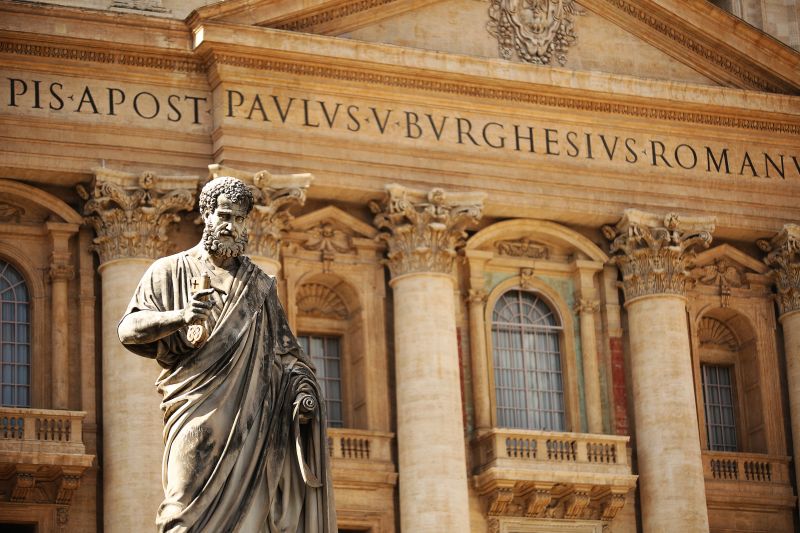
 Statue of St. Peter in front of St. Peter’s Basilica. / Credit: Vatican Media
National Catholic Register, Oct 2, 2023 / 02:34 am (CNA).
Five cardinals have sent a set of questions to Pope Francis to express their concerns and seek clarification on points of doctrine and discipline ahead of this week’s opening of the Synod on Synodality at the Vatican.
The cardinals said they submitted five questions, called “dubia,” on Aug. 21 requesting clarity on topics relating to doctrinal development, the blessing of same-sex unions, the authority of the Synod on Synodality, women’s ordination, and sacramental absolution.
Dubia are formal questions brought before the pope and the Dicastery for the Doctrine of the Faith (DDF) aimed at eliciting a “yes” or “no” response, without theological argumentation. The word “dubia” is the plural form of “dubium,” which means “doubt” in Latin. They are typically raised by cardinals or other high-ranking members of the Church and are meant to seek clarification on matters of doctrine or Church teaching.
The dubia were signed by German Cardinal Walter Brandmüller, 94, president of the Pontifical Committee for Historical Sciences; American Cardinal Raymond Burke, 75, prefect emeritus of the Apostolic Signatura; Chinese Cardinal Zen Ze-Kiun, 90, bishop emeritus of Hong Kong; Mexican Cardinal Juan Sandoval Íñiguez, 90, archbishop emeritus of Guadalajara; and Guinean Cardinal Robert Sarah, 78, prefect emeritus of the Dicastery for Divine Worship and the Discipline of the Sacraments.
The same group of senior prelates say they submitted a previous version of the dubia on these topics on July 10 and received a reply from Pope Francis the following day.
But they said that the pope responded in full answers rather than in the customary form of “yes” and “no” replies, which made it necessary to submit a revised request for clarification.
Pope Francis’ responses “have not resolved the doubts we had raised, but have, if anything, deepened them,” they said in a statement to the National Catholic Register, CNA’s partner news outlet. They therefore sent the reformulated dubia on Aug. 21, rephrasing them partly so they would elicit “yes” or “no” replies.
The cardinals declined the Register’s requests to review the pope’s July 11 response, as they say the response was addressed only to them and so not meant for the public.
They say they have not yet received a response to the reformulated dubia sent to the pope on Aug. 21.
The Register sought comment from the Vatican on Sept. 29 and again on Oct. 1 but had not received a response by publication time.
The cardinals explained in a “Notification to Christ’s Faithful” dated Oct. 2 that they decided to submit the dubia “in view of various declarations of highly placed prelates” made in relation to the upcoming synod that have been “openly contrary to the constant doctrine and discipline of the Church.”
Those declarations, they said, “have generated and continue to generate great confusion and the falling into error among the faithful and other persons of goodwill, have manifested our deepest concern to the Roman pontiff.”
The initiative, the cardinals added, was taken in line with canon 212 § 3, which states it is a duty of all the faithful “to manifest to the sacred pastors their opinion on matters which pertain to the good of the Church.”
The practice of issuing dubia has come to the fore during this pontificate. In 2016, Cardinals Burke and Brandmüller along with late Cardinals Carlo Caffarra and Joachim Meisner submitted a set of five dubium to Pope Francis seeking clarification on the interpretation of Francis’ apostolic exhortation Amoris Laetitia, particularly regarding the admission of divorced and remarried Catholics to the sacraments. They did not receive a direct response to their questions.
In 2021, the DDF issued a “responsa ad dubium” giving a simple “no” to a dubium on whether the Church has “the power to give the blessing to unions of persons of the same sex.” That same year, the Dicastery for Divine Worship issued a responsa ad dubia on various questions relating to the implementation of Traditionis Custodes, Pope Francis’ motu proprio restricting the Traditional Latin Mass.
Then in January of this year, Jesuit Father James Martin directly sent Pope Francis a set of three dubium seeking clarification of comments the Holy Father had given the Associated Press on the issue of homosexuality. The pope replied to the questions with a handwritten letter two days later.
What both dubia contain
The first dubium (question) concerns development of doctrine and the claim made by some bishops that divine revelation “should be reinterpreted according to the cultural changes of our time and according to the new anthropological vision that these changes promote; or whether divine revelation is binding forever, immutable and therefore not to be contradicted.”
The cardinals said the pope responded July 11 by saying that the Church “can deepen her understanding of the deposit of faith,” which they agreed with, but that the response did “not capture our concern.” They reinstated their concern that many Christians today argue that “cultural and anthropological changes of our time should push the Church to teach the opposite of what it has always taught. This concerns essential, not secondary, questions for our salvation, like the confession of faith, subjective conditions for access to the sacraments, and observance of the moral law,” they said.
They therefore rephrased their dubium to say: “Is it possible for the Church today to teach doctrines contrary to those she has previously taught in matters of faith and morals, whether by the pope ex cathedra, or in the definitions of an Ecumenical Council, or in the ordinary universal magisterium of the bishops dispersed throughout the world (cf. Lumen Gentium, 25)?”
In the second dubium on blessing same-sex unions, they underscored the Church’s teaching based on divine revelation and Scripture that “God created man in his own image, male and female he created them and blessed them, that they might be fruitful” (Gen 1:27-28), and St. Paul’s teaching that to deny sexual difference is the consequence of the denial of the Creator (Rom 1:24-32). They then asked the pope if the Church can deviate from such teaching and accept “as a ‘possible good’ objectively sinful situations, such as same-sex unions, without betraying revealed doctrine?”
The pope responded July 11, the cardinals said, by saying that equating marriage to blessing same-sex couples would give rise to confusion and so should be avoided. But the cardinals said their concern is different, namely “that the blessing of same-sex couples might create confusion in any case, not only in that it might make them seem analogous to marriage, but also in that homosexual acts would be presented practically as a good, or at least as the possible good that God asks of people in their journey toward him.”
They therefore rephrased their dubium to ask if it were possible in “some circumstances” for a priest to bless same-sex unions “thus suggesting that homosexual behavior as such would not be contrary to God’s law and the person’s journey toward God?” Linked to that dubium, they asked if the Church’s teaching continues to be valid that “every sexual act outside of marriage, and in particular homosexual acts, constitutes an objectively grave sin against God’s law, regardless of the circumstances in which it takes place and the intention with which it is carried out.”
Question about synodality
In the third dubium, the cardinals asked whether synodality can be the highest criterion of Church governance without jeopardizing “her constitutive order willed by her Founder,” given that the Synod of Bishops does not represent the college of bishops but is “merely a consultative organ of the pope.” They stressed: “The supreme and full authority of the Church is exercised both by the pope by virtue of his office and by the college of bishops together with its head the Roman pontiff (Lumen Gentium, 22).”
The cardinals said Pope Francis responded by insisting on a “synodal dimension to the Church” that includes all the lay faithful, but the cardinals said they are concerned that “synodality” is being presented as if it “represents the supreme authority of the Church” in communion with the pope. They therefore sought clarity on whether the synod can act as the supreme authority on crucial issues. Their reformulated dubium asked: “Will the Synod of Bishops to be held in Rome, and which includes only a chosen representation of pastors and faithful, exercise, in the doctrinal or pastoral matters on which it will be called to express itself, the supreme authority of the Church, which belongs exclusively to the Roman pontiff and, una cum capite suo, to the college of bishops (cf. can. 336 C.I.C.)?”
Holy Orders and forgiveness
In the fourth dubium, the cardinals addressed statements from some prelates, again “neither corrected nor retracted,” which say that as the “theology of the Church has changed,” so therefore women can be ordained priests. They therefore asked the pope if the teaching of the Second Vatican Council and St. John Paul II’s apostolic letter Ordinatio Sacerdotalis, which “definitively held the impossibility of conferring priestly ordination on women, is still valid.” They also sought clarification on whether or not this teaching “is no longer subject to change nor to the free discussion of pastors or theologians.”
In their reformulated dubium, the cardinals said the pope reiterated that Ordinatio Sacerdotalis is to be held definitively and “that it is necessary to understand the priesthood, not in terms of power, but in terms of service, in order to understand correctly Our Lord’s decision to reserve holy orders to men only.” But they took issue with his response that said the question “can still be further explored.”
“We are concerned that some may interpret this statement to mean that the matter has not yet been decided in a definitive manner,” they said, adding that Ordinatio Sacerdotalis belongs to the deposit of faith. Their reformulated dubium therefore comprised: “Could the Church in the future have the faculty to confer priestly ordination on women, thus contradicting that the exclusive reservation of this sacrament to baptized males belongs to the very substance of the sacrament of orders, which the Church cannot change?”
Their final dubium concerned the Holy Father’s frequent insistence that there’s a duty to absolve everyone and always, so that repentance would not be a necessary condition for sacramental absolution. The cardinals asked whether the contrition of the penitent remains necessary for the validity of sacramental confession, “so that the priest must postpone absolution when it is clear that this condition is not fulfilled.”
In their reformulated dubium, they note that the pope confirmed the teaching of the Council of Trent on this issue, that absolution requires the sinner’s repentance, which includes the resolve not to sin again. “And you invited us not to doubt God’s infinite mercy,” they noted, but added: “We would like to reiterate that our question does not arise from doubting the greatness of God’s mercy, but, on the contrary, it arises from our awareness that this mercy is so great that we are able to convert to him, to confess our guilt, and to live as he has taught us. In turn, some might interpret your answer as meaning that merely approaching confession is a sufficient condition for receiving absolution, inasmuch as it could implicitly include confession of sins and repentance.” They therefore rephrased their dubium to read: “Can a penitent who, while admitting a sin, refuses to make, in any way, the intention not to commit it again, validly receive sacramental absolution?”
Vatican context
The public release of the documents, obtained by the Register and other news outlets, comes two days before the opening of the 16th Ordinary General Assembly of the Synod of Bishops, a pivotal and highly controversial event in the Catholic Church.
The gathering in Rome marks a historic moment for the Church because for the first time in its history, laypeople, women, and other non-bishops will participate as full voting synod delegates, though the pope will ultimately decide whether to accept any of the assembly’s recommendations.
Pope Francis, either directly or through the Roman Curia, has previously addressed the topics brought up by the five cardinals and their dubia.
On the issue of the development of doctrine and possible contradictions, Pope Francis has frequently described a vision of doctrinal expansion grounded in a particular understanding of St. Vincent of Lerins’ maxim that Christian dogma “progresses, consolidating over the years, developing with time, deepening with age.” The pope has said doctrine expands “upward” from the roots of the faith as “our understanding of the human person changes with time, and our consciousness deepens.”
For instance, the Holy Father has said that while the death penalty was accepted and even called for by previous Catholic doctrine, it is “now a sin.” “The other sciences and their evolution also help the Church in this growth of understanding,” the pope said. In Evangelii Gaudium, Pope Francis said that this kind of approach might be considered “imperfect” by those who “dream of a monolithic doctrine defended by all without nuance,” but “the reality is that such variety helps us to better manifest and develop the different aspects of the inexhaustible richness of the Gospel.”
On the topic of blessing same-sex unions, which have been pushed for in places like Germany, the Vatican’s chief doctrinal office, the Dicastery for the Doctrine of the Faith, weighed in on the matter in 2021, clarifying that “the Church does not have, and cannot have, the power to bless unions of persons of the same sex.” However, some have speculated that, in spite of the DDF text referencing his approval, Pope Francis was displeased by the document. Relatedly, Antwerp’s Bishop Johan Bonny claimed in March that the pope did not disapprove of the Flemish-speaking Belgian bishops plan to introduce a related blessing, although this claim has not been substantiated and it is not clear that the Flemish blessing is, in fact, the kind explicitly disapproved by the DDF guidance.
Regarding the DDF text, Vatican Secretary of State Cardinal Pietro Parolin cited it in his criticism of the German Synodal Way’s decision to move forward with attempted blessings of same-sex unions, but he also added that the topic would require further discussion at the upcoming universal synod. More significantly, new DDF prefect Cardinal Victor Manuel Fernández, a close confidant of Pope Francis, stated in July that while he was opposed to any blessing that would confuse same-sex unions with marriage, the 2021 DDF guidance “lacked the smell of Francisco” and could be revisited during his tenure.
Regarding the authority of the forthcoming synod, although Pope Francis has expanded voting rights in the Synod of Bishops beyond the episcopacy, he has also repeatedly emphasized that the synod “is not a parliament” but a consultative, spiritual gathering meant to advise the pope. The pope did adjust canon law in 2018 to allow for the final document approved by a Synod of Bishops to “participate in the ordinary magisterium of the successor of Peter,” though only if “expressly approved by the Roman pontiff.”
On the possibility of the sacramental ordination of women, Pope Francis reaffirmed in 2016 that St. John Paul II’s clear “no” via Ordinato Sacederdotalis (1994) was the “final word” on the subject. In 2018, then-DDF prefect Cardinal Luis Ladaria confirmed that the male-only priesthood is “definitive.” In a 2022 interview with America magazine, Pope Francis again affirmed that women cannot enter ordained ministry and said that this should not be seen as a “deprivation.”
The pope has established two separate commissions to consider the question of a female diaconate, but the first, historically-based commission did not come to any definitive consensus and the second, focusing on the issue from a theological perspective, seems similarly unlikely to offer univocal support for a female diaconate. However, the synod’s Instrumentum Laboris does ask if “it is possible to envisage” women’s inclusion in the diaconate “and in what way?”
Finally, regarding withholding absolution in the confessional, the pope has previously referred to priests who refrain from offering absolution for certain moral sins without the bishop’s permission as “criminals” and told the Congolese bishops in February that they must “always forgive in the sacrament of reconciliation,” going beyond the Code of Canon Law to “risk on the side of forgiveness.”
Jonathan Liedl, senior editor of the National Catholic Register, contributed to this story.
[…]








Is this the same Pope who gave the green light for transgender Godparents and who seems to indicate that the disorder is just one amongst many? He needs to get his story straight, in the real world, ordinary Catholics and others are desperate for moral guidance and support, but the main Christian churches seem obsessed with falling in line with secular government.
Yes, in the real world. ordinary Catholics and others are desperate for support. For guidance, though — on this issue? There are indeed some thorny moral issues, but there are others for which “I didn’t know” is simply not a plausible excuse. I think it is genuinely possible for someone not to recognize that a child at the embryonic stage of development really is a human person, but I cannot accept that excuse for partial-birth abortion, let alone allowing children who survive abortion to die due to intentional neglect. Sometimes the problem is not that evil is not recognized, but that evil is desired; in such case support might be needed for those who oppose evil, but guidance is pointless.
Yep. Same guy. Same one who introduced an Argentinian friend as “she who was he but now is she.”
This guy talks a good game. And every time he turns right around and undoes it all with his decisions, his actions, his off-the-cuff remarks. He has lost all credibility. Don’t even bother reporting his speeches anymore; it’s all a sick game.
Pure cant and utter hypocrisy from a figure known universally as a man who says one thing in his words while he does the opposite in his actions. He receives transsexual prostitutes regularly in monthly luncheons, supports them financially, and never even remotely attempts their repentance and conversion. For almost 11 years he has surrounded himself with a cabal of grotesque homosexuals in the Vatican and has gone to extraordinary lengths to protect extreme homosexual predators like his favorites Rupnick and Zancetta from canonical and even secular criminal penalties.
The manifestation of God’s love in paradise is going to be Male-Female love, and anyone living in this world fails to conclude so is unlikely to gain everlasting life! There is no marriage (as there is no need of raising children) nor sexless lives, but both males and females are like angels and effectively (material)bodies of invisible and essenceless God, true Advaitha.
The Holy Family of Nazareth is an inspiration for all times. Jesus, Mary, and Joseph – Pray for us.
It’s the very gender ideology that even suggests that the sexual relationship of two men can be blessed. This Vatican creates confusion at every turn. The value of the Petrine ministry as a visible sign that the Church is One (i.e. a unifying sign) is lost on this pontiff. Even using the term “pontiff” to describe Francis is risable since the word pontiff comes from the root word meaning bridge. If anything, this Pope has been blowing up bridges since the day he was elected.
I’m just glad he didn’t say that the ugliest danger is Tradionalist Catholics.
He might not say it, but that seems to be what he thinks.
Today the greatest danger is mealymouthed Modernism that whipsaws the faithful with a Peronist form of weaponized ambiguity.
We read: “…the ugliest danger is gender ideology, which cancels out differences.”
The papal message throughout the article is sound and worthy of respect. And, yet, might the second-ugliest danger be the elevation of differences–as in some aspects of a tensely “polyhedral” and synodal Church?
Instead, how, both, to affirm things concrete (like personal “vocations”), but without appearing to discount the meaning of the “concrete universal” in the historical and incarnate Jesus Christ, as reflected in moral absolutes (Veritatis Splendor)?
How to affirm the existential “conscience” and “will,” but without seeming to omit the more traditional and informative “intellect” (Augustine: Man as memory, intellect and will)?
How to leaven an unfolding future at risk of ideological forwardism, but without demeaning or evading, and never formally contradicting the “backwarist’s” memory and Magisterium?
How to not only maintain the “tension” between man and woman, but affirm the larger and whole unity of “complementarity”? Analogous to the “hermeneutics of continuity” versus discontinuity?
___________________________________________
So, about the dangerous ideology of fluid “gender theory,” and the seeming carve-out of concrete “couples” (Fiducia Supplicans?)….And with Hamlet: “To truly bless the complementary, or to facsimile-bless the irregularly coupled, that is the question.”
No. Trafficking baby immigrants from their mother’s wombs to demonic, barbaric deaths, [before, during or after birth] or in and from the cryogenic wombs, or then, keeping them as cryogenic abandoned orphans for so much time and then killing unjustly…and others….and for money and power!!! These are worse, in kind and in degree.
Who was worse, Hitler, Himmler, or Mengele? Personally, I’m inclined to say Mengele, but (a) it’s really hard to say, and (b) it doesn’t matter at all. Beyond a certain level of nastiness, it’s best not to think about too much. And so it is with the two types of behavior you’re comparing.
They can be isolated and disparaged, but how do we draw them to Christ and his message? One failed Methodology…
Michelle Bachmann and her husband Marcus ran a “clinic” in Minnesota entitled “Pray the Gay away”. It was closed for engaging in a discredited therapy designed to convert gays to straights through prayer and self-reflection and not keeping “patient” records. It appears that lack of documentation includes successes.
Are our prayers unanswered since they continue the “out of the closet in your face” attitude? Am a fortunate father for not having a Gay child? I see no mention of parental guidance
Pray for God’s help.
From the very beginning of his papacy the overwhelming focus of Pope Francis has been on seeking Our Lord’s Mercy. This was the reason for declaring the year of mercy. (You protestants out there have you ever kicked off a truly global revival for an entire year? LOL) Everything is spelled out in the book “The Name Of God Is Mercy” in which Italian journalist Andrea Tornielli has long conversations with Pope Francis who explains it all. He NEVER endorses any kind of sin but teaches that there is deliverance even for those so buried in it that they have despaired of ever escaping. There is no confusion here except for those have some confusion originating in some of the storm of conflicting worldly outlooks which the pope has loosely termed ideology.
“Not everyone who says to me, ‘Lord, Lord,’ will enter the kingdom of heaven, but the one who does the will of my Father who is in heaven” (Mt 7:21).
“Everyone, everyone,” an ideology?
I beg your pardon, but has Pope Francis ever kicked off a truly global revival (LOL)? Oh, he can give a year a name, just the same as Congress can declare May 10 National Liver and Onions Day — but I would need evidence to believe that the pope’s declaration prompted an ACTUAL revival or to believe that the congressional declaration ACTUALLY increased the consumption of liver and onions.
Concerning the last comments by Ouris and Peter Beaulieu Their contradictions are obvious. If you were a catholic regularly attending mass during the year of mercy and following catholic media you would certainly have known what the focus of the Universal Church was. If you are not catholic and/or were not attending mass regularly then you would not have a clue and your demand for proof is so much liver and onions. Pope Francis preaches the Mercy of Christ. He preaches that people trapped in life of habitual mortal sin can be delivered and healed by seeking forgiveness of Jesus Who IS love and mercy. Teaching this is doing the will of God if anything ever is. To throw Mt.7:21 around as an insinuation is not doing God’s will. The point of mentioning the book “The Name Of God Is Mercy” is that we can no longer be couch potatoes where the facts are concerned these days. We have to the extent reasonably possible go to the trouble to learn the whole story. There are inexpensive books on Pope Francis teachings. They are inspiring as well as informative so check Amazon. At the beginning of this month I did a search for the popes prayer intention for March. I found six good online sources; these will serve to keep up with his teachings and observations without too much trouble. We as Catholics owe this to the man chosen by the Holy Spirit to be the Vicker of Christ.
This pope protects sexual predators, encourages and supports gay clergy, blesses gay couples, prioritizes a leftist climate agenda over more pressing spiritual concerns, and regularly attacks faithful traditional Catholics. Given his track record, there’s nothing this pope says that any discerning believer needs to take seriously.
Broadbrush! Not all Gays are predators. That very disparagement is a blatant reason why we are failing to “convert” them.
We don’t convert them or anyone else. Repentance and faith are the work of the Holy Spirit alone. Stop defending the indefensible.
Yes, of course, about “not all gays are predators.”
But the gayme-changer was when the predatory faction first sought civil unions by saying this was not a half-way house to full redefinition of “marriage;” immediately followed by the aggressive oxymoron of gay “marriage.” Even the ersatz United State Supreme Court got in the act, so to speak.
A tough ratchet to undo, if the compassionate thing is to “‘convert’ them”, not only them but everyone else for whatever temptations afflict the wider population. Instead, why not simply dilute the drop of cyanide in the punchbowl with spontaneous and informal semi-blessings poured on every kind of “irregular” coupling floating around?
Just move along folks, there’s nothing to see here.
Broadbrush! Athanasius did not claim or even imply that all “Gays are predators.”
Broadbrush! The wrongly alleged disparagement is not a blatant reason why “we are failing to ‘convert’ them.”
On the other hand, failing to properly counsel gays who actively engage in homosexual sex that such is mortally sinful, and that they should repent and do what’s necessary to avoid both the sinning and occasions of such sins demonstrates a lack of love for these people and the fate of their immortal souls.
We read: “[Pope Francis] preaches that people trapped in life of habitual mortal sin can be delivered and healed by seeking forgiveness of Jesus Who IS love and mercy.”
OF COURSE! ABSOLUTELY. But, the divisive ambiguity and (some say) capitulation is something else; it’s the inventive half-blessing of doubled “couples” as such, rather than the undivided and real blessing of “individual people” as such.
Might we finally consider the possibility that no longer being able to even SEE the difference (!) between homosexual/anti-binary actions and complementary/binary intercourse between a man and a woman IS an inflicted or acquired blindness at the very center of the parody (not parity)?
Is even the seeing flattened and displaced by the doing?
Homosexuals who successfully free themselves from the non-seeing (!) describe the “AHA MOMENT” that enabled their “conversion.” They report that this moment of freedom and insight is similar to playing cards, and then discovering that they’ve been playing with two cards stuck together, and have been betting on the wrong card.
They want to get back into the real world. The successful conversion therapist Dr. Nicolosi (RIP) explained this moment—as described NOT by him but by his clients!
But, OF COURSE, his finding and the testimony of his clients are often illegal and even punished by the establishment. Thomas More faced a similar persecution under the establishment of his day: “Some men think the Earth is round, others think it flat; it is a matter capable of question. But if it is flat, will the King’s [the establishment’s!] command make it round? And if it is round, will the King’s command flatten it? No, I will not sign” (Robert Bolt, “A Man for All Seasons,” 1962).
So, WHAT ABOUT the difference between the fully real blessing of struggling (and often victimized) persons as such, versus any pseudo-blessing of irregular “couples” as such?
This pope is the worst in my lifetime. He is political. He is singlehanded ly destroying the Catholic Church. I don’t need to hear him speak about climate change. He doesn’t need to tell America to have open borders. I was furious when he opened the door to gays. If they do not like the Catholic beliefs of a man and a woman, go to another church but leave mine alone. He needs to retire. We need a pope that speaks of helping the poor, respecting marriage between a man and a woman, the sanctity of life. I do not want to hear anything political. I go to church for a break from the real world. I need hope.