The cross of the German “Synodal Way.” (Credit: Maximilian von Lachner/Synodaler Weg)
CNA Newsroom, Jan 30, 2024 / 10:52 am (CNA).
In light of a Protestant abuse study unveiled in Germany, a Catholic lay group has called into doubt the “persistent narrative of the Synodal Way attributing systemic causes of abuse to specifically Catholic factors.”
Published on Jan. 25, the ForuM study identified 1,259 accused individuals and 2,174 survivors of abuse since 1946 within the Evangelical Church in Germany (EKD), according to a report by CNA Deutsch, CNA’s German-language news partner. This study’s findings starkly contrast with the claims of an “alleged Catholic-specific dimension of sexual abuse,” stated “Neuer Anfang,” a German lay group critical of the Synodal Way.
The German Synodal Way, which voted for women’s ordination and transgender ideology, among other issues, linked its resolutions to the MHG Study, an investigation of clerical sexual abuse in the Catholic Church in Germany.
However, Neuer Anfang has stated that “critics have consistently challenged the scientific validity of such a connection.” As CNA Deutsch reported, a noted medical expert also raised concerns in this context.
‘No monocausal connection’
Following the publication of the Protestant study last week, abuse expert Father Hans Zollner told German agency KNA: “There is no monocausal connection between certain church structures and abuse; it is much more complex.”
Zollner was part of the Pontifical Commission for the Protection of Children until 2023 and headed the Institute of Anthropology at the Pontifical Gregorian University.
The abuse expert said, according to CNA Deutsch, it was “certainly not wrong to think about what has facilitated sexual abuse in the Catholic Church and hindered clarification and how this should be changed.” However, he warned, “it is too short-sighted to think that married priests or more women in the leadership of the Church would in themselves prevent abuse.”
Neuer Anfang emphasized the presence of systemic causes of sexual abuse that transcend denominational boundaries, such as power imbalances, unclear role patterns, and the potential for manipulation in asymmetrical relationships.
“These structural factors, which are conducive to abuse, are not unique to the Catholic Church or any single denomination. They are cross-institutional, prevalent wherever children and young people are involved — in churches of all denominations, as well as in sports and educational settings.”
Democracy and synodality
The German bishops will debate the Synodal Way in their next plenary assembly in Augsburg from Feb. 19–22. This meeting is expected to be a critical juncture, as the bishops will vote on a committee with the goal of introducing a permanent Synodal Council to oversee the Church in Germany.
Ahead of the gathering, Bishop Georg Bätzing of Limburg, the German bishops’ conference president, wrote that the Church must “look for suitable meeting formats and participation procedures” that “enable as many people as possible to be seriously involved in consultations and decisions,” CNA Deutsch reported.
In this context, Bätzing wrote, modern democracy, with its recognition of human dignity and the separation of powers, the welfare state, and rule of law, should not “give rise to fears in the Church.”
If you value the news and views Catholic World Report provides, please consider donating to support our efforts. Your contribution will help us continue to make CWR available to all readers worldwide for free, without a subscription. Thank you for your generosity!
Click here for more information on donating to CWR. Click here to sign up for our newsletter.
South Bend, Ind., Jul 2, 2021 / 16:19 pm (CNA).
Appearing alongside the Catholic Archbishop of New York, an elder of the Church of Jesus Christ of Latter-day Saints this week highlighted instances o… […]
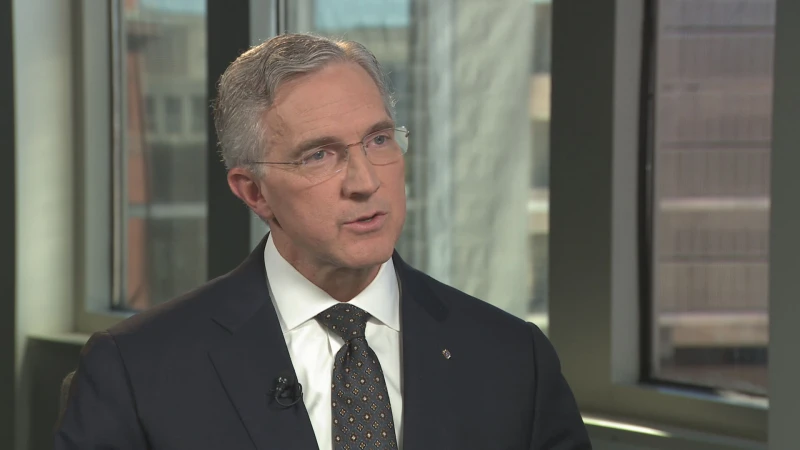
Knights of Columbus Supreme Knight Patrick Kelly speaks with EWTN News President and COO Montse Alvarado on Thursday, July 11, 2024, regarding the organization’s decision to cover mosaics by the accused abuser Father Marko Rupnik in chapels in Washington, D.C., and Connecticut. / Credit: EWTN News
Rome Newsroom, Jul 11, 2024 / 12:00 pm (CNA).
The Knights of Columbus announced Thursday they will cover mosaics by the accused abuser Father Marko Rupnik in Washington, D.C., and Connecticut, a dramatic move that represents the strongest public stand yet by a major Catholic organization regarding the former Jesuit’s embattled art.
The 2.1-million-member lay Catholic fraternal order said July 11 it would use fabric to cover the floor-to-ceiling mosaics in the two chapels of the St. John Paul II National Shrine in Washington and in the chapel at the Knights’ headquarters in New Haven, Connecticut — at least until the completion of a formal Vatican investigation into the Slovenian priest’s alleged abuse.
Patrick Kelly, Supreme Knight of the Knights of Columbus, told EWTN News Thursday the opaque material would be installed “very soon” but gave no firm timetable. The Knights said in a statement released Thursday afternoon that the artwork may later be more permanently hidden with a plaster covering after the Dicastery for the Doctrine of the Faith issues its ruling on Rupnik.
The decision by the Knights to cover the sprawling works, which envelop both spaces, was made at the end of a comprehensive, confidential review process that included consultations with sexual abuse victims and those who minister to them, art historians, pilgrims to the shrine, bishops, and moral theologians.
“The Knights of Columbus have decided to cover these mosaics because our first concern must be for victims of sexual abuse, who have already suffered immensely in the Church, and who may be further injured by the ongoing display of the mosaics at the shrine,” Kelly said in the statement.
“While opinions varied among those consulted,” he said, “there was a strong consensus to prioritize the needs of victims, especially because the allegations are current, unresolved, and horrific.”
Kelly reiterated that point in his interview with EWTN News.
“Our decision process really came down to multiple factors. But the No. 1 factor was compassion for victims,” Kelly said. “We needed to prioritize victims over anything, any material thing. So that was our primary consideration.”
The first segment of Kelly’s interview with EWTN News will air on “EWTN News Nightly” Thursday at 6 p.m. and 9 p.m. ET. Additional comments will air on “EWTN News In Depth” on Friday at 8 p.m. ET.
Knights of Columbus Supreme Knight Patrick Kelly speaks with EWTN News President and COO Montse Alvarado on Thursday, July 11, 2024, regarding the organization’s decision to cover mosaics by the accused abuser Father Marko Rupnik in chapels in Washington, D.C., and Connecticut. Credit: EWTN News
Once a renowned artist Rupnik, whose mosaics are featured in hundreds of Catholic shrines, churches, and chapels around the world, was expelled from the Jesuits in June 2023.
His expulsion followed a long review of what the society called “highly credible” accusations of serial spiritual, psychological, and sexual abuse of as many as 30 religious sisters by the priest spanning decades. Some women allege Rupnik’s abuse sometimes happened as part of the process of creating his art at the Centro Aletti, an art school he founded in Rome.
The Vatican announced in late October 2023 that Pope Francis had waived the statute of limitations in the Rupnik case, allowing the Dicastery for the Doctrine of the Faith to do a canonical investigation into the abuse allegations.
There has been no further communication from the Vatican about the inquiry, and it is unclear whether Rupnik may still be living in Rome despite having been given priestly faculties in a diocese of his home country of Slovenia last year.
Growing public outcry
What to do with Rupnik’s once widely-praised works, colorful mosaics characterized by grand, flowing figures and large eyes, has proven to be a divisive question in the wake of the numerous allegations against him, which first came to public attention in December 2022.
While some want to await Vatican judgment before dismantling and replacing Rupnik’s works, much of it made in collaboration with other artists of the Centro Aletti — a Rupnik-founded art school and theological center in Rome — the public outcry for the removal of his art has intensified.
The Knights also announced several immediate changes that would be enacted at the shrine in solidarity with abuse victims, including providing educational materials about the mosaics, making clear that their display during the consultation process “was not intended to ignore, deny, or diminish the allegations of abuse.”
Every Mass at the St. John Paul II National Shrine will now also include a prayer of the faithful for victims of sexual abuse, and saints with connections to abuse victims, such as St. Josephine Bakhita, will be specially commemorated.
The group said it became aware of the allegations against Rupnik in December 2022 — and noted that the artist, while under investigation, remains a priest in good standing in the Diocese of Koper, Slovenia.
“This decision is rooted in a foundational purpose of the Knights of Columbus, which is to protect families, especially women and children, and those who are vulnerable and voiceless,” Kelly said in the July 11 statement.
The “Redemptor Hominis” chapel of the National Shrine of St John Paul II in Washington, DC, is decorated with mosaics by Fatherr Marko Rupnik. Credit: Lawrence OP|Flickr|CC BY-NC-ND 2.0
The St. John Paul II National Shrine is a pastoral initiative of the Knights of Columbus, established in 2011, and designated a national shrine by the U.S. Catholic bishops in 2014.
Rupnik’s mosaics were installed at the shrine in 2015. The Holy Family Chapel at the Knights’ headquarters has featured Rupnik’s art since 2005.
Highlighting the John Paul II shrine’s mission of evangelization, the supreme knight said, “the art we sponsor must therefore serve as a stepping stone — not a stumbling block — to faith in Jesus Christ and his Church.”
Rupnik has not made any statements since the allegations came to light.
An eye on Lourdes
The Knights’ move to conceal the mosaics follows just a week after the bishop of Lourdes, France, said that despite his personal feelings that Rupnik’s artwork at the renowned Marian shrine there should be removed, he has decided to wait to make a final decision due to “strong opposition on the part of some.”
After forming a special commission in May 2023, Bishop Jean-Marc Micas of Tarbes announced July 2 that more time was needed “to discern what should be done” about Rupnik’s mosaics at the Marian apparition site, because his belief that they should be torn down “would not be sufficiently understood” and “would add even more division and violence” at this time.
As a “first step,” the French bishop said he had decided the mosaics will no longer be lit up at night during the shrine’s nightly candlelight rosary processions.
In his interview with EWTN News, Kelly said the Lourdes bishop’s intent to make a decision of some kind this spring galvanized the Knights to act at this time.
In his July 11 statement, Kelly thanked the Lourdes bishop for his “thoughtful decision” and said it “both informed and confirmed us in our own decision-making. Shrines are places of healing, prayer, and reconciliation. They should not cause victims further suffering.”
Emphasizing the importance of discernment based on mission and context, the supreme knight said: “Every situation is different. In the United States, Catholics continue to suffer in a unique way from the revelations of sexual abuse and, at times, from the response of the Church. It is clear to us that, as a national shrine, our decision must respect this country’s special need for healing.”
The Knights of Columbus was founded in New Haven, Connecticut, in 1882 by Blessed Michael McGivney, a parish priest. Dedicated to the advancement of the group’s key principles — charity, unity, fraternity, and patriotism — its members in 2022 provided 50 million service hours and nearly $185 million to charitable causes in their communities.
National Catholic Register Editor-in-Chief Shannon Mullen contributed to this story.
Denver Newsroom, May 24, 2022 / 17:27 pm (CNA).
The first and only certified Trappist brewery in the U.S. has said that it will close, citing a lack of financial viability. The monks of St. Joseph’s Abbey in S… […]
5 Comments
I’m probably missing something important but the Cross in the photo here reminds me of a flyswatter.
Bishop Batzing does a credible imitation of a resuscitated cadaver…
The proposed “permanent synodal council” recalls the 16th Century when the now-disinterred Martin Luther established a territorial German council which, by definition, excluded anything having to do with Church unity or the papacy. And which is why Pope Francis earlier offered the rebuke to Batzing & Co. that “we don’t need two Protestant (c)hurches in Germany.”
In yesteryear, the Protestant churches (sic “ecclesial communions”) became thoroughly territorial. Then, the local bishops’ roles were transferred to the secular rulers of the territories (breaking the Apostolic Succession). By comparison, today’s middle-ground muddle is not to retain the consistory courts of history’s individual lay rulers, but still to install a broader, permanent, and now more mongrel council—still quarantined from the papacy or any evidence of the universal Church. And, moreover, to include non-celibate priests and pseudo-ordained priestesses, both alongside a largely secular membership from the radicalized laity.
All this irregularity (!) with the double-speak claim to “be Catholic but in a different way.”
Perhaps the council’s charter will effuse about 5,000 words, symmetrically the same length as the pseudo-blessing of “irregular couples” under Fiducia Supplicans—which apparently (?) has failed to deter tribal Germania.
Why don`t they all dig deeper and ask what had pornography to do with the abuse of children? How many of the abusers used porn? Did the porn make them as individuals feel small that they had to act out their sexual fantasies on little children. I have been saying this for over 40 years but either no one wants to admit it or the porn industry has so much money that they pay to keep it quiet!
Regarding the issue of clergy sex abuse, I recommend reading Bill Donahue’s book “ The Truth about Clergy Sexual Abuse”. He does a very candid and honest analysis of the entire issue.
“…This work unpacks the history and root causes of the clergy sex abuse scandals in the United States. Building on decades of data and research, author Bill Donohue, who holds a doctorate in sociology, tells the story from a fresh angle and calls us to rethink our assumptions about the Church”s handling of these horrific abuses.The Truth about Clergy Sexual Abuse challenges many myths about the scandals, demonstrating that the abuse of minors is a problem that haunts virtually every institution–religious and secular–where adults interact with young people. The work also provides compelling evidence of the great progress that the Church has made in preventing abuse, contrary to public perceptions. Indeed, the media, Hollywood, and activist lawyers have poisoned the public mind with tales of old cases, giving the impression that nothing has changed.Donohue investigates at length the central role that homosexuality played in the scandal. While homosexuality does not cause sexual abuse, the prevalence of emotional and sexual immaturity among homosexual clergy explains why they committed most of the molestation. Indeed, all of the educational institutions of the Catholic Church, including the seminaries, have been affected by the sexual revolution that began in the 1960s, and this book explores the pernicious effects of dissent from Catholic sexual morality.”









I’m probably missing something important but the Cross in the photo here reminds me of a flyswatter.
Clerical abuse as the issue necessitating the German Synodal Way was a crock from the beginning.
Bishop Batzing does a credible imitation of a resuscitated cadaver…
The proposed “permanent synodal council” recalls the 16th Century when the now-disinterred Martin Luther established a territorial German council which, by definition, excluded anything having to do with Church unity or the papacy. And which is why Pope Francis earlier offered the rebuke to Batzing & Co. that “we don’t need two Protestant (c)hurches in Germany.”
In yesteryear, the Protestant churches (sic “ecclesial communions”) became thoroughly territorial. Then, the local bishops’ roles were transferred to the secular rulers of the territories (breaking the Apostolic Succession). By comparison, today’s middle-ground muddle is not to retain the consistory courts of history’s individual lay rulers, but still to install a broader, permanent, and now more mongrel council—still quarantined from the papacy or any evidence of the universal Church. And, moreover, to include non-celibate priests and pseudo-ordained priestesses, both alongside a largely secular membership from the radicalized laity.
All this irregularity (!) with the double-speak claim to “be Catholic but in a different way.”
Perhaps the council’s charter will effuse about 5,000 words, symmetrically the same length as the pseudo-blessing of “irregular couples” under Fiducia Supplicans—which apparently (?) has failed to deter tribal Germania.
Why don`t they all dig deeper and ask what had pornography to do with the abuse of children? How many of the abusers used porn? Did the porn make them as individuals feel small that they had to act out their sexual fantasies on little children. I have been saying this for over 40 years but either no one wants to admit it or the porn industry has so much money that they pay to keep it quiet!
Regarding the issue of clergy sex abuse, I recommend reading Bill Donahue’s book “ The Truth about Clergy Sexual Abuse”. He does a very candid and honest analysis of the entire issue.
“…This work unpacks the history and root causes of the clergy sex abuse scandals in the United States. Building on decades of data and research, author Bill Donohue, who holds a doctorate in sociology, tells the story from a fresh angle and calls us to rethink our assumptions about the Church”s handling of these horrific abuses.The Truth about Clergy Sexual Abuse challenges many myths about the scandals, demonstrating that the abuse of minors is a problem that haunts virtually every institution–religious and secular–where adults interact with young people. The work also provides compelling evidence of the great progress that the Church has made in preventing abuse, contrary to public perceptions. Indeed, the media, Hollywood, and activist lawyers have poisoned the public mind with tales of old cases, giving the impression that nothing has changed.Donohue investigates at length the central role that homosexuality played in the scandal. While homosexuality does not cause sexual abuse, the prevalence of emotional and sexual immaturity among homosexual clergy explains why they committed most of the molestation. Indeed, all of the educational institutions of the Catholic Church, including the seminaries, have been affected by the sexual revolution that began in the 1960s, and this book explores the pernicious effects of dissent from Catholic sexual morality.”