Republican presidential candidate Florida Gov. Ron DeSantis delivers remarks during the FOX Business Republican Primary Debate at the Ronald Reagan Presidential Library on September 27, 2023 in Simi Valley, California. / Credit: Justin Sullivan/Getty Images
Washington, D.C. Newsroom, Jan 21, 2024 / 16:38 pm (CNA).
Florida Gov. Ron DeSantis on Sunday announced the suspension of his presidential campaign nearly one week after the Republican finished a distant second in the Iowa caucuses.
“Following our second place finish in Iowa, we’ve prayed and deliberated on the way forward,” DeSantis said. “If there was anything I could do to produce a favorable outcome — more campaign stops, more interviews — I would do it.”
“But I can’t ask our supporters to volunteer their time and donate their resources if we don’t have a clear path to victory,” he said.
“Success is not final, failure is not fatal: it is the courage to continue that counts.”
DeSantis in the announcement endorsed Trump for the presidency, stating: “It is clear to me that a majority of Republican primary voters want to give Donald Trump another chance.”
“I signed a pledge to support the Republican nominee and I will honor that pledge,” he said.
“While this campaign has ended, the mission continues,” the governor added. “Down here in Florida, we will continue to show the country how to lead.”
DeSantis, a Catholic, spent much of his time on the campaign trail touting his record as governor of Florida. In August, at the first Republican primary debate, the Republican boasted of having won a “landslide” reelection victory after having supported and signed a pro-life “heartbeat” bill in Florida.
“You got to do what you think is right,” DeSantis said at the time. “I believe in a culture of life. I was proud to sign the heartbeat bill.”
“Why are you in office?” he told Alvarado. “Are you in office to put your finger in the wind and try to contort yourself into a pretzel, or are you in office to be able to stand up for things that you believe in?”
If you value the news and views Catholic World Report provides, please consider donating to support our efforts. Your contribution will help us continue to make CWR available to all readers worldwide for free, without a subscription. Thank you for your generosity!
Click here for more information on donating to CWR. Click here to sign up for our newsletter.
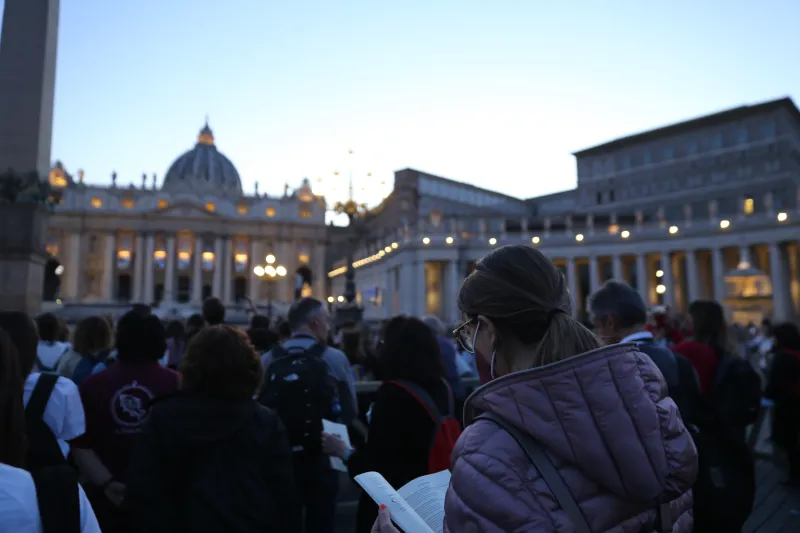
Pilgrims pray in front of St. Peter’s Basilica / Hannah Brockhaus/CNA
Rome, Italy, May 26, 2022 / 08:37 am (CNA).
When St. Philip Neri came to Rome from Florence in 1533, he encountered a city in upheaval. The Sack of Rome six years prior had left famine and plague in its wake. The Protestant Reformation was in full swing and the Church was rife with corruption.
The young Philip, who would spend around 16 years in Rome as a layman before becoming a priest, soon dedicated himself to caring for the city’s sick and poor.
The saint, whose feast day falls on May 26, also realized that Rome’s people were suffering from a spiritual sickness and tiredness as well, and so he set out to reinvigorate Catholics with the joy of the faith through song and dance — and jokes.
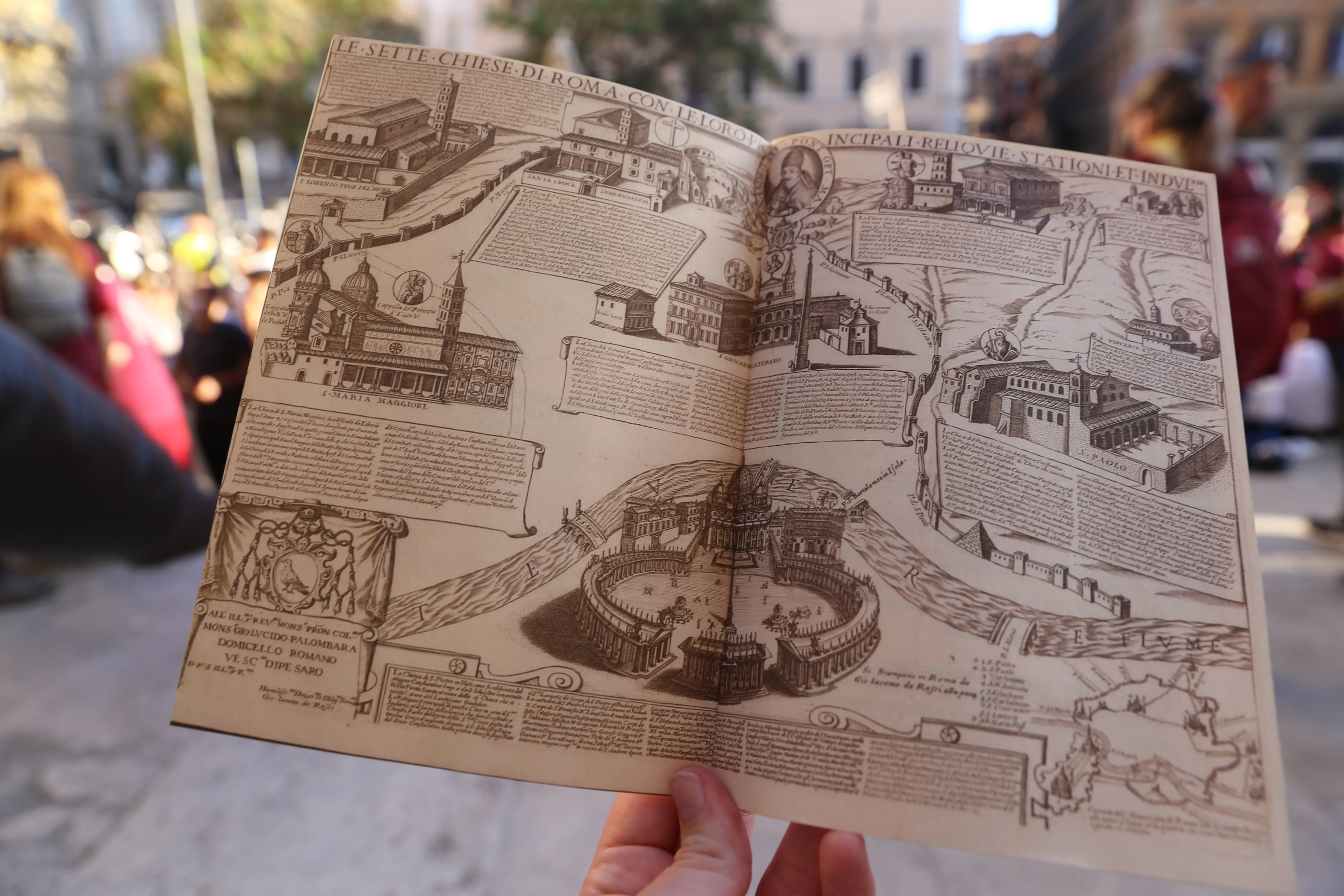
A historic illustration of the seven churches. Hannah Brockhaus/CNA
Part of St. Philip’s outreach was the revival of the Seven Churches visit. He may not be the originator of the idea of the pilgrimage to some of Rome’s most important churches, but he is credited with renewing its popularity.
After it fell out of use once again, St. Philip’s congregation of secular priests, the Oratory, revived it in the 1960s, including holding the walk one night each year, as close as possible to the way the saint would have done it.
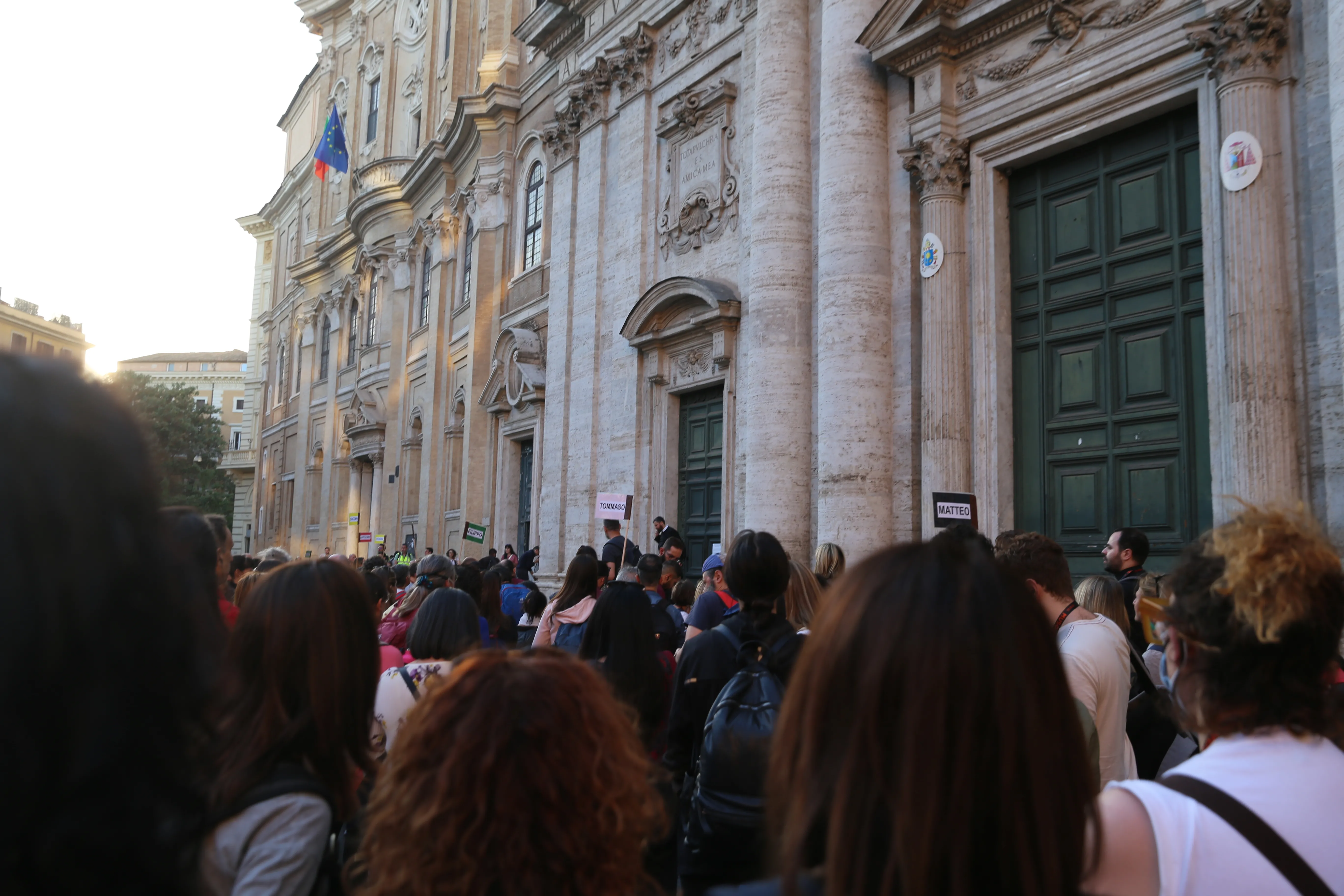
Fr. Maurizio Botta, who led the pilgrimage, speaks at the start in front of Chiesa Nuova. Hannah Brockhaus/CNA
After a two-year pause, on the evening of May 13 into the morning of May 14, around 800 people walked 15 and a half miles in the footsteps of the saint and his followers.
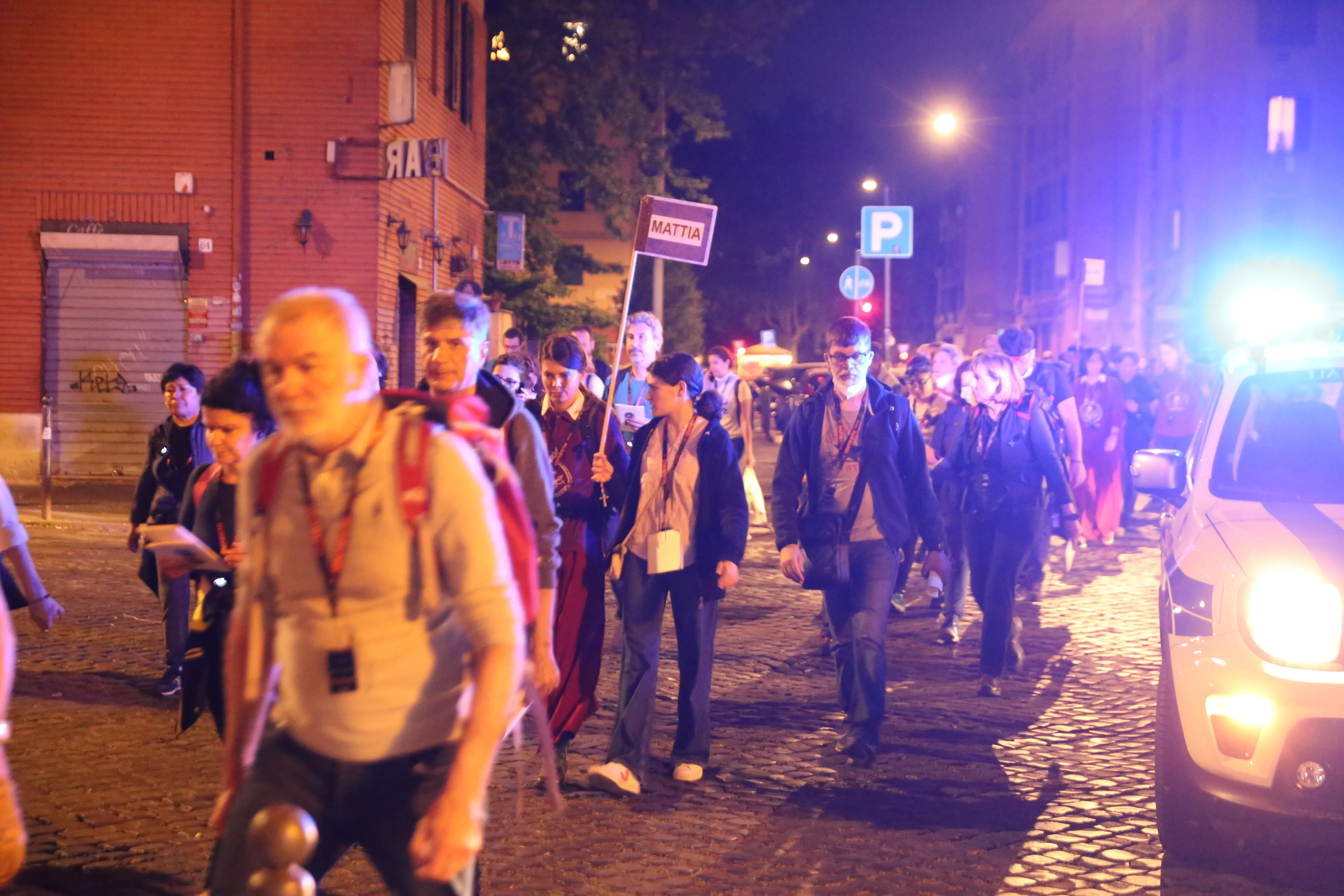
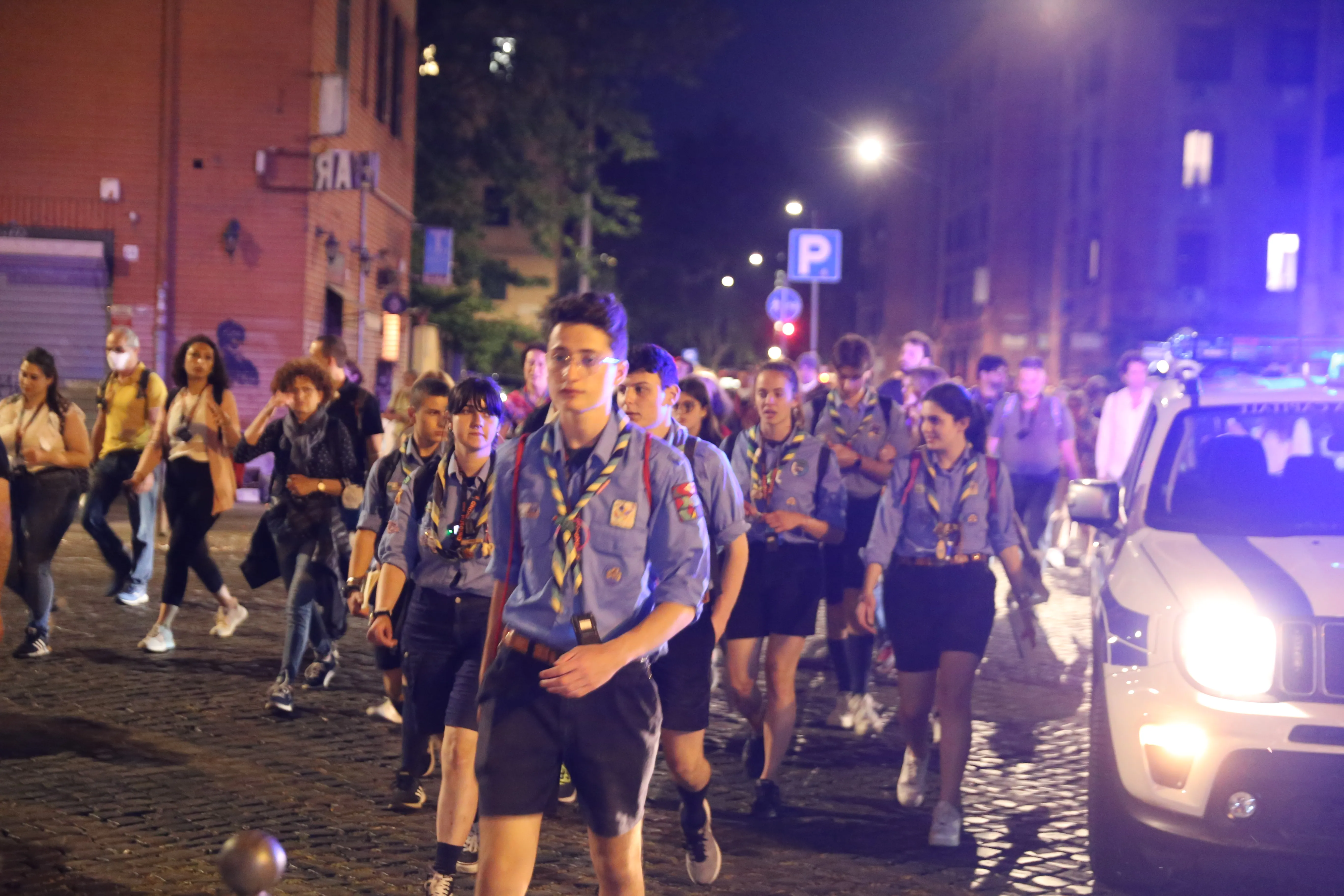
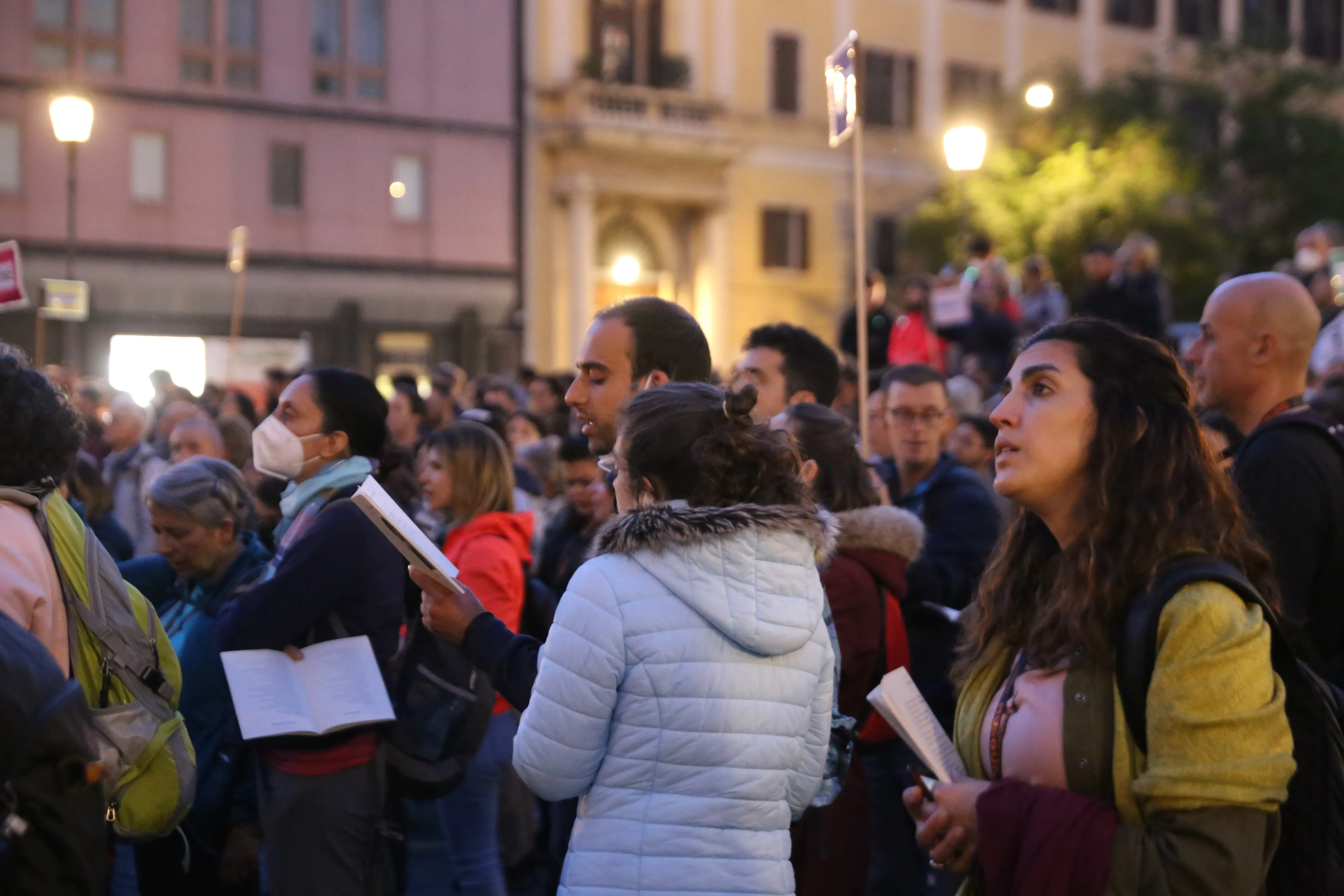
Police officers in cruisers drove ahead of the urban pilgrimage to block traffic as a sea of Catholics from around Italy crossed busy intersections and passed Friday night diners while praying the rosary in unison and singing the Taizé chant “Laudate Dominum,” whose words say in Latin, “Praise the Lord, all people, Alleluia.”
Pilgrims, including scouts, walk through Rome’s Ostiense neighborhood. Hannah Brockhaus/CNA
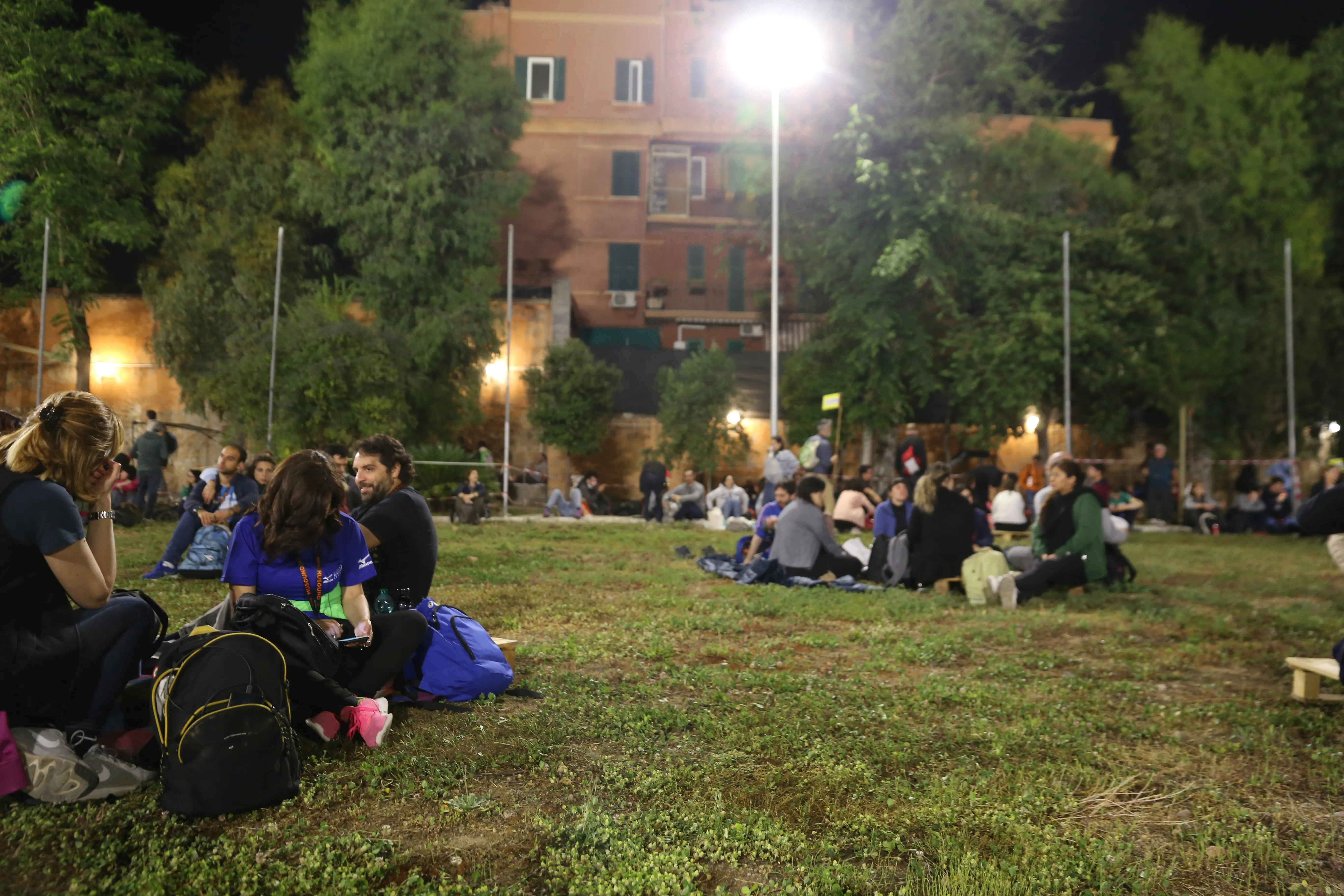
The rosary was prayed four times during the pilgrimage, which took almost 10 hours to complete, including stops for a sack dinner at midnight and short lessons on the virtues led by priests of the Oratory.
Pilgrims, including scouts, walk through Rome’s Ostiense neighborhood. Hannah Brockhaus
The seven basilicas were chosen by the saint for their importance to Christianity, and the walk on May 13-14 followed the path laid out in a 16th-century document almost certainly seen and used by St. Philip — and likely even written by him.
This document, recreated and printed into a booklet for use on the annual pilgrimage today, gives St. Philip’s guidance for those making the Seven Churches visit.
Eating a sack dinner in the courtyard of a church. Hannah Brockhaus/CNA
“Before setting out to make this holy Pilgrimage, each of the Brethren must lift up his mind to God, offering him the sincerity of his heart, with the purpose of desiring the sole glory of his divine Majesty in all actions, and especially in this one,” it says.
Those participating can also earn an indulgence under the usual conditions, and are asked to pray for specific intentions. These include praying for the penance of sins, the amendment of lukewarmness and negligence in the service of God, in thanksgiving for the forgiveness of sins, for the pope and the Church, for sinners still in the darkness of an evil life, for the conversion of heretics, schismatics, and infidels, and for the holy souls in purgatory.
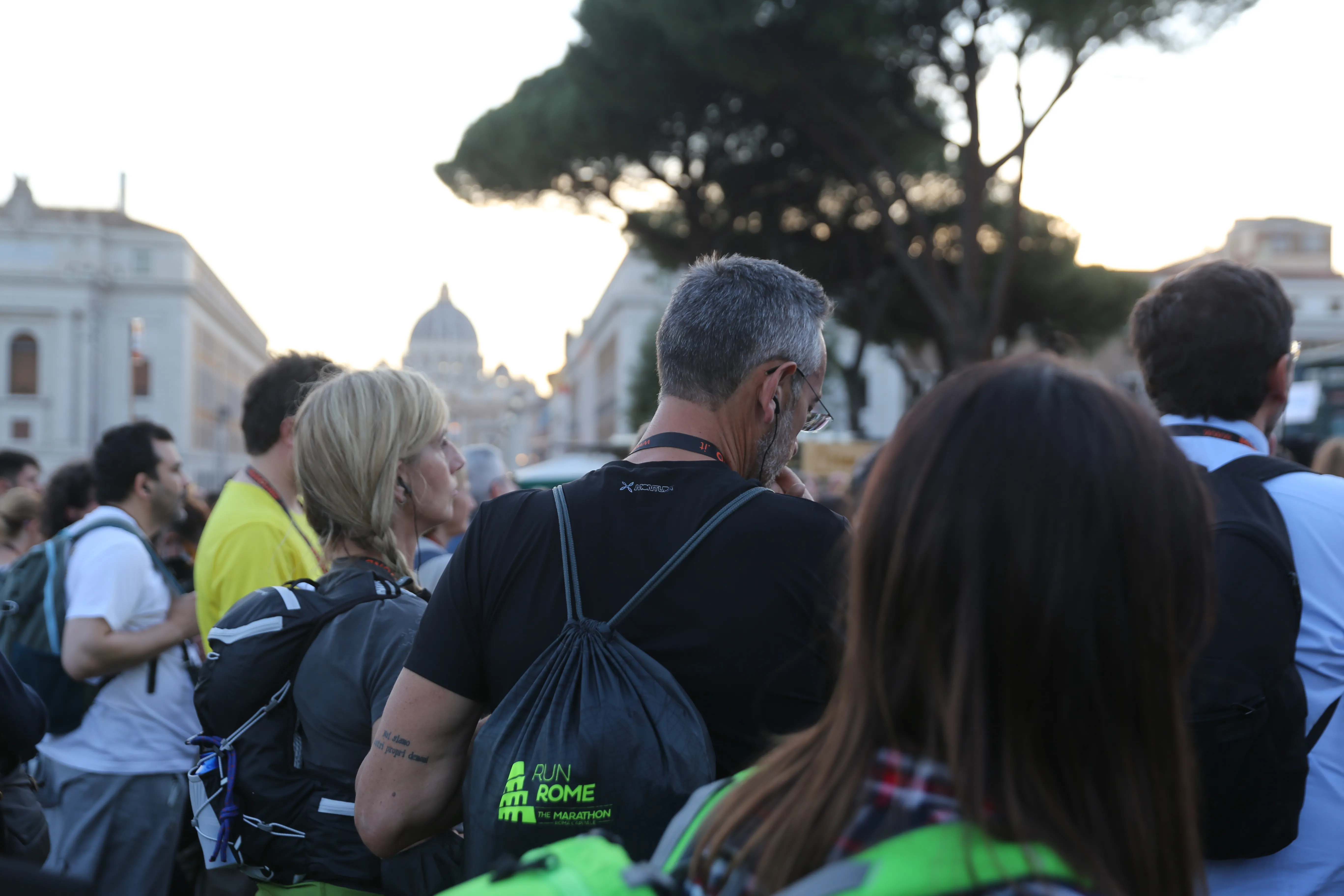
Pilgrims stop to pray on the way to St. Peter’s Basilica. Hannah Brockhaus/CNA
The pilgrimage began at Chiesa Nuova, the church built by St. Philip for the Oratory, and proceeded to St. Peter’s Basilica, reaching the site of St. Peter’s martyrdom at sunset.
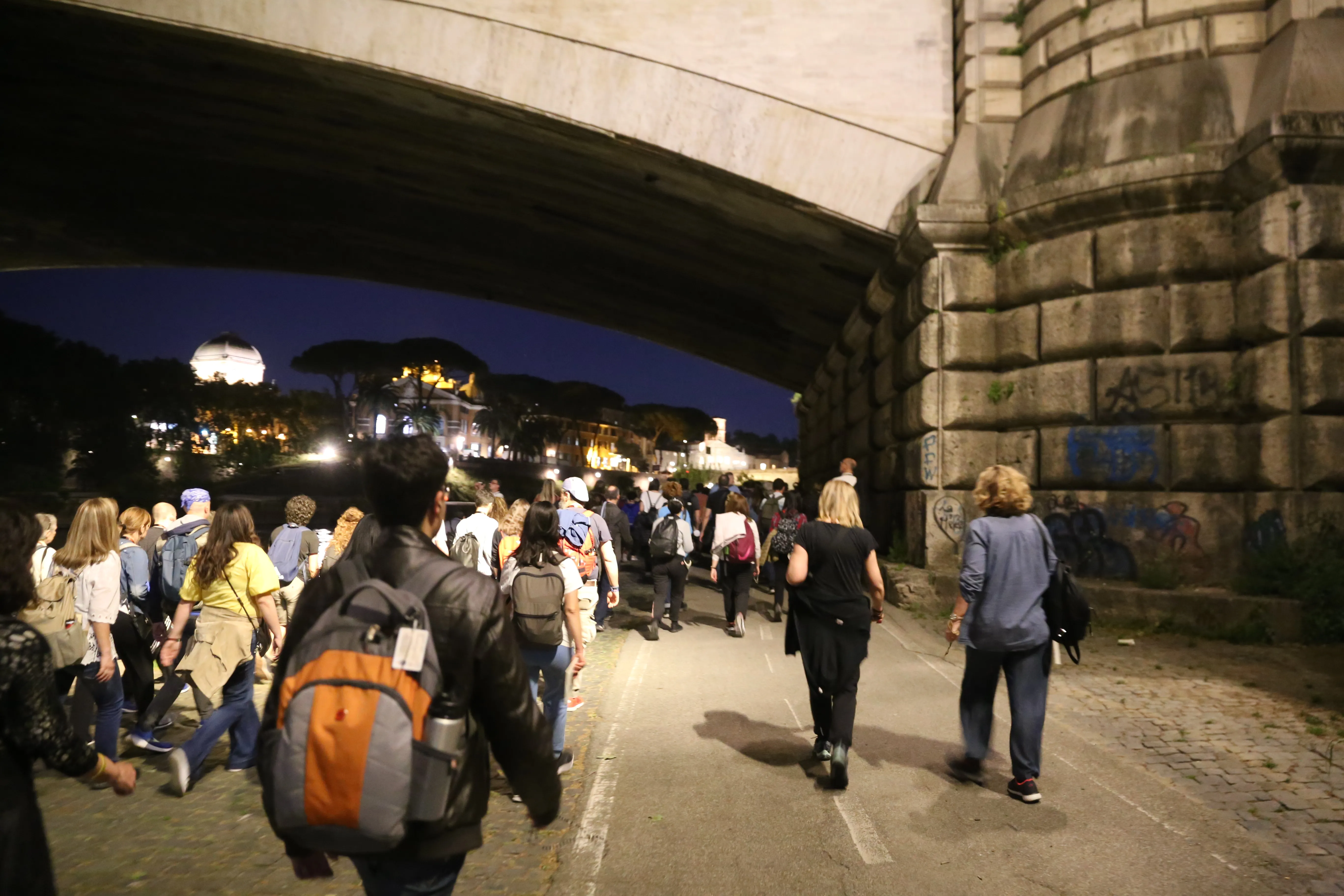
Pilgrims walk on a path next to the Tiber River. Hannah Brockhaus/CNA
Each of the seven churches is associated with a moment of Christ’s Passion and Crucifixion. At each stop, an Oratory priest preached on a virtue and its opposing vice, before everyone joined in a prayer for an increase in that virtue and for the gifts of the Holy Spirit.
The virtues and vices were abstinence against gluttony, patience against ire, chastity against lust, generosity against avarice, fervor of spirit against acedia, charity against envy, and humility against pride.
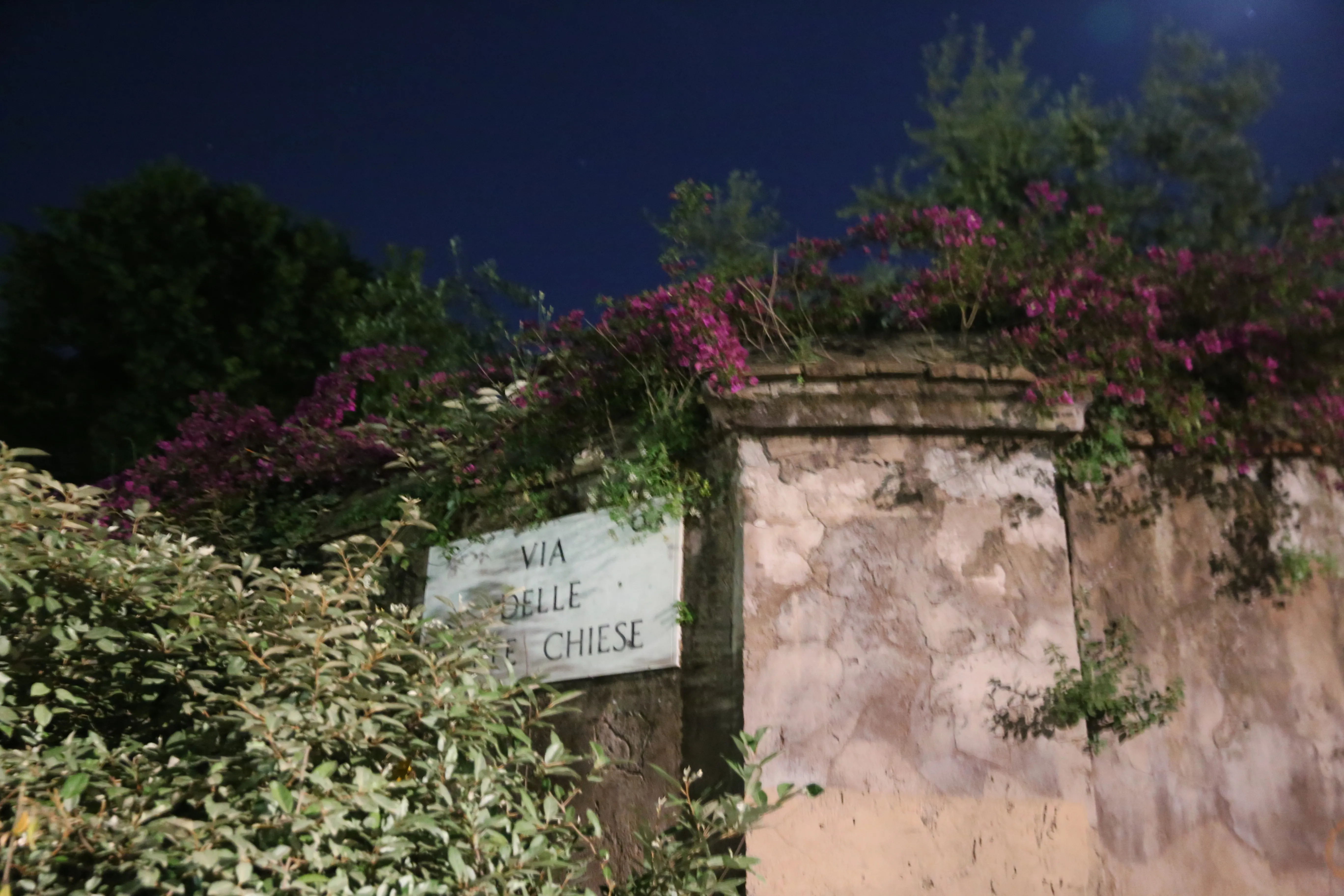
A street sign marking Seven Churches Way. Hannah Brockhaus/CNA
After the Basilica of St. Paul, the pilgrimage followed an ancient street still called Seven Churches Way to arrive at the catacombs and the Basilica of St. Sebastian, a third-century Christian martyr.
As a layman in Rome, St. Philip Neri used to visit the catacombs of St. Sebastian to pray. One night in the catacombs, about 10 years after moving to Rome, as he prayed, a mystical ball of fire entered his mouth and went down into his chest, exploding his ribs and doubling the size of his heart with love of God.
St. Philip was changed, both physically and spiritually, by this event, which he only revealed shortly before his death.
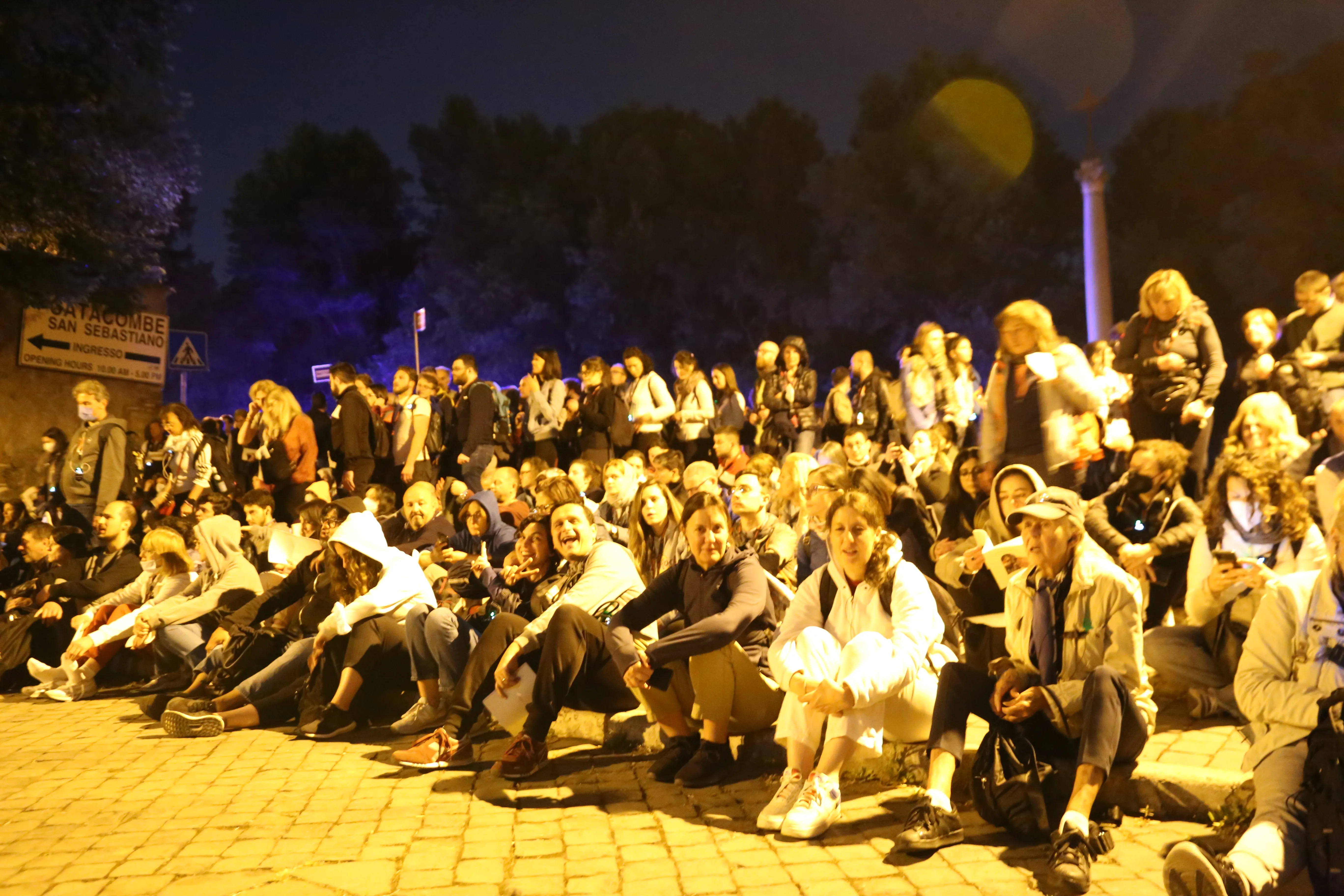
Pilgrims outside the catacombs of St. Sebastian. Hannah Brockhaus/CNA
Pilgrims next arrived at the Domine Quo Vadis Church after a silent, moonlit walk through the ancient Appian Way Park, flanked by the silhouettes of Italian cypress trees.
The small church of medieval origin marks the spot where, according to tradition, Jesus appeared to St. Peter as he was fleeing Rome to avoid martyrdom.
Peter asked Jesus, “Domine quo vadis?” (“Lord, where are you going?”), to which Christ said, “Venio Romam iterum crucifigi,” (“I am coming to Rome to be crucified again.”) This rebuke caused Peter to turn around and face his own martyrdom.
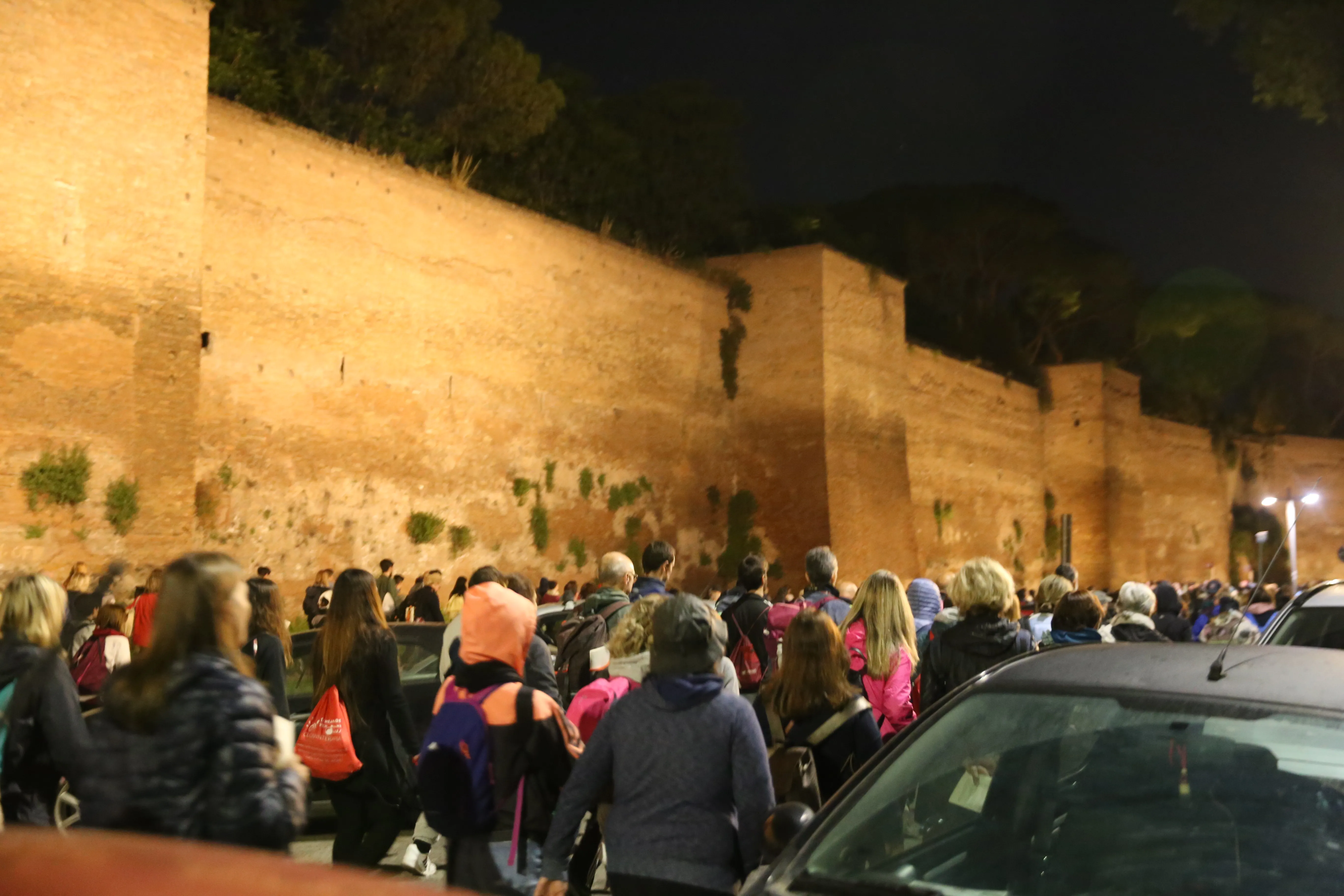
Pilgrims walk along the ancient Aurelian Wall on their way to the Basilica of St. John Lateran. Hannah Brockhaus/CNA
The Basilica of St. Lawrence Outside the Walls was the penultimate stop. The church, which has the tomb of St. Lawrence, is located next to Rome’s Verano Monumental Cemetery, and was included among the Seven Churches by St. Philip Neri, Father Botta said, as a reminder of mortality.
Almost 2 weeks ago I went on St. Philip Neri’s 7 Churches Walk in Rome.
800 people walked over 15 miles during the 10-hour night pilgrimage.
During the last stretch, at 5:15am, we passed through Termini train station, and Francesco caught this video of the moment. pic.twitter.com/C2SPHn5yoR
— Hannah Brockhaus (@HannahBrockhaus) May 26, 2022
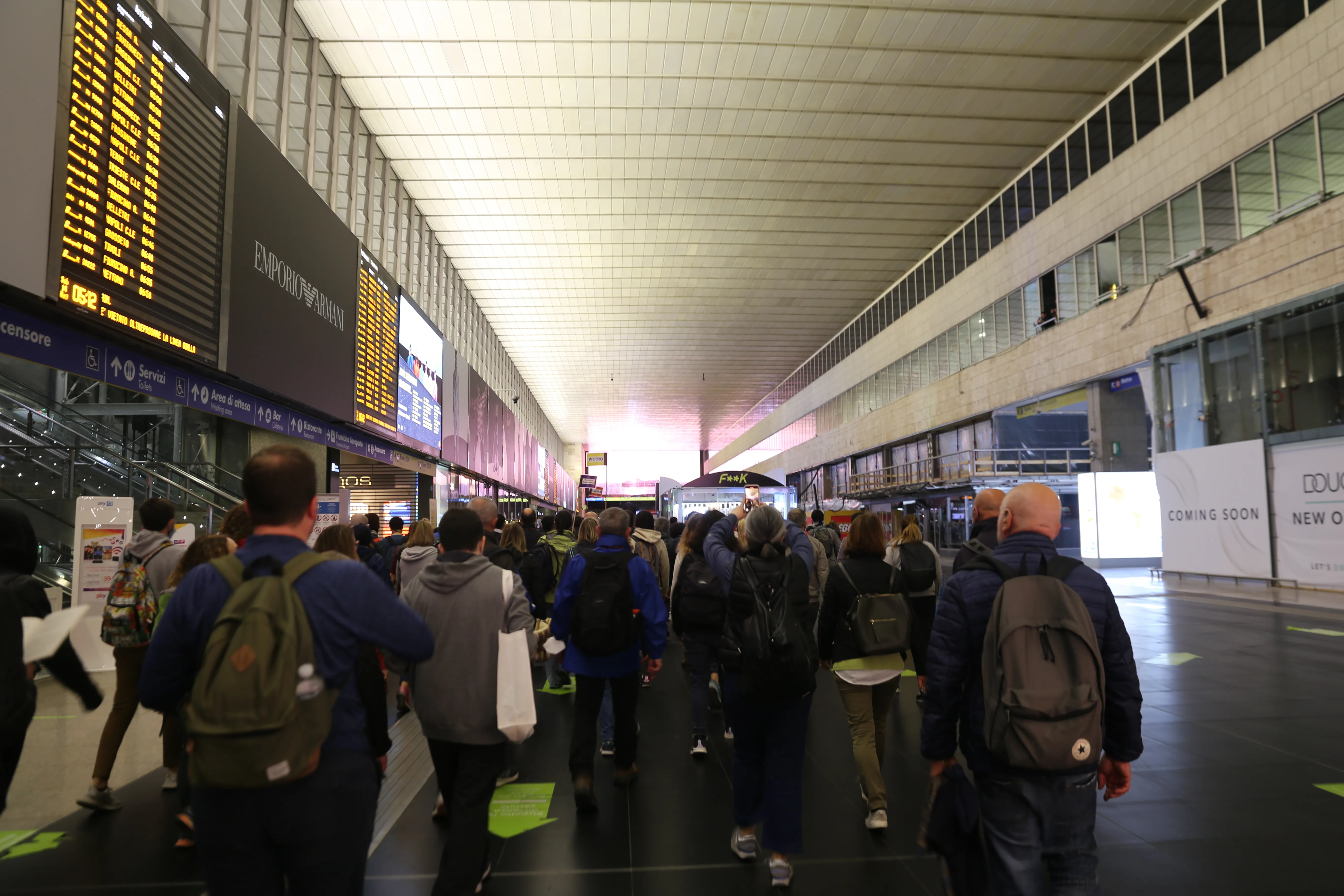
The final stretch of the walk passed through Rome’s main train station, Termini, where pilgrims sang the Marian antiphon “Salve Regina.”
Pilgrims walk through Termini train station singing the “Salve Regina”. Hannah Brockhaus/CNA
The pilgrimage finished shortly before 6:00 a.m. at the Basilica of St. Mary Major, the traditional end of the walk, where the “Salve Regina” hymn was sung again in honor of the Virgin Mary.
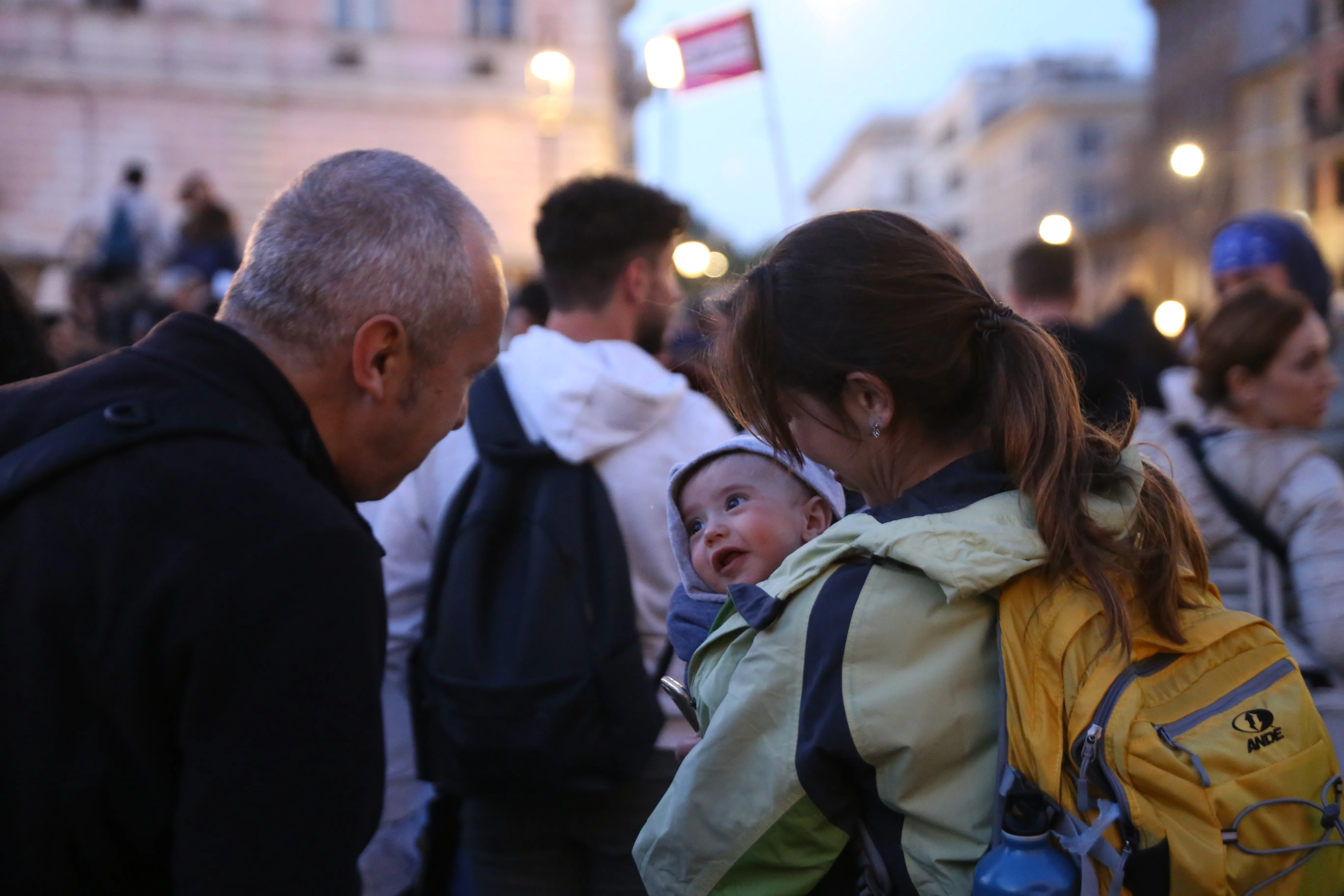
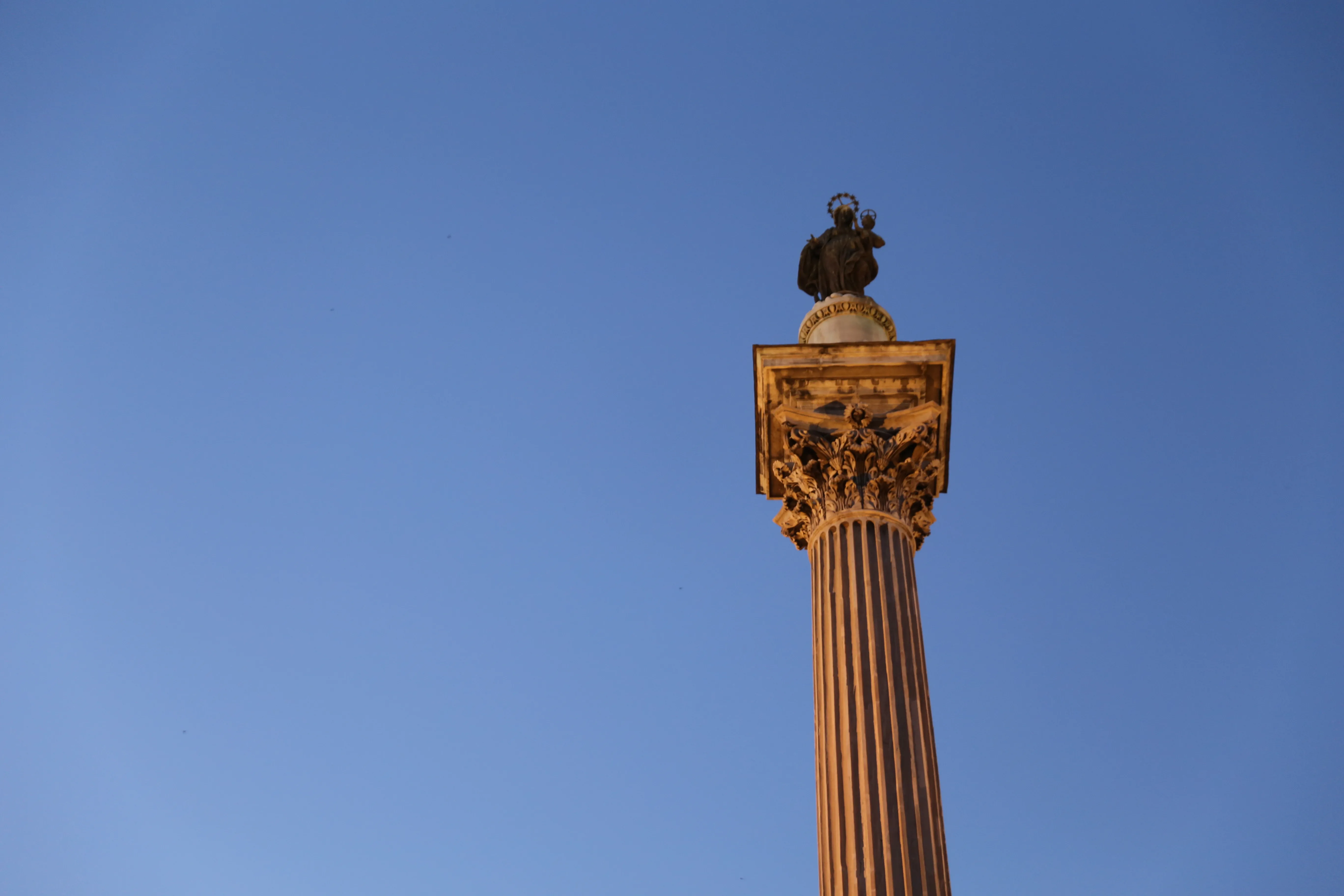
Pilgrims sing the “Salve Regina” outside the Basilica of St. Mary Major. Hannah Brockhaus/CNAA baby and his mom enjoy a moment with a new friend at the end of the pilgrimage. Hannah Brockhaus/CNAA statue of Mary on a column outside the Basilica of St. Mary Major. Hannah Brockhaus
Washington, D.C., Nov 12, 2025 / 13:15 pm (CNA).
The United States Conference of Catholic Bishops (USCCB) approved a new translation of the Bible, which will be used for personal Bibles, the lectionary at… […]
German Cardinal Gerhard Müller visited the home and family of Mark Houck, a pro-life father of seven who was arrested on Sept. 13 by several FBI agents in the early hours of the morning. / iFamNews via YouTube
DeSantis is young, 40’s I think, and you wonder if he is actually running for 2028? Trump owns the Republican Party and has turned it into a personality cult. DeSantis had little chance in this election cycle.




DeSantis is young, 40’s I think, and you wonder if he is actually running for 2028? Trump owns the Republican Party and has turned it into a personality cult. DeSantis had little chance in this election cycle.