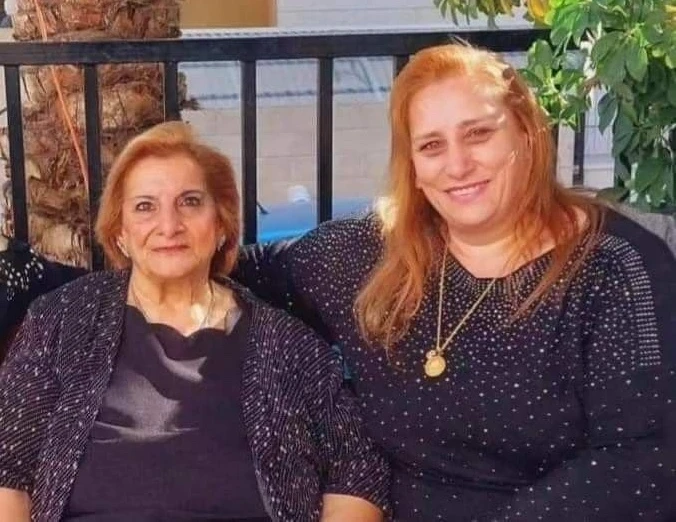
Nahida Anton and her daughter Samar Anton were killed as they were walked to the Missionaries of Charity convent in the compound of Holy Family Parish in Gaza on Dec. 16, 2023. / Credit: Father Gabriel Romanelli/Facebook
CNA Staff, Jan 2, 2024 / 18:36 pm (CNA).
Twenty Catholic missionaries were murdered in 2023, according to a new Dec. 30 report issued by the Vatican’s Fides News Agency.
Fides, the news agency of the Pontifical Mission Societies, arrived at that number by calculating “all baptized engaged in the life of the Church who died in a violent way, not only ‘in hatred of the faith.’”
The agency said that most of the missionaries shared the traits of living a “normal life” and did “not carry out any sensational actions or out-of-the ordinary deeds that could have attracted attention and put them in someone’s crosshairs.”
“They found themselves, through no fault of their own, victims of kidnappings, acts of terrorism, involved in shootings or violence of various kinds,” the report said.
The news agency reported that one bishop, eight priests, two non-religious men, one seminarian, one novice, and seven laypersons made up the missionaries murdered in the last year.
The number of murders represents an increase over 2022, when 18 missionaries were killed.
Africa
Nine missionaries were killed in Africa, the continent that saw the most such murders in 2023. Of the nine, five were priests, two were religious men, one was a seminarian, one was a novice.
Of these, four were killed in Nigeria. In recent months, a monk, Brother Godwin Eze, was kidnapped and brutally murdered at the Benedictine monastery in Eruku, Nigeria.
In Burkina Faso, two men, a priest and religious brother, were killed. In the western African country of Tanzania, one priest, Father Pamphili Nada, died after his parish was attacked.
In Cameroon, Brother Cyprian Ngeh was stabbed to death, and in the Democratic Republic of Congo, a priest, Father Léopold Feyen, was also stabbed to death.
Mexico and U.S.
Six missionaries were killed in the Americas in 2023, with all of the murders occurring in either Mexico or the United States. The deaths included one bishop, three priests, and two laywomen. Two catechists were killed on their way to a Eucharistic procession in the Mexican state of Oaxaca.
In the United States, Bishop O’Connell was killed in his home. Charges were filed against his housekeeper’s husband. Father Gutgsell was stabbed in his Church rectory; an arrest has been made and charges filed in that case as well.
Asia
Four laypeople were killed in Asia in the past year.
Two of those murders happened in the Philippines. Two Catholic college students, Junrey Barbante and Janine Arenas, were killed when a bomb went off during a Eucharistic celebration at the State University of Mindanao.
The other two murders occurred in Gaza during the Israel-Hamas war. Two women, Samar Kamal Anton, along with her mother, Nahida Khalil Anton, were killed by sniper fire while on their way to the convent of the Sisters of Mother Teresa.
Europe
One missionary was killed in Europe, a Spanish layperson.
Diego Valencia was the sacristan of Nuestra Senora de La Palma Parish in Algeciras when he was killed by a Moroccan man wielding a machete.
If you value the news and views Catholic World Report provides, please consider donating to support our efforts. Your contribution will help us continue to make CWR available to all readers worldwide for free, without a subscription. Thank you for your generosity!
Click here for more information on donating to CWR. Click here to sign up for our newsletter.
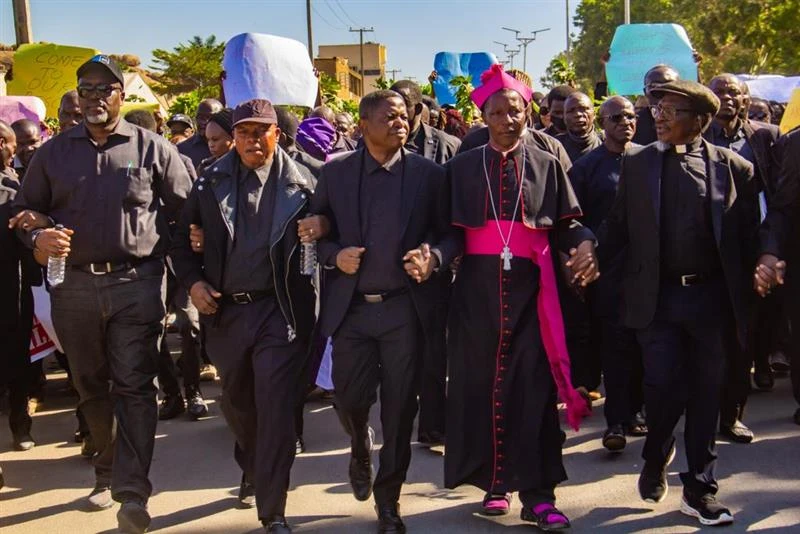
Catholic Archbishop Matthew Ishaya Audu of Jos marches alongside evangelical leader Rev. Dr. Gideon Para-Mallam in front of the Plateau state governor’s office building in Jos, Nigeria, Jan. 8, 2024. / Credit: Photo courtesy of Rev. Dr. Gideon Para-Mallam, photo by Plateau State Government Media Team.
Washington, D.C. Newsroom, Jan 9, 2024 / 15:30 pm (CNA).
Thousands of Christians rallied yesterday in front of the governor’s office in Nigeria’s Plateau state to demand action after more than 200 were killed in a series of Christmas massacres.
The attacks, which targeted Christian villages beginning Dec. 23 and continuing through Christmas day, left Christian communities in Nigeria’s Plateau state reeling. Photos obtained by CNA after the attack showed villagers burying their slain relatives and loved ones in mass graves.
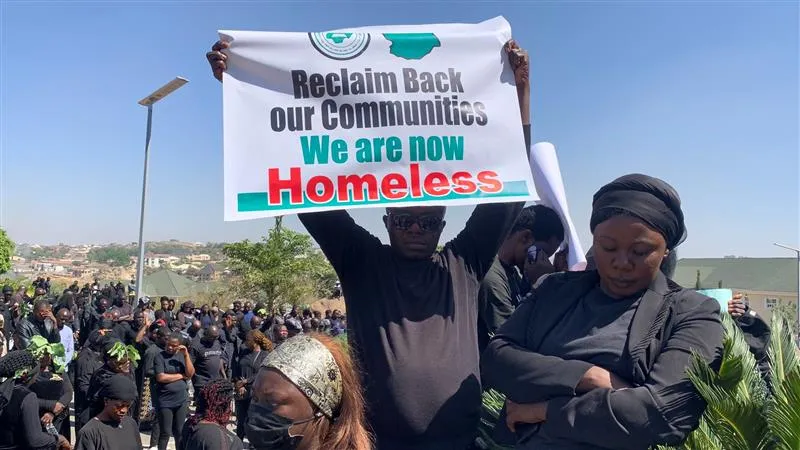
According to Rev. Dr. Gideon Para-Mallam, an evangelical leader who helped to organize the rally, the attacks also left 15,000 people displaced without homes.
Among the demands being made by the protestors, Para-Mallam said that they asked for an “urgent humanitarian relief material response by the state and federal government” and for the arrest of the perpetrators of the Christmas massacre, which he called a “genocidal,” “terrorist” attack.
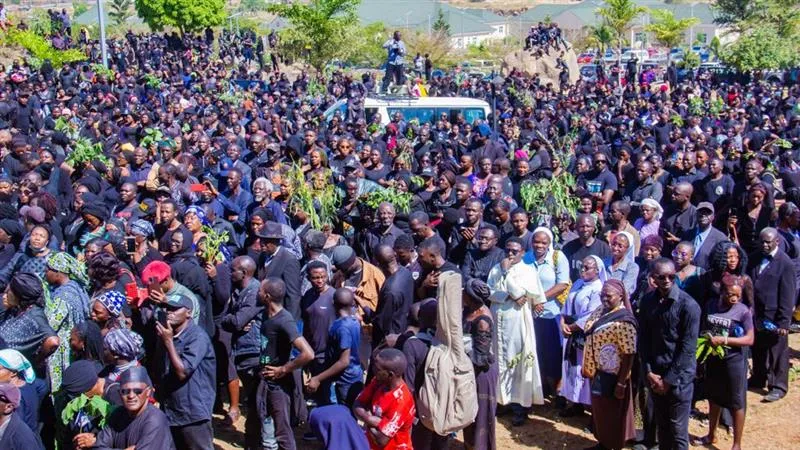
Thousands of Christians peacefully and prayerfully march to a rally in front of the Nigerian Plateau state governor’s office building in protest of the 2023 Christmas massacre that left over 200 Christian Nigerians dead, Jan. 8, 2024. Credit: Photo courtesy of Rev. Dr. Gideon Para-Mallam, photo by Plateau State Government Media Team.
The attack marks the latest instance of terrorists targeting Christian Nigerians on significant Christian feast days. In 2022, on Pentecost Sunday, 39 Catholic worshippers were killed at the St. Francis Xavier Owo Catholic Parish in Ondo Diocese.
Religious freedom advocates believe that militant Muslim Fulani herdsmen were responsible for the Christmas attacks. In Nigeria as a whole, at least 60,000 Christians have been killed in the past two decades. An estimated 3,462 Christians were killed in Nigeria in the first 200 days of 2021, or 17 per day, according to a new study.
Due to continued attacks, Nigeria is one of the most dangerous countries in the world to be a Christian, according to a 2023 report by the advocacy group International Christian Concern.
Para-Mallam told CNA that Nigeria’s middle belt region, of which Plateau state is a part, has “suffered sustained attacks for over a decade now with destruction of lives and properties.”
The thousands of protestors at the rally, he said, were “mournful, angry, but surprisingly joyful.”
Their “central objective,” he explained, was “to ask for an end to the killings not just in Plateau but Nigeria and seek justice for the people.”
Just-In: CAN Plateau State Chapter is having a Peaceful Walk to Government House pic.twitter.com/YbFRqtFI9J
“Above all, it was very peaceful and prayerful,” he added. “The old, the young all together felt that we had to do what we had to do to get our message across.”
According to Para-Mallam, the crowd numbered about 5,000 and included both Catholics and Protestants. Together, he said, they peacefully and prayerfully marched, ending in front of the governor’s office building in the city of Jos. Archbishop Matthew Ishaya Audu of Jos and several Catholic priests also took part in the march and rally, according to Para-Mallam.
The demonstration was “mournful, angry, and surprisingly joyful,” according to Rev. Dr. Gideon Para-Mallam. Credit: Photos by Nigerian multimedia journalist Jœy Shèkwônúzhïbó, used with permission.
The rally was organized with the help of the Christian Association of Nigeria (CAN), a coalition of Nigerian Christian Churches and groups that includes the Catholic Church in Nigeria.
Para-Mallam said the purpose of the demonstration was to “mourn in solidarity” with the devastated communities as well as to show them that the Church “cares” and “identify with them in the moment of suffering and mourning.”
A secondary purpose for the rally, Para-Mallam said, was to “get the Church on the Plateau to unite and to speak with one voice around the issues of social justice” and to “create awareness nationally and globally about the Christmas season attack.”
Para-Mallam said that Plateau’s governor, Caleb Mutfwang, addressed the crowds at the rally and was “sympathetic and understanding and spoke well on the pains of his people.”
Mutfwang condemned the attacks shortly after they occurred in a Dec. 26 statement in which he said: “This has indeed been a gory Christmas for us.”
“He promised to relay our concerns to the president and committed to work with the president to end the killings in the Plateau state,” Para-Mallam said.
Despite the governor and president voicing their support for the impacted communities, several religious freedom advocates have been critical of the lack of government response to the growing terrorist attacks.
Maria Lozano, a representative for the papal relief group Aid to the Church in Need, told CNA after the attacks that tangible government support was largely absent after the Christmas massacre and that a “lack of response from the government” over the years has worsened the situation in the region. The absence of government support, Lozano said, has forced Christian churches to take on the “primary responsibility of providing assistance.”
Para-Mallam asked for Christians outside of Nigeria to help by offering prayer, advocacy, and humanitarian intervention.
“We also want fellow believers to encourage policymakers to encourage the Nigerian government to do more to end the killings in general and particularly those targeted at Christians,” he said.
For several years now, religious freedom advocates have criticized the U.S. government for failing to include Nigeria in the State Department’s “Countries of Particular Concern” list, which some consider to be America’s most effective tool to encourage foreign governments to address the persecutions in their countries.
“There is no justification as to why the State Department did not designate Nigeria or India as a Country of Particular Concern,” said U.S. Commission on International Religious Freedom chair Abraham Cooper and vice chair Frederick Davie in a Jan. 4 statement.
Cooper and Davie mentioned the Christmas massacre as “just the latest example of deadly violence against religious communities in Nigeria.”
Speaking on “EWTN News Nightly” on Monday, Davie said that the decision to leave Nigeria off the list was “particularly” concerning and a “huge mistake.”
Davie told EWTN that “there are some who are saying that the government [of Nigeria] if it is not actively participating in some of this religious persecution is actually standing by and not doing what it can to prevent it.”
“We just believe,” Davie explained, “that by designating Nigeria a Country of Particular Concern, the United States puts itself in a position to work more closely with the government of Nigeria to address some of those fundamental security issues that are going unattended to.”
Despite this, the State Department has left Nigeria off the Countries of Particular Concern list since 2021.
The Sistine Hall of the Vatican Library. the library of the Holy See, currently located in Vatican City, is one of the oldest libraries in the world. / Credit: Checco2/Shutterstock
Vatican City, May 30, 2025 / 07:00 am (CNA).
More than 80,000 a… […]
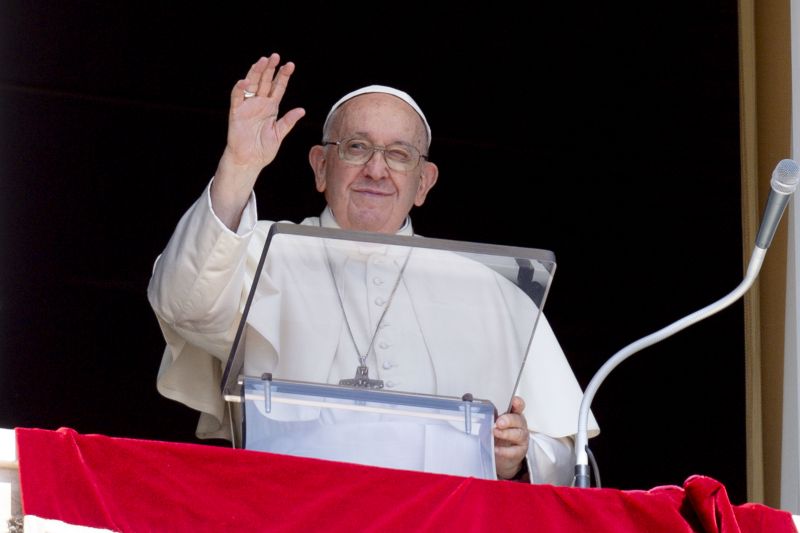
Pope Francis waves to pilgrims gathered in St. Peter’s Square for his Angelus reflection on Sept. 10, 2023. / Credit: Vatican Media
Rome Newsroom, Sep 10, 2023 / 07:05 am (CNA).
To dialogue with someone who has wronged us is a process that requires “real courage,” Pope Francis said Sunday, reflecting on the theme of “fraternal correction.”
In Sunday’s Gospel reading (Matthew 18:15-20) Jesus says: “If your brother sins against you, go and tell him his fault between you and him alone. If he listens to you, you have won over your brother.”
Fraternal correction is “one of the highest expressions of love, and also the most demanding, because it is not easy to correct others,” the Holy Father observed, speaking on Sept. 10 from a window at the Apostolic Palace to pilgrims gathered in St. Peter’s Square. “When a brother in the faith commits a fault against you, you, without rancor, help him, correct him: Help by correcting.”
The pope went on to condemn gossip, or “chattering,” which is “not right” and is “not pleasing to God.” He called gossip “a plague on the lives of people and communities because it brings division, it brings suffering, it brings scandal, and it never helps to improve, it never helps to grow.”
Fraternal correction, on the other hand, is a process that allows us to help the other person “understand where he is wrong. And do this for his good, overcoming shame and finding true courage, which is not to speak badly, but to say things to his face with meekness and kindness,” Pope Francis said. But he warned that “pointing the finger” at the other’s fault “is not good, in fact, it often makes it more difficult for those who made a mistake to recognize their mistake.”
“But we might ask, what if this is not enough? What if he does not understand?” the pope asked.
“Then we must look for help. Beware, though: not from the group that gossips! Jesus says: ‘Take one or two others along with you,’ meaning people who genuinely want to lend a hand to this misguided brother,” Francis urged.
“And if he still does not understand? Then, Jesus says, involve the community. But here, too, this does not mean to pillory a person, putting him to shame publicly, but rather to unite the efforts of everyone to help him change,” the pope said.
“And so, let us ask ourselves: How should I behave with a person who wrongs me? Do I keep it inside and accumulate resentment?” Pope Francis asked. “Do I talk about it behind their backs? ‘Do you know what he did?’ and so on. Or am I brave, courageous, and do I try to talk about it to him or her? Do I pray for him or her, ask for help to do good? And do our communities take care of those who fall so that they can get back up and start a new life? Do they point their fingers or open their arms?”
The pope asked again: “What do you do: Do you point the finger or open your arms?”
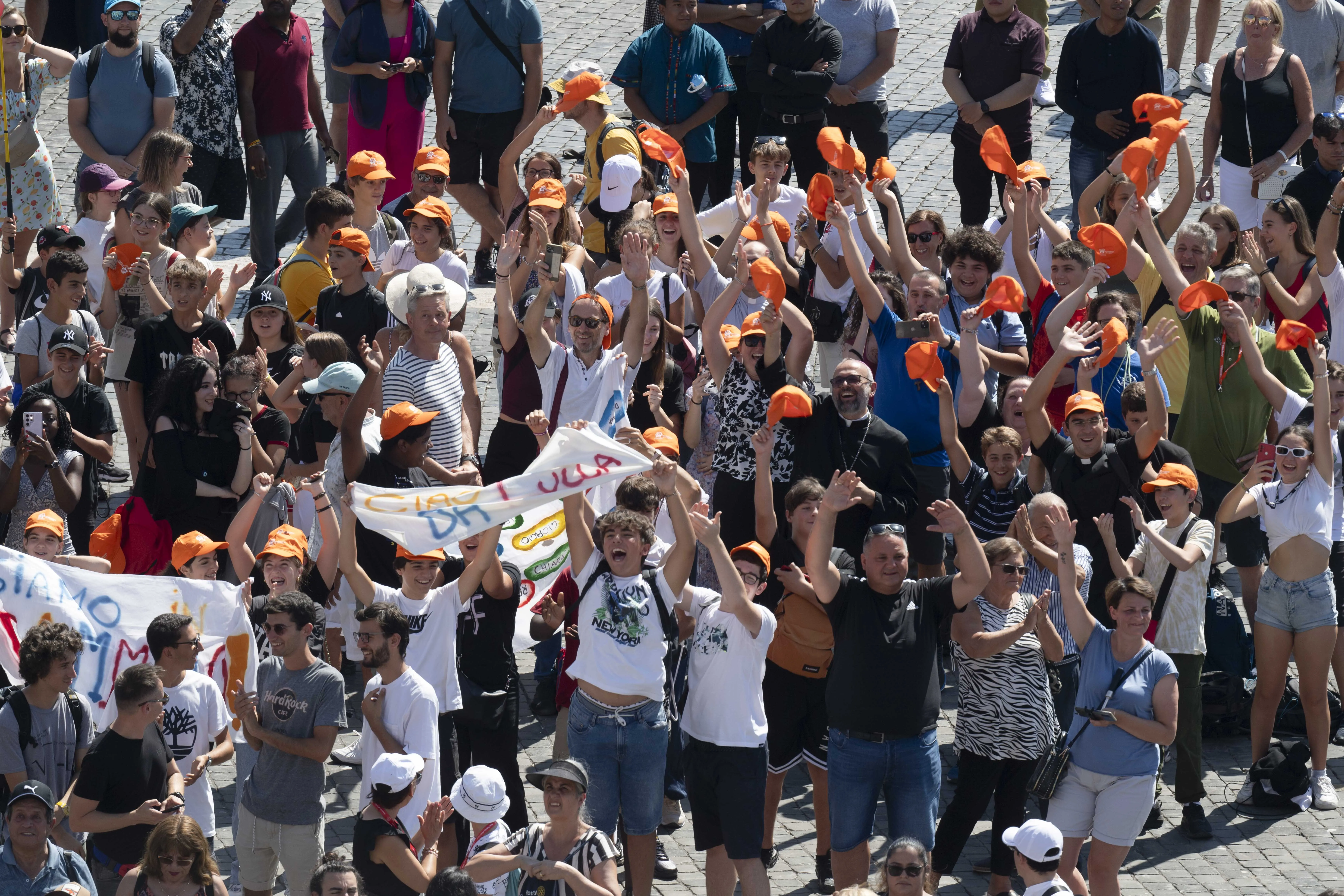
Pilgrims gathered in St. Peter’s Square for the pope’s weekly Angelus reflection on Sept. 10, 2023. Credit: Vatican Media
Following his reflection, the Holy Father expressed his “closeness to the dear people of Morocco” in the aftermath of a devastating 6.8 magnitude earthquake on the evening of Sept. 8 that has left more than 2,000 people dead and more than 2,000 injured as of Sept. 10.
Pope Francis also spoke briefly about the beatification of the Ulma family in Markowa, Poland. The Nazis brutally executed the devoutly Catholic family of Józef and Wiktoria Ulma and their seven children in 1944 for hiding eight Jews in their home outside the village of Markowa in southeast Poland. This is the first time an entire family has been beatified together.
The pope highlighted the family’s courage and evangelical love, for they “represent a ray of light in the darkness of the Second World War, be a model for all of us to imitate in our desire for good and in the service of those in need.“
Pope Francis used the example of the Ulma family to call for acts of charity to counter violence, as well as prayer; especially “for many countries that suffer from war; in a special way,” he said, “let us intensify our prayers for the tormented Ukraine.”





Leave a Reply