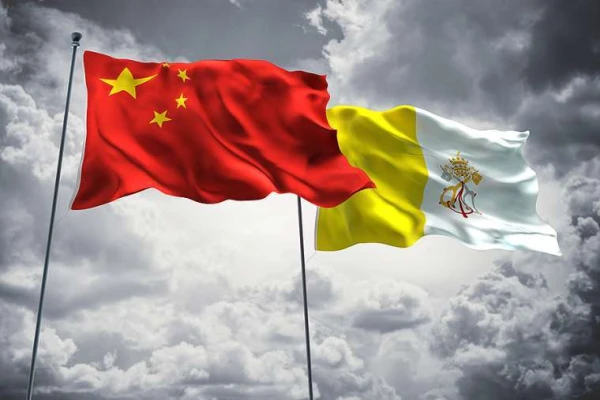
Rome Newsroom, Oct 22, 2020 / 12:00 pm (CNA).- As the Sino-Vatican provisional agreement was renewed Thursday, an article in a Vatican newspaper said that two Chinese bishops had been appointed under the “regulatory framework established by the agreement.”
Vatican officials have repeatedly stressed that the accord between China and the Holy See — which will not expire until Oct. 22, 2022 — is focused solely on the appointment of bishops.
While the terms of the agreement have been kept confidential, it reportedly allows the Chinese Catholic Patriotic Association to choose a slate of nominees for bishop.
An article published by L’Osservatore Romano Oct. 22 said: “The main purpose of the provisional agreement on the appointment of bishops in China is to support and promote the proclamation of the Gospel in those lands, restoring the full and visible unity of the Church … The question of the appointment of bishops is of vital importance for the life of the Church, both locally and universally.”
With this in mind, what do we know about the bishops who have been affected by the Sino-Vatican agreement? Those who were newly appointed under the confidential provisions of the deal, those whose excommunications were lifted after the deal, and the bishops who stepped back from their former leadership roles.
Who was appointed?
Bishop Antonio Yao Shun of Jining, in the Autonomous Region of Inner Mongolia, was the first bishop consecrated in China under the terms of the Sino-Vatican agreement, on Aug. 26, 2019.
Prior to his appointment, Yao had served as the secretary and later vice director of the liturgical commission overseen by the Chinese Catholic Patriotic Association and the Council of Chinese Bishops since 1998. He returned to the Diocese of Jining in 2010 to serve as victor general.
Born in Ulanqab in 1965, Yao is a native of Inner Mongolia. He both studied and taught at the national seminary in Beijing. After his ordination to the priesthood in 1991, Yao completed a degree in liturgy in the United States at St. John’s University in Minnesota from 1994 to 1998. He also spent some time pursuing biblical studies in Jerusalem.
Yao’s episcopal motto is “Misericordes sicut pater,” which means “Be merciful as the Father is.”
The New York Times has reported that the Vatican had approved Yao as the successor of Bishop John Liu Shigong in the Diocese of Jining in 2010, but the Chinese government refused to approve him, even after Bishop Liu died in 2017 at the age of 89.
But Chinese researchers have pointed out that Yao is not one to speak out critically about the Chinese government.
“The Communist Party feels comfortable with him,” said Francesco Sisci, a Beijing-based researcher on Chinese Catholicism told the Times in 2019. “They don’t want someone doing agitprop against them.”
Bishop Stephen Xu Hongwei of Hanzhong, in Shaanxi Province, was ordained a coadjutor bishop on August 28, 2019, at the age of 44.
He serves the Diocese of Hanzhong as coadjutor to 91-year-old Bishop Louis Yu Runchen. The diocese was divided between underground and state-approved Catholic communities for many years. Yu Runchen was selected by the Chinese Patriotic Association to be bishop without the approval of the Holy See in 1985, a year after the Vatican’s appointment of Bishop Bartholomew Yu Chengti. The Vatican recognized Yu only after the underground bishop died in 2009.
After his ordination in 2002, Xu studied at the Pontifical Urban University in Rome from 2004 to 2008. He undertook further studies in the Diocese of Vancouver, Canada. Upon returning to China in 2010, he was appointed pastor of West Street Cathedral in the Diocese of Hanzhong.
Xu was a member of a regional Standing Committee of the Chinese People’s Consultative Political Conference — the consultative political body part of the Chinese Communist Party’s United Front — in 2012 and 2017, and the Chinese Patriotic Catholic Association.
Whose excommunications were lifted?
With the signing of the provisional agreement between the Holy See and China in Sept. 2018, Pope Francis also lifted the excommunication of seven bishops who had been appointed illicitly by the state-controlled Chinese Patriotic Association.
They include Bishop Joseph Guo Jincai, 52, of Chengde in Hebei Province. Pope Francis created the Diocese of Chengde in 2019 out of the Dioceses of Jinzhou and Chifeng in 2018, so that Guo could lead his own diocese after his excommunication was lifted.
Guo participated in the Synod of Bishops in Rome in 2018 and has served three terms as a deputy to the National People’s Congress in Beijing.
As a member of China’s legislative body, Bishop Guo publicly supported an amendment to eliminate presidential term limits and enshrine “Xi Jinping Thought on Socialism with Chinese Characteristics for a New Era” in the Chinese constitution in March 2018.
“My position as a national legislator will not and cannot affect my religious service, as China implements the principle of separation of church and state,” Guo told the state-sponsored newspaper Global Times at the National People’s Congress in 2018.
Bishop Vincent Zhan Silu, 61, of Mindong/Funing in Fujian Province. After underground Bishop Joseph Guo Xijin stepped aside to allow him to lead the diocese, Zhan led a delegation of 33 priests from the Diocese of Mindong to participate in a “formation course” at the Central Institute of Socialism, in collaboration with the United Front of Fujian Province, where they listened to presentations on the “sinicization of religion.”
“We must contribute to the creation of a new reality in the diocese of Mindong and in the Catholic Church of Fujian,” Zhan said after the course, according to Asia News.
“We will deepen the content of Catholic doctrine in order to foster social harmony, progress and a positive culture. To carry out the sinicization of religion with determination, we will continue to follow a path that conforms to socialist society,” Zhan said in August 2019.
Bishop Paul Lei Shiyin, 56, of Leshan in Chongqing Province. Lei served as an official delegate at the government’s Chinese People’s Political Consultative Conference in 2018. He previously served as a vice president of the Patriotic Association.
After his excommunication was lifted, Lei was a speaker at a 2019 celebration of the Chinese Red Army’s Long March, led by Mao Zedong, in which he spoke of a meeting convened by Mao in a (requisitioned) Catholic priest’s house in Moxi in 1935 as a story of “patriotism of our country’s Catholicism,” according to the Catholic Patriotic Association website.
Bishop Joseph Huang Bingzhang, 53, of Shantou in Guangdong Province. After he was appointed by the government without papal permission in 2011, Huang became vice president of the Chinese Patriotic Catholic Association.
He served as a deputy in the most recent National People’s Congress, as well as the National People’s Congress that took place from 2008 to 2013.
Huang said in 2017 that he would work to actively promote the practice of Catholic patriotism, according to the Chinese Patriotic Association website.
Bishop Joseph Liu Xinhong, 56, of Anqing in Anhui Province. Illicitly ordained in 2006 after the government-controlled Catholic bishops’ conference combined the dioceses of Anqing, Bengbu and Wuhu to form the Anhui diocese — a restructuring that was not recognized by the Holy See, according to UCA News.
Bishop Joseph Ma Yinglin, 55, of Kunming in Yunnan Province. Ma previously served as secretary for the Council of Catholic Bishops at a time when the government-controlled “episcopal conference” was not recognized by the Holy See. In 2010, Ma was appointed president of the Chinese patriotic association’s bishops’ conference.
Bishop Joseph Yue Fusheng, 56, of Harbin in Heilongjiang Province. Yue was illicitly named bishop of Harbin in 2012 by the Chinese Catholic Patriotic Association.
Bishop Anthony Tu Shihua of Hanyang and Puqi in Hubei province. Before his death in 2017 at the age of 98, Tu expressed a desire to be reconciled with the Holy See. One of China’s first illicitly named bishops, Tu was appointed without papal mandate in 1959, and later served as rector of the National Seminary in Beijing between 1983 and 1992, and as a leader of the Patriotic Association and the Council of Chinese Bishops.
Who stepped aside?
Bishop Peter Zhuang Jianjian, 89, of Shantou in Guangdong Province was asked to retire by Archbishop Claudio Maria Celli in 2019 so that Bishop Joseph Huang Bingzhang would be recognized by the Vatican as the Bishop of Shantou.
Bishop Joseph Guo Xijin, 62, of Mindong/Funing in Fujian Province. In October this year, Guo announced that he was retiring to concentrate on prayer because he did not “want to become an obstacle to progress.” Guo was an underground bishop who previously agreed to become an auxiliary bishop so that state-appointed Bishop Zhan Silu would be recognized by the Vatican. “In any circumstance or change, you should never forget God, and neither ignore the Lord’s commandments, nor damage the integrity of faith, nor delay the salvation of the soul, which is the most important thing,” he said in a letter to his diocese Oct. 5.
Who is missing?
Bishop James Su Zhimin, 88, of Baoding in Hebei Province. The whereabouts of Bishop Su, who has spent 24 years in prison, is unknown. He was arrested by Chinese authorities in 1997. He was last seen by family at a hospital in 2003 while he was in government custody.
According to Bishop Su’s nephew, Chinese officials have reportedly asked the Vatican to appoint a new bishop of Baoding, UCA News reported on July 22. Their preferred candidate is said to be Coadjutor Bishop Francis An Shuxi, a member of the Chinese Catholic Patriotic Association, the state-sanctioned church.

[…]








With respect to migrants, given that the majority are Muslim, why don’t they go to those countries where their faith members live in great wealth : Saudi Arabia, UAE?
I assume this is a rhetorical question?
They don’t go because their Muslim “faith members” don’t want them and because Saudi Arabia and UAE are sand kingdoms run by psychopathic thugs.
Impressionistic wisdom of the moment, regardless if it contradicts what he said last week or yesterday or one hour ago. Never any coherent thought or understanding of anything about civilizational and economic interdependence or how improved efficiencies are dependent on economic productivity and independence from central planning. The only thing he needs to care about, his narcissism will not allow him to care about, a morally guided soul that only the Catholic truth he ridicules can provide.
But never a mention of Humanae Vitae.
Then maybe Pope Francis shouldn’t make off the cuff comments about how we’re not meant to breed like rabbits. What’s next? Pope Francis expresses concern for priestly vocations among the young? This guy went from the Vicar of Christ to quasi leader of an NGO to the head of the the mean girls cliche in high school after his treatment of Bishops Strickland and Burke. How much longer will God chastise us for Benedict’s weakness?
As much of the industrialized world is at zero population growth. Not good. I’ve got my video games and a couple pets good enough?
Elon Musk recently was analyzed on this site; I believe he recently said to the effect that the USA will end up being a nation of old folks in diapers
Perhaps refraining from giving the Eucharist to abortion-promoting world leaders would go a long way toward giving us some confidence in his statement about concern for the lack of population growth.
First of all, it is absolutely nobody’s place to make demands of how unrelated people spend their time and money. If they don’t want to have children that is THEIR business. Not YOURS.
Don’t people have free will? I find it entirely despicable when other people think it is their place to start making demands of couples in the realm of marriage and children. You are concerned about the falling birthrate? Fine. YOU have children if that’s what you want to do.You don’t get to make demands on how other people live. You don’t get to spend the money that other people work for. And you definitely have no right to lay claim to any of their time.
Maybe all of the busybodies who spend all of their time disparaging young people for the same old tropes of owning pets and playing video games needto get a real hobby and stop trying to subject innocent people to their very evil and disturbing control issues.
Says the embittered poster who is telling everyone what to think 🤔. A little self-awareness goes a long way.
OK, I get the sarcasm! You are being satirical? Right? Unless you are one of the “new Catholics” who never had a shred of exposure to actual Catholicism, so bankrupt in thought, that there is not even a capacity for sufficient imagination to conceive of a social ethos and all the factors that affect a social ethos, which would include, obviously, the effects of personal commitments of living a self-sacrificing life of virtue, as Our Lord asks of us.
This, obviously, would not involve a life committed to such things like an adolescent misinterpretation of freedom as personal willfulness rather than the opportunity to do what is right.
The government tells us more and more what to spend our money on.
Who will support older folks?
My comments are actually mostly facts and not judgment one way or another.
Who are you to say whether or not you procreate? Don’t you want human life to continue after you’re gone?
First of all, it is absolutely nobody’s place to make demands of how unrelated people spend their time and money. If they don’t want to have children that is THEIR business. Not YOURS.
Don’t people have free will? I find it entirely despicable when other people think it is their place to start making demands of couples in the realm of marriage and children. You are concerned about the falling birthrate? Fine. YOU have children if that’s what you want to do.You don’t get to make demands on how other people live. You don’t get to spend the money that other people work for. And you definitely have no right to lay claim to any of their time.
Maybe all of the busybodies who spend all of their time disparaging young people for the same old tropes of owning pets and playing video games need to get a real job and stop trying to subject innocent people to their very evil and disturbing control issues.
As usual pope Francis is not a leader on this issue but an observer only.
It sounds like this Pope wants to have his cake and eat it too. He thrashes the US for attempting to stem the flow of migrants ( who commit crime and bring in drugs. The jury is still out on terrorism but label it probable). Italy is now full of Muslims who are changing the culture and other things in a way Italians dont like. Possibly there are changes to the degree that young Italians dont see a future with children there?? Its probably why Italian young people do not want babies. I dont think it will prevent Francis from adovcating for open borders.
Italy is a beautiful country blessed with industrious people, awesome architecture, marvelous singers, high culinary culture renowned for delicious pizzas, and pastas. May Italy, the land and her people, be blessed.