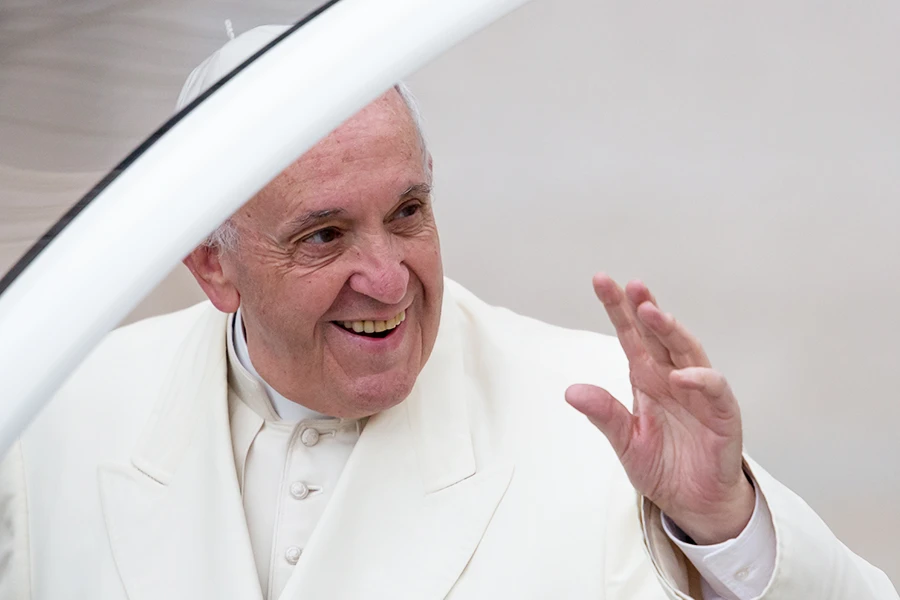
Papal aide Monsignor Paolo Braida reads Pope Francis’ prepared remarks for the Sunday Angelus on Dec. 3, 2023, from the chapel at the papal residence at Casa Santa Marta. / Vatican Media
Vatican City, Dec 3, 2023 / 08:32 am (CNA).
Pope Francis for the second consecutive Sunday was assisted by an aide in praying the Angelus as he continues to recover from an acute bronchial infection.
“Even today I won’t be able to read everything: I’m improving, but my voice still doesn’t work,” the pope said during the Sunday morning broadcast on the first Sunday of Advent. Instead “it will be Monsignor [Paolo] Braida who reads the catechesis,” Francis continued.
Braida, who serves as the head of office at the Vatican’s Secretariat of State, once again read the pope’s remarks from the chapel at the papal residence at Casa Santa Marta. Last week the pope introduced him, saying he is the person who usually drafts the pope’s Angelus reflections.
Pope Francis normally prays the Angelus from the window of his studio overlooking St. Peter’s Square.
On Saturday afternoon the Holy See Press Office reported that “the health conditions of the Holy Father are improving; the pope has no fever and is continuing with the appropriate therapy. To avoid exposure to sudden changes in temperature, tomorrow morning Pope Francis will recite the Angelus via connection from Casa Santa Marta.”
Braida opened the first Angelus of the new liturgical year by reading the pope’s remarks on the theme of “vigilance,” noting that in the Christian context being vigilant does not arise out of “fear” but instead stems from a sense “of longing, of waiting to go forth to meet their Lord who is coming.”
Reflecting on the parable of the master who goes from his house, leaving his servants in charge, the pope in his remarks noted that “they remain in readiness for his return because they care for him, because they have in mind that when he returns, they will make him find a welcoming and orderly home; they are happy to see him, to the point that they look forward to his return as a feast for the whole great family of which they are a part.”
The same sense of longing that defines the season of Advent prepares us “to welcome Jesus at Christmas.”
The idea of preparedness is, Braida read, ultimately one characterized by hope as seen in the “attitude of the sentinel, who in the night is not tempted by weariness, does not fall asleep but remains awake awaiting the coming light. The Lord is our light and it is good to dispose the heart to welcome him with prayer and to host him with charity, the two preparations that, so to speak, make him comfortable.”
To that end, Advent is not only a time of preparation but also of interior reflection where we can ask ourselves “how we can prepare a welcoming heart for the Lord.”
“We can do so by approaching his forgiveness, his word, his table, finding space for prayer, welcoming those in need. Let us cultivate his expectation without letting ourselves be distracted by so many pointless things and without complaining all the time, but keeping our hearts alert, that is, eager for him, awake and ready, impatient to meet him.”
After the recitation of the Angelus, Braida read the pope’s appeal, drawing attention to the end of the temporary truce between Israel and Hamas, which lasted from Nov. 24 to Dec. 1, allowed for humanitarian aid to flow into Gaza, and resulted in a prisoner exchange between the two parties.
“It grieves us that the truce has been broken: that means death, destruction, misery. Many hostages have been freed, but many are still in Gaza. Let’s think to them, to their families who had seen a light, a hope of hugging their loved ones again,” Braida read.
The Qatari state-owned media outlet Al-Jazeera reported that a Hamas official told the network that “negotiations on prisoner exchanges are now over and will not resume until Israel halts its attack and hands over all Palestinian prisoners.”
The pope’s aide then noted that the Holy Father was following the events of the United Nations Climate Conference despite not being able to take the trip himself due to his illness.
“Even if from a distance, I am following the COP28 proceedings in Dubai with great attention. I’m close. I renew my appeal to respond to climate change with concrete political changes: Let us escape from the constraints of particularism and nationalism, patterns of the past, and embrace a common vision, committing ourselves all now, without delay, for a necessary global ecological conversion,” Braida read.
The pontiff, who will turn 87 on Dec. 17, was supposed to be in Dubai from Dec. 1–3 to deliver a speech to the conference and preside over the opening of the first-ever faith pavilion. However, given his illness and the ongoing treatment, the Vatican’s secretary of state, Cardinal Pietro Parolin, led the Vatican delegation in place of the pope.
The pope closed the broadcast by telling the nearly 20,000 faithful present in the piazza and those watching the broadcast: “I wish everyone a happy Sunday and a happy Advent journey.”
If you value the news and views Catholic World Report provides, please consider donating to support our efforts. Your contribution will help us continue to make CWR available to all readers worldwide for free, without a subscription. Thank you for your generosity!
Click here for more information on donating to CWR. Click here to sign up for our newsletter.
Cardinal Timothy Dolan of New York. / Credit: Jonah McKeown/CNA
CNA Staff, Feb 21, 2024 / 18:05 pm (CNA).
Priests at St. Patrick’s Cathedral in New York City were surprised by the “irreverence and disrespect” that occurred during a funeral for … […]
Amanda Achtman’s last photo with her grandfather, Joseph Achtman. / Credit: Photo courtesy of Amanda Achtman
CNA Staff, Nov 5, 2023 / 06:00 am (CNA).
When the Canadian government began discussing the legalization of euthanasia for those whose deaths were “reasonably foreseeable,” 32-year-old Amanda Achtman said something in her began to stir. Her grandfather was in his mid-90s at the time and fit the description.
“There were a couple of times, toward the end of his life, that he faced some truly challenging weeks and said he wanted to die,” Achtman recalled. “But thank God no physician could legally concede to a person’s suicidal ideation in such vulnerable moments. To all of our surprise — including his — his condition and his outlook improved considerably before his death at age 96.”
Achtman said she and her grandfather were able to have a memorable final visit that “forged her character and became one of the greatest gifts he ever gave me.”
The experience of walking with her grandfather in his last days led Achtman to work that she believes is a calling. On Aug. 1, she launched a multifaceted cultural project called Dying to Meet You, which seeks to “humanize our conversations and experiences around suffering, death, meaning, and hope.” This mission is accomplished through a mix of interviews, short films, community events, and conversations.
Amanda Achtman speaks during the Evening Program at St. Mary’s Cathedral during “The Church as an Expert in Humanity” event in Calgary Sept. 23, 2023. Credit: Edward Chan/Community Productions
“This cultural project is my primary mission, and I am grateful to be able to dedicate the majority of my energy to it,” Achtman told CNA.
Early years
Achtman was born and raised in Calgary, Alberta, Canada. She grew up in a Jewish-Catholic family with, she said, “a strong attachment to these two traditions that constitute the tenor of my complete personality.”
Her Polish-Jewish grandfather, with whom she had a very close relationship as a young adult, had become an atheist because of the Holocaust and was always challenging her to face up to the big questions of mortality and morality.
“One of the ways I did this was by traveling on the March of Remembrance and Hope Holocaust study trip to Germany and Poland when I was 18,” Achtman said. “My experiences listening to the stories of Holocaust survivors and Righteous Among the Nations have undeniably forged my moral imagination and instilled in me a profound sense of personal responsibility.”
Shortly after her grandfather’s death, Achtman discovered a new English-language master’s program being offered in John Paul II philosophical studies at the Catholic University of Lublin in Poland.
“Immediately, I felt as though God were saying to me, ‘Leave your country and go to the land that I will show you — it’s Poland.’ At the time, the main things I knew about Poland were that the Holocaust had largely been perpetrated there and that Sts. John Paul II, Maximilian Kolbe, and Faustina were from there,” Achtman explained. “I wanted to be steeped in a country of saints, heroes, and martyrs in order to contemplate seriously what my life is actually about and how I could spend it generously in the service of preventing dehumanization and faithfully defending the sanctity of life in my own context.”
On Sept. 23, 2023, Amanda Achtman organized a daylong open-house-style event called “The Church as an Expert in Humanity” in Calgary, Alberta. Participants added ideas for how we, the Church, can prevent euthanasia and encourage hope. Credit: Edward Chan/Community Productions
The rise of euthanasia in Canada
In 2016, the Canadian government legalized euthanasia nationwide. The criterion to be killed in a hospital was informed consent on the part of an adult who was deemed to have a “grievous and irremediable condition.”
“The death request needed to be made in writing before two independent witnesses after a mandatory time of reflection. And, consent could be withdrawn any time before the lethal injection,” Achtman explained.
Then, in 2021, the Canadian government began to remove those safeguards. “The legislative change involved requiring only one witness, allowing the possible waiving of the need for final consent, and the removal, in many cases, of any reflection period,” Achtman told CNA.
“Furthermore, a new ‘track’ was invented for ‘persons whose natural death is not reasonably foreseeable.’ This meant that Canadians with disabilities became at greater risk of premature death through euthanasia. Once death-by-physician became seen as a human right, there was practically no limit as to who should ‘qualify.’ As long as killing is seen as a legitimate means to eliminate suffering, there is no limit to who could be at risk.”
Euthanasia — now called medical assistance in dying (MAiD) in Canada — is set to further expand on March 17, 2024, to those whose sole underlying condition is “mental illness.” Last year, Dr. Louis Roy of the Quebec College of Physicians and Surgeons testified before a special joint committee that his organization thinks euthanasia should be expanded to infants with “severe malformations” and “grave and severe syndromes.”
Renewing the culture
Achtman followed the debates around end-of-life issues in Canada and wanted to figure out a way to restore “a right response to the reality of suffering and death in our lives.”
“The fact is, our mortality is part of what makes life precious, our relationships worth cherishing, and our lives worth giving out of love. That’s why we need to bring cultural renewal to death and dying, restoring our understanding of its meaning to the human condition.”
At the Sept. 23, 2023, open-house event called “The Church as an Expert in Humanity,” there were table displays of ministries in the diocese who are doing the best work on suffering, death, grief, and caregiving. Credit: Edward Chan/Community Productions
On Jan. 1, 2021, Achtman made a new year’s resolution to blog about death every single day for an entire year in a way that was “hope-filled and edifying.”
It ended up being very fruitful to Achtman personally, but she said “it also touched a surprising number of people, inspiring them to take concrete actions in their own lives that I could not have anticipated.”
The experience, Achtman said, made her realize that it’s possible to contribute to cultural renewal through things like coffee shop visits, informal interviews, posting on social media, being a guest on podcasts and webinars, organizing community events, and making videos.
“Basically, there are countless practical and ordinary ways that we can humanize the culture — wherever we are and whatever we do the rest of the time.”
The Dying to Meet You project
When it comes to the mission of Dying to Meet You, Achtman told CNA that “God has put on my heart two key objectives: the prevention of euthanasia and the encouragement of hope” and added that “the aim of this cultural project is to improve our cultural conversation and engagement around suffering, death, meaning, and hope through a mix of interviews, writing, videos, and events.”
Achtman said the project is an experiment in the themes Pope Francis speaks about often — encounter, accompaniment, going to the peripheries, and contributing to a more fraternal spirit.
“There is a strong basis for opposition to euthanasia across almost all religions and cultures, traditionally speaking,” Achtman said. “Partly from my own upbringing in a Jewish-Catholic family, I am passionate about how the cultural richness of such a plurality of traditions in Canada can bolster and enrich our value of all human life.”
To that end, one of the projects Achtman has in the works is a short film on end of life from an Indigenous perspective to be released mid-November.
“It’s not so much that we have a culture of death as we now seem to have death without culture,” said Achtman, who hopes her efforts will help change that.
An inspiring hometown event
This past Sept. 23, Achtman organized a daylong open-house-style event called “The Church as an Expert in Humanity” in her home city of Calgary, which took place at Calgary’s Cathedral, the Cathedral Hall, and the Catholic Pastoral Centre. The morning featured a ministry hall of exhibits with 18 table displays of ministries throughout the diocese doing the best work on suffering, death, grief, and caregiving. In the afternoon, there were three-panel presentations.
The morning of “The Church as an Expert in Humanity” in St. Mary’s Cathedral Hall in Calgary, Alberta, featured a ministry hall of exhibits with table displays of ministries in the diocese doing the best work on suffering, death, grief, and caregiving. Credit: Edward Chan/Community Productions
The first involved Catholics of diverse cultural backgrounds speaking about hospitality and accompaniment in their respective traditions. It included a Filipino diaconal candidate, a Ukrainian laywoman working with refugees, an elderly Indigenous woman who is a community leader, and an Iraqi Catholic priest.
The second was called “Tell Me About the Hour of Death,” where participants heard from two doctors, a priest, and a longtime pastoral care worker.
The third panel focused on papal documents pertaining to death, hope, and eternal life. A Polish Dominican sister who has worked extensively with the elderly spoke about John Paul II’s “Letter to the Elderly.”
Later, an evening program was held in Calgary’s Catholic Cathedral and included seven short testimonies by different speakers that “were narratively framed as echoes of the Seven Last Words of Christ.” Among the speakers were a privately sponsored Middle Eastern Christian refugee, a L’Arche core member who has a disability, and a young father whose daughter only lived for 38 minutes. Afterward, Calgary’s Bishop William McGrattan gave some catechesis on the Anima Christi prayer, with a special emphasis on the line “In your wounds, hide me.”
“The day was extremely uplifting and instilled the local Church with confidence that the Church indeed is an expert in humanity, capable of meeting Christ in all who suffer with a gaze of love and the steadfast insistence, ‘I will not abandon you,’” Achtman told CNA.
Calgary’s Bishop William McGrattan listens to the seven testimonies echoing the seven last words of Christ during the evening program. Credit: Edward Chan/Community Productions
Our lives are not wholly our own
Many believe euthanasia is compassionate care for those who suffer. Shouldn’t we be able to do what we want with our own lives? And can suffering have any meaning for someone who doesn’t believe in God?
Achtman said these questions remind her of something Mother Teresa said: “If we have no peace, it is because we have forgotten that we belong to each other,” as well as the John Donne quote “Each man’s death diminishes me, for I am involved in mankind.”
“Our lives are not wholly our own and how we live and die affects the communities to which we belong,” Achtman said. “That is not a religious argument but an empirical observation about human life. If someone lacks ties and is without family and social support, then that is the crisis to which the adequate response is presence and assistance — not abandonment or hastened death. As one of my heroes, Father Alfred Delp, put it, a suffering person makes an ongoing appeal to your inner nobility, to your sacrificial strength and capacity to love. Don’t miss the opportunity.”
Amanda Achtman pictured with Christine, an 88-year-old woman who got a tattoo that says “Don’t euthanize me,” which is featured in a short four-minute documentary. Credit; Photo courtesy of Amanda Achtman
The mission continues
Achtman also organized a “Mass of a Lifetime,” a special Sunday Mass for residents of a local retirement home, on Oct. 15.
Attendees at the Mass of a Lifetime event, a special Sunday Mass for residents of a local retirement home held on Oct. 15, 2023, in Calgary, Alberta. Credit: Amanda Achtman
“I was inspired by a quotation of Dietrich von Hildebrand, who said: ‘Wherever anything makes Christ known, there nothing can be beautiful enough,’” Achtman said. “Applying that spirit to this Mass, we made it as elaborate as possible to show the seniors that they are worth the effort.”
Achtman also recently produced a four-minute short film about an 88-year-old woman named Christine who got a tattoo that says “Don’t euthanize me.” It can be viewed here:
Throughout 2023-2024, Achtman told CNA, she is basing herself in four different Canadian cities for three months each “in order to empower diverse faith and cultural communities in the task of preventing euthanasia and encouraging hope.” She started in her hometown of Calgary and is off to Vancouver this month.
In addition to her work with the Dying to Meet You project, Achtman does ethics education and cultural engagement with Canadian Physicians for Life and works to promote the personalist tradition with the Hildebrand Project.
Pope Francis speaks at the Vatican’s Chrism Mass on Holy Thursday, March 28, 2024. / Daniel Ibanez/CNA
Sydney, Australia, Apr 13, 2024 / 12:14 pm (CNA).
Pope Francis has reacted with deep sorrow at the news from Australia on Saturday, where a 40-year-old man, armed with a large knife, killed six people in a Sydney shopping center, injuring several others, including a nine-month-old child.
“Pope Francis was deeply saddened to learn of the violent attack in Sydney, and he sends the assurance of his spiritual closeness to all affected by this senseless tragedy, especially those who are now mourning the loss of a loved one,” read a telegram sent by Cardinal Pietro Parolin, Secretary of State, sent on behalf of the Pope.
The Holy Father offered prayers for the deceased, the wounded, and the first responders, invoking divine blessings of consolation and strength for the nation.
Daniel Ang, Director of the Sydney Centre for Evangelization at the Catholic Archdiocese of Sydney, reached out via X (formerly Twitter) to express solidarity and announce spiritual support: “We join in prayer for the victims & families affected by the horrific events at Bondi Junction today. The three Sunday Masses at the Catholic Parish of Bondi tomorrow will be offered for the repose of the souls that have passed away and all those others affected by these events.”
The bloody attack occurred in the busy Westfield Bondi Junction shopping center on April 13, the first day of the school holidays — a time when many families were out, adding to the shock and impact of the event.
Five victims died at the scene, while another person succumbed to their injuries in the hospital. Eight others remain hospitalized, some in critical condition, the Australian Broadcasting Corporation reported.
The attacker, who was known to the police but remains unidentified, was shot and killed by a policewoman at the scene. According to police, the man allegedly lunged at the officer before he was fatally shot.
Authorities have cautioned against speculation about the attacker’s motives, emphasizing that early indications suggest the incident was not terrorism-related. Police Commissioner Karen Webb said while the motive was unclear, evidence indicated the attack was not related to terrorism: “There’s no suggestion anyone was targeted but that could change.”
The incident has shocked the nation. The acting Premier of New South Wales, Penny Sharpe, told journalists the attack was “beyond distressing” and vowed as much information as possible would be shared with the public.
Investigations are ongoing, with the Australian Federal Police collaborating with local authorities to unravel the full circumstances of the attack.
Australia was previously rocked by a terror attack in Sydney almost ten years ago. The 2014 Lindt Café siege saw a lone jihadist gunman hold eighteen hostages, leading to three deaths, including the gunman.
His Holiness Pope Francis has been the voice of the voiceless. May the Holy Father regain his voice and keep evangelizing us with his customary zeal and fervor. God bless.
“…My voice still doesn’t work.”
Seems like maybe God is giving him a hint. He should take it.