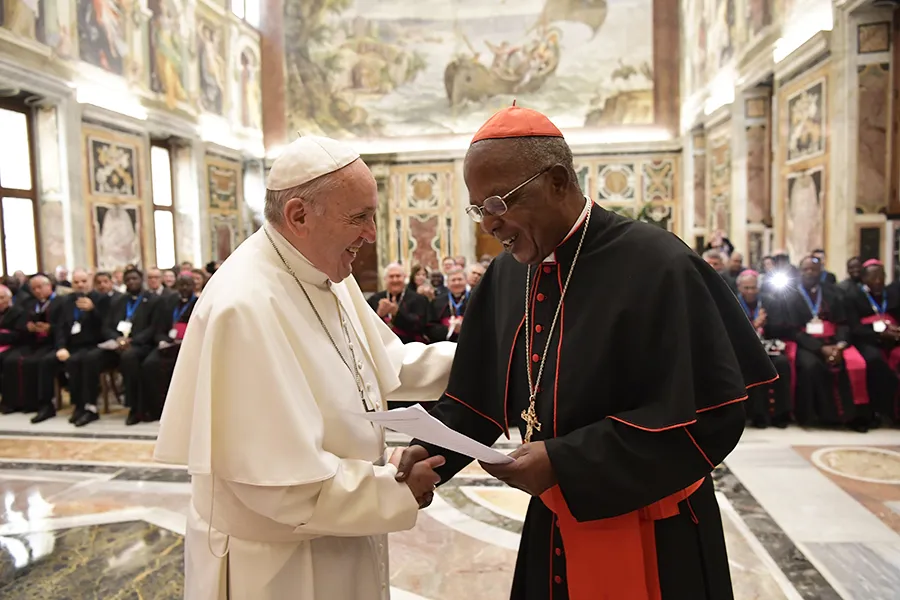
Cardinal Gianfranco Ghirlanda, SJ, takes possession of his titular church in Rome, the Church of the Gesù, on Dec. 8, 2022. / Credit: Daniel Ibanez/CNA
Rome Newsroom, Nov 6, 2023 / 08:55 am (CNA).
A cardinal and canon lawyer has denied reports that he is involved in changing the papal election process to make it more synodal.
The Pillar and The Remnant websites reported Nov. 4 that Cardinal Gianfranco Ghirlanda, an expert in Church law closely associated with the Vatican, had been tasked by Pope Francis with drafting revisions to conclaves.
The changes being considered, they reported, include changing pre-conclave meetings, called general congregations, to employ Synod on Synodality-style small group discussions and limiting participation in those meetings to cardinals eligible to vote, that is, cardinals under 80.
“I do not know anything about it and any implication I have in it is a pure lie,” Ghirlanda told EWTN News via email on Monday morning.
Vatican spokesman Matteo Bruni also denied knowledge of such a document in a statement to CNA Nov. 6.
The Remnant also reported Nov. 4 that Pope Francis is considering a proposal by Ghirlanda to allow lay people to participate in the conclave, including the vote for a new pope.
The Pillar, citing “a senior canon lawyer close to the Vatican,” reported that knowledge of the process to reform conclaves “is widespread in Vatican canonical circles, as is the role of Cardinal Ghirlanda.”
General congregations are preparatory meetings of the College of Cardinals held every day before the start of the election. They are a time for cardinals to familiarize themselves with the regulations concerning conclaves and, according to the norms in force, to “express their views on possible problems, ask for explanations in case of doubt and make suggestions.”
During general congregations, cardinals can address the entire college. But one of the proposed changes, according to The Pillar, is to make these exchanges into “spiritual conversations” of smaller groups of cardinals, similar to the small-group discussions at the Synod on Synodality assembly in October.
The papal election process and the sede vacante, the period between a pope’s death or resignation and the election of his successor, are regulated by St. Pope John Paul II’s 1996 apostolic constitution Universi Dominici Gregis and Pope Francis’ 2022 apostolic constitution Praedicate Evangelium.
Pope Benedict XVI made two revisions to Universi Dominici Gregis during his papacy, stipulating that in case of a deadlock, the election must be decided by a two-third majority, instead of a simple majority, and that a conclave can start sooner or later than 15 days after a pope’s death.
Conclaves, which take place in the Sistine Chapel, are held under strict secrecy. The cardinals who participate take an oath to “observe absolute and perpetual secrecy” about the ballots and their scrutiny from anyone outside the College of Cardinals under penalty of automatic excommunication.
According to the law of the Holy See, during a sede vacante, “all heads of curial institutions and members cease from their office,” though secretaries “attend to the ordinary governance of curial institutions, taking care of ordinary business only.”
Pope Francis ruled earlier this year that the office of the Auditor General, which is responsible for auditing the financial statements of the Holy See and the Vatican City State, and which does not have a secretary, may also continue its “ordinary administration” in the case of a vacant papal see.
The other positions which remain in place during a sede vacante are the major penitentiary, who deals with issues relating to the sacrament of confession and indulgences, the camerlengo, who oversees the preparations for a papal conclave and manages the administration of the Holy See during the interregnum, and the papal almoner.
If you value the news and views Catholic World Report provides, please consider donating to support our efforts. Your contribution will help us continue to make CWR available to all readers worldwide for free, without a subscription. Thank you for your generosity!
Click here for more information on donating to CWR. Click here to sign up for our newsletter.
Pope Francis prays during Christmas Mass in St. Peter’s Basilica on Dec. 24, 2023. / Vatican Media
Vatican City, Dec 24, 2023 / 18:00 pm (CNA).
Below is the full text of Pope Francis’ homily for the Solemnity of the Nativity of the Lord, delivered on Dec. 24, 2023, in St. Peter’s Basilica.
“A census of the whole earth” (cf. Lk 2:1). This was the context in which Jesus was born, and the Gospel makes a point of it. The census might have been mentioned in passing, but instead is carefully noted. And in this way, a great contrast emerges. While the emperor numbers the world’s inhabitants, God enters it almost surreptitiously. While those who exercise power seek to take their place with the great ones of history, the King of history chooses the way of littleness. None of the powerful take notice of him: only a few shepherds, relegated to the margins of social life.
The census speaks of something else. In the Scriptures, the taking of a census has negative associations. King David, tempted by large numbers and an unhealthy sense of self-sufficiency, sinned gravely by ordering a census of the people. He wanted to know how powerful he was. After some nine months, he knew how many men could wield a sword (cf. 2 Sam 24:1-9). The Lord was angered and the people suffered. On this night, however, Jesus, the “Son of David”, after nine months in Mary’s womb, is born in Bethlehem, the city of David. He does not impose punishment for the census, but humbly allows himself to be registered as one among many. Here we see, not a god of wrath and chastisement, but the God of mercy, who takes flesh and enters the world in weakness, heralded by the announcement: “on earth peace among those whom he favors” (Lk 2:14). Tonight, our hearts are in Bethlehem, where the Prince of Peace is once more rejected by the futile logic of war, by the clash of arms that even today prevents him from finding room in the world (cf. Lk 2:7).
The census of the whole earth, in a word, manifests the all-too-human thread that runs through history: the quest for worldly power and might, fame and glory, which measures everything in terms of success, results, numbers and figures, a world obsessed with achievement. Yet the census also manifests the way of Jesus, who comes to seek us through enfleshment. He is not the god of accomplishment, but the God of Incarnation. He does not eliminate injustice from above by a show of power, but from below, by a show of love. He does not burst on the scene with limitless power, but descends to the narrow confines of our lives. He does not shun our frailties, but makes them his own.
Christmas Mass in St. Peter’s Basilica on the night of Dec. 24, 2023. Vatican Media
Brothers and sisters, tonight we might ask ourselves: Which God do we believe in? In the God of incarnation or the god of achievement? Because there is always a risk that we can celebrate Christmas while thinking of God in pagan terms, as a powerful potentate in the sky; a god linked to power, worldly success, and the idolatry of consumerism. With the false image of a distant and petulant deity who treats the good well and the bad poorly; a deity made in our own image and likeness, handy for resolving our problems and removing our ills. God, on the other hand, waves no magic wand; he is no god of commerce who promises “everything all at once”. He does not save us by pushing a button, but draws near us, in order to change our world from within. Yet how deeply ingrained is the worldly notion of a distant, domineering, unbending, and powerful deity who helps his own to prevail against others! So many times this image is ingrained in us. But that is not the case: our God was born for all, during a census of the whole earth.
Let us look, then, to the “living and true God” (1 Thess 1:9). The God who is beyond all human reckoning and yet allows himself to be numbered by our accounting. The God, who revolutionizes history by becoming a part of history. The God who so respects us as to allow us to reject him; who takes away sin by taking it upon himself; who does not eliminate pain but transforms it; who does not remove problems from our lives but grants us a hope that is greater than all our problems. God so greatly desires to embrace our lives that, infinite though he is, he becomes finite for our sake. In his greatness, he chooses to become small; in his righteousness, he submits to our injustice. Brothers and sisters, this is the wonder of Christmas: not a mixture of sappy emotions and worldly contentment, but the unprecedented tenderness of a God who saves the world by becoming incarnate. Let us contemplate the Child, let us contemplate the manger, his crib, which the angels call “a sign” for us (cf. Lk 2:12). For it truly is the sign that reveals God’s face, a face of compassion and mercy, whose might is shown always and only in love. He makes himself close, tender, and compassionate. This is God’s way: closeness, compassion, tenderness.
Pope Francis brings a figure of the Christ child over to the nativity scene inside of St. Peter’s Basilica at the end of Mass. Vatican Media
Sisters and brothers, let us marvel at the fact that he “became flesh” (Jn 1:14). Flesh: the very word evokes our human frailty. The Gospel uses this word to show us that God completely assumed our human condition. Why did he go to such lengths? Because he cares for us, because he loves us to the point that he considers us more precious than all else. Dear brother, dear sister, to God, who changed history in the course of a census, you are not a number, but a face. Your name is written on his heart. But if you look to your own heart, and think of your own inadequacies and this world that is so judgmental and unforgiving, you may feel it difficult to celebrate this Christmas. You may think things are going badly, or feel dissatisfied with your limitations, your failings, your problems, and your sins. Today, though, please, let Jesus take the initiative. He says to you, “For your sake, I became flesh; for your sake, I became just like you”. So why remain caught up in your troubles? Like the shepherds, who left their flocks, leave behind the prison of your sorrows and embrace the tender love of the God who became a child. Put aside your masks and your armor; cast your cares on him and he will care for you (cf. Ps 55:22). He became flesh; he is looking not for your achievements but for your open and trusting heart. In him, you will rediscover who you truly are: a beloved son or daughter of God. Now you can believe it, for tonight the Lord was born to light up your life; his eyes are alight with love for you. We have difficulty believing in this, that God’s eyes shine with love for us.
Christmas Mass in St. Peter’s Basilica on the night of Dec. 24, 2023. Vatican Media
Christ does not look at numbers, but at faces. However, who looks at him amid the many distractions and mad rush of a bustling and indifferent world? Who is watching? In Bethlehem, as crowds of people were caught up in the excitement of the census, coming and going, filling the inns, and engaged in petty conversation, a few were close to Jesus: Mary and Joseph, the shepherds, and then the Magi.
Let us learn from them. They stood gazing upon Jesus, with their hearts set on him. They did not speak, they worshiped. Tonight, brothers and sisters, is a time of adoration, of worship.
Worship is the way to embrace the Incarnation. For it is in silence that Jesus, the Word of the Father, becomes flesh in our lives. Let us do as they did, in Bethlehem, a town whose name means “House of Bread”. Let us stand before him who is the Bread of Life. Let us rediscover worship, for to worship is not to waste time, but to make our time a dwelling place for God. It is to let the seed of the Incarnation bloom within us; it is to cooperate in the work of the Lord, who, like leaven, changes the world. To worship is to intercede, to make reparation, to allow God to realign history. As a great teller of epic tales once wrote to his son, “I put before you the one great thing to love on earth: the Blessed Sacrament… There you will find romance, glory, honor, fidelity, and the true way of all your loves on earth” (J.R.R. TOLKIEN, Letter 43, March 1941).
Brothers and sisters, tonight love changes history. Make us believe, Lord, in the power of your love, so different from the power of the world. Lord, make us, like Mary, Joseph, the shepherds, and the Magi, gather around you and worship you. As you conform us ever more to yourself, we shall bear witness before the world to the beauty of your countenance.
We read: “‘The Pillar, citing “a senior canon lawyer close to the Vatican,’ reported that knowledge of the process to reform conclaves ‘is widespread in Vatican canonical circles, as is the role of Cardinal Ghirlanda’.”
Might we find it very hard to believe that such an agenda is NOT in the works?
Consider the pattern…a curious footnote (#351) is loaded onto Amoris Laetitia; then a validating “synodality” was loaded onto a Synod on Young People (2018); then the worst feature of the German Synodal Way (mixed voting) was loaded onto Synod 2023; and now the synodal roundtables are to be loaded onto the next conclave. Or, at least the proposal will likely be loaded onto the awaited script for Synod 2024. Yes?
As they say in criminal investigations: the motive, the means, and the opportunity. But, who am I to judge?
Who does intrigue better? Byzantium of old seemed to have invented duplicity and veiled policy. Today’s Vatican is no slouch in that regard. Example. The last ten years. When was the last time an announcement didn’t compel the reader to contemplate at length its possible meanings?
Rumours of small round table discussion groups including laity to elect a new pontiff. Or is that banter of runaway imagination? So bizarre a proposal would be laughed off, if it weren’t for the Synodality obsession, synodal thinking, synodal outlook, synodal enlightenment, the incantation of some amorphous mystery reality. Why, even His Holiness had a syndal conference with thousands of children eliciting their views on climate, th environment, war and peace. Are we being drawn into a monumental abstraction from following our commitment to Christ?
In this “pontificate” we have all learned after more than 10 years that the truth is the opposite of what the Vatican apparatchiks and their puppet-dictator tell us.
If ever the the caution “where there is smoke there is fire” was more apropos it is the Bergoglian Vatican. Conclave reimaging according to the publicized model? If not now, later. In the meantime something equally perverse but less shocking will come across the desk and the groundlings will breathe a sigh of relief. This is the way they handle the faithful, a technique very much globalist manipulation in character.
The current pontificate has abandoned Catholic reasoning and no longer can expect any credence from faithful laity who see through the theatrics and are revolted by the actors. And everyone of the actors require a firm and just consequence.
The only thing that surprises me is that there are no proposals for allowing the possibility of a female (or trans male) Marxist atheist to not only participate in the conclave but be elected.
We read: “‘The Pillar, citing “a senior canon lawyer close to the Vatican,’ reported that knowledge of the process to reform conclaves ‘is widespread in Vatican canonical circles, as is the role of Cardinal Ghirlanda’.”
Might we find it very hard to believe that such an agenda is NOT in the works?
Consider the pattern…a curious footnote (#351) is loaded onto Amoris Laetitia; then a validating “synodality” was loaded onto a Synod on Young People (2018); then the worst feature of the German Synodal Way (mixed voting) was loaded onto Synod 2023; and now the synodal roundtables are to be loaded onto the next conclave. Or, at least the proposal will likely be loaded onto the awaited script for Synod 2024. Yes?
As they say in criminal investigations: the motive, the means, and the opportunity. But, who am I to judge?
Who does intrigue better? Byzantium of old seemed to have invented duplicity and veiled policy. Today’s Vatican is no slouch in that regard. Example. The last ten years. When was the last time an announcement didn’t compel the reader to contemplate at length its possible meanings?
Rumours of small round table discussion groups including laity to elect a new pontiff. Or is that banter of runaway imagination? So bizarre a proposal would be laughed off, if it weren’t for the Synodality obsession, synodal thinking, synodal outlook, synodal enlightenment, the incantation of some amorphous mystery reality. Why, even His Holiness had a syndal conference with thousands of children eliciting their views on climate, th environment, war and peace. Are we being drawn into a monumental abstraction from following our commitment to Christ?
Thank you Father.
In this “pontificate” we have all learned after more than 10 years that the truth is the opposite of what the Vatican apparatchiks and their puppet-dictator tell us.
If ever the the caution “where there is smoke there is fire” was more apropos it is the Bergoglian Vatican. Conclave reimaging according to the publicized model? If not now, later. In the meantime something equally perverse but less shocking will come across the desk and the groundlings will breathe a sigh of relief. This is the way they handle the faithful, a technique very much globalist manipulation in character.
The current pontificate has abandoned Catholic reasoning and no longer can expect any credence from faithful laity who see through the theatrics and are revolted by the actors. And everyone of the actors require a firm and just consequence.
The only thing that surprises me is that there are no proposals for allowing the possibility of a female (or trans male) Marxist atheist to not only participate in the conclave but be elected.