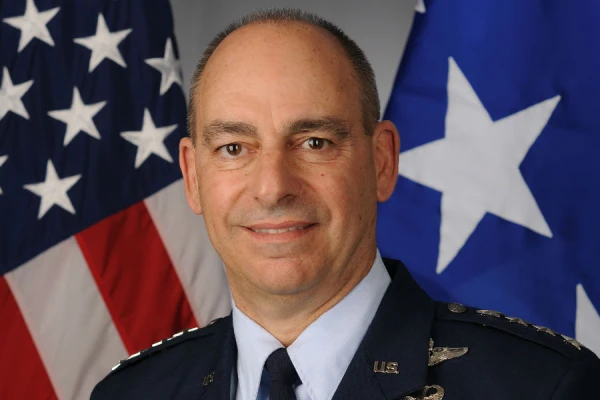
Lourdes, France, May 22, 2019 / 12:00 pm (CNA).- Gen. Jeff Harrigian, commander of U.S. Air Forces Europe and Africa, and Lt. Gen Chris Cavoli, commander of the U.S. Army in Europe, are two of the highest-ranking members of the American military. And over the weekend, they joined the thousands of military pilgrims who traveled to Lourdes seeking healing and peace.
Harrigian and Cavoli were asked to join the official American delegation to the International Military Pilgrimage, Warriors to Lourdes. Warriors to Lourdes is a program of the Knights of Columbus and the Archdiocese for the Military Services, USA.
Although the two generals are both Catholic, neither had been to Lourdes previously. Both explained to CNA how their faith impacts their military career, and what the pilgrimage meant to them.
Harrigian has been in his current position for only a few weeks, but joined the Air Force in 1985 and attended the Air Force Academy.
“I wanted to fly airplanes,” he explained, which led to him applying to the Academy.
Harrigian was unfamiliar with the story of Lourdes prior to this trip, but he said his wife taught him about the significance of the site, and thought the pilgrimage would be fruitful for the family, for a multitude of reasons.
“She thought it would be a great opportunity, first to experience it but also to be with some of our warriors here and have an opportunity to interact with them,” said Harrigian.
The size and scope of the pilgrimage came as a surprise to the general, who repeatedly used the word “extraordinary” to describe the event. Approximately 12,000 servicemembers from about 40 countries traveled to Lourdes.
“The first thing I would say is, I didn’t truly understand the breadth of all the nations that participated in this,” he said. “And to have an opportunity to interact with the different nations, the families, the warriors, it’s a once-in-a-lifetime opportunity, one that I’m not sure I truly appreciated as I read about it.”
“But now that I’m here I find it to be an extraordinary experience,” he added. Part of this experience included talking to senior French military officers and members of the Italian military.
“The interaction has been extraordinary,” he said. “It’s been a great opportunity to interact with them on a personal basis and get a sense of what Lourdes means to them as well.”
Harrigian said that he considers his Catholic faith to be an important facet that helps him maintain balance in his life and helps him with his military duties. He told CNA he is “always praying for our troops that are deployed down-range.”
“Reflecting on what your faith brings to you, your background, and having that underpin who you are is very important to any person,” he said. “And for me personally, it really helps in the command role that I have now.”
Cavoli is also visiting Lourdes for the first time. Unlike Harrigian, he was very familiar with the story of Lourdes and had been wanting to visit.
“I’ve been hearing about [Lourdes] my whole life, since I was a kid, so this is a unique opportunity to get to do something I’ve wanted to do so much,” he said.
Cavoli told CNA that he finds his faith to be “intertwined” with his military career, and calls upon his faith to provide the graces needed to carry out the duties of his job.
“Of course, I have my strictly military duties, which are mainly secular in nature, but the moral compass that religion gives me, the moral compass and the ethical fortitude, as well as the emotional strength to deal with what is a pretty hard profession, that helps me a great deal,” he said.
Additionally, Cavoli credits his faith with giving him the wisdom to make the choices in tough decisions, as well as “the strength to carry on when things are hard.”
One of the benefits of the International Military Pilgrimage is that it gives servicemembers a chance to be surrounded by people who have similar experiences and can understand and empathize.
“It gives folks time to be together and to share their thoughts. In this case, in the context of their faith, which adds strength to the discussion.”
Of course, soldiers, sailors, and airmen train and deploy to defend lives and to risk their own in the service of others. But an inherent truth of military service is that it can involve armed conflict and the taking of human life.
Even in pursuit of the noblest cause or in defense against the clearest of evil, killing and death leave marks on the consciences of all those involved. The “moral injuries” of armed conflict can be as real and as in need of healing as physical wounds.
“Moral injury is a serious thing,” Cavoli said, offering that civilians could best help in the healing process by not make assumptions about the experiences of servicemen and women. Listening comes before understanding, he said.
During the pilgrimage, there were major events for all pilgrims, and smaller events for subsets. Both Cavoli and Harrigian said that they considered a shared Mass for English-speaking pilgrims, including servicemen and chaplains from the U.S., the U.K., and Ireland at the Lourdes Grotto, to be a highlight of the journey.
“The Mass at the Grotto was absolutely moving. It was beautiful,” said Cavoli. Afterwards, he joined a group for the Stations of the Cross, something he said added up to a “beautiful, beautiful morning” that was “just perfect.”
Harrigian called the Mass was “a great chance to just reflect upon everything that this experience brings to the entire community of warriors that are here, along with our families.”
And while neither had visited the baths when they spoke to CNA, both were carrying specific intentions with them.
“Personally, internal to our family, I’m always looking for grace and the opportunity to appropriately look over all those that I work with and work for, in the role that I currently have,” Harrigian told CNA. He said he was extremely grateful to the Knights of Columbus for orchestrating Warriors to Lourdes, which he called “an incredible event.”
Cavoli had similar intentions, saying he would be praying for “Peace, my soldiers, [and] my family.” He has appreciated his time in Lourdes, saying it was a place that made him feel “very calm” and fully aware of the presence of God.
“It’s just a wonderful pilgrimage,” he said.
 […]
[…]






Justice Scalia shocked many when he made an observation that offended the prejudices of most Americans who can not deal with the possibility that they are unable to apply commonsense to a treasured belief. He insisted that in law there is no presumption of innocence as commonly assumed. Of course. The law does not presume anything, neither guilt nor innocence. Neither should we. But we are always obligated to be prudent. Given that Rupnik is a self-admitted degenerate, commonsense would preclude his fitness to function as an active priest.
Francis ignoring this reality is one of numerous reasons for him to step down.
Edward. Law, applied as a just arbiter cannot presume innocence or guilt until the person who is under the law is charged. A charge presumes some degree of guilt. The accused consequently is a defendant. Legal codices including the Roman required that the defendant be allowed a defense. Cicero argued for the presence of a defense attorney. Although it wasn’t until the Inquisition that the Dominicans, who were the sanctioned inquisitors, insisted that a defendant have an attorney to represent their defense.
Insofar as Rupnik it’s not clear whether he admitted guilt of sexual abuse followed by confession of the abused. There appears sufficient circumstantial evidence to convict him, based on the sisters’ testimonies.
Has he committed criminal acts that should be investigated by law enforcement?
Edward. Law, applied as a just arbiter cannot presume innocence or guilt until the person who is under the law is charged. A charge presumes some degree of guilt. The charged consequently is a defendant. Legal codices including the Roman required that the defendant be allowed a defense. Cicero argued for the presence of a defense attorney. Although it wasn’t until the Inquisition that the Dominicans, who were the sanctioned inquisitors insisted that a defendant have an attorney to represent their defense.
Insofar as Rupnik, it’s not clear whether he admitted guilt of sexual abuse followed by sacramental confession of the abused. Just scanned Altieri’s article who claims a “mountain of evidence”, although no citing of his confession of guilt. There nonetheless appears sufficient circumstantial evidence to convict him, based on the sisters’ testimonies. Added to that, their are priests who have been convicted of sexual abuse and incarcerated on unreliable allegations.
Read the commentary recommended by Carl Olson, which provides strong circumstantial evidence since it cites three locales from which Sisters had claimed abuse, Ljubljana, Slovenia, Rome at the Centro Aletti, and Gorizia, Italy. The charge of hearing the confession of a woman following sexual activity with her, allegedly occurred at the Centro Aletti Rome. What apparently sealed his conviction was his unwillingness to respond to a Jesuit investigation team.
It may be said silence doesn’t necessarily admit guilt. Christ is said to have remained silent when accused. However, when Caiaphas asked directly if he was the son of God, Jesus answered in the affirmative in witness to himself.
It appears Fr Rupnik hasn’t directly admitted guilt, if it can be justifiably differentiated from acknowledgement. “Fr Sosa [Jesuit Superior General] said that Fr Rupnik acknowledged the crime and repented, and so the excommunication was lifted. Given that the penalty was declared by the CDF to have been automatically incurred, which action is akin to a non-automatic penalty being imposed by the CDF, it is probably the case that Fr Rupnik did not admit guilt for the crime, thus ‘purging the contempt’, which means abandoning his contumacious and stubborn refusal to make such an admission” (Fr Gerald Murray in Diane Montagna interview, Catholic Herald Dec 2022). It’s complex. Acknowledgment of a crime means it was understood by Rupnik to have been committed. Silence may signify guilt if there’s no denial. In contrast Christ in response to Caiaphas declared the truth of the allegation.
I totally agree by what the headline screams. Compare that with Donald Trump. I see him as innocent of all the charges brought against him in various courts until proven guilty in these courts.
You might want to read this exhaustive piece published by America Magazine in June 2023…
What the Bishop protecting Rupnik meant to say is this: “Rupnik is assumed innocent until be proven guilty a second time.”
That’s just being “open to the spirit.”
And now that their esteemed sex abuser friend and macabre-artist Rupnik is safe from a second guilty verdict, Cardinal O’Malley (who “mis-spoke” when he last messaged us this year, by “incorrectly” and pre-emptively asserting that the leading priest of the papal sex abuse committee was resigning because he was too busy with other stuff, resulting in the public contradiction…within 24 hours…by the same priest who had to tell the truth that the committee was a farce…as did Marie Collins a few short years before), has deemed it a fitting time to finally “reach out” to the women religious victims that Rupnik is “presumed innocent” of abusing.
Apparently, to this group above, this all makes sense to them, in their own internal logic: like worshipping Pachamama and then saying you didn’t.
Because for the sake of “the movement,” we are all asked…to pretend for the hierarchy…that reality isn’t happening.