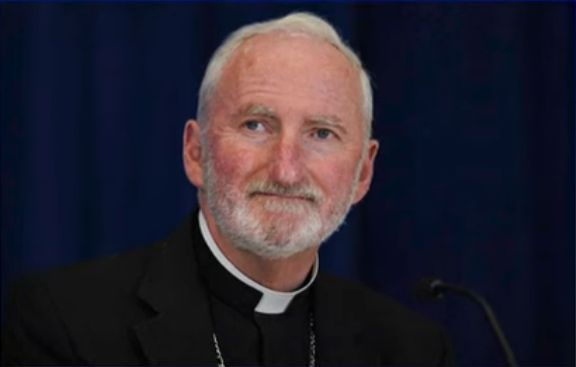
 Bishop David O’Connell. / Credit: KTLA screenshot
St. Louis, Mo., Feb 21, 2023 / 10:40 am (CNA).
David O’Connell, an auxiliary bishop of Los Angeles who was shot and killed over the weekend, is being mourned in his home country of Ireland.
O’Connell was born in 1953 in County Cork, on Ireland’s southern coast. He was baptized at Sacred Heart Church in the village of Glounthaune, where he later served as an altar boy. Sacred Heart was also where he celebrated his first Mass following his ordination in 1979, RTÉ reported.
Father Tom Hayes, a priest of the local Diocese of Cork and Ross, said his entire parish — about an hour’s drive from O’Connell’s — is talking about the tragic killing. O’Connell maintained close ties to Cork, returning at least once a year, most recently last summer, Hayes said.
“[His murder] is a front-page story here in Ireland since it happened, and it’s on the television and radio news, and so it’s getting quite a lot of news attention,” Hayes told CNA.
“So almost everybody has heard about it. And, yeah, people are shocked. I met one young woman today, and her issue was that she just couldn’t understand how one human being could take up a gun in close proximity to somebody else and kill them. But that’s kind of a reflection of maybe the difference in cultures as well, because in Ireland, we don’t have gun violence for the most part.”
Appointed a bishop in 2015, O’Connell ministered to immigrants, the poor, and victims of gang violence for 45 years in the South Los Angeles area. O’Connell was 69 when a deacon found him dead in his home Saturday in Hacienda Heights with at least one gunshot wound to the chest. A suspect has been arrested and on Monday was identified as 65-year-old Carlos Medina, the husband of O’Connell’s housekeeper. The investigation is ongoing.
Father Damian O’Mahony, co-pastor of O’Connell’s home parish of Sacred Heart, told CNA that “Bishop Dave never forgot his native home here in Cork,” describing him as “a proud Corkman, and he always let people know.”
“Naturally, those parishioners who knew Bishop Dave and those who know his family here in the parish were very shocked and upset and there was an air of disbelief,” O’Mahony told CNA.
“A Memorial Mass will be held in the Sacred Heart Glounthaune at a later date where those in his native parish will gather to pray for, remember, and celebrate the life of a good man who was taken so tragically and so cruelly from this life. It will also be an opportunity to show our continued support for his family as they come to terms with the loss of someone much loved and who will be missed dearly.”
At the regularly scheduled Mass on Feb. 20, O’Mahony noted that O’Connell has several surviving family members in County Cork, including a brother.
“We also pray for and remember his family at this time in the parish … his many, many friends in this time of heartbreak, shock, tears, sadness, and sorrow and all here in the parish who would have known him as well,” O’Mahony said, as reported by RTÉ.
The local bishop of O’Connell’s home diocese also spoke out in remembrance of the murdered bishop, urging prayers for him and for his family.
“Since his ordination in 1979 Bishop David has served as a priest in Los Angeles but has always maintained his connection with family and friends here in Cork, where has been a regular visitor. We pray that the Lord will console Bishop David’s many friends in Cork and throughout Ireland,” Bishop Fintan Gavin of Cork and Ross said in a Feb. 19 statement.
“We will pray for Bishop David at Mass throughout the Diocese of Cork and Ross in the coming days, asking the Lord to comfort his family, his colleagues, and all the bereaved. Bishop David worked tirelessly for peace and harmony in communities; may he now rest in the peace of the Lord.”
O’Connell was ordained during an era when many of the young men from Ireland becoming priests were sent abroad as missionaries, Hayes noted. For his part, O’Connell decided to come to the United States due in part to meeting fellow Irishman Cardinal Timothy Manning, who was then the archbishop of Los Angeles.
“In that providential conversation, the cardinal convinced him that Los Angeles was where he should go. So then he went and trained for the priesthood here in Ireland. The college that he trained at in Dublin is called All Hallows College, and the vast majority of seminarians who studied in that college studied to serve in dioceses in other countries,” Hayes said.
Many priests of a similar age to O’Connell came from Ireland to the United States and continue to minister throughout the country, he said. Beyond his visits back to Ireland, O’Connell was a very faithful supporter of his home diocese’s missions to Peru and Ecuador. Hayes said O’Connell would always warmly welcome Irish missionary priests to his parishes in the U.S., allowing them to preach and fundraise for their mission.
Hayes said his parishioners remain shocked that a person who made such a positive effort in his community could be the victim of such a crime.
“A lot of the people as well, and they’re also just shocked at the loss of what we see as somebody who was contributing very significantly to the life of his diocese and to the people that he was ministering to. And to have his life cut short is just such a shame,” Hayes said.
He said that if anything at all good can come from O’Connell’s murder, it would be a wider recognition of the peacemaking work he did for so many years in Los Angeles.
“It may inspire others to pick up some of the issues that he was advocating for — justice for the people on the margins of society — and to create a world of peace and fairness where people don’t have to be violent to one another. I think if that message gets amplified both in Ireland and in L.A., then that in itself would be a blessing.”
[…]




Where are the voices of moderate Muslim leaders condemning the violence of Islamists?
“Moderate Muslim Leaders”?
How to Tell the Difference Between Radical Islamic Doctrine and Moderate Islamic Doctrine
The terms “radical Islam” and “moderate Islam” have been bandied about in the Western world for many years, and the presumption in the use of these terms is that “radical Islam” teaches violence and terrorism and anti-Western values while “moderate Islam” teaches peace and harmony and pro-Western values. Below is a handy comparison chart so you can actually see some of the differences for yourself.
Radical Islam Teaches the Following
1. Muhammad is the ideal human being. One way we know this is because he married Aisha when she was 6 years old, but he considerately waited until she was 9 before consummating his marriage to her.
2. Muhammad is Allah’s prophet.
3. Muhammad is superior to Jesus Christ who was only a prophet and not God.
4. Jesus Christ was not crucified.
5. Sharia Law should be the law of every land.
6. Death is the punishment for apostasy from Islam.
7. The Qur’an is the perfect word of Allah that was dictated word for word to Muhammad.
8. All true Muslims follow the commands of the Qur’an.
9. Muslim husbands are commanded to beat disobedient wives.
10. Muslims are commanded to wage jihad against non-believers in Islam. This includes killing them, torturing them, and humiliating them…unless they convert to Islam.
But on the other hand….
Moderate Islam Teaches the Following
1. Muhammad is the ideal human being. One way we know this is because he married Aisha when she was 6 years old, but he considerately waited until she was 9 before consummating his marriage to her.
2. Muhammad is Allah’s prophet.
3. Muhammad is superior to Jesus Christ who was only a prophet and not God.
4. Jesus Christ was not crucified.
5. Sharia Law should be the law of every land.
6. Death is the punishment for apostasy from Islam.
7. The Qur’an is the perfect word of Allah that was dictated word for word to Muhammad.
8. All true Muslims follow the commands of the Qur’an.
9. Muslim husbands are commanded to beat disobedient wives.
10. Muslims are commanded to wage jihad against non-believers in Islam. This includes killing them, torturing them, and humiliating them…unless they convert to Islam.
__________________
Now that you know some of the “differences,” it should be easy to understand what people mean when they refer to the teachings of “radical Muslims” and the teachings of “moderate Muslims.” It’s pretty obvious, isn’t it? No wonder many people declare that Islam is a “religion of peace.” They are basing this claim on the significant “differences” between the teachings of “radical Islam” and “moderate Islam.”
It should also be easy to now understand why we are not at war with Islam itself or “moderate Islam,” nor should we even criticize or question any of its doctrines. It’s only “radical Muslims” with their “different teachings” that we in the West can oppose. Otherwise, we are simply bigots engaging in Islamophobia. Clear?!
While considering the listed differences between “radical Islam” and “moderate Islam,” recall a similar distinction between “radical Nazism” and “moderate Nazism” that was prevalent during the Nazi regime in Germany from 1933 to 1945. Thank God we only went to war with “radical Nazism” and not Nazism or “moderate Nazism” – the “ideology of peace.”
But let us not use these isolated and very uncommon acts of inexplicable violence, perhaps motivated (as per Francis) by a generic religious fundamentalism (you know, the attacker could have just as easily have been a Latin Mass attendee) as an excuse to even think about curbing migration from the Muslim world. These young men of military age are simply looking for a better life for themselves and their families (wherever they may be). Besides, there are a couple million residents of Gaza whom, we are being told by supporters of the only democracy in the Middle East, will be looking for a new home in Europe or North America. Now is absolutely not the time to shut the door, not that ever would be a good time.
Dr. Veritatis above – I realize the problem of trying to differentiate between moderate and radical Islam.
However, I am of the understanding that there are two parts of the Koran, the first when Mohammed was in Mecca and the second when he was in Medina. It is the second part in which he stopped trying to play nice.
I agree that Pope Francis’ references to Islam as “a religion of peace” are naive/dishonest/dangerous – take your pick or combinations.
Gilberta:
In and of itself, there is only Islam; not a radical nor a moderate Islam. As such, there is no legitimate distinction between a so-called radical and a so-called moderate Islam, and no real problem in trying to make such a bogus distinction that should not be tried (just like there is only Catholicism; not a radical nor a moderate Catholicism). People who push the false distinction do so in order to pretend that the fundamental doctrines of violence in Islam are only a fringe part of Islam practiced only by “radical Muslims” who have “hijacked the religion of peace.” This narrative is pure rubbish, but way too many gullible people continue to drink this Kool-Aid.
With respect to the so-called Meccan/earlier part of the Qur’an and the Medinan/later part of the Qur’an, note the Islamic principle of abrogation wherein later passages and teachings (in time; not how they are often arranged in popular selling Qur’ans) take precedence and abrogate or make null and void earlier passages and teachings on the same topics. As such, the more violent or Medinan passages take precedence over and abrogate the more peaceful passages on the same topics.
A great irony: the most fervent and faithful Muslims are those who practice and/or support Jihadi terrorism and seek to impose Islam on the world via a worldwide Caliphate. Many ignorantly refer to these Muslims as radical and not representative of true Islam when in point of fact they are among the best representatives of Islam in many respects. At the same time, the less fervent and less faithful Muslims are hailed as the best representatives of true Islam when in point of fact they do not fully practice their religion as they are commanded to do by Islam.
Book Recommendation:
1. “What Catholics Need to Know About Islam” by Dr. William Kilpatrick.