Victims of Father Marko Rupnik’s alleged spiritual and sexual abuse on Tuesday expressed “bewilderment” with the Diocese of Rome’s recent statement praising the art and theology center founded by the former Jesuit artist, saying that it “ridicules victims’ pain” and shows little care for those seeking justice.
In an open letter published on Sept. 19, former members of the Slovenian religious community Rupnik is accused of abusing said they were “left speechless” by the diocese’s concluding report on its canonical investigation of the Aletti Center, an art and theology school in Rome where Rupnik lived and served as the director from 1995 to 2020.
The diocese described the Aletti Center — where Rupnik has been accused of engaging in sex acts with consecrated women — as currently having “a healthy community life … that is free of particular serious issues” and added that the investigation raised “doubts” about the procedures that led to Rupnik’s excommunication.
“This report …. which exonerates Rupnik of any responsibility, ridicules the pain of the victims, but also of the whole Church, mortally wounded by such blatant hubris,” the open letter said.
The letter was signed by Fabrizia Raguso and other former sisters of the Loyola Community, a Slovenian community co-founded by Rupnik and Sister Ivanka Hosta. The letter was posted to the website Italy Church Too, an online platform for victims of clerical abuse.
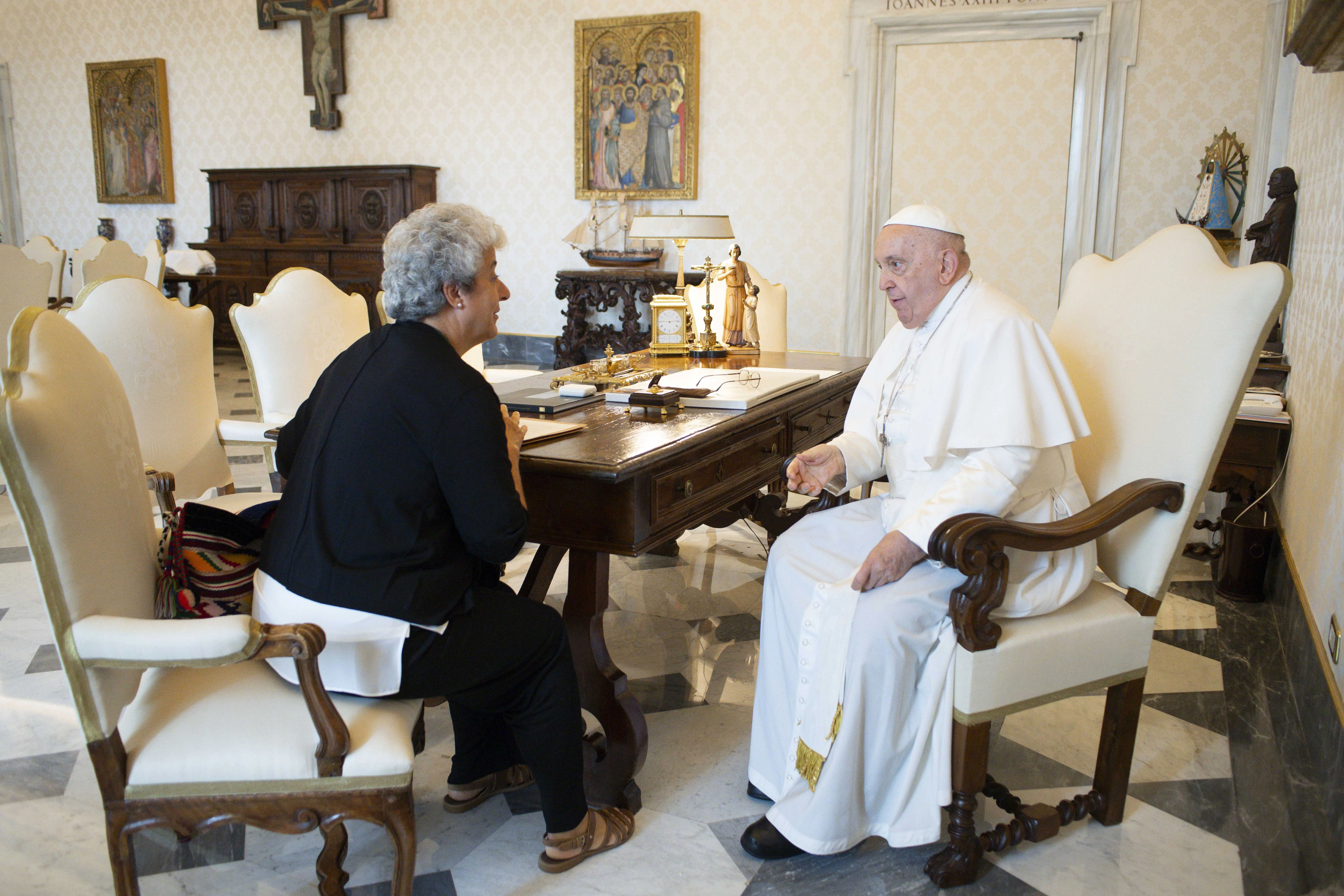
Pope Francis meets Maria Campatelli, director of the Aletti Center, at the Vatican on Sept. 15, 2023. The Aletti Center was founded in Rome by the former Jesuit priest Father Marko Rupnik. Credit: Vatican Media
The women said that Pope Francis’ recent meeting with Maria Campatelli, the current director of the Aletti Center and a close collaborator of Rupnik, further caused them pain because the pope never responded to letters from members and former members of the Loyola Community.
“That meeting granted by the pope to Campatelli in such a friendly atmosphere was thrown in the faces of the victims (these and all victims of abuse); a meeting that the pope denied them,” the open letter said.
“The victims are left with a voiceless cry of new abuse,” it added.
Rupnik was dismissed by the Jesuits in June after having been accused of spiritual, psychological, and sexual abuse spanning more than three decades.
The Diocese of Rome announced on Sept. 18 that a canonical investigation into the Aletti Center conducted by Monsignor Giacomo Incitti, a professor of canon law at the Pontifical Urbaniana University in Rome, had concluded and cleared the community of having any serious problems.
Last year, a woman claimed in an interview with the Italian newspaper Domani that Rupnik had previously abused her in his room at the Aletti Center in Rome when she was a religious sister.
The statement released by the diocese said that the visitation was “able to ascertain that the members of the Aletti Center, although saddened by the accusations received and the ways in which they were handled, chose to maintain silence — despite the vehemence of the media — to guard their hearts and not claim some blamelessness with which to stand as judge of others.”
It said that the investigation also had examined the main accusations against Rupnik and the procedures behind his excommunication.
Rupnik previously received an automatic, or “latae sententiae,” excommunication for hearing the confession and then attempting to grant absolution to a woman with whom he had sexual relations. The Jesuits’ internal investigation confirmed Rupnik’s excommunication in January 2020, which was lifted in May 2020 after Rupnik repented of the canonical crime.
According to the Diocese of Rome, the visitation identified “gravely irregular procedures” that “generated well-founded doubts about even the request for excommunication itself.”
In light of these “doubts,” Cardinal Angelo De Donatis, the vicar of the Diocese of Rome, submitted the report to Church authorities.
The announcement from the Rome Diocese came days after Pope Francis met with Campatelli, the director of the Aletti Center, who published a letter in June defending Rupnik against “a media campaign based on defamatory and unproven accusations” and claiming the Jesuits had withheld documents “which would demonstrate a truth different from that which was being published.”
In the letter posted to the Aletti Center website on June 17, two days after the public announcement of Rupnik’s expulsion from the Society of Jesus, Campatelli accused the Jesuit order of withholding information from the media, including documents “which would demonstrate a truth different from that which was being published.”
She said that Rupnik had in January requested to leave the Jesuits after losing trust in his superiors for favoring “a media campaign based on defamatory and unproven accusations (which exposed the person of Father Rupnik and the Aletti Center to forms of lynching).” She also said other Jesuits who are part of the Aletti Center had put in requests to leave the religious order.
The canonical visitation of the Aletti Center took place between Jan.16 and June 23, and included community meetings and interviews with members of the center.
If you value the news and views Catholic World Report provides, please consider donating to support our efforts. Your contribution will help us continue to make CWR available to all readers worldwide for free, without a subscription. Thank you for your generosity!
Click here for more information on donating to CWR. Click here to sign up for our newsletter.
Pope Francis at the general audience in St. Peter’s Square, Oct. 5, 2016. / Daniel Ibanez/CNA.
Washington, D.C. Newsroom, Mar 13, 2023 / 13:15 pm (CNA).
Today marks the 10th anniversary of the election of Pope Francis as the 265th successor of St. Peter. Here is a timeline of key events during his papacy:
2013
March 13 — About two weeks after Pope Benedict XVI steps down from the papacy, Cardinal Jorge Bergoglio is elected pope. He takes the papal name Francis in honor of St. Francis of Assisi and proclaims from the central balcony of St. Peter’s Basilica: “Let us begin this journey, the bishop and people, this journey of the Church of Rome, which presides in charity over all the Churches, a journey of brotherhood in love, of mutual trust. Let us always pray for one another.”
March 14 — The day after he begins his pontificate, Pope Francis returns to his hotel to personally pay his hotel bill and collect his luggage.
July 8 — Pope Francis visits Italy’s island of Lampedusa and meets with a group of 50 migrants, most of whom are young men from Somalia and Eritrea. The island, which is about 200 miles off the coast of Tunisia, is a common entry point for migrants who flee parts of Africa and the Middle East to enter Europe. This is the pope’s first pastoral visit outside of Rome and sets the stage for making reaching out to the peripheries a significant focus.
Pope Francis gives the Wednesday general audience in St. Peter’s Square on Oct. 2, 2013. . Elise Harris/CNA.
July 23–28 — Pope Francis visits Rio de Janeiro, Brazil, to participate in World Youth Day 2013. More than 3 million people from around the world attend the event.
July 29 — On the return flight from Brazil, Pope Francis gives his first papal news conference and sparks controversy by saying “if a person is gay and seeks God and has goodwill, who am I to judge?” The phrase is prompted by a reporter asking the pope a question about priests who have homosexual attraction.
Nov. 24 — Pope Francis publishes his first apostolic exhortation Evangelii gaudium (The Joy of the Gospel). The document illustrates the pope’s vision for how to approach evangelization in the modern world.
2014
Feb. 22 — Pope Francis holds his first papal consistory to appoint 19 new cardinals, including ones from countries in the developing world that have never previously been represented in the College of Cardinals, such as Haiti.
March 22 — Pope Francis creates the Pontifical Commission for the Protection of Minors. The commission works to protect the dignity of minors and vulnerable adults, such as the victims of sexual abuse.
Pope Francis greets pilgrims during his general audience on Nov. 29, 2014. Bohumil Petrik/CNA.
Oct. 5 — The Synod on the Family begins. The bishops discuss a variety of concerns, including single-parent homes, cohabitation, homosexual adoption of children, and interreligious marriages.
Dec. 6 — After facing some pushback for his efforts to reform the Roman Curia, Pope Francis discusses his opinion in an interview with La Nacion, an Argentine news outlet: “Resistance is now evident. And that is a good sign for me, getting the resistance out into the open, no stealthy mumbling when there is disagreement. It’s healthy to get things out into the open, it’s very healthy.”
2015
Jan. 18 — To conclude a trip to Asia, Pope Francis celebrates Mass in Manila, Philippines. Approximately 6 million to 7 million people attend the record-setting Mass, despite heavy rain.
March 23 — Pope Francis visits Naples, Italy, to show the Church’s commitment to helping the fight against corruption and organized crime in the city.
May 24 — To emphasize the Church’s mission to combat global warming and care for the environment, Pope Francis publishes the encyclical Laudato si’, which urges people to take care of the environment and encourages political action to address climate problems.
Pope Francis at a Wednesday general audience in St. Peter’s Square on June 17, 2015. Bohumil Petrik.
Sept. 19–22 — Pope Francis visits Cuba and meets with Fidel Castro in the first papal visit to the country since Pope John Paul II in 1998. During his homily, Francis discusses the dignity of the human person: “Being a Christian entails promoting the dignity of our brothers and sisters, fighting for it, living for it.”
Sept. 22–27 — After departing from Cuba, Pope Francis makes his first papal visit to the United States. In Washington, D.C., he speaks to a joint session of Congress, in which he urges lawmakers to work toward promoting the common good, and canonizes the Franciscan missionary St. Junípero Serra. He also attends the World Meeting of Families in Philadelphia, which focuses on celebrating the gift of the family.
Oct. 4 — Pope Francis begins the second Synod on the Family to address issues within the modern family, such as single-parent homes, cohabitation, poverty, and abuse.
Oct. 18 — The pope canonizes St. Louis Martin and St. Marie-Azélie “Zelie” Guérin. The married couple were parents to five nuns, including St. Therese of Lisieux. They are the first married couple to be canonized together.
Dec. 8 — Pope Francis’ Jubilee Year of Mercy begins. The year focuses on God’s mercy and forgiveness and people’s redemption from sin. The pope delegates certain priests in each diocese to be Missionaries of Mercy who have the authority to forgive sins that are usually reserved for the Holy See.
2016
March 19 — Pope Francis publishes the apostolic exhortation Amoris laetitia, which discusses a wide variety of issues facing the modern family based on discussions from the two synods on the family. The pope garners significant controversy from within the Church for comments he makes in Chapter 8 about Communion for the divorced and remarried.
April 16 — After visiting refugees on the Greek island of Lesbos, Pope Francis allows three Muslim refugee families to join him on his flight back to Rome. He says the move was not a political statement.
Pope Francis at the General Audience in St. Peter’s Square, Feb. 24, 2016. Daniel Ibanez/CNA.
July 26–31 — Pope Francis visits Krakow, Poland, as part of the World Youth Day festivities. About 3 million young Catholic pilgrims from around the world attend.
Sept. 4 — The pope canonizes St. Teresa of Calcutta, who is also known as Mother Teresa. The saint, a nun from Albania, dedicated her life to missionary and charity work, primarily in India.
Sept. 30–Oct. 2 — Pope Francis visits Georgia and Azerbaijan on his 16th trip outside of Rome since the start of his papacy. His trip focuses on Catholic relations with Orthodox Christians and Muslims.
Oct. 4 — Pope Francis makes a surprise visit to Amatrice, Italy, to pray for the victims of an earthquake in central Italy that killed nearly 300 people.
2017
May 12–13 — In another papal trip, Francis travels to Fatima, Portugal, to visit the Shrine of Our Lady of Fatima. May 13 marks the 100th anniversary of the first Marian apparition to three children in the city.
July 11 — Pope Francis adds another category of Christian life suitable for the consideration of sainthood: “offering of life.” The category is distinct from martyrdom, which only applies to someone who is killed for his or her faith. The new category applies to those who died prematurely through an offering of their life to God and neighbor.
Pope Francis greets a participant in the World Day of the Poor in Rome, Nov. 16, 2017. L’Osservatore Romano.
Nov. 19 — On the first-ever World Day of the Poor, Pope Francis eats lunch with 4,000 poor and people in need in Rome.
Nov. 27–Dec. 2 — In another trip to Asia, Pope Francis travels to Myanmar and Bangladesh. He visits landmarks and meets with government officials, Catholic clergy, and Buddhist monks. He also preaches the Gospel and promotes peace in the region.
2018
Jan. 15–21 — The pope takes another trip to Latin America, this time visiting Chile and Peru. The pontiff meets with government officials and members of the clergy while urging the faithful to remain close to the clergy and reject secularism. The Chilean visit leads to controversy over Chilean clergy sex abuse scandals.
Aug. 2 — The Vatican formally revises No. 2267 of the Catechism of the Catholic Church, which concerns the death penalty. The previous text suggested the death penalty could be permissible in certain circumstances, but the revision states that the death penalty is “inadmissible.”
Aug. 25 — Archbishop Carlo Viganò, former papal nuncio to the United States, publishes an 11-page letter calling for the resignation of Pope Francis and accusing him and other Vatican officials of covering up sexual abuse including allegations against former Cardinal Theodore McCarrick. The pope initially does not directly respond to the letter, but nine months after its publication he denies having prior knowledge about McCarrick’s conduct.
Aug. 25–26 — Pope Francis visits Dublin, Ireland, to attend the World Meeting of Families. The theme is “the Gospel of family, joy for the world.”
Pope Francis at the 2018 World Meeting of Families in Ireland. . Daniel Ibanez/CNA.
Oct. 3–28 — The Synod on Young People, the Faith, and Vocational Discernment takes place. The synod focuses on best practices to teach the faith to young people and to help them discern God’s will.
2019
Jan. 22–27 — The third World Youth Day during Pope Francis’ pontificate takes place during these six days in Panama City, Panama. Young Catholics from around the world gather for the event, with approximately 3 million people in attendance.
Feb. 4 — Pope Francis signs a joint document in with Sheikh Ahmed el-Tayeb, the grand imam of Al-Azhar, in Abu Dhabi, United Arab Emirates, titled the “Document on Human Fraternity for World Peace and Living Together.” The document focuses on people of different faiths uniting together to live peacefully and advance a culture of mutual respect.
Pope Francis and Ahmed el-Tayeb, grand imam of al-Azhar, signed a joint declaration on human fraternity during an interreligious meeting in Abu Dhabi, UAE, Feb. 4, 2019. Vatican Media.
Feb. 21–24 — The Meeting on the Protection of Minors in the Church, which is labeled the Vatican Sexual Abuse Summit, takes place. The meeting focuses on sexual abuse scandals in the Church and emphasizes responsibility, accountability, and transparency.
Oct. 6–27 — The Church holds the Synod of Bishops for the Pan-Amazon region, which is also known as the Amazon Synod. The synod is meant to present ways in which the Church can better evangelize the Amazon region but leads to controversy when carved images of a pregnant Amazonian woman, referred to by the pope as Pachamama, are used in several events and displayed in a basilica near the Vatican.
Oct. 13 — St. John Henry Newman, an Anglican convert to Catholicism and a cardinal, is canonized by Pope Francis. Newman’s writings inspired Catholic student associations at nonreligious colleges and universities in the United States and other countries.
2020
March 15 — Pope Francis takes a walking pilgrimage in Rome to the chapel of the crucifix and prays for an end to the COVID-19 pandemic. The crucifix was carried through Rome during the plague of 1522.
March 27 — Pope Francis gives an extraordinary Urbi et Orbi blessing in an empty and rain-covered St. Peter’s Square, praying for the world during the coronavirus pandemic.
Pope Francis venerates the miraculous crucifix of San Marcello al Corso in St. Peter’s Square during his Urbi et Orbi blessing, March 27, 2020. Vatican Media.
2021
March 5–8 — In his first papal trip since the start of the COVID-19 pandemic, Pope Francis becomes the first pope to visit Iraq. On his trip, he signs a joint statement with Grand Ayatollah Ali al-Sistani condemning extremism and promoting peace.
July 3 — Cardinal Giovanni Angelo Becciu, who was elevated to the College of Cardinals by Pope Francis, is indicted in a Vatican court for embezzlement, money laundering, and other crimes. The pope gives approval for the indictment.
July 4 — Pope Francis undergoes colon surgery for diverticulitis, a common condition in older people. The Vatican releases a statement that assures the pope “reacted well” to the surgery. Francis is released from the hospital after 10 days.
July 16 — Pope Francis issues a motu proprio titled Traditionis custodes. The document imposes heavy restrictions on the celebration of the Traditional Latin Mass.
Dec. 2–6 — The pope travels to Cyprus and Greece. The trip includes another visit to the Greek island of Lesbos to meet with migrants.
Pope Francis greets His Beatitude Ieronymos II in Athens, Greece on Dec. 5, 2021. Vatican Media
2022
Jan. 11 — Pope Francis makes a surprise visit to a record store in Rome called StereoSound. The pope, who has an affinity for classical music, blesses the newly renovated store.
March 19 — The pope promulgates Praedicate evangelium, which reforms the Roman Curia. The reforms emphasize evangelization and establish more opportunities for the laity to be in leadership positions.
May 5 — Pope Francis is seen in a wheelchair for the first time in public and begins to use one more frequently. The pope has been suffering from knee problems for months.
Pope Francis greeted the crowd in a wheelchair at the end of his general audience on Aug. 3, 2022. Daniel Ibanez/CNA
July 24–30 — In his first papal visit to Canada, Pope Francis apologizes for the harsh treatment of the indigenous Canadians, saying many Christians and members of the Catholic Church were complicit.
2023
Jan. 31–Feb. 5 — Pope Francis travels to the Democratic Republic of Congo and South Sudan. During his visit, the pope condemns political violence in the countries and promotes peace. He also participates in an ecumenical prayer service with Anglican Archbishop of Canterbury Justin Welby and Moderator of the Church of Scotland Iain Greenshields.
Director Dallas Jenkins (left) and Jonathan Roumie, who plays Jesus in the wildly successful TV series “The Chosen,” speak with journalists during a press conference on June 23, 2025, at the Vatican. / Credit: Daniel Ibañez/CNA
Pope Francis and the editor of his autobiography, Carlo Musso. / Credit: Courtesy or Carlo Musso
Vatican City, Jan 28, 2025 / 11:00 am (CNA).
“Hope is the mainstay that undergirds Pope Francis’ entire life and is the thread that holds together … […]
9 Comments
This can all be understood with one simple submission of the mind. All that these “shepherds” ask is that “the sheep” pretend reality isn’t happening.
Or to put it more poetically, in this “new-Church,” there are no sheep, only cattle.
The Synod on Synodaling will explore a solution to the Rupnik problem: Sharing power with women, especially by ordaining them.
The synodal logic suggests that the because Rupnik abused his power in secret practices to abuse some physically, this pontificate will abuse its power in secret Synodaling to abuse all of us theologically.
Even more than the Pachamama desecration, the Rupnik imbroglio is the best depiction of the profound depths of the spiritual darkness of Bergoglio’s Dark Vatican.
Compare and contrast these monstrous opacities with the greatest objective of Bergoglio’s papacy:
Stamping out the ancient and traditional Catholic Mass celebrated in Latin.
A tad disturbing, eh?
You don’t have to work very hard to uncover the presence of the unholy spirit in all of this.
The alleged actions of Father Rupnick, if actually true (and with which the Jesuits and others seem to agree), are reprehensible and require ongoing attention and action. Nevertheless, in keeping with historic Catholic Theology, such actions do not undermine either the art or the ministry and mission of the Center. A priest can produce glorious and theologically faithful art while engaging in criminal actions and behaving faithlessly himself. While we must advocate and pray for victims, we must also acknowledge historic Catholic teaching.
Closing one’s eyes and holding one’s nose doesn’t remove the stench that emits from that “Center”. Seeing Rupnik’s spooky art on the cover of our hymnal every week sullies the reverence of the Holy Sacrifice.
The Jesuit authority had dismissed FrcRupnik for his sexual depravity. The director of Alletti stated that the pope never responded to letters sent to him on the matter an and defended Fr Rupnik. The Diocese of Rome praised Fr Rupnik. What all these show ? When he was dismissed for sexual offences , how he was not reported to
Pope and why pope remained silent is not known. The net effect is confusion in the minds of all specially the young ones and becoming a new believer in the Church
This can all be understood with one simple submission of the mind. All that these “shepherds” ask is that “the sheep” pretend reality isn’t happening.
Or to put it more poetically, in this “new-Church,” there are no sheep, only cattle.
The Synod on Synodaling will explore a solution to the Rupnik problem: Sharing power with women, especially by ordaining them.
The synodal logic suggests that the because Rupnik abused his power in secret practices to abuse some physically, this pontificate will abuse its power in secret Synodaling to abuse all of us theologically.
That is way of synodaling…
All cattle synodaling are asked to signal their assent by mooing.
“A truth different from the one being published.” Leave it to a Jesuit to not comprehend the principle of non-contradiction.
Even more than the Pachamama desecration, the Rupnik imbroglio is the best depiction of the profound depths of the spiritual darkness of Bergoglio’s Dark Vatican.
Compare and contrast these monstrous opacities with the greatest objective of Bergoglio’s papacy:
Stamping out the ancient and traditional Catholic Mass celebrated in Latin.
A tad disturbing, eh?
You don’t have to work very hard to uncover the presence of the unholy spirit in all of this.
The alleged actions of Father Rupnick, if actually true (and with which the Jesuits and others seem to agree), are reprehensible and require ongoing attention and action. Nevertheless, in keeping with historic Catholic Theology, such actions do not undermine either the art or the ministry and mission of the Center. A priest can produce glorious and theologically faithful art while engaging in criminal actions and behaving faithlessly himself. While we must advocate and pray for victims, we must also acknowledge historic Catholic teaching.
Closing one’s eyes and holding one’s nose doesn’t remove the stench that emits from that “Center”. Seeing Rupnik’s spooky art on the cover of our hymnal every week sullies the reverence of the Holy Sacrifice.
The Jesuit authority had dismissed FrcRupnik for his sexual depravity. The director of Alletti stated that the pope never responded to letters sent to him on the matter an and defended Fr Rupnik. The Diocese of Rome praised Fr Rupnik. What all these show ? When he was dismissed for sexual offences , how he was not reported to
Pope and why pope remained silent is not known. The net effect is confusion in the minds of all specially the young ones and becoming a new believer in the Church
If it took over 30 years to catch this fox there must be many a story yet to be told.