


Vatican City, Sep 17, 2023 / 07:41 am (CNA).
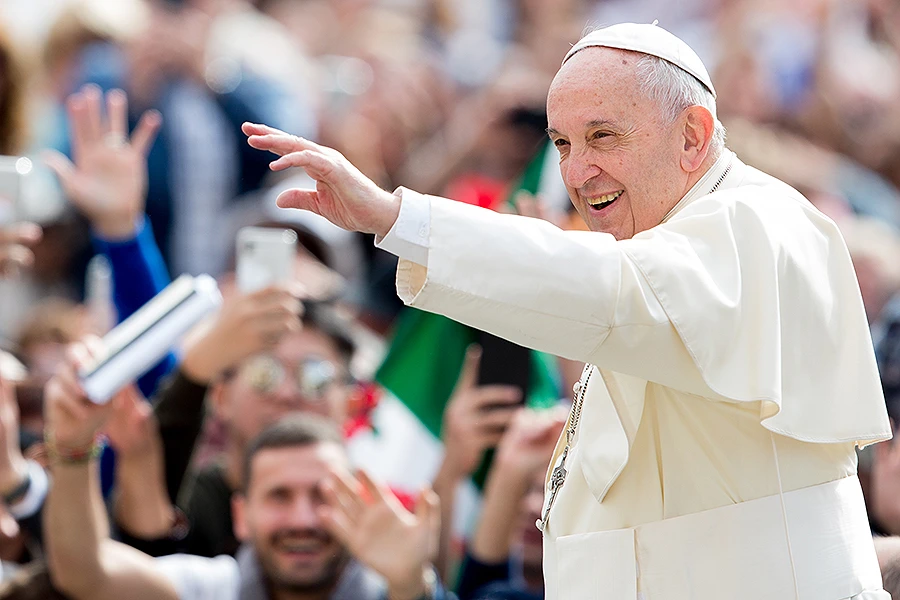
Think of someone who has hurt you and ask God for the strength to forgive that person, Pope Francis told the crowd gathered in St. Peter’s Square on Sunday.
Speaking from a window of the Vatican’s Apostolic Palace on Sept. 17, the pope underlined that forgiveness can heal “the poisons of resentment” and “restore peace to our hearts.”
In his Angelus message, the pope said that forgiving is “not a good deed that we can choose to do or not do,” but “a fundamental condition for those who are Christians.”
“Every one of us, in fact, is ‘forgiven,’” he said. “God gave His life for us and in no way can we compensate for his mercy, which he never withdraws from his heart. However, by corresponding to his gratuitousness, that is, by forgiving one another, we can bear witness to him, sowing new life around us.”
“For outside of forgiveness, there is no hope; outside of forgiveness there is no peace.”
The pope compared forgiveness to “oxygen that purifies the air polluted by hatred” and heals the “many diseases of the heart that contaminate society.”

He reflected on Jesus’ response to Peter, who had asked: “Lord, if my brother sins against me, how often must I forgive him? As many as seven times?”
“Jesus answered, ‘I say to you, not seven times but seventy-seven times. (Mt. 18:21-22)’”
Pope Francis added: “Jesus’ message is clear: God forgives incalculably, exceeding all measure. This is how he is; He acts out of love, and gratuitously. … We cannot repay Him but, when we forgive a brother or a sister, we imitate Him.”
“May Mary, Mother of Mercy, help us to receive the grace of God and to forgive each other,” he said.

After praying the Angelus prayer in Latin with the crowd, Pope Francis noted that he will travel to Marseille, France on Friday to attend a meeting of bishops from the Mediterranean region that will have a special focus on the issue of migration.
He said that migration is a “challenge” that must be faced together, adding that the future will only be prosperous if “it is built on fraternity, putting human dignity first … especially for those most in need.”
Pope Francis said that Marseille is called to be “a port of hope,” and asked people to pray for his upcoming journey to the French city Sept. 22-23.
If you value the news and views Catholic World Report provides, please consider donating to support our efforts. Your contribution will help us continue to make CWR available to all readers worldwide for free, without a subscription. Thank you for your generosity!
Click here for more information on donating to CWR. Click here to sign up for our newsletter.


A friend told me that Pope John Paul II had forgiven his attacker, three days after the assassination attempt on his life. Wow! “So did Pope John Paul II have his attacker over for dinner at the Vatican to forgive him?”, I anxiously wanted to know. My friend exclaimed, “He didn’t let him out of prison! He forgave him from the heart!” Please remember that Jesus wants you to call the police and protect yourself from the domestic violence of a loved one. It is ok to forgive a violent loved one from behind prison bars.
“For the sake of peace”, Pope Francis does not get rid of his armed protectors, in order to love and forgive his enemies, by letting his enemies just walk in and murder him. No, Pope Francis forgives his enemies, even if he has to kill them to protect himself, while he forgives his enemies from the heart. It is, Outside of Justice, that there is no peace, while you are forgiving your enemies from the heart.
“For outside of forgiveness, there is no hope; outside of forgiveness there is no peace.”, says Pope Francis, but it should actually read, outside of ‘Justice’ there is no peace. You can kill an aggressor, in order to, ‘love your neighbor as yourself’ protect the innocent, while, at the same time, forgiving the aggressor in your heart.
Leviticus 19 Various Rules of Conduct
…nor shall you stand by idly when your neighbor’s life is at stake. I am the LORD. “You shall not bear hatred for your brother in your heart. Though you may have to reprove your fellow man, do not incur sin because of him. Take no revenge and cherish no grudge against your fellow countrymen. You shall love your neighbor as yourself. I am the LORD.”
Luke 22:35
“And the man without a sword must sell his coat and buy one.”
It’s a win-win situation. Forgiveness is healing and empowering the forgiver and the receiver of forgiveness.