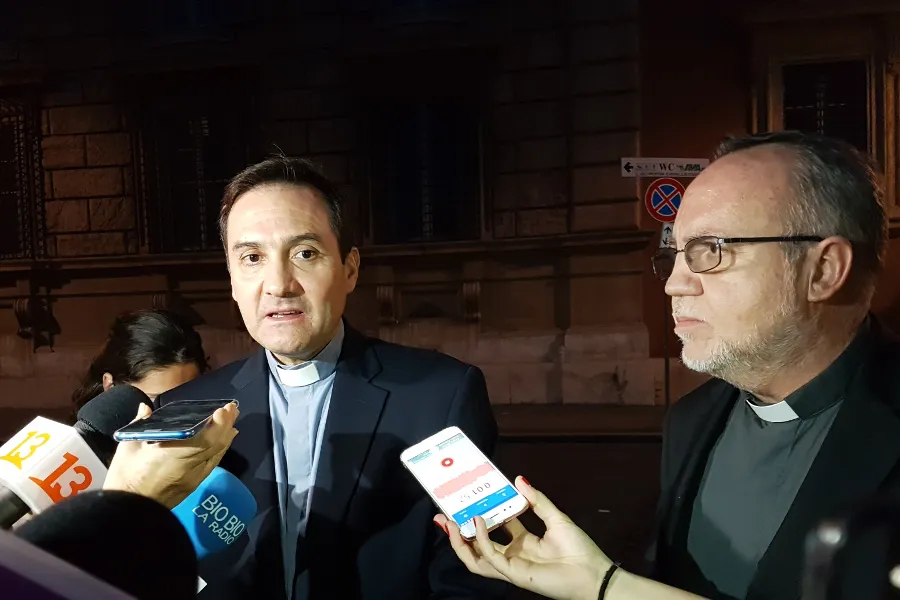
Vatican City, Jun 2, 2018 / 03:42 pm (CNA/EWTN News).- Survivors of sexual abuse and other abuses perpetrated by Chile’s most notorious abuser priest, Fernando Karadima, met with Pope Francis Saturday. They said they found a pope who not only listened and suffered with them, but who truly understood the depth of the crisis and the steps that are needed going forward.
“I came to Rome with three ideas. First, that he invited us, the advice that Peter would share with us, and also with hope. I have to say that the three things are confirmed and have exceeded my expectations,” Fr. Eugenio de la Fuente Lora told journalists June 2 after meeting with the pope.
Three fundamental takeaways from the encounter, he said, are the pope’s “listening, empathy and welcome.”
De la Fuente, who was a victim of Karadima’s abuse, voiced gratitude for feeling “completely understood by someone admirably empathetic, who suffered with my pain and understood it.”
Pope Francis, he said, “has a very deep understanding of the problem and… he has some very concrete ideas for how to advance, always on the short, medium and long term.”
Renewal won’t be immediate, but it will take time, he said, adding that the pope is “very clear” about what needs to be done.
De la Fuente is part of a second group of priests and victims of Chile’s most notorious abuser priest, Fr. Fernando Karadima. They are holding meetings with Pope Francis at the Vatican June 1-3.
Staying at the Santa Marta guesthouse, where Pope Francis lives, the group of nine includes five priests who were victims of abuse of power, conscience, and sexuality; two priests who have been assisting the victims; and two lay people.
In addition to De la Fuente, the group includes Fr. Francisco Javier Astaburuaga Ossa, a priest who accompanied victims Juan Carlos Cruz and James Hamilton before they went public about their abuse. Another victim of Karadima’s abuse, Fr. Alejandro Vial Amunátegui, is also in the group.
Two of the other priests who will meet with the pope are Fr. Javier Barros Bascuñán and Fr. Sergio Cobo Montalba. The remaining four participants have chosen not to go public.
Msgr. Jordi Bertomeu, who assisted Maltese Archbishop Charles Scicluna in the February investigation of the Chilean crisis, was also present. The two investigators will travel to Chile again in the coming days, this time visiting the Diocese of Osorno, rather than Santiago.
Saturday’s meeting with survivors began with 4 p.m. Mass June 2, after which the group stayed with the pope for four hours and fifteen minutes. Francis met them individually and as a group before taking his leave at 8:15 p.m. No other encounters with the pope are expected before the group returns to Chile.
In comments to the press after meeting with the pope, Astaburuaga said Francis focused heavily on the concept of the “holy faithful People of God” spoken of in the Second Vatican Council document “Lumen Gentium,” saying the Church must work harder to build an ecclesiology that has “a strong sense” of this concept.
“The people of God are essential, pastors are from the people of God and they are also there to serve the people of God,” Astaburuaga said, adding that all baptized are called to be “builders of the Church.”
The priest said that in order to change the “culture of abuse and concealment” Pope Francis spoke of in a recent letter to Chilean Catholics, a careful process of discernment is needed which takes three things into consideration: time, people and place.
When contemplating any decision, it’s important to think about “who are the people, places and times,” he said, stressing that the process of renewal in Chile is “the work of everyone, not just one.”
“This is why the pope insisted on returning to the concept of the people of God from the Second Vatican Council. We are all responsible: priests, bishops, laity, the holy people. It’s a joint task.”
Pope Francis, he said, listened “very carefully” when he spoke about his experience accompanying victims of abuse. “This is the testimony he gave us. To listen, and to listen with a lot of attention (and) a lot of trust.”
Though the process has at times been difficult, Astaburuaga said accompanying victims such as Cruz and Hamilton over the past 20 years “has its fruits,” and “it’s a great joy in the midst of their great suffering.”
Pope Francis, he said, also asked them to continue praying for the Church in Chile, particularly by emphasizing Eucharistic Adoration more strongly in local dioceses.
The pope also again asked for forgiveness in the name of the Church for the suffering each of them has lived, said Astaburuaga, who called the act “a great humility” on the part of the pope.
“I’ll go back to Chile with a lot of hope,” he said, adding that “beyond the difficulties there are, conflicts are always an opportunity. Conflicts that we have to face, but always with hope.”
Most of those who came to the Vatican for the June 2 meeting with the pope participated in an investigation of abuse cover-up by the hierarchy in Chile, which took place in February and was conducted by Archbishop Charles Scicluna of Malta and Msgr. Jordi Bertomeu of the Congregation for the Doctrine of the Faith. The others worked with the investigation after the archbishop’s time in Chile.
This weekend’s gathering conclude the pope’s first round of meetings with the victims of abuses which occurred at Karadima’s Sacred Heart parish in Santiago.
Pope Francis said Mass for the group June 2, after which he met the nine as a group before holding individual conversations. He had met with three more of Karadima’s victims, Juan Carlos Cruz, James Hamilton, and Andres Murillo, at the Vatican April 27-30.
Karadima was convicted by the Congregation for the Doctrine of the Faith in 2011 of abusing minors, and sentenced to a life of prayer and penance. He has not been sentenced by civil courts because of Chile’s statue of limitations.
A priestly association Karadima was involved in and which he had led for many years, the Priestly Union of the Sacred Heart, was suppressed within a year of his conviction.
Attention to Karadima’s abuse has heightened since the appointment of Bishop Juan de la Cruz Barros Madrid to the Diocese of Osorno in 2015. Barros had been accused of both covering up and at times participating in Karadima’s abuses.
Pope Francis initially defended Barros, saying he had received no evidence of the bishop’s guilt, and called accusations against him “calumny” during a trip to Chile in January. He later relented, and sent Scicluna to investigate the situation in Chile.
After receiving Scicluna’s report, Francis apologized, said that he had been seriously mistaken, and asked to meet the country’s bishops and more outspoken survivors in person.
He met with Chile’s bishops May 15-17. As a result, each of them tendered letters of resignation, which Pope Francis has yet to accept or reject. The pope also gave the bishops a letter chastising them for systemic cover-up of clerical abuse and calling them to institute deep changes.
On May 31, the Vatican announced that Francis has decided to send Scicluna and Bertomeu back to Chile in the coming days, this time traveling to the Diocese of Osorno, where Barros is stationed, in order to “advance the process of healing and reparation for victims of abuse” in Chile.
 […]
[…]



In complete support for this message, and understanding the despair that lies behind addictive escapism—yours truly wonders whether drug abuse should be alphabetized and aggregated?
What if the not-real and new psychoactive substances (NPS), for example, are simply aggregated with real drugs as in NPS-C-MPMA-LSD? And, what if the case then is made that NPS addiction might yet remain unsanctioned—and even “blessed” in some way? The same way that alphabetized and aggregated LGBTQA addiction is attached to real marriage and then seeks a blessing for unreal “gay marriage”?
For an answer, should we channel the synodal reporter general Cardinal Hollerich and synodal guru Fr. Jiminy-Cricket Martin? Hollerich, at least, no longer seeks to overturn Church teaching about binary sexual reality, but does look for a change in “attitude.” Meaning what, exactly? As for Jiminy-Cricket Martin’s fluid spirit of accompaniment/accommodation—and as the saying goes, “sauce for a [male] goose is sauce for a [female] gander, AND now is sauce for the third option, and for whatever!
In all underlying “concrete experiences, stories of loneliness, inequality, exclusion, lack of integration [Pope Francis]”—and then addictive escapes into unreality—there’s the graced invitation and narrow path of Christ, the “concrete universal.” A higher and deeper and more healing path than any therapeutic adjustment of “attitude” alone, against the diabolical betrayal of both God and the real self.
Life is a precious gift. Drug dealers, drug users, and drug makers need to be evangelized.
Absolutely Dr. Coelho. I agree. That & the practical steps that need to be taken also.
We need to reopen mental hospitals ASAP. There’s a relentless circle of mental/emotional illness & addiction. Society can do a lot better than watching homeless addicts overdose in our streets.
But of course, we cannot build a border wall to help stem the flood of illegal drugs ravaging the nation, especially the poor. That would be too “rigid,” no doubt.
Drugs do enter hidden in migrant backpacks but the overwhelming majority come right through official US border crossings concealed in vehicles including 18 wheelers. You can smuggle an enormous amount of contraband that way. US citizens often smuggle drugs purchased in Mexico. And we provide the guns & ammo to the cartels.
It takes two sides to smuggle successfully.