




Vatican City, Aug 26, 2023 / 09:30 am (CNA).
Pope Francis acknowledged Saturday that the upcoming Synod on Synodality may be “of little interest to the general public,” but underlined that the synod is “truly important” for the Catholic Church.
“I am well aware that speaking of a ‘Synod on Synodality’ may seem something abstruse, self-referential, excessively technical, and of little interest to the general public,” Pope Francis said on Aug. 26.
“But what has happened over the past year, which will continue with the assembly next October and then with the second stage of Synod 2024, is something truly important for the Church.”
The pope spoke about the significance of the synod nearly one month ahead of the first global Synod on Synodality assembly taking place at the Vatican Oct. 4–28.
It is the first of two assemblies that culminate the Church’s multiyear, worldwide undertaking during which Catholics were asked to submit feedback at diocesan, national, and continental levels.
“We have opened our doors, we have offered everyone the opportunity to participate, we have taken into account everyone’s needs and suggestions. We want to contribute together to build the Church where everyone feels at home, where no one is excluded,” Pope Francis said.
“That word of the Gospel that is so important: everyone. Everyone, everyone: there are no first-, second- or third-class Catholics, no. All together. Everyone. It is the Lord’s invitation.”
The pope underlined that the Church needs to “get used to listening to each other, to talking, not cutting our heads off for a word” and “to listen and discuss in a mature way.”
“This is a grace we all need in order to move forward. And it is something the Church today offers the world, a world so often so incapable of making decisions, even when our very survival is at stake,” he said.
“We are trying to learn a new way of living relationships, listening to one another to hear and follow the voice of the Spirit.”
To explain the significance of the Synod on Synodality, Pope Francis described the synod as “a journey that St. Paul VI began at the end of the [Vatican II] Council when he created the Secretariat of the Synod of Bishops because he had realized that in the Western Church synodality had disappeared, whereas in the Eastern Church they have this dimension.”
“And this years-long journey — 60 years — is bearing great fruit,” he added.
Pope Francis spoke about the upcoming synod while accepting an award from Italian journalists at the Vatican’s Apostolic Palace, noting that he usually declines awards and honors.
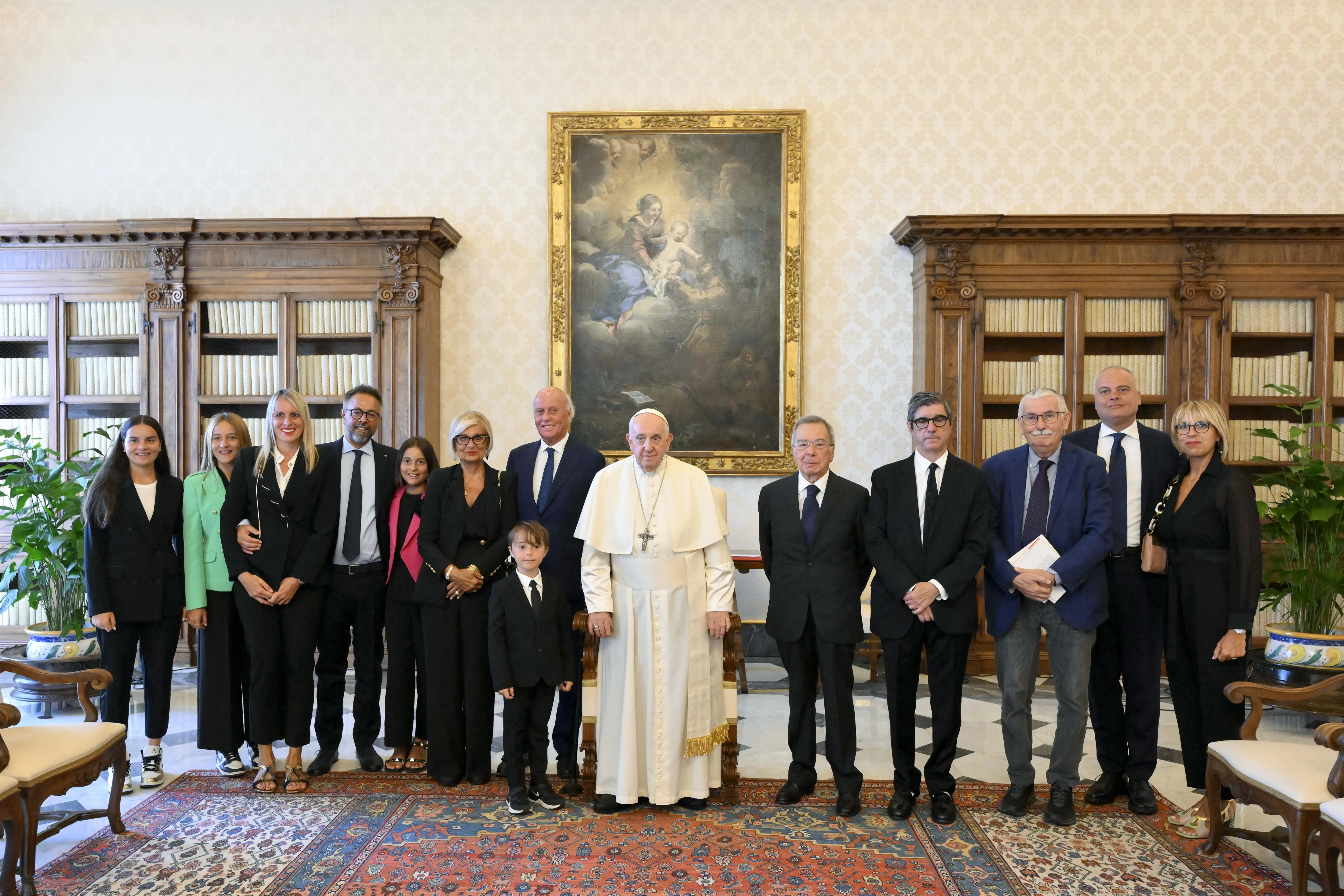
“You must know that, even before becoming bishop of Rome, I used to decline the offer of awards. I never received any, I did not want to. And I have continued to do so even as pope. There is, however, one reason that prompted me to accept yours, and that is the urgency of constructive communication, which fosters the culture of encounter and not of confrontation; the culture of peace and not of war; the culture of openness to the other and not of prejudice,” he said.
“Disinformation is one of the sins of journalism,” he added while enumerating other “journalistic sins,” including slander, defamation, and a “love of scandal.”
“We need to spread a culture of encounter, a culture of dialogue, a culture of listening to the other and his or her reasons,” he said. “Digital culture has brought us so many new possibilities for exchange, but it also risks turning communication into slogans.”
Pope Francis also met with a delegation of Catholic legislators on Saturday who are taking part in a meeting on the topic of “Great Power Struggle, Corporate Capture, and Technocracy: A Christian Answer to Dehumanizing Trends.”
The International Catholic Legislators Network is a group of Catholic parliamentarians from around the world that holds an annual private meeting in Rome.
The group, founded in 2010 by the Austrian Cardinal Christoph Schönborn and David Alton, a member of Britain’s House of Lords, is dedicated to religious liberty, Church-state relations, the protection of life, and communicating Catholic thought in secular politics.

Pope Francis spoke to the lawmakers about how “today’s dominant technocratic paradigm raises profound questions about the place of human beings and of human action in the world.”
“Surely one of the most concerning aspects of this paradigm, with its negative impact upon both human and natural ecology alike, is its subtle seduction of the human spirit, lulling people — and especially the young — into misusing their freedom,” the pope said.
He encouraged the lawmakers to continue to promote Catholic social teaching, “especially the centrality of the God-given value and dignity of every human person.”
“I pray that the Holy Spirit will inspire and guide your efforts to form a new generation of well-educated and faithful Catholic leaders committed to promoting the Church’s social and ethical teachings in the public sphere. In this way, you will surely contribute to the building up of God’s kingdom,” he said.
If you value the news and views Catholic World Report provides, please consider donating to support our efforts. Your contribution will help us continue to make CWR available to all readers worldwide for free, without a subscription. Thank you for your generosity!
Click here for more information on donating to CWR. Click here to sign up for our newsletter.


I wonder if Bergoglio has ever read the Epistles of St. Paul, who advised that some people should indeed be excluded from the Church? Maybe he never heard of Jesus of Nazareth either, who also spoke of separating the sheep and the goats.
Pope Francis said: “I am well aware that speaking of a ‘Synod on Synodality’ may seem something abstruse, self-referential, excessively technical, and of little interest to the general public…”
Agreed. So why spends millions for 450+ to get autumn vacations in Rome?
Pope Francis says the Synods show must go on because marginalized Jesuit friends like Fr. James Martin are working with the Holy Spirit to help the Catholic Church grow by changing its teaching on sodomy, like it did for slavery and ecumenism. https://catholicherald.co.uk/leading-u-s-catholics-clash-over-schismatic-synod-agenda/
Um, this sounds like a serious case of stuckedness.
Well, ‘scuzee Your Holiness, but those you have persecuted under TC, and The Dubia, and the FFI, and in and on, beg to differ…
Ironic that Pope Francis invokes Paul VI as the initiator of the Synod of Bishops. Bishops.
One thing he’s got right, that the S on S is of little interest to most Catholics, in spite of their supposedly having been encountered, dialogued with and listened to at every turn.
A number of things do not make sense to me.
1. Trying to make the works of mercy into a creed – they’re already part of our creed.
2. Building bridges like Greeks – when the Greeks came to Christ He moved swiftly to the Cross.
3. “Redefining structures and permanently eradicating sin possibilities through the poor” – preferential option for the poor never meant that and neither is that a true teaching of the faith.
4. Updating doctrine by minimizing it for sake of inclusivity and/or the universal service of the poor – is not the witness of the saints.
Pope Francis said of the Greeks in their approach to Jesus near the time of the Passion, that what the Lord indicated was “neither yes nor no”. I suspect that this “between memory and the future” -the between the yes and the no,- is what Pope Francis is trying to flesh out through the horizonless synod.
And I do not believe that it is what is meant by the incident in question.
The bridge building image is said to have come from James Martin. I do not know the point in time when it arose from him.
During 2014 I applied to a Jesuit University in the US midwest for an MA program in Literature and was eventually enrolled in mid-2015. In my application essays I had used the image of bridge building to indicate a mode of getting my thoughts from one place to another in tackling ideas between secular subjects that I ordinarily find very difficult. I had made some references to my faith mixed in with the essays.
If someone has felt “inspired” by what I wrote to interpret the image as some kind of “apostolic brilliance”, I would like to make it clear I never meant any such thing. Also, I do not grasp what such meaning would entail, even now.
(As it turned out I couldn’t make sense of the curriculum or the online portal or the degree director of the time; and I suspended my study.)
Surely these are strange discussions!
The Pope seems to say it is called for because the very survival of the Church is at stake? – and/or he seems to say it is called for because the very survival of the world is at stake?
‘ “This is a grace we all need in order to move forward. And it is something the Church today offers the world, a world so often so incapable of making decisions, even when our very survival is at stake,” he said.
“We are trying to learn a new way of living relationships, listening to one another to hear and follow the voice of the Spirit.”
To explain the significance of the Synod on Synodality, Pope Francis described the synod as “a journey that St. Paul VI began at the end of the [Vatican II] Council when he created the Secretariat of the Synod of Bishops because he had realized that in the Western Church synodality had disappeared, whereas in the Eastern Church they have this dimension.”
“And this years-long journey — 60 years — is bearing great fruit,” he added. ‘
https://www.ncregister.com/blog/bishop-manuel-nin-synod-on-synodality-unlike-eastern-synods
https://www.thecatholicthing.org/2015/03/17/on-the-paradox-of-abundance/
We read: “today’s dominant technocratic paradigm raises profound questions about the place of human beings and of human action in the world.” The same can be said about some entries on old-fashion flip charts at synodal focus groups.
“Forward, ever forward” said trail guide Jim Bridger to the “walking together” and ill-fated Donner Party, in the face of late autumn weather, as he wandered off elsewhere to fame and awards (lines in history books, and a mountain range in Montana!). And, as on the bridge of the Titanic when Joseph Ismay, White Star resident expert from the corporate boardroom, insisted to the captain–ever faster with an arrival deadline clearly in sight! The turning of the screw, so to speak.
Butt, yes, to engagement and invitation–and to actual “listening”… still waiting for the pope’s business-as-usual and cya advisors to flip. Never “backward!” Late autumn 2023! and 2024!
“Important to the Church”? What church? As for the synodal “dimension in the Eastern Church:” https://www.ncregister.com/blog/bishop-manuel-nin-synod-on-synodality-unlike-eastern-synods
Have the Catholics who prefer the traditional Latin mass been invited?
“Let the people eat cake.”
Peace Journalism is the need of the hour worldwide. The basic concept of Peace Journalism is to prevent violence and war.
War journalism is the need of the hour worldwide. The basic concept of war journalism is to expose the truth of violence and war.
To call sin love is to wage war on the truth that love is never sin. “God is love, and whoever abides in love abides in God, and God abides in him. (1 John 4:16). God the Holy Spirit inspired St. John to write about Him Truth: “If you love Me, keep My commandments … He who has My commandments and keeps them, it is he who loves Me … If anyone loves Me, he will keep My word; and My Father will love him, and We will come to him and make Our home with him.” (John 14:15-24)
And Gandhi said: “The way to peace is the way of truth. Truthfulness is even more important than peacefulness. Indeed, lying is the mother of violence. The truth of a few will count; the untruth of millions will vanish even like chaff before whiff of wind.”
Christ is the Truth of God. To prevent violence, we must tell the truth of Christ. And Christ said in His Sacred Scripture and Tradition that concubinage and sodomy are sinful and never loving in practice. A Synod, or anyone, that says sin loves like Christ is lying and leading us to spiritual and physical violence, like war.
Don’t be deceived, Francis. Some of us are listening and watching you very closely. More than you think.
The synod will be an embarrassment and disaster for the Church.c
We do get this: “That word of the Gospel that is so important: everyone. Everyone, everyone: there are no first-, second- or third-class Catholics, no. All together. Everyone. It is the Lord’s invitation.”
But, beyond the invitation, what is the distinction between the universal and sacramental Catholic Church as historically established by the incarnate Jesus Christ, and the Islam’s inclusive and doctrinally minimalist family of the ummah, in which full membership requires only a mere declaration of intention to belong, from which follows “not only a sense [feeling?] of belonging, but a knowledge of being accepted as well” (Farooq Hassan, “The Concept of State and Law in Islam,” 1981)?
Rising above all considerations of the efficacy of a more inclusive Church, one that suggests that we least provide the opportunity for conversion and salvation to all, inclusive of those in irregular union or practice, the ‘garment of faith’ the sole requirement to receive the sacraments, particularly the Holy Eucharist – is the given perception that reception of the Body and Blood of Christ is a uniquely redemptive sacrament consistent with reparation for sins. As is the sacrament of penance.
While this holds true for sins that are commonly reparable, venial sins, it isn’t for those that are intrinsically evil. These sins require acknowledgment to the Church by confession to a priest, followed by legitimate absolution. This regulation has persisted since Trent, the Church forbidding commonly held private practices of absolution.
The Holy Eucharist is a remedy, a strengthening of our faith, and will [the rational appetite or desire] to refrain from serious sin. To increasingly transform our life style to that of Christ. Exclusion, as opposed to inclusion, is a necessary feature in Christ’s revelation of the Father’s will, that we are willing to convert, to cross the barrier of our own making by adopting a way of life contrary to the revelation of Christ the Way.
LET US PRAY FOR POPE FRANCIS THAT AFTER ALL THE SYNODS OF SYNODALITY HAVE THEIR SAY HE WILL HAVE THE COURAGE TO UPHOLD THE TEACHINGS OF JESUS CHRIST AND THE CATHOLIC CHURCH AS POPE ST. PAUL VI DID.
Noreen, your comment reminds me of a line from a film. John Cleese in “Clockwise” says “It’s not the despair, but rather the hope that’s killing me.” The hope that after 10 years of destroying the legacy of ppJPII and ppBXVI, the hope that after 10 years of Bergoglioism’s Cancel Catholicism Programme, he might suddenly turn around and say “ha, I was only joking. I don’t really want to destroy the last remains of the Catholic Church for her enemies,” seems to me worse than handling the despair and acknowledging the Catholic Church is eclipsed by full blown Apostasy.
Noreen’s heartfelt prayer made me think of Jane Austen’s Persuasion on this great Sunday of Simon Peter’s confession of faith:
“All the privilege I claim for my own sex (it is not a very enviable one: you need not covet it), is that of loving longest, when existence or when hope is gone!”
If Pope Francis allows the type of weaponised ambiguity to dominate the Synod as Paul VI did during VII then we will see the church head further into confusion.
I remember at the local diocesan synod level discussion and I brought up the Latin Mass effect and I was met with shifting seats, puzzled looks and a sharp intervention that the alphabet soup mafia and need for women to be in charge of the liturgy were far more important!! Well then let them proceed and we know that it will be a complete train wreck!
“The measure is full, and the time has come to choose which side we are on. Either with Bergoglio and Spadaro, with the Synod on Synodality, with a human and counterfeit church enslaved to the New World Order, or with God, His Church, and His Saints. And on closer inspection it is already unheard of to hypothesize that Catholics – I am not speaking of priests or prelates – can consider it possible to have a choice.”
Archbishop Carlo Maria Vigano
https://twitter.com/CarloMVigano/status/1695760255815147927
“Surely one of the most concerning aspects of this paradigm, with its negative impact upon both human and natural ecology alike, is its subtle seduction of the human spirit, lulling people — and especially the young — into misusing their freedom,” the pope said.
If “this paradigm” is the Synod and if “human and natural ecology” is the traditional dogmatic teaching and practice of Catholicism, then Francis has spoken truly of the disorientation diabolically lodged in the sulci of his and his psycho-fanatical synodalists.
Francis has misunderstood faithful Catholics for far too long. We care that demons have been given access to Christ’s seed under Francis’ watch. We care that Francis has allowed distorted truth to stand for Christ’s Word. We care that Christ’s Body has been in recent years repeatedly dishonored. We care that souls are lost because Francis has failed to learn, to respect, or to transmit the Faith handed to him. Francis does not care.
But Christ cares, and He is our salvation. Francis is an open door to a dark and horrid place from which there is no escape.